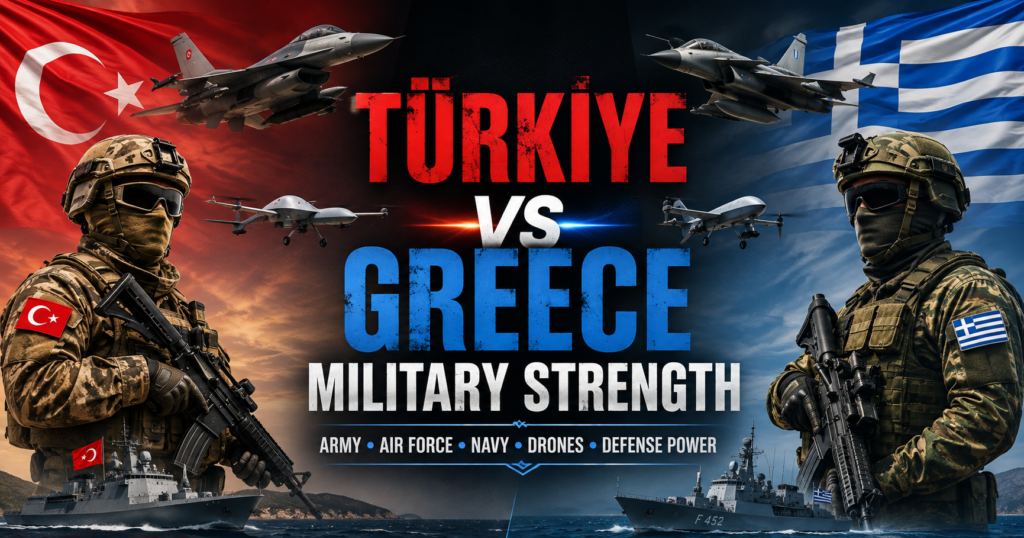
The Türkiye vs Greece military strength comparison in 2026 is one of the more complex military comparisons in Europe because raw numbers tell only part of the story.
Türkiye has the larger population, substantially more active military personnel, a much larger defense budget, more aircraft, more tanks, more helicopters and greater overall economic and industrial depth. The 2026 military ranking reflects that scale: Türkiye ranks #9 among 145 countries with a PowerIndex of 0.1975, while Greece ranks #30 with 0.5484.
Yet the comparison becomes much closer in several strategically important areas.
Greece operates a sizeable fighter fleet relative to its population, has been modernizing its combat aviation, maintains a substantial submarine force and fields a navy whose total number of vessels is surprisingly close to Türkiye’s. Geography also matters enormously. The Aegean Sea is filled with islands, narrow maritime spaces and overlapping air and naval operating areas, while the eastern Mediterranean creates another strategically important maritime environment.
There is another essential point: Türkiye and Greece are both NATO members. A military comparison can help explain their relative capabilities, force structures and defense priorities, but equipment inventories should not be treated as a prediction of a future conflict.
The more useful question is therefore not simply “Who would win?”
It is:
Where does Türkiye hold the larger structural advantages, where does Greece remain comparatively strong, and why does geography make this military balance more complicated than the headline numbers suggest?
☷On this pageJump to a section of this military guide
Türkiye vs Greece Military Strength 2026 at a Glance
The broad 2026 figures show Türkiye’s overall advantage clearly. Its population is more than eight times Greece’s, while its active military is more than three times larger. Türkiye also has roughly twice as many total military aircraft and a defense budget more than six times larger in the supplied dataset.
But some categories are much closer than those differences might suggest. Greece has 178 fighters against Türkiye’s 201, for example, while total naval assets stand at 186 for Greece and 192 for Türkiye.
That combination makes this matchup unusually interesting.
| Military Category | Türkiye | Greece |
|---|---|---|
| 2026 Military Rank | #9 | #30 |
| PowerIndex | 0.1975 | 0.5484 |
| Population | 84,119,531 | 10,461,091 |
| Active Personnel | 481,000 | 142,700 |
| Reserve Personnel | 380,000 | 221,350 |
| Defense Budget | $51.4 billion | $8.24 billion |
| Total Aircraft | 1,101 | 560 |
| Fighter Aircraft | 201 | 178 |
| Transport Aircraft | 84 | 17 |
| Helicopters | 509 | 285 |
| Attack Helicopters | 111 | 28 |
| Tanks | 2,284 | 1,344 |
| Armored Vehicles | 98,193 | 56,416 |
| Self-Propelled Artillery | 1,045 | 589 |
| Towed Artillery | 635 | 698 |
| Mobile Rocket Projectors | 237 | 152 |
| Naval Assets | 192 | 186 |
| Submarines | 14 | 9 |
| Frigates | 17 | 14 |
| Patrol Vessels | 40 | 45 |
The key takeaway is that Türkiye leads the overall conventional balance, particularly in manpower, land forces, aviation scale, logistics and financial capacity.
Greece’s military is smaller but not proportionally weak in every domain. Its fighter count, tank inventory, submarine force, frigates and overall naval fleet are substantial for a country of roughly 10.5 million people.
That is why population or budget alone cannot explain the entire Türkiye–Greece military balance.
Türkiye vs Greece Military Ranking 2026
The 2026 ranking places Türkiye at #9 globally and Greece at #30.
Türkiye’s 0.1975 PowerIndex reflects advantages across multiple categories rather than one overwhelming weapon system. It has more manpower, aircraft, helicopters, armored vehicles, self-propelled artillery, rocket systems, submarines and economic capacity.
Türkiye also benefits from a growing domestic defense-industrial ecosystem.
Greece’s #30 position should not be interpreted as meaning its military is insignificant relative to Türkiye. Composite rankings combine many factors, including categories that may be more or less relevant depending on geography and mission.
For example, Türkiye’s population and manpower advantages are enormous.
Its population is about 84.1 million, compared with approximately 10.46 million for Greece.
But fighter numbers are 201 versus 178—a dramatically narrower difference.
Similarly, the total naval fleet comparison is 192 versus 186.
So the overall ranking correctly identifies Türkiye as the larger conventional military power, while individual domains show a more nuanced balance.
Why Geography Makes Türkiye vs Greece Different
Few military comparisons are as geographically sensitive as Türkiye vs Greece.
The two countries share a land border, but much of their strategic interaction is associated with the Aegean Sea and eastern Mediterranean.
Greece has an extensive island geography. Türkiye has a much larger landmass and a long coastline bordering several strategically important seas.
The supplied data gives Türkiye approximately 783,562 square kilometers of land area, compared with 131,957 square kilometers for Greece.
But Greece has the longer listed coastline:
Greece: 13,676 km
Türkiye: 7,200 km
That contrast immediately reveals why simply comparing army size is insufficient.
Türkiye has greater territorial and demographic depth.
Greece’s geography gives maritime and air power disproportionate importance.
The Aegean environment means that fighter aircraft, air defense, frigates, submarines, patrol vessels, surveillance, anti-ship capabilities and the ability to support islands can matter enormously.
Türkiye vs Greece Military Manpower
Manpower is one of Türkiye’s clearest structural advantages.
Türkiye has approximately 481,000 active personnel, compared with 142,700 for Greece.
Its reserve force is also larger, although the reserve gap is considerably narrower than the population difference: 380,000 for Türkiye against 221,350 for Greece.
| Manpower Category | Türkiye | Greece |
|---|---|---|
| Population | 84,119,531 | 10,461,091 |
| Available Manpower | 42,985,080 | 4,916,713 |
| Fit for Service | 36,087,279 | 3,985,676 |
| Reaching Military Age Annually | 1,430,032 | 104,611 |
| Active Personnel | 481,000 | 142,700 |
| Reserve Personnel | 380,000 | 221,350 |
| Paramilitary Forces | 150,000 | 55,000 |
The long-term difference is particularly important.
Türkiye has more than 1.43 million people reaching military age annually in the supplied dataset, compared with roughly 104,600 in Greece.
That gives Türkiye a much deeper demographic pool from which personnel can potentially be recruited.
Greece partially offsets its smaller population through a comparatively substantial military establishment and reserve component.
This is a recurring pattern throughout the comparison: Türkiye has the scale advantage, while Greece devotes significant military capacity relative to its smaller demographic base.
Türkiye Army vs Greece Army
Land power strongly favors Türkiye numerically.
Türkiye has more tanks, armored vehicles, self-propelled artillery and mobile rocket systems. Greece leads only slightly in the supplied towed-artillery count.
However, both countries maintain sizeable mechanized forces.
Türkiye’s larger army reflects more than the Greek dimension of its security environment. Türkiye borders several countries and sits between Europe, the Caucasus and the Middle East. Its land forces therefore have broader geographic responsibilities.
Greece’s land forces operate under a different strategic structure, including defense of mainland territory and islands.
| Land-Power Category | Türkiye | Greece |
|---|---|---|
| Tanks | 2,284 | 1,344 |
| Armored Vehicles | 98,193 | 56,416 |
| Self-Propelled Artillery | 1,045 | 589 |
| Towed Artillery | 635 | 698 |
| Mobile Rocket Projectors | 237 | 152 |
Türkiye holds the larger overall land inventory, but Greece’s 1,344 tanks and 589 self-propelled artillery systems remain significant for a country with only around 10.5 million people.
And these totals require another qualification: a tank inventory is not automatically an inventory of equally modern or immediately operational tanks.
Fleet age, modernization, ammunition, maintenance, crew availability and actual operational readiness can substantially change the military value of the headline number.
Türkiye vs Greece Tanks
The 2026 dataset lists 2,284 Turkish tanks against 1,344 Greek tanks.
Türkiye therefore has roughly 940 more tanks.
Both militaries, however, operate mixed fleets rather than thousands of identical vehicles.
Türkiye’s armored force includes Leopard-series tanks alongside other platforms, while Greece also operates Leopard tanks and older systems.
This creates an important distinction between quantity and fleet composition.
A database may count every vehicle in the same broad “tank” category, but a newer tank with modern optics, protection, communications and fire-control systems cannot automatically be treated as equivalent to an older vehicle.
The comparison therefore supports two conclusions simultaneously:
Türkiye has the larger tank inventory.
Greece still maintains substantial heavy armor relative to the size of its armed forces.
Artillery Is More Balanced Than the Tank Count
Artillery provides an interesting contrast.
Türkiye has 1,045 self-propelled artillery systems, compared with 589 for Greece, giving Türkiye a considerable advantage in that category.
But Greece actually leads the towed-artillery count 698 to 635.
Türkiye also has 237 mobile rocket projectors against Greece’s 152.
These numbers matter because artillery remains an important part of conventional land warfare, but again, raw launchers and guns are not the entire capability.
Range, precision, ammunition stocks, targeting networks, drones, counter-battery systems and mobility can all influence effectiveness.
Türkiye’s growing unmanned-aircraft capabilities are especially relevant because drones can support reconnaissance and targeting in ways that make artillery and missile systems more useful.
Turkish Drones Are a Major Part of the Comparison
One of the biggest weaknesses of a purely inventory-based Türkiye vs Greece comparison is that it can understate the importance of Türkiye’s drone industry.
Türkiye has developed a significant domestic unmanned-aircraft ecosystem.
Platforms associated with Turkish manufacturers have given the country experience in producing multiple classes of unmanned aircraft for surveillance and combat-related roles.
For military analysis, the significance extends beyond counting drones.
Unmanned systems can contribute to:
- Intelligence and surveillance
- Target acquisition
- Reconnaissance
- Maritime monitoring
- Battle-damage assessment
- Communications support
- Precision-strike operations
Türkiye’s domestic drone sector also illustrates a broader advantage: defense-industrial autonomy.
A country able to design, manufacture, modify and replenish important military systems domestically has a different long-term position from one that depends heavily on foreign suppliers.
That does not mean drones automatically determine the military balance. Air defenses, electronic warfare, fighter aircraft and counter-drone systems all matter.
But leaving Turkish unmanned systems out of this comparison would miss one of the country’s most distinctive modern military capabilities.
Türkiye vs Greece Air Force 2026
The air-power comparison is considerably closer than the population or budget figures.
Türkiye has 1,101 total aircraft, almost twice Greece’s 560.
But the fighter category is surprisingly competitive:
Türkiye: 201 fighters
Greece: 178 fighters
That difference of only 23 aircraft is much smaller than Türkiye’s overall aircraft advantage.
| Air-Power Category | Türkiye | Greece |
|---|---|---|
| Total Aircraft | 1,101 | 560 |
| Fighter Aircraft | 201 | 178 |
| Dedicated Attack Aircraft | 0* | 0* |
| Transport Aircraft | 84 | 17 |
| Trainer Aircraft | 301 | 86 |
| Special-Mission Aircraft | 27 | 8 |
| Aerial Tankers | 7 | 0 |
| Helicopters | 509 | 285 |
| Attack Helicopters | 111 | 28 |
Türkiye’s overall air-power advantage becomes much clearer outside the fighter column.
It has nearly five times as many listed transport aircraft, more than three times as many trainers, seven aerial tankers compared with zero in the supplied Greek category, and significantly larger helicopter and attack-helicopter fleets.
*A zero under “dedicated attack aircraft” is a database classification. It does not mean either country lacks aircraft capable of air-to-ground missions; multirole fighters can perform strike missions without being classified as dedicated attack aircraft.
Fighter Numbers Are Much Closer Than Overall Aircraft Numbers
The 201 vs 178 fighter comparison deserves special attention.
Türkiye’s population is roughly eight times larger than Greece’s, yet its listed fighter fleet is only modestly larger.
That illustrates the importance Greece places on air power.
Airspace and maritime geography make fighter aviation central to Greek defense planning.
For Türkiye, meanwhile, combat aviation has to support a larger country and a wider range of potential operating environments.
So fighter quantity alone does not establish air superiority.
The quality of individual aircraft, radar systems, weapons, airborne early-warning support, electronic warfare, pilot training, aerial refueling and command-and-control systems all matter.
Greece’s Rafale Fighters Change the Quality Discussion
Greece’s Rafale fleet is particularly important when looking beyond total aircraft numbers.
Modern fighter capability cannot be measured by counting airframes alone.
Sensors, electronic systems, weapons integration and networking can significantly influence what an aircraft can do.
Greece’s fighter modernization therefore makes the air comparison more competitive than a simple 1,101-versus-560 total-aircraft comparison suggests.
Greece also operates a substantial F-16 fleet, with modernization increasing the importance of those aircraft.
The result is a Greek air force that is numerically smaller overall but remains a major component of the country’s military strength.
Türkiye’s F-16 Fleet Remains Central
Türkiye’s F-16 fleet remains central to its combat-air capability.
The aircraft has served as a major multirole platform, supporting air-defense and strike missions.
Türkiye’s much larger overall aviation structure also gives it advantages in supporting categories.
For example, the supplied data lists:
84 Turkish transports vs 17 Greek transports
27 special-mission aircraft vs 8
7 aerial tankers vs 0
These assets can be less visible than fighters but are extremely important.
Tankers extend aircraft endurance and operating radius.
Transport aircraft move personnel and equipment.
Special-mission aircraft can support surveillance, command, intelligence and other specialized functions.
Air power is an ecosystem, not merely a fighter count.
KAAN and Türkiye’s Long-Term Fighter Ambition
Türkiye’s KAAN fighter program represents another dimension of the comparison: future domestic aerospace capability.
The strategic significance of such a program goes beyond whether a particular number of aircraft is operational in 2026.
Developing an advanced fighter involves building expertise in:
- Airframe design
- Avionics
- Sensors
- Software
- Weapons integration
- Manufacturing
- Testing
- Maintenance
That can strengthen the wider domestic aerospace sector.
For Türkiye, KAAN fits into a broader effort to reduce dependence on foreign suppliers across several defense categories.
It should not, however, be counted as though a mature large operational fleet already exists. Development programs and operational inventories are different things.
Greece’s F-35 Path Matters for the Future Balance
Greece’s planned move toward the F-35 is equally important for understanding where its air force is heading.
Fifth-generation fighters bring capabilities that cannot be represented accurately by adding one more aircraft to an inventory table.
Stealth, sensor fusion, networking and information sharing can change how aircraft interact with other military systems.
For Greece, combining future F-35 capability with upgraded F-16s and Rafales could create a technologically sophisticated fighter mix.
The 2026 comparison should therefore distinguish between current inventory and future modernization.
That avoids one of the most common problems in military content: presenting ordered or developing equipment as though it were already fully operational.
Türkiye’s Helicopter Advantage Is Significant
Türkiye leads the helicopter category 509 to 285.
The difference becomes larger in attack helicopters:
Türkiye: 111
Greece: 28
Helicopters can support troop transport, reconnaissance, logistics, anti-armor operations, special operations and other missions.
Türkiye’s larger helicopter fleet complements its larger ground force and broader geographic responsibilities.
The numbers also fit Türkiye’s wider investment in domestic aerospace production.
Again, actual availability can differ from total inventory, so these figures should be interpreted as force-structure indicators rather than real-time readiness counts.
Türkiye vs Greece Navy 2026
The naval comparison is arguably the most surprising part of the entire dataset.
Türkiye has 192 listed naval assets.
Greece has 186.
Only six vessels separate the two fleet totals.
That is remarkably close considering the enormous differences in population, economy and active manpower.
But total ship count is one of the easiest military statistics to misinterpret.
A patrol vessel, submarine, frigate and large amphibious ship cannot be treated as interchangeable units simply because each counts as one naval asset.
The composition of the fleets therefore matters far more.
| Naval Category | Türkiye | Greece |
|---|---|---|
| Total Naval Assets | 192 | 186 |
| Aircraft Carriers | 0 | 0 |
| Helicopter Carriers | 1 | 0 |
| Submarines | 14 | 9 |
| Frigates | 17 | 14 |
| Corvettes | 9 | 0* |
| Patrol Vessels | 40 | 45 |
| Mine-Warfare Vessels | 11 | 3 |
Türkiye has advantages in submarines, frigates, corvettes and mine-warfare vessels under the supplied classification.
Greece has slightly more patrol vessels.
The near-equal total fleet count therefore does not mean the two navies have identical structures.
*A zero in a particular ship classification should be read according to the dataset’s categorization rather than as proof that a navy has no vessels capable of overlapping missions.
Türkiye’s TCG Anadolu Adds a Different Naval Dimension
The supplied dataset records Türkiye with one helicopter carrier and Greece with zero.
This reflects the role of TCG Anadolu, a large amphibious assault ship and aviation-capable platform.
It should not be confused with a conventional American-style aircraft carrier.
Its significance is different.
A large amphibious platform can support helicopters, unmanned aviation, troops, vehicles, command functions and expeditionary operations.
For Türkiye, Anadolu also connects directly with the country’s growing unmanned-aircraft ambitions.
That gives the Turkish Navy a type of large-deck aviation and amphibious capability that cannot be captured simply by comparing frigate totals.
Submarine Warfare Is Crucial in the Aegean and Eastern Mediterranean
Türkiye leads the supplied submarine count 14 to 9.
That is a numerical advantage, but Greece’s nine submarines remain strategically important.
Submarines can be especially valuable in constrained maritime environments because they complicate an opponent’s surveillance and naval movement.
Their effectiveness depends on far more than fleet size:
- Acoustic signature
- Sensors
- Weapons
- Crew proficiency
- Maintenance
- Underwater geography
- Anti-submarine opposition
The Aegean and eastern Mediterranean therefore make submarine capability more important than the relatively small raw numbers might imply.
For both Türkiye and Greece, undersea warfare is a core part of naval capability.
Frigates: 17 vs 14
Türkiye has 17 listed frigates, while Greece has 14.
This is another relatively close category.
Frigates can perform air-defense, anti-surface, anti-submarine, escort and maritime-security missions depending on configuration.
Modernization is therefore crucial.
A newly built ship with modern radar, electronic warfare, missiles and networked sensors may contribute very differently from an older frigate even though both appear as “1” in a fleet table.
Both countries have reasons to modernize their surface fleets because naval competition in the eastern Mediterranean is increasingly shaped by sensors, missiles and networked warfare rather than ship numbers alone.
Türkiye’s Domestic Shipbuilding Is a Strategic Advantage
Türkiye’s naval strength is increasingly connected to its domestic shipbuilding sector.
Domestic warship programs give Türkiye greater ability to develop vessels around national requirements while building expertise in sensors, weapons integration, electronics and maintenance.
This has long-term implications.
Military power is not simply the equipment already in service.
It also includes the ability to replace, upgrade and manufacture equipment over time.
Türkiye’s broader defense-industrial development therefore strengthens its position beyond what the 192-ship headline reveals.
Greece Is Modernizing Its Navy Too
Greece’s smaller industrial base does not mean its naval capability is static.
The country has pursued modernization designed to improve the quality of its surface fleet.
For Greece, this is particularly important because its geography places unusually heavy demands on naval forces.
Hundreds of inhabited islands and a very long coastline create requirements for maritime surveillance, patrol, reinforcement and sea-lane protection.
This helps explain why Greece maintains 186 listed naval assets despite having only around one-eighth of Türkiye’s population.
The fleet is not an optional secondary capability for Greece. Maritime security is fundamental to the country’s geography.
Aegean Geography Prevents Simple Naval Conclusions
The Aegean Sea is not an open-ocean environment where the navy with the most ships automatically has the advantage.
It contains numerous islands and restricted maritime spaces.
That can increase the relevance of:
- Coastal sensors
- Anti-ship missiles
- Fighter aircraft
- Submarines
- Small naval vessels
- Electronic warfare
- Air defense
- Shore-based systems
Land-based aircraft can also influence naval operations because distances are relatively short.
This creates a deeply interconnected air-maritime environment.
A Türkiye vs Greece naval comparison therefore cannot be separated cleanly from the air-force comparison.
Defense Budget: $51.4 Billion vs $8.24 Billion
Financially, Türkiye holds one of the largest advantages in the comparison.
The supplied 2026 figures list a $51.4 billion Turkish defense budget, compared with approximately $8.24 billion for Greece.
That is more than a six-to-one difference.
The wider economic figures also show major disparities.
Türkiye has approximately $3.018 trillion in purchasing-power parity under the supplied dataset, compared with $192.205 billion for Greece.
Foreign reserves are listed at approximately $154.744 billion for Türkiye and $15.222 billion for Greece.
These figures should not be converted mechanically into military effectiveness, but they help explain the different scale at which each country can support defense activity.
Türkiye has a larger domestic economy, population and industrial base from which military spending can be sustained.
Greece, however, has historically devoted substantial resources to defense relative to the size of its economy because of its security requirements.
Defense Spending Doesn’t Tell the Whole Story
Nominal defense budgets are useful but imperfect.
The same dollar amount does not purchase identical quantities of personnel, locally produced equipment or maintenance in every country.
Domestic production can change the equation significantly.
If equipment is designed and manufactured locally, some expenditure circulates through domestic industry rather than paying entirely for imported systems.
Türkiye’s expanding domestic defense industry therefore matters alongside its larger nominal budget.
Greece remains more dependent on foreign suppliers for several major high-end platforms.
But foreign procurement can also provide access to sophisticated systems without requiring Greece to fund an entire domestic development program.
So budget size, procurement strategy and industrial capacity must be interpreted together.
Türkiye’s Defense Industry Is One of Its Biggest Structural Advantages
This is one of the most important areas where a standard military ranking table provides too little information.
Türkiye has spent years developing domestic defense capabilities across multiple sectors.
These include areas such as:
- Unmanned aircraft
- Armored vehicles
- Missiles
- Naval vessels
- Electronic systems
- Aerospace
- Munitions
The strategic value is not simply national prestige.
Domestic production can provide more control over upgrades, integration, supply chains and replenishment.
It can also generate export revenue and expand production experience.
For a country seeking long-term military autonomy, this is a major advantage.
Greece’s Strategy Relies More on Selective High-End Modernization
Greece faces a different industrial and financial environment.
Instead of trying to match Türkiye’s defense-industrial scale across every category, Greek modernization can focus resources on selected high-value capabilities.
Combat aviation provides the clearest example.
Rafale fighters, upgraded F-16s and the planned transition toward F-35 capability represent a strategy of strengthening the quality and technological sophistication of the fighter force.
Naval modernization follows a similar logic.
This approach cannot eliminate Türkiye’s advantages in population, industry and overall scale, but it can make strategically important Greek capabilities more competitive than the overall ranking gap suggests.
Logistics and Infrastructure
Military forces depend on civilian and military infrastructure.
Aircraft require airfields.
Ground units require roads and railways.
Navies need ports.
Personnel and equipment need transportation networks.
The supplied dataset shows different strengths in this area.
| Infrastructure Category | Türkiye | Greece |
|---|---|---|
| Airports | 116 | 82 |
| Merchant Marine | 1,170 | 1,215 |
| Ports & Terminals | 54 | 57 |
| Labor Force | 36.08 million | 4.66 million |
| Roadways | 68,526 km | 117,000 km |
| Railways | 11,497 km | 2,345 km |
Türkiye has the much larger labor pool and railway network, while Greece leads in the dataset’s merchant-marine, ports and roadway figures.
The Greek merchant-marine figure is particularly relevant because it reinforces the country’s strong maritime orientation.
Türkiye’s much larger labor force, meanwhile, provides greater economic and industrial depth.
Neither set of infrastructure figures translates directly into combat power, but logistics determines whether military forces can be moved, supplied and sustained.
Energy and Resource Depth
Neither country is comparable to the world’s largest oil-producing powers, but the supplied figures still show Türkiye with greater domestic resource scale in several categories.
Türkiye is listed with oil production of approximately 83,000 barrels, compared with 5,000 for Greece, and proven oil reserves of 366 million barrels compared with 10 million.
The dataset also gives Türkiye larger natural-gas and coal figures.
However, the larger strategic point is more important than the individual totals.
Both countries operate in a region where energy imports, maritime routes and eastern Mediterranean energy security can matter.
Türkiye’s larger economy also consumes significantly more energy.
So higher production does not automatically mean energy independence.
Resource security needs to be interpreted against consumption and import dependence rather than production alone.
Türkiye’s Larger Geography Creates Both Depth and Responsibilities
Türkiye has nearly 784,000 square kilometers of land, compared with approximately 132,000 square kilometers for Greece.
A larger territory can provide strategic depth.
But it also creates more territory to protect.
Türkiye borders multiple countries and faces security requirements extending toward the Black Sea, Caucasus, Middle East, Mediterranean and Aegean.
Greece’s smaller territory is geographically fragmented by islands.
So the two countries face almost opposite military-geography problems.
Türkiye must distribute forces across a large state with several strategic directions.
Greece must defend a smaller but highly dispersed territory where air and maritime mobility become particularly important.
This is another reason the larger Turkish army and the relatively large Greek navy can both make strategic sense.
NATO Membership Changes How the Comparison Should Be Read
Türkiye and Greece are both members of NATO.
That fact is fundamental.
They participate in the same broader collective-defense alliance even though bilateral disagreements have existed over issues including maritime boundaries, airspace and the eastern Mediterranean.
Military comparisons often encourage readers to imagine a direct conflict and then declare a winner based on equipment totals.
That approach is particularly misleading here.
A responsible comparison can identify relative capabilities without pretending that a spreadsheet can predict political decisions, alliance dynamics, escalation or conflict outcomes.
The more useful conclusion is about force structure:
Türkiye has greater overall military scale.
Greece maintains unusually substantial air and maritime capability for its size.
Air Defense Could Matter as Much as Fighter Numbers
One of the limitations of broad military databases is that integrated air defense can be difficult to summarize in one number.
Air defense includes more than surface-to-air missile launchers.
It depends on:
- Radar coverage
- Early warning
- Command networks
- Interceptors
- Electronic warfare
- Fighter integration
- Sensor sharing
Both Türkiye and Greece have strong reasons to invest in air defense because of their geography and modern missile environment.
For that reason, the 201-vs-178 fighter count should not be treated as a standalone measure of control of the air.
Modern air warfare is increasingly a contest between networks of sensors, fighters, missiles and electronic systems.
Electronic Warfare and Cyber Capabilities Are Hard to Rank
Cyber and electronic warfare are another area where numerical comparisons become unreliable.
Countries rarely publish complete information about offensive cyber capabilities, electronic attack systems or vulnerabilities.
Türkiye’s growing domestic electronics and defense sector gives it an important base for developing these capabilities.
Greece also operates within NATO’s wider technological and information environment.
But assigning an exact cyber ranking or declaring one side decisively superior would require evidence that public inventory tables cannot provide.
This is precisely where responsible military comparison should recognize the limits of open-source data rather than invent certainty.
Neither Raw Inventory Nor Ranking Equals Readiness
This distinction is essential throughout the article.
The supplied data tells us that Türkiye has 2,284 tanks and Greece 1,344.
It does not tell us that every one of those tanks is immediately deployable.
The same applies to aircraft and ships.
Operational availability depends on factors including:
- Maintenance
- Spare parts
- Crew availability
- Training
- Ammunition
- Modernization status
- Repair cycles
Some equipment may be stored, undergoing maintenance or older than other equipment counted in the same category.
Therefore, the figures in this comparison should be read as public inventory and structural indicators, not confirmed real-time readiness levels.
Where Türkiye Has the Clearest Advantages
Türkiye’s strongest advantages come from scale and depth rather than a single category.
Its population is much larger, providing a deeper manpower base.
Its active force is more than three times Greece’s.
Its defense budget is more than six times larger in the supplied dataset.
Türkiye also leads substantially in total aircraft, helicopters, attack helicopters, transport aircraft, armored vehicles, self-propelled artillery and rocket systems.
Its defense industry adds another important layer because domestic production can support modernization and replacement over the longer term.
Türkiye also has the larger submarine and frigate counts and operates a large amphibious aviation-capable ship.
Taken together, these factors explain why Türkiye ranks considerably higher in the overall 2026 military index.
Where Greece Remains Particularly Competitive
Greece’s strengths become clearer when its capabilities are compared with its much smaller demographic and economic base.
Despite having around 10.46 million people, Greece fields 178 fighters, only 23 fewer than Türkiye’s 201.
It has 1,344 tanks, 589 self-propelled artillery systems, nine submarines and 14 frigates.
Its total naval fleet of 186 assets is only six below Türkiye’s 192.
Greece also has slightly more patrol vessels and towed artillery in the supplied dataset.
Its island geography has encouraged a defense structure where air and naval capabilities receive substantial importance.
Ongoing fighter and naval modernization can also improve capability without requiring Greece to match Türkiye platform-for-platform.
Türkiye vs Greece: Capability-by-Capability Assessment
The complete picture becomes clearer when the categories are interpreted rather than simply counted.
| Capability Area | 2026 Assessment |
|---|---|
| Overall Conventional Scale | Türkiye advantage |
| Population & Manpower Depth | Türkiye major advantage |
| Active Personnel | Türkiye advantage |
| Reserve Personnel | Türkiye advantage |
| Tank Numbers | Türkiye advantage |
| Armored Vehicles | Türkiye advantage |
| Self-Propelled Artillery | Türkiye advantage |
| Towed Artillery Count | Greece slight numerical advantage |
| Rocket Artillery | Türkiye advantage |
| Total Aircraft | Türkiye advantage |
| Fighter Numbers | Relatively close; Türkiye numerical lead |
| Air Transport | Türkiye advantage |
| Aerial Refueling | Türkiye advantage in supplied data |
| Helicopters | Türkiye advantage |
| Total Naval Fleet | Very close numerically |
| Submarines | Türkiye numerical advantage |
| Frigates | Türkiye slight numerical advantage |
| Patrol Vessels | Greece slight numerical advantage |
| Defense Budget | Türkiye major advantage |
| Domestic Defense-Industrial Scale | Türkiye advantage |
| Island/Maritime Defense Focus | Major Greek specialization |
| Overall 2026 Ranking | Türkiye |
The table reinforces the central conclusion: Türkiye has the stronger overall conventional military structure, but the size of its advantage varies dramatically by domain.
Manpower and financial differences are enormous.
The fighter and naval comparisons are much tighter.
That uneven balance is far more informative than simply declaring one country “stronger.”
Is Türkiye Militarily Stronger Than Greece in 2026?
By overall conventional scale, yes—Türkiye is stronger in the supplied 2026 data.
It ranks #9 compared with Greece at #30 and leads in most major quantitative categories.
But that conclusion should not be stretched into a prediction about hypothetical warfare.
Military outcomes depend on circumstances that rankings cannot measure adequately, including objectives, geography, mobilization, surprise, readiness, logistics, alliances, political decisions, intelligence and escalation.
In the Aegean especially, geography can make relatively small distances and island positions highly significant.
So there is a major difference between saying:
“Türkiye has the larger overall conventional military.”
and saying:
“A future conflict would have a predetermined result.”
The first is supported by the broad force data.
The second is not.
Data & Accuracy Note
Military inventories change as aircraft, ships and vehicles enter service, undergo modernization, move into storage or retire.
The figures in this guide should therefore be treated as 2026 public inventory estimates and comparative indicators, not confirmed real-time operational availability.
Categories can also differ between databases. A vessel or aircraft may be classified differently depending on methodology.
Future platforms, planned purchases and development programs should not be counted as fully operational capabilities until they actually enter service.
This distinction is particularly important when discussing rapidly changing areas such as fighter modernization, drones, missiles and new naval programs.
FAQs
Which country has the stronger military in 2026, Türkiye or Greece?
Türkiye has the larger overall conventional military in the supplied 2026 comparison. It ranks #9 globally, while Greece ranks #30, and it leads in manpower, budget, aircraft, tanks and several naval categories.
What is Türkiye’s military ranking in 2026?
Türkiye ranks #9 out of 145 countries with a PowerIndex of 0.1975 in the supplied 2026 data.
What is Greece’s military ranking in 2026?
Greece ranks #30 out of 145 countries with a PowerIndex of 0.5484.
How many active military personnel do Türkiye and Greece have?
Türkiye is listed with approximately 481,000 active personnel, while Greece has about 142,700.
Which country has more fighter jets, Türkiye or Greece?
Türkiye leads narrowly in the supplied fighter count, with 201 fighters compared with Greece’s 178.
Why is the Türkiye vs Greece fighter comparison relatively close?
Greece maintains a large combat-air capability relative to its population because air power is particularly important to its geographic and security requirements. Its fighter modernization also focuses on improving quality rather than matching Türkiye’s entire aircraft inventory.
How many military aircraft does Türkiye have compared with Greece?
Türkiye has approximately 1,101 total aircraft, while Greece has 560 in the supplied 2026 comparison.
Does Greece have Rafale fighter jets?
Yes. Rafale aircraft form an important part of Greece’s combat-air modernization alongside its F-16 fleet.
Is Greece getting F-35 fighter jets?
Greece is pursuing F-35 capability as part of its longer-term air-force modernization. Planned aircraft should be distinguished from aircraft already operational in the 2026 inventory.
Does Türkiye have a fifth-generation fighter?
Türkiye is developing the KAAN fighter program. A development program, however, should not be treated as equivalent to a mature operational fleet.
Which country has more tanks?
Türkiye has 2,284 listed tanks, compared with 1,344 for Greece.
Which country has the larger navy?
The overall fleet totals are extremely close: Türkiye has 192 listed naval assets and Greece 186. Fleet composition matters more than the six-ship difference.
Which country has more submarines?
Türkiye has 14 submarines, compared with nine for Greece in the supplied 2026 data.
Which country has more frigates?
Türkiye has 17 listed frigates, while Greece has 14.
Does Türkiye have an aircraft carrier?
The supplied dataset lists Türkiye with zero conventional aircraft carriers but one helicopter carrier. TCG Anadolu is a large amphibious and aviation-capable vessel and should not be treated as equivalent to a conventional large aircraft carrier.
Why is the Aegean Sea important in a Türkiye vs Greece military comparison?
The Aegean contains numerous islands and relatively short distances between important locations. That increases the importance of fighters, submarines, frigates, coastal defense, surveillance, air defense and anti-ship capabilities.
Which country spends more on defense?
The supplied 2026 figures list Türkiye at approximately $51.4 billion and Greece at $8.24 billion, giving Türkiye a substantial nominal spending advantage.
Does Türkiye have a stronger defense industry than Greece?
Türkiye has developed a broader domestic defense-industrial base across areas including drones, armored vehicles, missiles, naval construction and aerospace. That gives it greater domestic production depth across several major categories.
Are Türkiye and Greece military enemies?
Türkiye and Greece have experienced bilateral disputes and periods of tension, but both countries are NATO members. A military comparison should not be interpreted as a prediction that they will fight each other.
Could military rankings predict the result of a Türkiye-Greece conflict?
No. Rankings and inventories can compare broad conventional capabilities, but they cannot reliably predict conflict outcomes. Geography, readiness, objectives, logistics, alliances, intelligence, political decisions and many other variables would matter.
Conclusion
The Türkiye vs Greece military strength comparison in 2026 shows an overall conventional advantage for Türkiye—but also demonstrates why this matchup cannot be understood through a ranking alone.
Türkiye ranks #9 globally with a 0.1975 PowerIndex, compared with Greece at #30 with 0.5484. It has approximately 481,000 active personnel against Greece’s 142,700, a $51.4 billion defense budget against $8.24 billion, 1,101 aircraft against 560 and 2,284 tanks against 1,344.
Those are substantial differences.
Türkiye also benefits from a population of more than 84 million, a larger economy, deeper manpower reserves and an increasingly important domestic defense industry. Its drone ecosystem, naval shipbuilding, armored-vehicle production, missile development and aerospace ambitions add capabilities that a basic equipment table cannot fully represent.
But Greece is much more competitive in several strategically important areas than the overall size difference suggests.
The fighter comparison is 201 to 178.
The submarine comparison is 14 to nine.
The frigate comparison is 17 to 14.
Most strikingly, the total naval comparison is just 192 to 186.
Those numbers reflect Greece’s security priorities. With an extensive island geography and long coastline, Greece has strong reasons to maintain substantial air and maritime forces despite its much smaller population.
Modernization also matters. Greece’s Rafale aircraft, upgraded F-16s and future F-35 plans emphasize high-end combat aviation, while naval modernization aims to strengthen the quality of its maritime forces. Türkiye, meanwhile, combines greater numerical scale with growing domestic production and programs such as KAAN and its expanding unmanned-aircraft ecosystem.
Geography makes the balance even more complicated.
The Aegean is not an open battlefield where the side with the largest national inventory automatically gains an equivalent advantage. Islands, short distances, coastal systems, submarines, air defenses, fighters and maritime surveillance can interact in ways that raw totals cannot capture.
And there is an even larger political context: Türkiye and Greece are both NATO members.
For that reason, this comparison should be understood as an examination of two different military structures rather than a forecast of war.
The most defensible 2026 conclusion is straightforward:
Türkiye has the stronger overall conventional military, greater demographic and economic depth, a larger defense budget, more extensive land and air forces, and a broader domestic defense-industrial base. Greece fields a significantly smaller military but remains comparatively strong in fighter aviation, submarines, surface warships and maritime defense—capabilities shaped heavily by its Aegean and island geography.