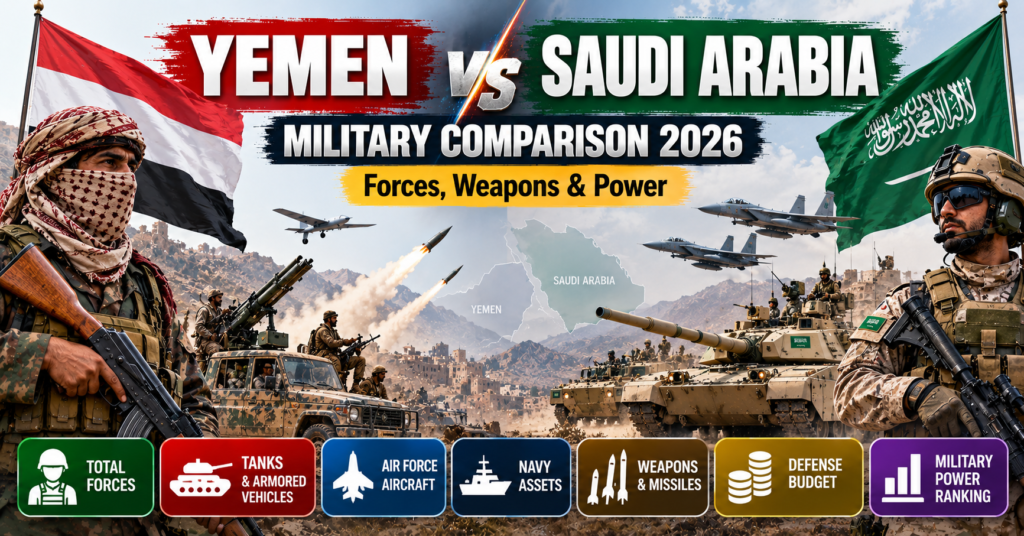
Saudi Arabia has spent decades building one of the Middle East’s most heavily equipped militaries. Yet across its southern border, armed groups in Yemen have repeatedly demonstrated that a much smaller military force can still create serious security challenges. This contrast makes the Yemen vs Saudi Arabia military strength comparison in 2026 more revealing than a simple ranking of soldiers, tanks, and fighter jets.
Saudi Arabia holds a commanding advantage in conventional military power, ranking 25th in the world compared with Yemen’s 98th position in the 2026 Global Firepower ranking. The kingdom operates advanced combat aircraft, a substantially larger armored force, and an established navy backed by extensive financial resources. Yemen, meanwhile, has endured years of civil war that have divided its military institutions and severely disrupted its economy.
But the comparison has an important second dimension. The Houthi movement’s use of missiles and drones has challenged Saudi Arabia’s security despite the enormous difference in conventional military resources. To understand the actual military balance, it is necessary to examine not only the size of the two armed forces but also the type of equipment they possess, who controls it, and how their capabilities differ.
☷On this pageJump to a section of this military guide
Yemen vs Saudi Arabia Military Strength 2026: Full Comparison
Saudi Arabia leads Yemen in nearly every major category of conventional military strength. Its advantage extends from active personnel and combat aircraft to tanks, artillery, naval vessels, and defense spending.
Yemen’s military figures require a different interpretation. The country does not operate under a single, fully unified military command. Its forces have been divided among the internationally recognized government, the Houthi movement, and other armed organizations. The reported national equipment totals therefore do not necessarily represent assets available to one authority.
Here is how the two countries compare in 2026.
| Military Category | Yemen | Saudi Arabia |
|---|---|---|
| Global military rank | 98th | 25th |
| PowerIndex | 2.1617 | 0.4473 |
| Population | 32.14 million | 36.54 million |
| Active military personnel | 33,350 | 247,000 |
| Paramilitary personnel | 20,000 | 150,000 |
| Total military aircraft | 160 | 917 |
| Fighter aircraft | 68 | 283 |
| Helicopters | 59 | 264 |
| Tanks | 0 recorded | 1,085 |
| Armored vehicles | 1,550 | 22,370 |
| Self-propelled artillery | 12 | 380 |
| Towed artillery | 60 | 557 |
| Rocket artillery | 30 | 327 |
| Naval assets | 26 | 32 |
| Estimated defense budget | $405.19 million | $63.99 billion |
The difference is immediately apparent in aviation and armored equipment. Saudi Arabia possesses nearly six times the reported aircraft inventory and more than fourteen times the armored vehicle inventory.
But one figure stands out for a different reason: Yemen’s recorded naval fleet is numerically not far behind Saudi Arabia’s, despite the enormous disparity in their broader military capabilities. That apparent similarity disappears when the fleets are examined by ship type and condition.
The same principle applies to fighter aircraft. Yemen’s listed fighter inventory includes platforms whose operational condition and control are uncertain after years of conflict.
A useful military comparison must therefore consider what the reported equipment can realistically tell us—not merely which country has the higher number.
Yemen vs Saudi Arabia Military Ranking 2026
Saudi Arabia occupies a position among the world’s top 25 conventional military powers, while Yemen ranks considerably lower.
In the 2026 Global Firepower assessment, Saudi Arabia received a PowerIndex score of 0.4473, compared with 2.1617 for Yemen. Lower scores represent stronger conventional military positions under this proprietary ranking methodology.
| Ranking | Yemen | Saudi Arabia |
|---|---|---|
| Global position | 98 of 145 | 25 of 145 |
| PowerIndex | 2.1617 | 0.4473 |
| Ranking gap | 73 positions | — |
Saudi Arabia benefits from extensive aviation capabilities, large inventories of military vehicles, established defense institutions, and the financial resources to sustain modern equipment.
Yemen’s position reflects a substantially smaller recorded conventional force and the consequences of prolonged political and military fragmentation.
The 73-place difference is significant, but the ranking does not directly measure every missile, drone, or armed group operating in Yemen.
That limitation matters because the Houthi movement has demonstrated capabilities that are not adequately reflected in a conventional country-level equipment comparison.
Saudi Arabia’s ranking advantage is clear. Its security challenges, however, cannot be explained by the ranking alone.
Yemen vs Saudi Arabia Army Strength 2026
Saudi Arabia maintains a much larger regular military establishment than Yemen’s recorded national force. Its military institutions are supported by established command structures, training systems, logistics, and equipment procurement.
The contrast becomes more interesting when population is considered. Saudi Arabia’s population is only moderately larger than Yemen’s, yet its listed active military personnel total is more than seven times greater.
Active Military Personnel and Manpower Comparison
| Manpower Category | Yemen | Saudi Arabia |
|---|---|---|
| Total population | 32,140,443 | 36,544,431 |
| Available manpower | 12,213,368 | 19,003,104 |
| Fit-for-service population | 9,031,464 | 17,468,238 |
| Reaching military age annually | 610,668 | 621,255 |
| Active personnel | 33,350 | 247,000 |
| Reserve personnel | 0 recorded | 0 recorded |
| Paramilitary personnel | 20,000 | 150,000 |
Saudi Arabia’s estimated 247,000 active personnel give it a substantial advantage over Yemen’s listed 33,350.
Yet the annual number of people reaching military age is remarkably close: approximately 621,000 in Saudi Arabia and 611,000 in Yemen.
This illustrates why demographic size and military organization should be evaluated separately. Both countries have substantial populations, but Saudi Arabia possesses much greater financial and institutional capacity to recruit, train, equip, and maintain a conventional standing force.
Saudi Arabia’s Army and National Guard
Saudi Arabia’s regular armed forces include the Royal Saudi Land Forces, Royal Saudi Air Force, Royal Saudi Navy, and specialized air-defense components.
The Saudi Arabian National Guard forms another important part of the country’s security establishment, with responsibilities and an organizational structure distinct from the regular army.
These institutions provide the kingdom with a broad military and internal-security structure.
Saudi Arabia also benefits from longstanding international defense relationships, access to modern military equipment, and established training facilities.
Its manpower advantage is therefore not simply a matter of possessing more soldiers. It has a more extensive system for supporting and sustaining those personnel.
Why Yemen’s Soldier Count Is More Complicated
Yemen’s listed active military strength of 33,350 personnel should not be interpreted as the total number of armed fighters operating throughout the country.
The civil war has divided Yemen’s military and security institutions among competing authorities and armed groups.
The internationally recognized government commands forces and works with allied formations. The Houthi movement maintains a separate military organization in territory under its control. Other locally and regionally aligned armed formations further complicate the picture.
As a result, Yemen does not possess one national military structure comparable to Saudi Arabia’s.
This distinction is more important than trying to combine uncertain personnel estimates into a single total.
Saudi Arabia has a larger and more coherent conventional military establishment. Yemen has multiple armed organizations with different command structures, equipment, and security objectives.
Yemen vs Saudi Arabia Air Force Strength 2026
The gap between Saudi Arabia and Yemen is particularly large in military aviation.
Saudi Arabia operates a modern combat air force supported by aircraft maintenance, pilot training, aerial refueling, and specialized aviation systems.
Yemen historically operated a conventional air force, but years of war have damaged its aviation infrastructure and disrupted the institutions required to maintain a functioning fleet.
Fighter Jets and Aircraft Comparison
| Aircraft Category | Yemen | Saudi Arabia |
|---|---|---|
| Total aircraft | 160 | 917 |
| Fighter aircraft | 68 | 283 |
| Dedicated attack aircraft | 0 | 81 |
| Transport aircraft | 3 | 49 |
| Trainer aircraft | 30 | 202 |
| Special-mission aircraft | 0 | 16 |
| Aerial refueling tankers | 0 | 22 |
| Helicopters | 59 | 264 |
| Attack helicopters | 14 | 34 |
Saudi Arabia has 283 reported fighter aircraft, compared with Yemen’s recorded 68.
More importantly, the kingdom has an established operational aviation structure. Its fighter fleet includes aircraft such as the F-15 and Eurofighter Typhoon, supported by specialized training and maintenance organizations.
Saudi Arabia also maintains 22 aerial refueling tankers and 16 special-mission aircraft. These represent support capabilities that Yemen does not have on a comparable documented scale.
What Makes Saudi Arabia’s Air Force Stronger?
Saudi Arabia’s advantage goes beyond the number of fighter jets.
Its air force includes advanced combat platforms, dedicated support aircraft, organized training systems, and infrastructure designed for continuing military aviation operations.
The fleet also contains different aircraft types for different responsibilities. Fighter aircraft, transport planes, helicopters, and aerial refueling tankers cannot be treated as interchangeable platforms.
Saudi Arabia’s maintenance and training institutions are particularly important because modern aviation requires continuous technical support.
Yemen’s aviation system has suffered extensive disruption, making direct comparisons of recorded aircraft inventories especially misleading.
Are Yemen’s 68 Fighter Jets Still Operational?
Yemen’s 68 recorded fighter aircraft should not be described as 68 confirmed operational combat jets.
Before the civil war, the Yemeni Air Force operated aircraft including MiG-29 fighters and older Soviet-origin designs.
The conflict damaged military facilities, interrupted training, and fragmented control over equipment.
Some aircraft may remain stored, damaged, unavailable, or outside the control of institutions represented in conventional national inventories.
There is no reliable basis for treating the entire recorded fighter fleet as a unified, ready-to-deploy force.
Saudi Arabia consequently has a much greater advantage in functioning conventional combat aviation than the numerical comparison alone suggests.
Yemen’s Drone Capabilities Change the Airpower Discussion
Yemen’s security situation introduces an important distinction between conventional airpower and unmanned weapons.
The Houthi movement has used drones in regional attacks, demonstrating capabilities that differ from those associated with traditional fighter aircraft.
A country does not need a large fleet of modern fighter jets to possess unmanned systems capable of creating significant security concerns.
The Houthi movement’s drone inventory is not equivalent to Yemen’s listed national aircraft inventory, and the two should not be combined.
The comparison therefore has two separate conclusions: Saudi Arabia possesses vastly superior conventional aviation, while Houthi unmanned systems remain relevant to regional security.
Yemen vs Saudi Arabia Tanks and Land Forces 2026
Saudi Arabia’s advantage in tanks and armored vehicles is substantial.
Its land forces operate modern armored platforms and artillery within an established military organization. Yemen’s remaining heavy equipment is distributed among different armed groups and has been affected by years of conflict.
Tanks, Armored Vehicles and Artillery
| Land Equipment | Yemen | Saudi Arabia |
|---|---|---|
| Tanks | 0 recorded | 1,085 |
| Armored vehicles | 1,550 | 22,370 |
| Self-propelled artillery | 12 | 380 |
| Towed artillery | 60 | 557 |
| Mobile rocket projectors | 30 | 327 |
Saudi Arabia has 1,085 recorded tanks and an armored vehicle inventory of 22,370, compared with Yemen’s 1,550 armored vehicles.
Its advantage extends across artillery categories.
Saudi Arabia has more than 30 times Yemen’s recorded self-propelled artillery inventory and over nine times its towed artillery inventory.
These figures reflect the kingdom’s considerably greater conventional equipment resources.
Saudi Arabia’s Tanks and Armored Vehicles
Saudi Arabia operates the American-origin M1A2 Abrams tank family, along with other armored platforms.
Its army also maintains armored personnel carriers, protected vehicles, and support equipment.
A key distinction is that the 22,370 armored vehicle figure does not represent 22,370 main battle tanks. It includes different equipment categories with varying responsibilities.
Saudi Arabia’s land forces benefit from an established equipment maintenance and procurement structure.
Yemen’s armed groups, by contrast, operate a mixture of inherited, captured, and otherwise acquired platforms whose availability and technical condition are difficult to assess consistently.
Does Yemen Really Have Zero Tanks?
No. A zero in Yemen’s 2026 recorded tank inventory does not establish that no tanks remain anywhere in the country.
Before the civil war, Yemen operated several tank types, including Soviet-origin designs.
Tanks have also appeared during the country’s prolonged armed conflict, although the present quantity and serviceability of equipment controlled by different groups remain uncertain.
The meaningful conclusion is not that Saudi Arabia possesses tanks while Yemen has never had them.
It is that Saudi Arabia maintains a much larger, better documented, and institutionally supported armored force.
Yemen vs Saudi Arabia Naval Strength 2026
At first glance, the naval comparison looks surprisingly close.
Saudi Arabia has 32 reported naval assets, while Yemen has 26. Judging the fleets only by their total number of vessels would therefore suggest a relatively small difference.
Their composition tells a different story.
Naval Ships and Warships Comparison
| Naval Category | Yemen | Saudi Arabia |
|---|---|---|
| Total naval assets | 26 | 32 |
| Frigates | 0 | 7 |
| Corvettes | 1 | 9 |
| Patrol vessels | 9 | 9 |
| Mine warfare vessels | 0 | 3 |
| Submarines | 0 | 0 |
| Aircraft carriers | 0 | 0 |
Saudi Arabia has seven frigates and nine corvettes, compared with Yemen’s one recorded corvette and no frigates.
Both countries have nine patrol vessels in the comparative inventory, but patrol craft are not equivalent to larger surface combatants.
Saudi Arabia maintains a functioning naval organization with modern surface vessels and supporting facilities.
Yemen’s conventional navy has been weakened by political fragmentation and the destruction or deterioration of military infrastructure.
Why Saudi Arabia’s Navy Is Stronger Despite the Similar Fleet Count
Naval strength depends heavily on the types of ships a country operates.
A frigate generally provides capabilities and operational characteristics distinct from those of a smaller patrol boat.
Saudi Arabia’s surface fleet includes larger modern combatants, while Yemen’s recorded naval assets are much less representative of an established, unified operational navy.
The kingdom’s navy also operates across the Red Sea and Arabian Gulf, supporting different maritime defense responsibilities.
Yemen’s coastline remains strategically important, but its conventional naval strength has been heavily affected by years of conflict.
The Red Sea Makes Yemen Strategically Important
Yemen lies near the Bab el-Mandeb Strait, which connects the Red Sea with the Gulf of Aden.
This location places the country close to a major international shipping corridor.
The Houthi movement has demonstrated that attacks involving missiles and drones can disrupt maritime activity without relying on a large conventional warship fleet.
These actions are distinct from the capabilities represented by Yemen’s reported naval vessels.
Saudi Arabia’s navy is considerably stronger in conventional terms. Yemen’s geographical position and the Houthi movement’s maritime-related capabilities nevertheless make the country’s security situation important far beyond its fleet size.
Yemen vs Saudi Arabia Defense Budget 2026
The most extreme numerical difference between the countries is their estimated defense expenditure.
Saudi Arabia has extensive financial resources supporting military procurement, personnel, training, and maintenance. Yemen’s economy has suffered serious damage from prolonged conflict, weakening the resources available to national institutions.
| Financial Indicator | Yemen | Saudi Arabia |
|---|---|---|
| Comparative defense budget | $405.19 million | $63.99 billion |
| Purchasing power parity | $18.72 billion | $2.213 trillion |
| Foreign exchange reserves | $831.03 million | $463.87 billion |
| External debt | $6.49 billion | $248.17 billion |
Saudi Arabia’s comparative defense budget is approximately 158 times Yemen’s.
That enormous difference helps explain why the kingdom can maintain advanced aircraft, expensive armored vehicles, modern naval systems, and continuing military training programs.
Saudi Arabia’s military expenditure also exceeds the narrower comparative figure under some international accounting methodologies. Its estimated spending reached $83.2 billion in 2025 in SIPRI’s military expenditure assessment.
Yemen’s divided institutions make its total military expenditure harder to measure consistently, especially when armed groups outside conventional government budgets are considered.
How Military Spending Influences the Strength Gap
A modern fighter aircraft creates costs throughout its service life, not just when it is purchased.
The same applies to naval vessels, tanks, communications systems, and other military platforms.
Maintenance, training, replacement components, and infrastructure all require continuing expenditure.
Saudi Arabia’s financial resources allow it to support a much larger conventional military system than Yemen.
This advantage does not guarantee success in every security situation. It does, however, give Saudi Arabia a substantially stronger base for maintaining advanced equipment over time.
Yemen vs Saudi Arabia Missile and Drone Capabilities
Missiles and drones are essential to understanding this particular military comparison.
Saudi Arabia’s conventional military is overwhelmingly stronger, but the Houthi movement has developed capabilities that have posed threats to the kingdom and regional shipping.
The comparison is therefore not simply between a modern air force and a weaker air force. It also involves different types of military technology and organizations.
Saudi Arabia’s Air Defense Systems
Saudi Arabia operates air-defense equipment, including Patriot systems, supported by military aviation and surveillance infrastructure.
These capabilities form part of the kingdom’s defense establishment.
However, possessing advanced air-defense systems does not mean that every threat can be prevented.
Missiles and drones create different detection and interception challenges, while the outcome of particular defensive engagements depends on several operational factors.
Houthi Missiles and Drones
The Houthi movement has employed missiles and unmanned aircraft in attacks connected with Yemen’s wider conflict.
These weapons are not adequately represented by conventional fighter-jet or artillery inventories.
The movement’s exact missile and drone stocks are not reliably established in publicly available information.
Its capabilities should also not be described as belonging to a unified Yemeni national military, because Yemen remains divided among competing authorities.
Still, Houthi missiles and drones are central to understanding why Saudi Arabia’s much larger military has continued to face serious security threats.
Saudi Arabia leads decisively in conventional equipment and financial resources, while the Houthis have demonstrated the ability to employ different military technologies within a prolonged and complex conflict.
Yemen vs Saudi Arabia Geography and Military Logistics
Geography creates another important difference between the two countries.
Saudi Arabia occupies most of the Arabian Peninsula and has extensive desert regions, major population centers, and coastlines along two significant maritime areas.
Yemen is smaller but includes rugged mountainous highlands, coastal plains, and geographically difficult regions.
These conditions influence infrastructure, transportation, economic activity, and national defense responsibilities.
Geography Comparison
| Geographical Category | Yemen | Saudi Arabia |
|---|---|---|
| Land area | 527,968 km² | 2,149,690 km² |
| Total land boundaries | 1,601 km | 4,272 km |
| Coastline | 1,906 km | 2,640 km |
| Inland waterways | 0 km recorded | 0 km recorded |
Saudi Arabia is more than four times Yemen’s size by land area.
Yemen’s mountainous terrain creates distinctive transportation and infrastructure challenges, while its coastline connects it to important maritime routes.
Neither geographical characteristic should be treated as an automatic measure of military superiority.
Mountains can restrict movement, but they can also complicate supplies and transportation for populations and armed groups within the same region.
Military Infrastructure Comparison
| Infrastructure Category | Yemen | Saudi Arabia |
|---|---|---|
| Airports | 37 | 90 |
| Roadways | 71,300 km | 221,372 km |
| Merchant marine vessels | 30 | 433 |
| Ports and terminals | 10 | 16 |
| Labor force | 7,848,000 | 17,168,000 |
Saudi Arabia has approximately three times Yemen’s reported road network and a substantially larger merchant marine fleet.
Its economic resources also support more extensive transport, industrial, and maintenance infrastructure.
Yemen’s infrastructure has suffered from prolonged conflict, affecting transportation, trade, and access to essential services.
These factors help explain why Saudi Arabia has the stronger national logistical foundation, while Yemen’s terrain and fractured institutions contribute to a very different security environment.
Saudi Arabia vs Yemen: Oil Resources and Economic Strength
Saudi Arabia’s oil sector is a major contributor to its broader economic capacity and ability to finance military spending.
Yemen also possesses oil and natural gas resources, but its production is much smaller and has been disrupted by conflict.
| Oil Indicator | Yemen | Saudi Arabia |
|---|---|---|
| Oil production | 15,000 barrels/day | 11,174,000 barrels/day |
| Oil consumption | 58,000 barrels/day | 3,524,000 barrels/day |
| Proven oil reserves | 3 billion barrels | 258.6 billion barrels |
Saudi Arabia’s reported proven oil reserves are approximately 86 times Yemen’s.
Its oil production is also vastly greater, creating a much larger economic resource base.
Nevertheless, national oil reserves should not be equated directly with military strength.
Oil revenue depends on production, prices, infrastructure, and government spending decisions. Having natural resources does not mean that an equivalent amount of money is available for defense.
The broader significance is that Saudi Arabia has much greater economic capacity to support a sophisticated military establishment, while Yemen’s economic resources remain severely constrained.
Yemen–Saudi Arabia Military Tensions in 2026
The military relationship between Saudi Arabia and Yemen has been shaped by more than a decade of conflict.
The Houthi movement seized Yemen’s capital, Sanaa, in 2014. In March 2015, a Saudi-led coalition intervened in support of Yemen’s internationally recognized government.
The conflict evolved into a prolonged struggle involving multiple armed organizations, regional interests, and severe humanitarian consequences.
A United Nations-brokered truce in 2022 reduced the intensity of some hostilities, but it did not resolve Yemen’s political divisions.
Renewed violence during 2026 has demonstrated the fragility of the security situation.
In October 2026, reported Houthi missile and drone attacks and renewed clashes in Yemen highlighted continuing regional tensions. Attacks on civilian infrastructure and deadly violence inside Yemen also intensified concerns about civilian safety.
The Houthi movement has denied responsibility for some attacks attributed to it, illustrating the importance of distinguishing competing claims during an active conflict.
These developments do not alter Saudi Arabia’s substantial conventional military superiority. They do show that national equipment inventories cannot fully describe the consequences of a prolonged conflict involving fragmented armed groups.
Yemen’s humanitarian crisis remains a central consequence, with civilians facing displacement, damaged infrastructure, economic hardship, and difficulties accessing essential services.
Who Has the Stronger Military in 2026: Yemen or Saudi Arabia?
Saudi Arabia has the stronger conventional military by a considerable margin. Its advantage is evident in military personnel, fighter aircraft, tanks, armored vehicles, artillery, naval forces, and financial resources.
The kingdom ranks 25th in the 2026 Global Firepower assessment, compared with Yemen’s 98th position.
It maintains an established conventional military supported by modern equipment and a much larger defense budget.
Yemen’s conventional military organization has been weakened and divided by prolonged conflict, making its national equipment and personnel inventories difficult to interpret as a single operational force.
However, the security relationship is not adequately explained by conventional rankings alone.
The Houthi movement’s missiles and drones have created significant challenges, while Yemen’s rugged terrain and strategically important coastline add further complexity.
The conclusion is therefore straightforward: Saudi Arabia possesses overwhelming conventional military strength, but that advantage does not eliminate the security threats associated with Yemen’s continuing conflict.
Frequently Asked Questions
Is Saudi Arabia stronger than Yemen militarily in 2026?
Yes. Saudi Arabia has a substantially stronger conventional military, including larger regular armed forces, more fighter aircraft, heavier armored formations, stronger naval capabilities, and a far greater defense budget.
What is Yemen’s military ranking in 2026?
Yemen ranks 98th out of 145 countries in the 2026 Global Firepower ranking, with a PowerIndex score of 2.1617.
What is Saudi Arabia’s military ranking in 2026?
Saudi Arabia ranks 25th out of 145 countries, with a PowerIndex score of 0.4473.
How many fighter jets does Saudi Arabia have compared with Yemen?
Saudi Arabia has 283 recorded fighter aircraft, while Yemen has 68 listed in the 2026 comparison. Yemen’s recorded figure should not be treated as a verified operational fighter fleet because the country’s aviation infrastructure and armed forces have been disrupted by war.
How many tanks does Saudi Arabia have?
Saudi Arabia has approximately 1,085 tanks in the comparative inventory. Yemen has zero qualifying tanks recorded in the same assessment, although tanks and other heavy equipment have historically been used in Yemen’s conflict.
What is the Yemen vs Saudi Arabia defense budget in 2026?
The comparative estimates list Saudi Arabia’s defense budget at approximately $63.99 billion and Yemen’s at $405.19 million. The figures differ from some broader military expenditure assessments because reporting definitions and institutional coverage vary.
Does Yemen have missiles and drones?
Yes. Houthi forces in Yemen have employed missiles and drones during the country’s conflict. These capabilities are distinct from the conventional aircraft and artillery totals used in national military inventories.
Does Saudi Arabia have nuclear weapons?
Saudi Arabia has no publicly established nuclear-weapons arsenal. Yemen is also not a nuclear-armed state.
Why does Yemen remain a security concern despite Saudi Arabia’s larger military?
The Houthi movement’s missile and drone capabilities, Yemen’s prolonged political fragmentation, and the country’s strategic geographical position mean that conventional military superiority does not eliminate every security threat.
Which country has a stronger navy, Yemen or Saudi Arabia?
Saudi Arabia has the stronger conventional navy, with seven reported frigates and nine corvettes, compared with Yemen’s one recorded corvette and no frigates. Saudi Arabia also maintains a more established naval organization and modern maritime infrastructure.