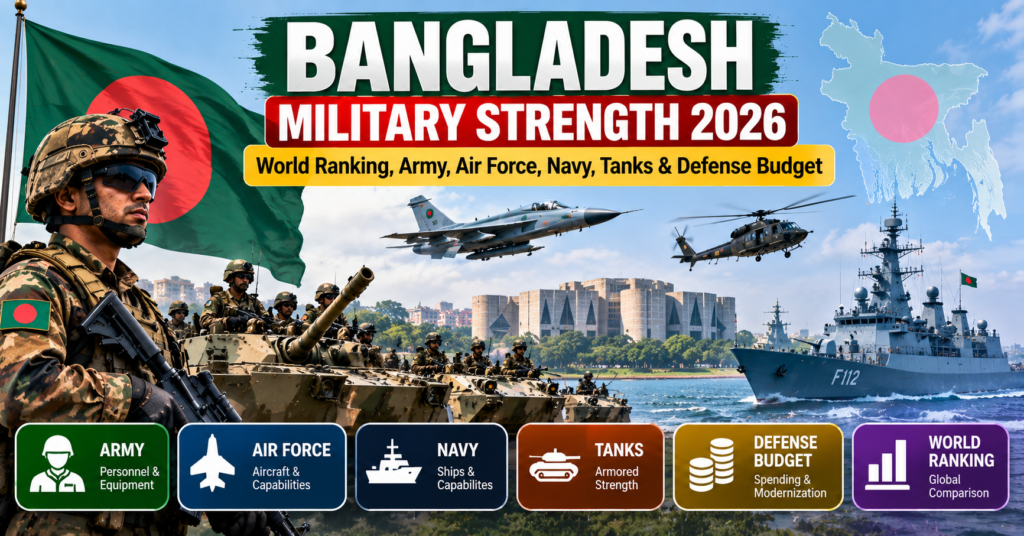
Bangladesh ranks 37th among 145 countries in the 2026 military strength ranking, with a Global Firepower PowerIndex score of 0.6517. The country maintains approximately 204,000 active military personnel, 212 military aircraft, 320 tanks, and a naval fleet that includes frigates, corvettes, and two submarines.
The Bangladesh military strength in 2026 reflects a defense establishment built around three services: the Bangladesh Army, Bangladesh Navy, and Bangladesh Air Force. Its military priorities include territorial defense, airspace security, maritime protection in the Bay of Bengal, and contributions to international peacekeeping operations.
Bangladesh’s large population provides a considerable manpower base, while its geography creates distinct defense requirements. A densely populated river-delta country with extensive inland waterways and access to the Bay of Bengal needs more than a large standing army. Ground mobility, naval patrols, air surveillance, and the ability to maintain equipment are all important to its defense capabilities.
☷On this pageJump to a section of this military guide
Bangladesh Military Strength 2026: Overview and Key Statistics
Bangladesh possesses a conventional military with armored formations, fighter aircraft, artillery, helicopters, surface warships, and submarines. Its armed forces are smaller than those of the world’s leading military powers, but the country maintains capabilities across land, air, and maritime defense.
The following table summarizes the main indicators of Bangladesh’s military strength in 2026.
| Military Category | Bangladesh in 2026 |
|---|---|
| World military rank | 37th of 145 |
| PowerIndex score | 0.6517 |
| Total population | 168,697,184 |
| Active military personnel | 204,000 |
| Reserve personnel | 0 separately recorded |
| Paramilitary category | 6,800,000 |
| Total military aircraft | 212 |
| Fighter aircraft | 41 |
| Military helicopters | 67 |
| Tanks | 320 |
| Armored vehicles | 11,584 |
| Self-propelled artillery | 36 |
| Towed artillery | 487 |
| Rocket artillery systems | 103 |
| Total naval assets | 121 |
| Submarines | 2 |
| Estimated defense budget | $3.34 billion |
Bangladesh’s most notable military resources are its active personnel, armored formations, and diversified naval fleet. With more than 200,000 active personnel, the armed forces maintain a permanent organizational structure covering the country’s land, air, and maritime responsibilities.
The country has also developed capabilities that extend beyond basic infantry defense. Submarines provide an underwater naval capability, while armored vehicles and artillery support conventional land formations.
However, the different inventory categories should not be treated as equal measures of military effectiveness. A patrol vessel is not equivalent to a frigate, and the number of armored vehicles does not reveal how many are tanks or infantry fighting vehicles.
Understanding Bangladesh’s military strength therefore requires examining the composition and responsibilities of its armed services.
Bangladesh Military Ranking 2026: What Is Its Position in the World?
Bangladesh holds the 37th position in the 2026 Global Firepower ranking, placing it within the top 40 countries assessed for conventional military strength.
Its PowerIndex score of 0.6517 reflects a combination of military personnel, equipment, financial indicators, infrastructure, geography, and national resources.
| Ranking Indicator | Position |
|---|---|
| Global military strength | 37th |
| PowerIndex | 0.6517 |
| Active military personnel | 30th |
| Total aircraft | 44th |
| Tank strength | 44th |
| Naval fleet strength | 30th |
| Frigate strength | 12th |
| Submarine strength | 15th |
| Towed artillery | 26th |
The individual category rankings reveal aspects of Bangladesh’s military structure that the overall position does not show.
For example, Bangladesh ranks 30th in total naval assets and 12th in frigate inventory. These positions reflect the importance of maritime capabilities within its armed forces.
In contrast, its 44th-place ranking for total aircraft indicates a smaller aviation inventory relative to many other military powers.
A PowerIndex score is not a percentage, and the difference between two scores should not be interpreted as a direct measure of combat effectiveness. The index is designed to provide a broad conventional military assessment rather than determine how individual armed forces would perform in specific circumstances.
Bangladesh Army Strength 2026: Soldiers, Tanks and Ground Forces
The Bangladesh Army forms the largest component of the country’s armed forces. It is responsible for land defense and maintains infantry, armored, artillery, engineering, and supporting formations.
The army’s equipment includes main battle tanks, armored personnel carriers, artillery systems, and other vehicles needed for military transportation and field operations.
Bangladesh’s geography shapes its land-defense requirements. Much of the country consists of plains, river systems, and densely populated settlements, while the southeastern region includes hills and more difficult terrain.
Consequently, the army must maintain a combination of personnel, mobility, engineering support, and equipment suited to different environments.
How Many Active Soldiers Does Bangladesh Have in 2026?
Bangladesh has approximately 204,000 active military personnel across its armed services. This represents the country’s active-duty military establishment rather than army personnel alone.
The estimated service-level distribution is as follows:
| Armed Service | Estimated Personnel |
|---|---|
| Bangladesh Army | 173,408 |
| Bangladesh Navy | 22,000 |
| Bangladesh Air Force | 19,000 |
| Total active personnel, national estimate | 204,000 |
The branch-level estimates are approximate and should not be added together as though they form an exact audited total. Their combined figure is slightly higher than the separate national active-personnel estimate, reflecting differences in reporting and estimation.
The army accounts for the largest share of Bangladesh’s military personnel. Its organizational responsibilities extend from conventional land defense to engineering, logistics, communications, and other support functions.
Bangladesh’s military also has experience participating in United Nations peacekeeping operations, which involve international deployments under mandates different from conventional national defense.
Bangladesh Army Tanks and Armored Vehicles in 2026
Bangladesh maintains an armored force consisting of tanks and a larger inventory of military vehicles.
| Land Equipment | Reported Inventory |
|---|---|
| Tanks | 320 |
| Armored and military vehicles | 11,584 |
| Self-propelled artillery | 36 |
| Towed artillery | 487 |
| Multiple-launch rocket systems | 103 |
The 320 reported tanks represent the army’s heavy and light armored combat inventory under the ranking’s classification.
Bangladesh has historically operated Chinese-origin tank designs, including upgraded Type 59 and Type 69 vehicles. Its armored forces have also incorporated more modern platforms such as the MBT-2000 and VT-5 light tank.
These equipment types have different characteristics. Main battle tanks emphasize armored firepower and protection, while lighter platforms may offer advantages in mobility and transportation.
Bangladesh’s geographical conditions make vehicle mobility particularly important. Bridges, waterlogged terrain, narrow roads, and densely populated areas can influence where different types of vehicles are practical.
The reported inventory of 11,584 vehicles includes a wider range of platforms than tanks alone. Armored personnel carriers, protected vehicles, and support equipment perform different roles and should not be treated as equivalent combat systems.
Bangladesh Artillery and Rocket Systems
Artillery provides supporting fire for ground formations and forms another important part of Bangladesh’s conventional military inventory.
Bangladesh has 487 reported towed artillery systems, 36 self-propelled artillery units, and 103 multiple-launch rocket systems.
Towed artillery generally relies on separate vehicles for transportation. Self-propelled artillery combines a weapon with a mobile platform, while rocket artillery represents a different type of indirect-fire system.
Maintaining several artillery categories allows an army to organize different forms of supporting fire, although the usefulness of these inventories depends on training, technical condition, and ammunition availability.
The presence of artillery and armored formations demonstrates that Bangladesh maintains a conventional ground force rather than relying only on infantry personnel.
Bangladesh Military Manpower and Paramilitary Forces
Bangladesh’s population is one of its largest national resources. With an estimated 168.7 million residents in the ranking dataset, the country has a substantial pool of people potentially eligible for military recruitment.
However, there is an important difference between population-based manpower estimates and the number of trained military personnel.
| Manpower Category | Estimated Number |
|---|---|
| Total population | 168,697,184 |
| Available manpower | 82,661,620 |
| Fit-for-service population | 66,129,296 |
| Reaching military age annually | 3,205,246 |
| Active military personnel | 204,000 |
| Separately recorded military reserves | 0 |
| Broad paramilitary category | 6,800,000 |
Approximately 82.7 million people are classified as available manpower, while around 66.1 million fall within the fit-for-service estimate.
These figures describe theoretical demographic resources, not existing military formations.
The country also has more than 3.2 million people reaching military age annually, indicating the scale of its potential recruitment population. That does not mean all of those individuals join the military.
Why Does Bangladesh Have 6.8 Million Paramilitary Personnel Listed?
The estimated 6.8 million paramilitary figure needs special explanation because it can easily be misunderstood.
Bangladesh has a large Ansar and Village Defence Party (VDP) system. This organization includes different categories of personnel involved in community security, public safety, and auxiliary responsibilities.
The VDP component includes millions of members within a broad volunteer-based structure. Most are not full-time armed soldiers serving in regular military units.
As a result, Bangladesh should not be described as having seven million active soldiers.
The regular armed forces, with approximately 204,000 active personnel, are fundamentally different from the much larger volunteer and auxiliary security network.
This distinction is particularly important when comparing Bangladesh’s military manpower with countries that use narrower definitions of paramilitary forces.
A zero in the separately recorded military reserve category also does not mean Bangladesh has no other trained personnel or auxiliary organizations. It reflects how those groups are classified in the particular inventory.
Bangladesh Air Force Strength 2026: Fighter Jets, Aircraft and Helicopters
The Bangladesh Air Force is responsible for protecting national airspace and maintaining military aviation capabilities.
Its inventory includes fighter aircraft, transport planes, training aircraft, helicopters, and specialized platforms. The air force’s responsibilities require not only aircraft but also pilots, ground crews, maintenance infrastructure, radar systems, and air-defense coordination.
Bangladesh has expanded and modernized parts of its aviation inventory over time, although the country’s fighter fleet remains relatively small compared with the world’s largest air forces.
How Many Fighter Jets Does Bangladesh Have in 2026?
Bangladesh has 41 reported fighter aircraft within a total military aviation inventory of 212 aircraft.
| Aircraft Category | Reported Inventory |
|---|---|
| Total military aircraft | 212 |
| Fighter aircraft | 41 |
| Dedicated attack aircraft | 0 |
| Transport aircraft | 17 |
| Trainer aircraft | 83 |
| Special-mission aircraft | 4 |
| Aerial refueling tankers | 0 |
| Helicopters | 67 |
| Attack helicopters | 0 |
Fighters account for approximately 19% of the reported aircraft inventory.
Training aircraft form another substantial part of the fleet, with 83 platforms recorded. Trainers are important for developing and maintaining aviation personnel, although they should not all be treated as equivalent to frontline fighter aircraft.
The helicopter inventory of 67 aircraft supports a different range of aviation functions, including transportation, utility tasks, and other military support missions.
The absence of dedicated attack aircraft or attack helicopters in the ranking’s categories does not mean that other aircraft cannot carry weapons. It indicates that no platforms are recorded under those specific classifications.
Bangladesh Air Force Fighter Aircraft
The Bangladesh Air Force has operated fighter aircraft from different generations, including Chinese-origin F-7 variants and Russian MiG-29 aircraft.
The F-7 family forms an important part of the air force’s historical fighter inventory. The MiG-29 provides a different class of combat aircraft with capabilities distinct from the older F-7 series.
The overall fighter fleet therefore contains aircraft with different designs, technologies, and maintenance requirements.
This distinction matters because 41 fighter aircraft do not represent 41 identical platforms. Their capabilities, configurations, and levels of modernization can differ.
Bangladesh also operates training platforms such as the K-8W and Yak-130. These contribute to pilot preparation and aviation training, although they should not automatically be counted as frontline fighters.
Air Force Modernization and Operational Readiness
Modernizing an air force involves more than purchasing additional fighter jets.
Aircraft must be supported by maintenance facilities, technical personnel, communications infrastructure, ground-based systems, and a continuing supply of replacement components.
Bangladesh has pursued aviation modernization under its broader Forces Goal 2030 defense development framework. Improvements in aircraft, radars, training, and supporting systems have formed part of that process.
At the same time, aircraft inventories should not be confused with verified operational availability.
The 2026 comparative assessment applies modeled readiness assumptions that place the estimated available aircraft below the full inventory. Those calculations do not constitute a publicly confirmed count of aircraft ready for immediate missions.
For assessing Bangladesh’s air force, the reliable starting point is the reported fleet composition, followed by the capabilities and limitations of the aircraft types involved.
Bangladesh Navy Strength 2026: Warships, Frigates and Submarines
Bangladesh’s navy has a strategically important role because the country borders the Bay of Bengal and depends heavily on maritime transportation and trade.
The Bangladesh Navy maintains surface warships, patrol vessels, submarines, and specialized maritime capabilities.
Its responsibilities include defending maritime interests, protecting coastal waters, supporting maritime security, and maintaining naval operations within the country’s surrounding waters.
Bangladesh Navy Ships and Submarines in 2026
Bangladesh has 121 reported naval assets, with a combined assessed displacement of approximately 75,280 tonnes.
| Naval Category | Reported Inventory |
|---|---|
| Total naval assets | 121 |
| Total naval tonnage | 75,280 tonnes |
| Aircraft carriers | 0 |
| Destroyers | 0 |
| Frigates | 7 |
| Corvettes | 6 |
| Submarines | 2 |
| Patrol vessels | 61 |
| Mine warfare vessels | 5 |
The composition of the fleet is more informative than the total number of vessels.
Bangladesh has seven reported frigates and six corvettes, representing larger surface combatants with different capabilities from smaller patrol craft.
Its 61 reported patrol vessels form another significant component of the maritime inventory. Patrol vessels are associated with maritime security, surveillance, and other coastal or offshore responsibilities.
The fleet also includes five mine warfare vessels.
Not every vessel in the reported total is a major combat ship. Different naval inventories may include auxiliary and support vessels, and the categories shown above do not account for every asset individually.
Does Bangladesh Have Submarines?
Yes. Bangladesh has two submarines, which were commissioned into the Bangladesh Navy in 2017.
The vessels are BNS Nobojatra and BNS Joyjatra, both Chinese-origin diesel-electric submarines.
Their induction marked an important development in Bangladesh’s naval history, giving the navy a dedicated submarine arm in addition to its surface fleet.
Submarine operations require specialized crews, maintenance facilities, training, and supporting infrastructure that differ from those used by surface ships.
Bangladesh’s submarine capability is therefore significant not only because of the two vessels themselves but also because of the institutions needed to operate them.
The country does not possess a publicly established nuclear-powered submarine fleet.
Frigates, Corvettes and Maritime Security
Bangladesh’s seven frigates and six corvettes provide important surface naval capabilities.
Frigates are generally larger vessels designed for a broader range of maritime missions. Corvettes are typically smaller combat ships used for a variety of coastal and offshore roles.
The navy’s fleet structure reflects the needs of a country with substantial coastal interests, offshore economic activity, and busy maritime trade connections.
Bangladesh’s location in the Bay of Bengal also makes maritime surveillance and the protection of shipping routes important national concerns.
Naval aviation, coastal facilities, and maritime patrol capabilities complement the country’s surface and submarine forces.
Overall, the navy represents one of the more diversified components of Bangladesh’s defense establishment.
Bangladesh Defense Budget 2026: Military Spending and Financial Resources
Bangladesh’s defense financing supports the personnel, equipment, infrastructure, and maintenance requirements of its three armed services.
A conventional military must sustain recurring expenses beyond equipment purchases. Salaries, technical maintenance, training, transportation, infrastructure, and procurement all require financial resources.
The 2026 military ranking uses an estimated $3.34 billion defense budget for Bangladesh.
The government’s fiscal-year budget provides another perspective. For FY 2026–27, Bangladesh allocated approximately Tk 42,497 crore to the Ministry of Defence, compared with a revised Tk 40,662 crore for the preceding fiscal year.
The two figures use different reporting and accounting frameworks and should not be treated as identical measurements.
Bangladesh Military Budget and Economic Indicators
| Financial Indicator | Figure |
|---|---|
| Comparative defense budget estimate | $3.34 billion |
| FY 2026–27 Ministry of Defence allocation | Tk 42,497 crore |
| Purchasing power parity | $1.473 trillion |
| Foreign exchange and gold reserves | $21.395 billion |
| External debt | $58.02 billion |
The financial indicators help place military spending within the country’s wider economy, but they measure different things.
Purchasing power parity provides an economic comparison adjusted for differences in price levels. It is not a defense spending allocation.
Foreign exchange reserves and external debt describe broader national financial conditions rather than money that is automatically available to the armed forces.
Bangladesh faces the challenge of maintaining existing equipment while funding modernization programs and other national priorities.
Its defense budget must therefore support both routine military requirements and longer-term improvements to land, air, and naval capabilities.
Bangladesh Military Modernization and Forces Goal 2030
Bangladesh has pursued a long-term modernization program commonly known as Forces Goal 2030.
The program has been associated with expanding and improving the capabilities of the Bangladesh Army, Navy, and Air Force through equipment modernization, infrastructure development, and changes to supporting institutions.
The three services have different modernization requirements, reflecting the distinct roles of land, maritime, and air defense.
Army Modernization
Bangladesh’s army modernization has included upgrading older armored platforms and introducing newer equipment.
The use of modernized tanks alongside newer designs illustrates an approach that combines extending the service life of existing equipment with selected procurement.
Artillery, protected mobility, communications, and military infrastructure also influence the effectiveness of ground formations.
Air Force Modernization
The air force’s modernization requirements include fighter capability, pilot training, radar coverage, aviation support, and equipment maintenance.
Bangladesh continues to operate aircraft from different generations, making long-term replacement and maintenance planning important considerations.
Plans, negotiations, and procurement announcements should be distinguished from aircraft that have actually entered service. A proposed fighter purchase does not increase the active aircraft inventory until the relevant platforms are delivered and incorporated.
Naval Modernization
The Bangladesh Navy’s expansion into submarine operations represents one of its most important structural developments.
Alongside submarines, the navy has developed surface combatant, patrol, and support capabilities.
Naval infrastructure is particularly important because Bangladesh must maintain ships operating in coastal waters as well as vessels requiring specialized maintenance and training facilities.
The navy’s modernization reflects the growing importance of maritime security, trade, and offshore interests to the country’s national defense planning.
Bangladesh Military Logistics, Geography and Natural Resources
Bangladesh’s military requirements are closely connected to its geography.
The country has a relatively small land area compared with its large population, extensive river networks, substantial agricultural regions, and a coastline along the Bay of Bengal.
These conditions influence transportation, infrastructure, emergency response, maritime activity, and the organization of national defense resources.
Bangladesh Geography and Military Infrastructure
| Indicator | Reported Figure |
|---|---|
| Land area | 148,460 km² |
| Coastline | 580 km |
| Total land boundaries | 4,413 km |
| Usable inland waterways | 8,370 km |
| Road network | 369,105 km |
| Railway network | 2,460 km |
| Airports | 17 |
| Merchant marine vessels | 558 |
| Labor force | 77,355,000 |
The extensive inland waterway system is a distinctive feature of Bangladesh’s geography.
Rivers influence settlement patterns, commercial transportation, connectivity, and the movement of goods. Flooding and seasonal water conditions can also create infrastructure challenges.
Bangladesh’s roads, railways, ports, and maritime transportation networks provide important national logistical resources.
However, infrastructure totals are not direct measurements of military transportation readiness. Local road conditions, bridges, vehicle availability, and weather can affect the practical use of those networks.
Natural Resources and Energy Supply
Energy resources contribute to a country’s ability to maintain industrial production, transportation, and economic activity.
Bangladesh produces natural gas but also faces demand that exceeds its reported domestic production in the comparison dataset.
| Energy Indicator | Reported Figure |
|---|---|
| Oil production | 13,000 barrels/day |
| Oil consumption | 263,000 barrels/day |
| Proven oil reserves | 28 million barrels |
| Natural gas production | 24.62 billion m³ |
| Natural gas consumption | 30.38 billion m³ |
| Proven natural gas reserves | 126.29 billion m³ |
| Coal production | 767,000 metric tonnes |
| Coal consumption | 14.05 million metric tonnes |
| Proven coal reserves | 3.26 billion metric tonnes |
Bangladesh’s reported oil consumption is substantially higher than domestic production, making external energy supplies important to the wider economy.
Natural gas also plays an important role in the country’s energy system.
These figures represent underlying resource estimates that may come from reporting periods preceding 2026. They should not automatically be interpreted as freshly measured annual production levels.
Energy availability matters to national resilience and logistics, although natural resource totals alone do not indicate military readiness.
Bangladesh Military Strengths and Limitations in 2026
Bangladesh’s military has several established capabilities, but its overall strength must be understood in relation to its equipment, organization, and geographic responsibilities.
Main Military Strengths
Large recruitment population: Bangladesh has a substantial demographic base, with approximately 168.7 million people in the comparative population estimate.
Established land forces: The army maintains regular personnel, armored vehicles, tanks, and different artillery systems rather than depending solely on light infantry.
Diversified naval fleet: Frigates, corvettes, patrol vessels, and two submarines provide multiple categories of maritime capability.
Military training and peacekeeping experience: Bangladesh’s participation in international peacekeeping has provided experience in multinational deployments, although peacekeeping and conventional combat operations have different requirements.
Long-term modernization framework: Forces Goal 2030 has provided a policy framework for developing and upgrading military capabilities over time.
Main Military Limitations
Relatively small fighter inventory: Bangladesh’s 41 reported fighter aircraft represent a limited fixed-wing combat fleet compared with major regional air forces.
Mixed equipment generations: Different aircraft and armored systems require continuing maintenance, and some older platforms have different capabilities from newer designs.
Financial constraints: Defense modernization competes with other national spending priorities and must be balanced against the expense of sustaining existing forces.
Dependence on imported systems: Important categories of military aircraft, tanks, and naval equipment have been acquired from foreign suppliers, making long-term maintenance and supply arrangements significant.
Geographical and infrastructure challenges: Dense settlement patterns, waterways, flooding, and varying transport conditions create distinctive mobility and logistical requirements.
These strengths and limitations help explain Bangladesh’s position as an established conventional military power with a substantial manpower base and a developing range of modern equipment.
How Strong Is Bangladesh’s Military in 2026?
Bangladesh has a substantial conventional military, ranking 37th globally in 2026. Its defense capabilities include approximately 204,000 active personnel, 41 fighter aircraft, 320 tanks, 121 naval assets, and two submarines.
The army remains the country’s largest military service, supported by armored vehicles and artillery systems. The air force provides fighter, transport, helicopter, and training capabilities, while the navy maintains both surface and underwater platforms.
Bangladesh’s military profile is particularly notable for its large manpower base and diversified maritime capabilities.
At the same time, military strength cannot be determined simply by adding aircraft, soldiers, tanks, and ships. The condition of equipment, quality of training, logistics, maintenance, and the responsibilities of each military branch all influence actual capabilities.
Bangladesh’s armed forces are structured primarily around defending national territory, protecting maritime interests, maintaining airspace security, and fulfilling other assigned national and international responsibilities. Continued modernization will influence how those capabilities develop beyond 2026.
Frequently Asked Questions about Bangladesh Military Strength 2026
What is Bangladesh’s military rank in 2026?
Bangladesh ranks 37th out of 145 countries in the 2026 Global Firepower military ranking, with a PowerIndex score of 0.6517.
How many active soldiers does Bangladesh have?
Bangladesh has approximately 204,000 active military personnel across the army, navy, and air force. This is a national estimate, not a count of army personnel alone.
How many fighter jets does Bangladesh have in 2026?
Bangladesh has approximately 41 fighter aircraft in its reported 2026 military inventory. Its fighter fleet includes aircraft from the F-7 and MiG-29 families.
How many tanks does the Bangladesh Army have?
The Bangladesh Army has approximately 320 reported tanks, including older modernized platforms and newer armored designs. The inventory covers different tank types rather than 320 identical vehicles.
How strong is the Bangladesh Navy in 2026?
The Bangladesh Navy has 121 reported naval assets, including seven frigates, six corvettes, two submarines, and 61 patrol vessels. Its capabilities are primarily associated with maritime defense and security in the Bay of Bengal.
Does Bangladesh have submarines?
Yes. Bangladesh has two diesel-electric submarines, BNS Nobojatra and BNS Joyjatra, commissioned into the navy in 2017.
What is Bangladesh’s defense budget in 2026?
The 2026 conventional military assessment uses an estimated defense budget of $3.34 billion. Bangladesh’s separate FY 2026–27 government budget allocates Tk 42,497 crore to the Ministry of Defence. These figures use different reporting frameworks.
Does Bangladesh have nuclear weapons?
No. Bangladesh is not a nuclear-armed state and does not possess a publicly established nuclear-weapons arsenal.
Does Bangladesh have 7 million soldiers?
No. Bangladesh has approximately 204,000 active military personnel. The much larger paramilitary-category figure includes a broad Ansar and Village Defence Party membership structure, including millions of volunteers who are not regular active-duty soldiers.
What is Forces Goal 2030 in Bangladesh?
Forces Goal 2030 is Bangladesh’s long-term military modernization framework, associated with improving the army, navy, and air force through equipment acquisition, infrastructure development, and other capability enhancements.