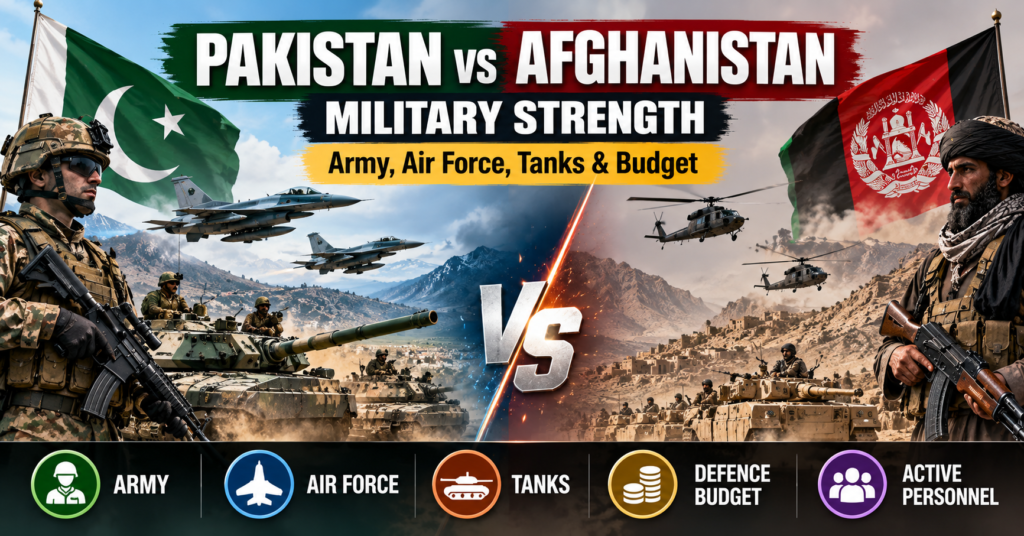
The Pakistan vs Afghanistan military strength comparison 2026 shows a clear gap in overall conventional military capability. Pakistan ranks 14th globally in the 2026 Global Firepower ranking, while Afghanistan is placed 121st out of 145 countries.
Pakistan maintains a much larger and more developed conventional force across the army, air force, artillery, armored units, and naval capabilities. Afghanistan, under Taliban rule, operates a far smaller force structure with more limited heavy equipment and air power.
This Pakistan vs Afghanistan military comparison 2026 looks at the most important differences in army strength, fighter jets, tanks, artillery, defense spending, nuclear capability, and overall military power without relying only on headline numbers.
☷On this pageJump to a section of this military guide
Pakistan vs Afghanistan Military Strength 2026: Full Comparison
Pakistan has a substantial advantage over Afghanistan in conventional military strength, personnel, equipment, and defense infrastructure. Its armed forces operate established land, air, and naval branches, while Afghanistan’s Taliban-led forces have a smaller and less conventional structure.
Following the collapse of the former Afghan government in August 2021, Taliban forces took control of military vehicles, weapons, and other equipment. However, the operational condition and availability of some inherited systems remain uncertain, so Afghanistan’s published inventory figures should be interpreted cautiously.
| Military Category | Pakistan | Afghanistan |
|---|---|---|
| Global military rank | 14th | 121st |
| PowerIndex | 0.2626 | 2.7342 |
| Total population | 252,363,571 | 40,121,552 |
| Active military personnel | 660,000 | 75,000 |
| Reserve personnel | 550,000 | 0 reported |
| Paramilitary personnel | 500,000 | 90,000 |
| Total military aircraft | 1,397 | 5 |
| Fighter aircraft | 331 | 0 reported |
| Tanks | 2,677 | 0 reported |
| Armored vehicles | 59,044 | 3,902 |
| Self-propelled artillery | 662 | 0 reported |
| Towed artillery | 2,629 | 0 reported |
| Mobile rocket projectors | 652 | 0 reported |
| Naval fleet strength | 120 | Not applicable |
| Defense budget estimate | $9.10 billion | $145 million |
The biggest differences are in air power, armored forces, artillery, and naval capability. Pakistan fields hundreds of combat aircraft, thousands of armored platforms, and a functioning navy, while Afghanistan has no comparable documented force in these categories.
A reported zero should not automatically be read as proof that no equipment exists. It means that no qualifying inventory is recorded in the dataset used for this comparison.
Pakistan vs Afghanistan Army Strength 2026: Soldiers and Manpower
The Pakistan vs Afghanistan army strength comparison in 2026 shows a substantial manpower advantage for Pakistan. Its much larger population provides a broader recruitment base, while its military structure includes active personnel, reserve forces and paramilitary organizations.
Afghanistan has a smaller population and a Taliban-controlled security structure in which personnel estimates can vary depending on whether regular military, policing, administrative and internal-security forces are counted separately or together.
Pakistan vs Afghanistan Military Personnel Comparison
| Manpower Category | Pakistan | Afghanistan |
|---|---|---|
| Total population | 252,363,571 | 40,121,552 |
| Available manpower | 108,516,336 | 15,647,405 |
| Fit-for-service population | 85,803,614 | 8,826,741 |
| Reaching military age annually | 4,794,908 | 842,553 |
| Active military personnel | 660,000 | 75,000 |
| Reserve military personnel | 550,000 | 0 reported |
| Paramilitary personnel | 500,000 | 90,000 |
Pakistan has approximately 8.8 times more active military personnel than Afghanistan in the figures used for this comparison.
Its larger population also gives Pakistan a much broader long-term manpower pool. Around 4.79 million people reach military age annually, compared with about 843,000 in Afghanistan.
These figures indicate potential recruitment capacity rather than immediately deployable military strength. Available manpower, reserve personnel and military-age population should not be treated as trained frontline soldiers.
Pakistan Army Personnel and Reserve Strength
The Pakistan Army is the largest branch of the country’s armed forces and operates an established command structure with infantry, armored units, artillery, engineers and other combat and support formations.
Pakistan also maintains approximately 550,000 reserve personnel, providing an additional manpower pool beyond the active force. Paramilitary organizations such as the Pakistan Rangers and Frontier Corps perform separate border-security and internal-security roles.
Active personnel, reserves and paramilitary forces should not simply be added together and presented as one combat force. Their training, equipment, responsibilities and readiness differ.
Afghanistan Army Strength Under Taliban Rule in 2026
Afghanistan’s military structure changed fundamentally after the Taliban returned to power in August 2021 and the former Afghan National Defense and Security Forces collapsed.
The 2026 comparison dataset lists approximately 75,000 active military personnel and 90,000 paramilitary personnel for Afghanistan. These should be treated as classification-based estimates rather than a definitive count of everyone serving under Taliban-controlled security institutions.
Taliban authorities have also cited larger totals for personnel under defense and interior ministry structures. Such figures may include police, administrative staff and internal-security personnel, making direct comparisons with a conventional standing army difficult.
Pakistan vs Afghanistan Air Force Strength 2026
The Pakistan vs Afghanistan air force comparison in 2026 shows one of the widest gaps between the two militaries. Pakistan operates an established air force with fighter jets, helicopters, transport aircraft, trainers and specialized support platforms, backed by air bases, maintenance facilities and trained aviation personnel. Afghanistan’s military aviation capability is far more limited following the collapse of the former Afghan government in 2021. Pasted markdown
Pakistan vs Afghanistan Fighter Jets and Military Aircraft
| Aircraft Category | Pakistan | Afghanistan |
|---|---|---|
| Total military aircraft | 1,397 | 5 |
| Fighter jets | 331 | 0 reported |
| Dedicated attack aircraft | 90 | 0 reported |
| Transport aircraft | 63 | 2 |
| Trainer aircraft | 563 | 0 reported |
| Special-mission aircraft | 27 | 0 reported |
| Aerial refueling aircraft | 4 | 0 reported |
| Helicopters | 379 | 3 |
| Attack helicopters | 55 | 0 reported |
Pakistan’s 1,397 reported military aircraft give it a much larger aviation inventory than Afghanistan’s five recorded aircraft. The difference is particularly important in combat aviation: Pakistan has 331 fighter aircraft, while Afghanistan has no qualifying fighter jets recorded in the 2026 dataset.
Aircraft totals should not be read as a simple measure of combat power. Fighters, transports, helicopters, trainers and support aircraft perform different roles, while their effectiveness also depends on maintenance, trained crews and operational readiness. Attack helicopters are already included within the broader helicopter category and should not be added again to the total.
Pakistan Air Force Fighter Jets in 2026
The Pakistan Air Force fighter fleet includes the JF-17 Thunder, F-16 Fighting Falcon and J-10CE.
The JF-17 has become a central part of Pakistan’s combat aviation fleet and reflects the country’s aircraft-development cooperation with China. The F-16 remains an established combat platform, while the J-10CE forms part of Pakistan’s continuing fighter modernization.
Pakistan also operates transport aircraft, trainers, special-mission platforms and aerial refueling aircraft, giving its air force capabilities beyond fighter operations alone. The overall inventory, however, does not indicate how many aircraft are immediately operational at any particular time.
Does Afghanistan Have Fighter Jets in 2026?
Afghanistan does not have a publicly established modern operational fighter-jet fleet comparable to Pakistan’s.
The 2026 inventory used for this comparison records only five Afghan military aircraft: two transport aircraft and three helicopters, with no qualifying fighters or dedicated attack aircraft listed.
Before August 2021, the former Afghan Air Force operated helicopters, transports and light-attack platforms with substantial foreign training and maintenance support. Some aircraft remained in Afghanistan after the government collapsed, while others were flown to neighboring countries or became unavailable.
Taliban authorities have retained or attempted to restore limited aviation capability, but publicly available information does not establish a modern operational fighter force.
Pakistan vs Afghanistan Tank Strength and Land Forces 2026
The Pakistan vs Afghanistan land-force comparison is particularly relevant because the two countries share a long land border.
Pakistan operates a conventional army with main battle tanks, armored vehicles, artillery and mobile rocket systems supported by established training, maintenance and logistics infrastructure. Afghanistan’s Taliban-controlled forces rely more heavily on personnel, light weapons, vehicles and inherited military equipment, with a substantially smaller documented heavy-weapons inventory.
Pakistan vs Afghanistan Tanks, Artillery and Armored Vehicles
| Land Equipment | Pakistan | Afghanistan |
|---|---|---|
| Main battle tanks | 2,677 | 0 reported |
| Armored vehicles | 59,044 | 3,902 |
| Self-propelled artillery | 662 | 0 reported |
| Towed artillery | 2,629 | 0 reported |
| Mobile rocket projectors | 652 | 0 reported |
Pakistan’s reported 59,044 armored vehicles are roughly 15 times Afghanistan’s recorded 3,902. Pakistan also has 2,677 tanks and large artillery and rocket inventories, giving it a far deeper conventional ground-force structure.
Afghanistan’s zero entries for tanks and artillery should be interpreted carefully. They indicate that no qualifying inventory is recorded in those categories in the dataset, not necessarily that no inherited heavy equipment remains anywhere in the country.
Pakistan Army Tanks and Armored Vehicles
Pakistan’s tank fleet includes the Al-Khalid family alongside other armored platforms acquired or developed over different periods.
Main battle tanks provide heavy firepower, armor protection and battlefield mobility, but their effectiveness also depends on crew training, logistics, maintenance and terrain.
Pakistan’s much larger armored-vehicle total includes several types of platforms. Not every armored vehicle is a tank: many are designed for troop transport, reconnaissance, protection or specialized support roles.
Pakistan vs Afghanistan Artillery Strength
Pakistan also has a major advantage in artillery strength. Its 2026 inventory includes:
- 2,629 towed artillery systems
- 662 self-propelled artillery systems
- 652 mobile rocket projectors
Together, these systems give Pakistan substantial conventional fire-support capability for large ground formations.
Afghanistan does not have a comparable documented artillery inventory in the same dataset. Some systems inherited from the former Afghan security forces may still exist, but their current condition and operational availability cannot be established from inventory counts alone.
Taliban Military Equipment and Armored Vehicles
The Taliban gained access to significant quantities of military equipment when the former Afghan government collapsed in 2021, including vehicles, small arms, communications equipment and other military supplies.
Possession, however, does not automatically equal operational capability. Vehicles and advanced systems require fuel, trained operators, spare parts, maintenance and suitable storage.
Afghanistan’s 3,902 recorded armored vehicles therefore provide only a partial picture of Taliban-controlled ground equipment and should not be treated as a complete inventory of everything physically present in the country.
Pakistan vs Afghanistan Naval Strength 2026
The Pakistan vs Afghanistan naval comparison is fundamentally shaped by geography. Pakistan has access to the Arabian Sea and operates a functioning navy, while Afghanistan is landlocked and therefore has no requirement for an ocean-going naval force.
Pakistan’s coastline creates responsibilities involving maritime security, coastal defense, commercial shipping and protection of sea-based national interests.
Pakistan vs Afghanistan Naval Fleet Comparison
| Naval Category | Pakistan | Afghanistan |
|---|---|---|
| Total fleet strength | 120 | Not applicable |
| Aircraft carriers | 0 | Not applicable |
| Submarines | 8 | Not applicable |
| Frigates | 9 | Not applicable |
| Corvettes | 6 | Not applicable |
| Patrol vessels | 79 | Not applicable |
| Mine warfare vessels | 3 | Not applicable |
The Pakistan Navy operates submarines, frigates, corvettes, patrol vessels and specialized maritime platforms. Its eight reported submarines represent one of the more significant capabilities within the fleet because submarine operations require specialized crews, maintenance and supporting infrastructure.
The total fleet figure of 120 should not be interpreted as 120 equivalent combat ships. A submarine, frigate and patrol craft differ substantially in size, equipment and mission.
Afghanistan’s security priorities are instead centered on land territory, internal security and its borders with neighboring countries.
Pakistan vs Afghanistan Defense Budget 2026
The Pakistan vs Afghanistan defense budget comparison shows another major structural difference between the two countries.
Military spending supports personnel, training, maintenance, infrastructure and equipment procurement. Maintaining fighter aircraft, armored formations and naval vessels requires considerably greater recurring expenditure than operating a smaller, primarily land-focused security force.
Pakistan vs Afghanistan Military Budget Comparison
| Financial Indicator | Pakistan | Afghanistan |
|---|---|---|
| Estimated defense budget | $9.10 billion | $145 million |
| Purchasing power parity | $1.39 trillion | $82.24 billion |
| Foreign exchange reserves | $18.41 billion | $8.85 billion |
| External debt | $89.15 billion | $1.93 billion |
Pakistan’s estimated $9.10 billion defense budget is approximately 63 times Afghanistan’s $145 million estimate in the dataset used for this comparison.
The figures help explain Pakistan’s ability to maintain a much larger conventional military, including combat aircraft, armored formations and naval forces. However, the two budget estimates should not be treated as directly audited like-for-like accounts. Pakistan publishes formal government defense allocations, while military spending under Taliban rule in Afghanistan is considerably less transparent.
Pakistan Defense Spending and Military Modernization
Pakistan’s defense spending supports multiple armed-service branches and a substantial military infrastructure.
Maintaining fighter aircraft, tanks, artillery, naval vessels and support systems requires continuous expenditure on training, maintenance, procurement and technical support.
Pakistan also has a domestic defense-industrial sector involved in producing and maintaining selected military equipment. Modernization programs have included combat aircraft, armored platforms and naval systems, adding both capability and long-term procurement costs.
Afghanistan Defense Budget and Military Limitations
Afghanistan operates under much greater financial and institutional constraints.
Its smaller estimated defense budget, limited aviation-maintenance capacity and dependence on inherited equipment restrict its ability to sustain advanced conventional systems on the same scale as Pakistan.
Budget figures alone cannot measure training quality, readiness or battlefield effectiveness, but the difference in available financial resources remains an important part of the Pakistan vs Afghanistan military strength comparison in 2026.
Pakistan vs Afghanistan Nuclear Weapons Comparison 2026
The Pakistan vs Afghanistan nuclear weapons comparison in 2026 shows a fundamental strategic difference between the two countries. Pakistan is a nuclear-armed state, while Afghanistan has no publicly established nuclear arsenal or nuclear-weapons program.
Pakistan’s nuclear capability developed primarily in the context of its long-term security competition with India. Its nuclear forces and delivery systems form a strategic deterrent and should be considered separately from conventional indicators such as fighter jets, tanks, artillery, or troop strength.
Pakistan vs Afghanistan Nuclear Capability
| Nuclear Indicator | Pakistan | Afghanistan |
|---|---|---|
| Nuclear-armed country | Yes | No |
| Estimated nuclear warheads, January 2026 | Approximately 170 | None reported |
| Nuclear delivery capability | Established | None established |
| Nuclear deterrent | Yes | No |
Pakistan’s nuclear stockpile was estimated at approximately 170 warheads in January 2026 in publicly available international nuclear-force assessments. This is an estimate rather than an officially disclosed complete inventory.
Afghanistan has no recognized nuclear arsenal or established nuclear-weapons capability.
Pakistan’s nuclear deterrent gives it a major strategic capability, but nuclear weapons should not be treated as a simple extension of conventional military strength. Nuclear deterrence and conventional border operations involve different strategic calculations.
Pakistan vs Afghanistan Military Logistics and Infrastructure 2026
The Pakistan vs Afghanistan military logistics comparison highlights another important difference that raw weapons totals do not show. Military forces need roads, transport, fuel, maintenance facilities, communications, skilled personnel, and supply networks to keep equipment operational.
Pakistan has a significantly larger road network, labor force, and maritime infrastructure, giving it a broader national base for supporting conventional military operations.
Pakistan vs Afghanistan Infrastructure Comparison
| Infrastructure Indicator | Pakistan | Afghanistan |
|---|---|---|
| Airports | 117 | 68 |
| Roadways | 264,175 km | 34,903 km |
| Labor force | 83,644,000 | 9,133,000 |
| Internet coverage | 27% | 18% |
| Merchant marine vessels | 60 | 0 reported |
| Ports and terminals | 3 | 0 |
Some of these infrastructure figures come from reporting periods earlier than 2026 and should be treated as reference indicators rather than newly measured 2026 totals.
Pakistan’s reported road network is more than seven times longer than Afghanistan’s. It also benefits from maritime access, larger population centers, industrial facilities, and a much bigger workforce.
Afghanistan faces greater logistical constraints because of its mountainous terrain, shorter road network, and landlocked position, which increase its dependence on overland trade and transport through neighboring countries.
Why Military Logistics Matter
Military logistics determines how effectively a force can move, supply, repair, and sustain personnel and equipment.
Key requirements include:
- transport capacity
- fuel supply
- equipment maintenance
- replacement parts
- communications
- medical support
Pakistan’s larger economy and transportation network provide a broader support base for these functions.
Afghanistan’s difficult terrain can make movement and resupply more challenging, particularly in remote mountainous regions. However, national infrastructure totals alone do not determine military readiness. Road quality, terrain, weather, and access to specific locations can vary significantly within both countries.
Pakistan vs Afghanistan Geography and Border Strength 2026
The Pakistan vs Afghanistan geography comparison is especially important because the two countries share a long and strategically sensitive land frontier.
Their border, commonly known as the Durand Line, extends for approximately 2,640 kilometers through mountainous terrain, valleys, and populated border regions. Its historical and political status has also remained contentious.
Geography influences border security, transport, population distribution, logistics, and the movement of people and goods, making it an important part of any Pakistan vs Afghanistan military comparison.
Pakistan vs Afghanistan Geographical Comparison
| Geographical Indicator | Pakistan | Afghanistan |
|---|---|---|
| Land area | 796,095 km² | 652,230 km² |
| Total land boundaries | 7,257 km | 5,987 km |
| Coastline | 1,046 km | Landlocked |
| Reported inland waterways | 0 km | 1,200 km |
The land-boundary figures represent each country’s borders with all neighboring states, not only the Pakistan–Afghanistan frontier.
Pakistan has the larger land area and direct access to the Arabian Sea, while Afghanistan is landlocked and contains extensive mountainous terrain. These differences affect both countries’ transport networks, trade access, and military logistics.
Does Afghanistan Have a Geographical Military Advantage?
Afghanistan’s mountainous terrain can make movement, surveillance, and large-scale military operations more difficult in some regions. Difficult terrain has historically complicated access and transportation for forces operating inside the country.
But mountainous geography is not automatically a military advantage.
The same terrain can also:
- slow resupply
- restrict movement
- complicate communications
- raise infrastructure costs
- make transport between regions more difficult
Pakistan has geographical advantages of its own, including maritime access, a larger transportation network, major population centers, and broader economic infrastructure.
The military value of geography therefore depends on the specific location, mission, terrain, logistics, and forces involved rather than on mountains or land area alone.
Pakistan vs Afghanistan Border Tensions in 2026
Pakistan–Afghanistan border tensions in 2026 have remained elevated because of militant violence, cross-border security disputes, and continuing disagreements over responsibility for attacks near the frontier.
A central issue is the Tehrik-e-Taliban Pakistan (TTP), which is separate from Afghanistan’s governing Taliban movement. Pakistan has accused TTP militants of operating from Afghan territory, while Taliban authorities have denied allowing Afghanistan to be used for attacks against Pakistan.
Relations deteriorated further during 2026 following cross-border violence, Pakistani airstrikes, and periodic border clashes, including serious confrontations reported in February and October.
These tensions show why military strength and border security are not the same thing. Pakistan has a much larger conventional military, but troop numbers, fighter jets, and tanks alone cannot explain the political, geographic, and militant-security challenges along the shared border.
Who Has the Stronger Military: Pakistan or Afghanistan in 2026?
Pakistan has the stronger conventional military than Afghanistan in 2026.
Pakistan ranks 14th in the 2026 Global Firepower ranking, compared with 121st for Afghanistan, and maintains major advantages in active personnel, fighter aircraft, tanks, artillery, naval strength, defense spending, and military infrastructure.
The difference is especially large in air power and heavy conventional weapons. Pakistan operates an established air force, mechanized land forces, artillery formations, and a navy, while Afghanistan’s documented capabilities in these areas remain much smaller.
Pakistan also possesses nuclear weapons, giving it a strategic capability that Afghanistan does not have.
Afghanistan nevertheless presents a different type of security environment. Its Taliban-controlled forces, inherited military equipment, mountainous terrain, and less transparent personnel and equipment data make direct comparisons more complex.
Overall, the Pakistan vs Afghanistan military strength comparison shows a clear Pakistani advantage in conventional and strategic military capability. Rankings and inventory totals, however, should not be treated as predictions of how any specific border confrontation would unfold.
Frequently Asked Questions
Is Pakistan stronger than Afghanistan militarily in 2026?
Yes. Pakistan has a substantially stronger conventional military, with larger forces, more aircraft, tanks, artillery, naval capability, and defense spending.
What is Pakistan’s military rank in 2026?
Pakistan ranks 14th out of 145 countries in the 2026 Global Firepower ranking.
What is Afghanistan’s military rank in 2026?
Afghanistan ranks 121st out of 145 countries in the same 2026 ranking.
How many active soldiers do Pakistan and Afghanistan have?
Pakistan is listed with about 660,000 active personnel, compared with approximately 75,000 for Afghanistan in the dataset used for this comparison.
How many fighter jets does Pakistan have in 2026?
Pakistan has approximately 331 fighter aircraft in the 2026 military inventory used here.
Does Afghanistan have fighter jets in 2026?
No modern operational fighter fleet comparable to Pakistan’s is recorded. Afghanistan’s listed military aviation inventory is very limited.
How many tanks does Pakistan have?
Pakistan has approximately 2,677 tanks in the 2026 comparison dataset.
Does Afghanistan have tanks?
No qualifying tank inventory is recorded in the same dataset, although inherited equipment may still exist.
Does Pakistan have nuclear weapons?
Yes. Pakistan is a nuclear-armed state, with an estimated stockpile of about 170 warheads in January 2026.
Does Afghanistan have nuclear weapons?
No. Afghanistan has no publicly established nuclear-weapons arsenal.
What is the Pakistan vs Afghanistan defense budget?
The comparison uses an estimated $9.10 billion for Pakistan and $145 million for Afghanistan.
Why is Pakistan ranked much higher than Afghanistan militarily?
Pakistan has a larger established military, stronger air and land forces, naval capability, greater defense spending, and broader military infrastructure.