The China vs United States military strength comparison in 2026 is not simply a contest between the country with the most soldiers and the country with the most aircraft.
It is a comparison between two military systems designed around very different strategic requirements.
The United States military remains the world’s highest-ranked conventional force in the 2026 Global Firepower assessment, holding the #1 position among 145 countries with a PowerIndex score of 0.0741. China ranks #3 with a score of 0.0919.
Those rankings place both countries near the top of global military power, but they do not mean their forces are built in the same way.
The United States has spent decades developing a military capable of operating across multiple continents and oceans. Its strength is built around a huge aviation fleet, aircraft carriers, nuclear-powered submarines, aerial refueling, strategic transport, satellites, overseas bases, precision weapons, intelligence networks and alliances.
China’s People’s Liberation Army (PLA) has followed a different path.
China maintains the larger active-duty force, more tanks, more self-propelled artillery, more mobile rocket systems and more naval vessels by total hull count in the supplied 2026 comparison. It has also developed one of the world’s largest missile forces, rapidly expanded the People’s Liberation Army Navy, modernized its Air Force, enlarged its nuclear arsenal and built an enormous domestic defense-industrial base.
Most importantly, China does not need to copy the United States globally to create a serious military challenge close to China.
In the Western Pacific, Chinese forces can operate near mainland airfields, ports, missile bases, air-defense networks, surveillance systems and industrial infrastructure. The United States, by comparison, must project much of its power across the Pacific or through forward bases and allied territory.
That difference between global military power and regional force concentration is the key to understanding the China vs USA military balance in 2026.
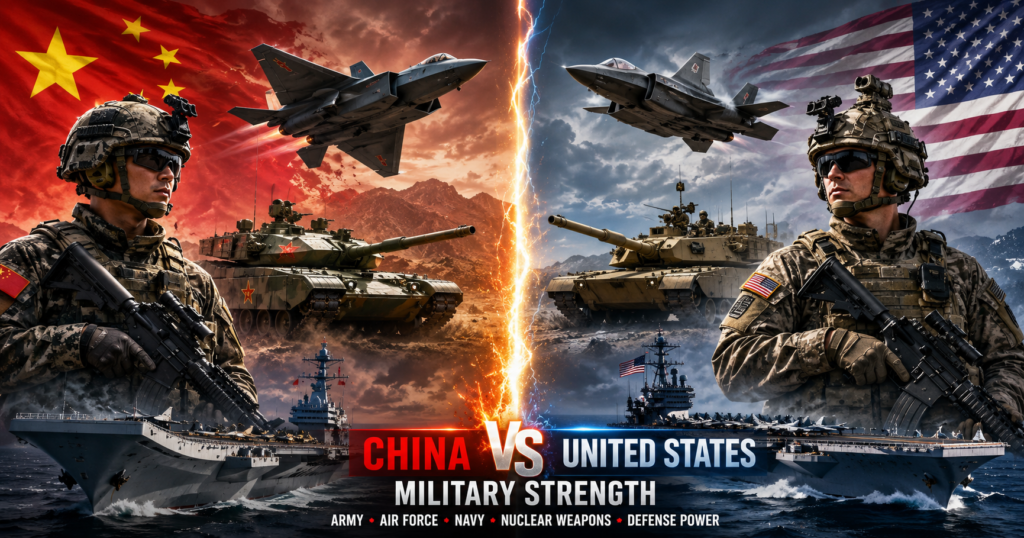
China vs USA Military Strength 2026 at a Glance
The headline numbers reveal two different kinds of military strength.
China has significantly more active personnel and leads in several land-force categories. It also has a larger naval fleet when vessels are counted individually.
The United States dominates many aviation categories, particularly the support aircraft that make long-distance military operations possible. It also operates far more aircraft carriers and maintains the larger nominal defense budget.
| Military Category | China | United States |
|---|---|---|
| Global Military Rank | #3 | #1 |
| PowerIndex | 0.0919 | 0.0741 |
| Active Personnel | 2,035,000 | 1,333,030 |
| Reserve Personnel | 510,000 | 799,500 |
| Defense Budget | $303 billion | $831.5 billion |
| Total Aircraft | 3,529 | 13,032 |
| Fighter Aircraft | 1,443 | 1,791 |
| Transport Aircraft | 287 | 917 |
| Special-Mission Aircraft | 105 | 611 |
| Aerial Tankers | 9 | 610 |
| Helicopters | 1,007 | 5,913 |
| Tanks | 5,870 | 4,666 |
| Armored Vehicles | 152,040 | 409,660 |
| Self-Propelled Artillery | 2,940 | 1,521 |
| Mobile Rocket Projectors | 2,770 | 1,731 |
| Naval Assets | 841 | 465 |
| Aircraft Carriers | 3 | 11 |
| Submarines | 61 | 66 |
| Destroyers | 53 | 83 |
The table makes one thing clear: there is no single category called “military power.”
China’s strongest areas are concentrated around manpower, land-based fires, missile capability, naval expansion, industrial scale and regional geography.
The United States’ strongest advantages appear in air power, carrier aviation, tanker support, strategic transport, high-end submarine forces, global logistics and worldwide military access.
China vs USA Military Ranking in 2026
The United States holds the #1 military ranking in 2026, while China occupies the #3 position.
The PowerIndex scores are:
United States: 0.0741
China: 0.0919
The difference is relatively small compared with many other country comparisons, but the numbers should not be read as though the two militaries are nearly identical.
Military rankings combine manpower, equipment, finance, geography, resources and logistics into a broad conventional-power assessment.
They cannot fully measure:
- Operational readiness
- Training standards
- Ammunition availability
- Command quality
- Intelligence
- Electronic warfare
- Cyber capabilities
- Satellite resilience
- Geographic concentration
- Alliance support
- Wartime production
- Political objectives
Those missing variables matter enormously for China vs United States military power.
A U.S. military operation in Europe or the Middle East involves very different geography from an operation near Taiwan or the South China Sea.
China’s #3 ranking therefore understates some advantages it gains close to its own territory, while America’s global ranking reflects capabilities China does not yet reproduce on the same worldwide scale.
China vs USA Military Personnel
China maintains the larger active-duty military.
The 2026 comparison lists approximately 2.035 million active Chinese military personnel, compared with around 1.333 million active U.S. personnel.
The reserve comparison moves in the opposite direction.
The United States is listed with approximately 799,500 reservists, while China has around 510,000.
China also has an enormous population from which military-age manpower can theoretically be drawn.
| Manpower Category | China | United States |
|---|---|---|
| Active Personnel | 2,035,000 | 1,333,030 |
| Reserve Personnel | 510,000 | 799,500 |
| Paramilitary Personnel | 625,000 | 0 |
| Available Manpower | 764,123,366 | 150,463,900 |
| Fit for Service | 626,864,169 | 124,816,644 |
| Reaching Military Age Annually | 19,810,606 | 4,445,524 |
China’s demographic advantage is substantial, but modern warfare does not scale directly with population.
A fifth-generation fighter pilot, submarine officer, cyber specialist or air-defense technician cannot simply be replaced by an untrained civilian.
Modern military power increasingly depends on specialized training, technical education, command systems, communications, maintenance and integration across multiple services.
That is why China’s larger active force matters, but does not by itself make China militarily stronger overall.
How the PLA Is Organized Differently From the U.S. Military
One of the most important differences is how the two countries structure military power.
China’s armed forces are built around the People’s Liberation Army, which includes major land, air, naval, rocket and strategic-support capabilities.
The PLA has spent decades transforming from a manpower-heavy territorial force toward a more technologically sophisticated military emphasizing:
- Joint operations
- Precision strike
- Long-range missiles
- Integrated air defense
- Naval power
- Space
- Cyber
- Electronic warfare
- Surveillance
- Information dominance
The U.S. military, meanwhile, has developed around worldwide expeditionary operations.
Its force structure places enormous emphasis on:
- Long-distance airlift
- Aerial refueling
- Carrier strike groups
- Amphibious forces
- Overseas bases
- Nuclear submarines
- Satellite networks
- Strategic bombers
- Joint command systems
- Allied interoperability
This difference explains why some inventory categories produce seemingly contradictory results.
China may own more tanks or more ships by count while the United States retains a much greater ability to move military power across oceans and sustain it far from home.
China vs USA Army and Land Power 2026
China has one of the world’s largest land forces.
Its Army has modernized significantly through newer armored vehicles, tanks, self-propelled artillery, rocket systems, air-defense equipment, drones and improved communications.
The United States Army operates with fewer active personnel but is supported by an enormous ecosystem of helicopters, armored vehicles, precision weapons, surveillance systems, logistics and long-range transport.
The 2026 inventory shows a mixed land-power picture rather than a clear numerical winner.
| Land Category | China | United States |
|---|---|---|
| Tanks | 5,870 | 4,666 |
| Armored Vehicles | 152,040 | 409,660 |
| Self-Propelled Artillery | 2,940 | 1,521 |
| Towed Artillery | 1,400 | 1,878 |
| Mobile Rocket Projectors | 2,770 | 1,731 |
China leads in tanks, self-propelled artillery and mobile rocket systems.
The United States has far more listed armored vehicles and somewhat more towed artillery.
More importantly, the strategic importance of land forces differs between the two countries.
China shares long land borders with numerous states and maintains significant territorial-security requirements across its continental geography.
The United States, protected geographically by Canada, Mexico and two oceans, does not structure its Army primarily around defending a vulnerable continental frontier.
Its Army is expected to deploy abroad.
China Has More Tanks Than the United States
China is listed with approximately 5,870 tanks, compared with 4,666 U.S. tanks.
China operates several generations of armored systems. Its more modern main battle tanks include the Type 99 and Type 96 families, alongside other armored platforms.
The United States centers its heavy tank force around the M1 Abrams family.
The comparison illustrates why simple tank counting is limited.
China’s larger number gives it greater numerical depth, but tank effectiveness depends on:
- Sensors
- Armor
- Ammunition
- Crew training
- Maintenance
- Engineering support
- Air defense
- Logistics
- Reconnaissance
- Drone protection
- Terrain
China also has to allocate its land forces across a very different geographic environment.
A tank that is useful on open terrain is not equally useful in mountainous or heavily urbanized areas.
So China leads in tank quantity, but quantity alone cannot establish overall land-combat superiority.
China’s Artillery and Long-Range Fires
China’s land-fire advantage is more notable in self-propelled artillery and mobile rocket systems.
The PLA is listed with approximately:
2,940 self-propelled artillery systems
2,770 mobile rocket projectors
The United States is listed with 1,521 and 1,731 respectively.
That difference fits a wider characteristic of Chinese military development: a strong focus on long-range precision fire.
The PLA has invested extensively in systems intended to strike targets beyond the immediate frontline.
And once the comparison moves beyond conventional artillery into ballistic and cruise missiles, China’s land-based strike capability becomes even more important.
This is especially relevant in the Western Pacific, where land-based Chinese missiles can reach areas that the U.S. would otherwise support primarily through aircraft and ships.
China vs USA Air Force 2026
Air power is one of the largest overall U.S. strengths.
The 2026 comparison lists approximately 13,032 American military aircraft, compared with 3,529 Chinese aircraft.
That difference initially looks overwhelming.
But the fighter comparison is considerably closer:
United States: 1,791 fighters
China: 1,443 fighters
The real American advantage becomes clearer once support aircraft are included.
| Air Category | China | United States |
|---|---|---|
| Total Aircraft | 3,529 | 13,032 |
| Fighter Aircraft | 1,443 | 1,791 |
| Dedicated Attack Aircraft | 371 | 926 |
| Transport Aircraft | 287 | 917 |
| Trainer Aircraft | 401 | 2,610 |
| Special-Mission Aircraft | 105 | 611 |
| Aerial Tankers | 9 | 610 |
| Helicopters | 1,007 | 5,913 |
| Attack Helicopters | 281 | 1,024 |
The difference between 13,032 and 3,529 aircraft is therefore not merely a fighter difference.
Much of the American advantage comes from the aviation infrastructure surrounding its fighters.
That matters because air power is not simply about shooting down another aircraft. It is also about finding targets, moving forces, refueling aircraft, controlling airspace, supplying distant bases and maintaining operations over time.
China Fighter Jets: J-20, J-16 and J-10
China’s fighter modernization has been rapid.
Important Chinese fighter aircraft include:
- J-20
- J-16
- J-10
- Other older fighter variants
The J-20 is particularly significant because it represents China’s move into operational stealth combat aviation.
The J-16 provides a heavy multirole platform, while the J-10 family gives China a large modern fighter base across multiple variants.
China has also been developing carrier-based aviation as its Navy expands.
This means the Chinese fighter fleet should no longer be viewed as a predominantly aging force.
The PLA Air Force has increasingly moved toward modern sensors, long-range weapons, airborne warning aircraft, electronic warfare and networked operations.
Its challenge is not simply acquiring advanced aircraft but integrating them consistently across a very large force.
U.S. Fighter Jets: F-35, F-22, F-15 and F-16
The United States operates a large and diverse combat-aircraft fleet.
Key fighters include:
- F-35 Lightning II
- F-22 Raptor
- F-15
- F-16
- Carrier-based fighters
The United States has an especially large fifth-generation aircraft fleet built around the F-35 and F-22.
The F-35 is also important beyond the United States because allied countries operate the platform, increasing interoperability across several U.S.-aligned air forces.
The F-22 remains focused primarily on air superiority, while updated F-15 variants provide long-range payload capacity.
The U.S. advantage therefore comes from more than fighter quantity.
It includes a large supporting network of:
- Tankers
- AWACS
- Intelligence aircraft
- Electronic warfare
- Satellite support
- Long-range bombers
- Tanker bases
- Logistics
- Allied airfields
That supporting ecosystem is one of America’s most important advantages.
The 610 vs 9 Tanker Difference May Matter More Than Fighter Count
One of the most revealing statistics in the entire China vs USA Air Force comparison is aerial refueling.
The 2026 figures list:
United States: 610 tankers
China: 9
That gap is enormous.
Why does it matter?
Fighter aircraft have limited combat radius. They need fuel to fly long distances, remain on station, patrol and return safely.
Aerial tankers extend that range dramatically.
For the United States, which often operates thousands of kilometers from its mainland, tankers are essential.
China has less need for an equally large tanker fleet when operating close to its own mainland because many aircraft can use nearby airbases.
But as China attempts to extend military aviation deeper into the Pacific, aerial refueling becomes increasingly important.
So the tanker difference illustrates both American global reach and China’s traditionally more regional air-power orientation.
Strategic Transport: Another Major U.S. Advantage
The U.S. is listed with 917 transport aircraft, compared with China’s 287.
This difference matters because combat power is not useful if it cannot be moved.
Transport aircraft carry:
- Troops
- Ammunition
- Spare parts
- Vehicles
- Medical supplies
- Aircraft components
- Equipment
The United States has spent decades building global air mobility around large transport fleets.
China has also expanded strategic airlift and introduced modern transport aircraft, but its fleet remains much smaller.
Near the Chinese mainland, this disadvantage is reduced by China’s extensive domestic road, rail and air infrastructure.
Farther from China, however, transport capacity becomes more important.
Special-Mission Aircraft, AWACS and Electronic Warfare
The United States is listed with 611 special-mission aircraft, compared with China’s 105.
This category is easy to overlook, but it can be extremely important.
Special-mission aircraft may support:
- Airborne early warning
- Intelligence gathering
- Electronic warfare
- Communications
- Battlefield surveillance
- Command and control
- Signals intelligence
Modern combat increasingly depends on knowing where the enemy is before the enemy knows where you are.
That makes sensors, data links and command aircraft critical.
China has developed capable airborne-warning and electronic systems of its own, but the American inventory remains much larger.
Again, this demonstrates why fighter count alone does not equal air power.
China vs USA Navy 2026
The naval comparison may be the most misunderstood part of China vs United States military strength.
China is listed with approximately 841 naval assets, compared with 465 U.S. assets.
That means China has the larger fleet by total hull count in the supplied 2026 data.
But that does not mean 841 Chinese vessels provide exactly 1.8 times the naval capability of 465 American vessels.
Ships vary enormously.
A coastal patrol craft cannot be treated as equivalent to a destroyer, submarine or aircraft carrier.
| Naval Category | China | United States |
|---|---|---|
| Total Naval Assets | 841 | 465 |
| Aircraft Carriers | 3 | 11 |
| Helicopter Carriers | 4 | 9 |
| Submarines | 61 | 66 |
| Destroyers | 53 | 83 |
| Frigates | 46 | 0 |
| Corvettes | 50 | 27 |
| Patrol Vessels | 150 | 0 |
| Mine-Warfare Vessels | 36 | 4 |
China leads decisively in total hull count.
The United States leads in aircraft carriers, helicopter carriers, destroyers and submarines.
This means the more useful naval question is not “who has more ships?”
It is what kinds of ships each country operates and where those fleets are expected to fight.
Why China Has More Naval Vessels
China’s naval expansion has been one of the most important military developments of the past two decades.
The People’s Liberation Army Navy (PLAN) has grown rapidly across:
- Destroyers
- Frigates
- Corvettes
- Submarines
- Amphibious ships
- Patrol vessels
- Aircraft carriers
- Support ships
China benefits from an enormous domestic shipbuilding industry.
That industrial base allows it to launch modern warships at a pace few countries can match.
The PLAN is also geographically concentrated around China’s maritime approaches.
That means many of its ships can operate with support from mainland:
- Aircraft
- Missiles
- Air defense
- Radar
- Ports
- Repair facilities
- Coastal logistics
That gives China’s Navy important regional advantages even before other PLA services are included.
U.S. Navy: Fewer Ships, Different Force Structure
The U.S. Navy is optimized around blue-water operations.
It routinely operates across the:
- Pacific
- Atlantic
- Mediterranean
- Indian Ocean
- Persian Gulf
- Arctic approaches
That requires a different type of fleet.
American naval power emphasizes:
- Nuclear-powered carriers
- Nuclear submarines
- Large destroyers
- Long-range aviation
- Replenishment
- Worldwide bases
- Allied ports
- Expeditionary operations
As a result, total hull count can understate the amount of displacement, aviation capacity and long-range endurance represented by U.S. vessels.
China vs USA Aircraft Carriers: 3 vs 11
China is listed with three aircraft carriers, compared with 11 for the United States.
This remains one of the most significant differences between the fleets.
China’s carrier program has developed progressively from initial experience toward increasingly advanced naval aviation.
Its carriers have provided the PLAN with experience in:
- Carrier takeoffs and landings
- Deck operations
- Escort coordination
- Naval aviation training
- Fleet logistics
- Long-distance deployments
China’s newer carrier designs represent another stage in that evolution.
The United States, however, has operated large carrier strike groups for decades.
American carriers are supported by:
- Carrier-based fighters
- Airborne early-warning aircraft
- Destroyers
- Submarines
- Supply ships
- Tankers
- Satellite networks
- Overseas facilities
So 3 vs 11 understates the actual institutional gap in carrier operations.
China is developing a carrier force.
The United States operates an established global carrier system.
China vs USA Submarine Strength
The submarine numbers are surprisingly close.
China is listed with 61 submarines.
The United States has 66.
But fleet composition is crucial.
The U.S. submarine force is nuclear-powered and includes:
- Nuclear attack submarines
- Ballistic-missile submarines
- Guided-missile capabilities
China operates both diesel-electric and nuclear-powered submarines, including ballistic-missile submarines.
China has been modernizing its undersea force, particularly as it seeks to strengthen sea denial, nuclear deterrence and operations farther into the Pacific.
But submarine effectiveness is difficult to measure publicly.
Factors such as:
- Acoustic quietness
- Sensors
- Crew training
- Weapons
- Maintenance
- Undersea surveillance
- Anti-submarine warfare
can matter more than raw numbers.
Therefore 66 vs 61 tells us that both countries have major submarine fleets, but not which force would perform better in every undersea environment.
Destroyers: United States 83 vs China 53
The United States is listed with 83 destroyers, compared with 53 for China.
China’s modern destroyer fleet nevertheless deserves close attention.
Important Chinese classes include the Type 052D and Type 055, which represent increasingly capable air-defense and multi-mission surface combatants.
These ships can contribute to:
- Fleet air defense
- Anti-ship warfare
- Anti-submarine warfare
- Long-range missile operations
- Carrier escort
The PLAN’s growing destroyer force is particularly important because it supports China’s transition from coastal defense toward larger blue-water formations.
The U.S. continues to operate more destroyers overall, but the rapid expansion of Chinese high-end surface combatants has narrowed the qualitative and numerical gap in important areas.
The PLA Rocket Force: One of China’s Biggest Strategic Advantages Near Home
Any China vs USA military comparison that treats missiles as a side topic is incomplete.
China’s PLA Rocket Force is one of the most important elements of Chinese military power.
China has developed a broad family of:
- Short-range ballistic missiles
- Medium-range ballistic missiles
- Intermediate-range systems
- Anti-ship ballistic missiles
- Cruise missiles
- Strategic nuclear missiles
These weapons allow China to threaten military facilities across a large portion of the Western Pacific.
Targets potentially relevant to this force could include:
- Airbases
- Ports
- Command centers
- Logistics hubs
- Radar installations
- Ships
This creates what is often described broadly as an anti-access/area-denial problem.
The idea is not that missiles automatically prevent U.S. forces from operating.
Rather, they increase the risks and costs associated with bringing aircraft, ships and bases closer to China’s coastline.
DF-21, DF-26 and China’s Anti-Ship Missile Strategy
China’s missile development has received particular attention because of systems designed to threaten ships at long range.
Missiles such as the DF-21D and DF-26 are frequently discussed in the context of anti-ship missions.
The strategic importance is straightforward.
Aircraft carriers are enormously powerful, but they are also large and valuable platforms.
If land-based missiles can threaten carriers and forward bases from considerable distances, naval operations become more complicated.
However, targeting a moving carrier at long range requires much more than the missile itself.
China also needs:
- Surveillance
- Satellites
- Aircraft
- Radar
- Data links
- Target identification
- Real-time tracking
- Command networks
That makes China’s broader sensor-to-shooter network just as important as missile range.
U.S. Long-Range Strike Capability
The United States does not rely on one equivalent land-based missile force.
Its long-range strike capability is distributed across multiple platforms.
These include:
- Strategic bombers
- Submarines
- Surface ships
- Tactical aircraft
- Long-range precision missiles
- Emerging ground-launched systems
The U.S. also benefits from the ability to disperse strike capability across multiple geographic locations.
China’s missile structure is concentrated heavily around mainland-based systems.
The American model is more geographically distributed.
That difference is another example of how the countries achieve similar strategic effects through very different force structures.
China vs USA Nuclear Weapons 2026
Both countries possess nuclear weapons and nuclear-capable delivery systems.
The United States maintains a mature nuclear triad consisting of:
- Land-based ICBMs
- Ballistic-missile submarines
- Strategic bombers
China has historically maintained a significantly smaller arsenal but has been expanding and diversifying its nuclear forces.
China’s nuclear modernization increasingly involves:
- Land-based ballistic missiles
- Ballistic-missile submarines
- Nuclear-capable aviation
- Hardened and mobile launch systems
Exact operational nuclear-warhead totals should be treated cautiously.
Much of the information is estimated, and nuclear-force readiness is inherently secretive.
The key strategic conclusion is clearer than the exact number:
Both countries possess survivable nuclear forces capable of catastrophic retaliation.
That makes any direct U.S.–China conflict fundamentally different from an ordinary conventional military comparison.
China vs USA Defense Budget 2026
The United States maintains a major nominal defense-spending advantage.
The supplied 2026 comparison lists:
United States: $831.5 billion
China: $303 billion
That makes the listed U.S. budget approximately 2.7 times larger.
The U.S. budget supports an exceptionally expensive force structure that includes:
- Global bases
- Carrier strike groups
- Nuclear submarines
- Strategic bombers
- Large salaries
- Research and development
- Satellite programs
- Logistics fleets
- Overseas deployments
China’s budget operates inside a different domestic cost environment.
China manufactures much of its military equipment at home, has lower personnel costs in nominal dollar terms, and possesses a vast industrial economy.
That means $303 billion in China does not necessarily purchase only 36% of the military output of $831.5 billion in the United States.
Nominal budget comparisons remain useful, but purchasing power and industrial efficiency matter.
China’s Defense Industry and Shipbuilding Capacity
China’s industrial scale may be one of its most important long-term military strengths.
It can domestically produce:
- Fighters
- Warships
- Missiles
- Tanks
- Artillery
- Drones
- Air-defense systems
- Satellites
- Submarines
- Radars
China also possesses an enormous civilian manufacturing ecosystem that can support military production indirectly.
Shipbuilding is particularly notable.
China’s commercial and naval shipyards give it the capacity to produce large numbers of vessels.
This means the military balance should not only ask:
How many ships does China have now?
It should also ask:
How quickly can China build additional ships, missiles and equipment during a prolonged strategic competition?
Production capacity increasingly matters almost as much as standing inventory.
U.S. Defense-Industrial Advantages
The United States retains world-leading capabilities in several high-technology defense sectors.
These include:
- Stealth aircraft
- Nuclear submarines
- Aircraft carriers
- Precision weapons
- Sensors
- Satellites
- Engines
- Electronic systems
- Long-range aviation
- Advanced networking
The U.S. also benefits from defense-industrial cooperation with allied countries.
However, modern conflicts have highlighted another issue: advanced systems are not enough if missiles, ammunition and replacement equipment cannot be produced rapidly.
The long-term China–U.S. competition therefore includes an industrial question:
Can each country manufacture enough complex weapons at the pace required during sustained competition or conflict?
That question cannot be answered simply from annual defense budgets.
China vs USA Space Power
Space has become inseparable from modern military operations.
Satellites support:
- Navigation
- Communications
- Missile warning
- Intelligence
- Weather
- Surveillance
- Targeting
The United States operates an extensive military space infrastructure and a dedicated U.S. Space Force.
China has also built a substantial military and dual-use space architecture.
For China, space capability is especially important because long-range missiles and naval operations require accurate surveillance, communications and targeting.
Both countries also possess capabilities designed to disrupt or threaten an opponent’s space systems.
Because many counter-space capabilities are classified, assigning a simple “USA wins space” or “China wins space” label would create false certainty.
The important conclusion is that space is now a core layer of both countries’ military systems.
China vs USA Cyber and Electronic Warfare
Cyber and electronic warfare are even more difficult to compare publicly.
Both countries maintain sophisticated military and intelligence organizations focused on:
- Network defense
- Cyber operations
- Communications disruption
- Electronic attack
- Electronic protection
- Signals intelligence
- Information operations
Unlike tanks or aircraft, cyber weapons cannot be counted reliably from public sources.
Capabilities may remain hidden until used.
That means the most responsible conclusion is not to rank cyber power numerically.
Instead, it should be recognized that cyber and electronic warfare could affect:
- Command networks
- Communications
- Logistics
- Radar
- Satellites
- Intelligence
- Infrastructure
This makes cyber capability a potentially major factor that conventional military databases cannot represent properly.
Logistics: America’s Most Underappreciated Advantage
One of the most important military differences between China and the United States is logistics.
The United States has built a military system designed to deploy people and equipment across the world.
Its advantages include:
- 917 transport aircraft
- 610 aerial tankers
- Large sealift capacity
- Overseas bases
- Pre-positioned equipment
- Logistics ships
- Allied ports
- Extensive military transportation systems
Those capabilities explain why the U.S. can sustain substantial forces thousands of kilometers from its mainland.
China is expanding long-range logistics but remains much less globally distributed.
Yet geography changes the comparison dramatically near China.
The PLA does not need 610 tankers to operate fighters over the Taiwan Strait if those fighters can launch from mainland airbases.
That means China’s regional proximity can partly substitute for the global logistics infrastructure that the United States needs.
Infrastructure and Merchant Shipping
China and the United States both possess enormous transportation systems.
The supplied comparison lists:
China roadways: about 5.2 million km
United States roadways: about 6.59 million km
Rail networks are approximately:
China: 150,000 km
United States: 293,564 km
China has the larger listed merchant marine:
China: 8,314 vessels
United States: 3,533
Merchant shipping is not military combat power by itself, but it reflects the broader maritime-economic systems that support national logistics.
China’s merchant fleet and port infrastructure are especially important because its economy is deeply connected to global shipping.
Energy Security: A Different Kind of Military Vulnerability
The United States has a major advantage in domestic oil production.
The supplied figures list approximately:
United States: 20.953 million barrels
China: 4.984 million barrels
China is a major oil consumer and imports substantial energy through maritime trade.
That makes access to sea lanes strategically important.
Major shipping routes connecting the Indian Ocean and Western Pacific carry energy and commercial traffic vital to China’s economy.
In a prolonged crisis, China would therefore care deeply about protecting trade access and reducing vulnerability to maritime disruption.
The United States has greater domestic energy production, which can provide more resilience in certain scenarios.
Energy security is rarely visible in fighter or tank comparisons, but it can influence the ability to sustain military activity over time.
Geography: Why China Does Not Need to Match America Globally
China and the United States are similar in overall land area.
China covers approximately 9.597 million square kilometers, while the United States covers roughly 9.834 million square kilometers.
But their strategic geography is radically different.
China sits beside:
- East China Sea
- South China Sea
- Taiwan Strait
- Korean Peninsula
- Japan
- Southeast Asia
- Central Asia
- Russia
- India
It shares long land borders and faces multiple maritime disputes and security concerns.
The continental United States is bordered by Canada and Mexico and separated from major Eurasian military powers by the Atlantic and Pacific oceans.
This gives the U.S. considerable homeland geographic security.
But it also means American forces must cross enormous distances to operate near China.
That trade-off is central to the military balance.
Taiwan Changes the China vs USA Military Equation
The Taiwan Strait is one of the most frequently discussed potential flashpoints in the U.S.–China military relationship.
A responsible military comparison should not attempt to predict whether China or the United States would “win” a hypothetical conflict over Taiwan.
But the geography can be explained.
China would operate close to:
- Mainland airbases
- Missile units
- Ports
- Air-defense systems
- Surveillance networks
- Industrial infrastructure
The United States would rely more heavily on:
- Forward bases
- Aircraft carriers
- Submarines
- Long-range bombers
- Tankers
- Regional logistics
- Allied access
That creates an important paradox.
The United States is the stronger global military, but China can concentrate a much larger percentage of its available force close to its own coast.
Therefore the worldwide U.S. inventory advantage does not translate directly into the same advantage inside every Western Pacific scenario.
First Island Chain and Regional Geography
China’s military planning is often discussed in relation to the first island chain, broadly extending through island territories and countries along the Western Pacific.
Why does this matter?
Islands can influence:
- Airbase locations
- Radar coverage
- Missile deployment
- Naval movement
- Submarine routes
- Surveillance
- Logistics
For China, gaining greater freedom of movement beyond nearby seas is strategically important.
For the United States and its allies, regional bases can help distribute aircraft, sensors, missiles and logistics.
This means geography is not background information.
In an Indo-Pacific military comparison, geography is part of the weapons system.
U.S. Alliances and Regional Access
The United States has another advantage that cannot be represented in its national inventory totals: alliances.
Major U.S. relationships in the Indo-Pacific include countries such as:
- Japan
- South Korea
- Australia
- Philippines
These relationships can affect:
- Basing
- Logistics
- Intelligence
- Training
- Maintenance
- Maritime operations
- Air operations
Allied military forces should not simply be added to American totals.
Each government makes its own political decisions.
But access to bases and allied infrastructure can greatly alter the practical military geography of the Indo-Pacific.
China has important strategic partnerships of its own, but it does not possess an equivalent worldwide network of formal alliances and overseas military access.
China’s Regional Concentration Advantage
China’s strongest strategic advantage is not that it has more of every weapon.
It does not.
Its advantage is the ability to combine multiple systems within one concentrated region:
Navy + Air Force + Rocket Force + Air Defense + Satellites + Mainland Logistics + Coastal Infrastructure
This creates overlapping layers of capability.
A Chinese destroyer operating near the mainland is not operating alone.
It may be supported by:
- Land-based aircraft
- Long-range missiles
- Radar
- Space surveillance
- Coastal air defense
- Nearby ports
This makes regional force concentration one of the most important concepts in the entire China vs United States military comparison.
America’s Global Power-Projection Advantage
The U.S. advantage is almost the opposite.
America’s military is built around taking power somewhere else.
Its most important enablers include:
- Carriers
- Nuclear submarines
- Tankers
- Transports
- Bombers
- Overseas bases
- Satellites
- Logistics
- Allied access
This is why the 610 U.S. tankers versus 9 Chinese tankers can reveal more about force structure than the difference between 1,791 and 1,443 fighters.
The United States has built the infrastructure necessary to make aircraft useful far beyond home territory.
That remains one of the defining differences between the two militaries.
Where China Has the Stronger Numerical Position
China leads the supplied 2026 comparison in several significant areas:
- Active personnel
- Population and theoretical manpower
- Tank inventory
- Self-propelled artillery
- Mobile rocket projectors
- Total naval hull count
- Frigates
- Corvettes
- Patrol vessels
- Mine-warfare vessels
- Merchant marine
- Foreign-exchange reserves
- Purchasing-power measure
China also has a major regional advantage in land-based missile concentration close to the Western Pacific.
Its industrial and shipbuilding capacity gives those numbers additional long-term significance.
Where the United States Has the Stronger Numerical Position
The United States leads in:
- Overall military ranking
- Reserve personnel
- Defense budget
- Total aircraft
- Fighter aircraft
- Attack aircraft
- Transport aircraft
- Trainer aircraft
- Special-mission aircraft
- Aerial tankers
- Helicopters
- Attack helicopters
- Armored vehicles
- Aircraft carriers
- Helicopter carriers
- Submarines
- Destroyers
- Oil production
Beyond those numbers, the U.S. also has much broader worldwide logistics and military access.
The most consequential advantages are therefore not necessarily the most visually impressive statistics.
Tankers, transport aircraft, submarines, carriers, satellites and logistics are what allow the United States to convert equipment into global military reach.
China vs USA: Which Military Is Stronger in 2026?
In terms of overall global conventional military capability, the United States remains stronger in 2026.
It ranks #1 globally, operates by far the larger overall aviation fleet, has dramatically more aerial refueling and transport capacity, operates 11 aircraft carriers, maintains an extensive nuclear-submarine force and spends substantially more on defense.
China, however, possesses advantages that become much more important in Asia.
It has:
- More active troops
- More tanks
- More self-propelled artillery
- More mobile rocket systems
- More naval vessels by hull count
- A massive missile force
- Huge industrial capacity
- Geographic proximity to likely Western Pacific operating areas
So the comparison is better summarized this way:
| Capability Area | Broader 2026 Position |
|---|---|
| Overall Global Military Capability | United States |
| Active Personnel | China |
| Tank Inventory | China |
| Self-Propelled Artillery | China |
| Rocket Artillery | China |
| Total Air Fleet | United States |
| Fighter Inventory | United States |
| Aerial Refueling | United States by a very large margin |
| Strategic Airlift | United States |
| Naval Hull Count | China |
| Aircraft Carriers | United States |
| Destroyers | United States |
| Submarine Numbers | United States, narrowly |
| Nominal Defense Budget | United States |
| Global Military Logistics | United States |
| Regional Force Concentration Near China | China |
| Land-Based Missile Density | China is especially strong |
| Alliance Network | United States |
| Nuclear Deterrence | Both possess strategic nuclear forces |
The United States therefore remains the stronger global military system, while China represents a particularly powerful regional military challenge with rapidly expanding global capabilities.
Could China Defeat the United States in a War?
No serious public military comparison can answer that question with certainty.
Any hypothetical U.S.–China conflict would depend on:
- Location
- Political objectives
- Allied involvement
- Warning time
- Mobilization
- Airbase availability
- Missile attacks
- Submarine operations
- Intelligence
- Electronic warfare
- Cyber operations
- Logistics
- Ammunition
- Industrial replacement
- Duration
- Nuclear escalation
A conflict near the Chinese mainland would look completely different from a global comparison because China could use its forces much closer to home.
A prolonged worldwide confrontation would create entirely different requirements and place greater weight on logistics, allies, industrial production and global access.
And above all, China and the United States are nuclear-armed powers.
That makes simplistic “who wins?” claims not only unreliable but strategically meaningless.
FAQs
Which country has the stronger military in 2026, China or the USA?
The United States retains the stronger overall global conventional military system and ranks #1 in the supplied 2026 comparison. China ranks #3 and has major advantages in manpower, several land categories, naval hull count, missile concentration and regional geography.
How many active soldiers does China have compared with the United States?
China is listed with approximately 2.035 million active military personnel, compared with about 1.333 million for the United States.
Does China have more fighter jets than the USA?
No. The United States is listed with approximately 1,791 fighter aircraft, while China has about 1,443.
Which country has more total military aircraft?
The United States has a much larger overall aviation inventory: approximately 13,032 aircraft compared with China’s 3,529.
Why does the USA have so many more tanker aircraft?
The U.S. military is designed for global operations, so aerial refueling is essential for fighters and bombers operating thousands of kilometers from home. China’s military has traditionally operated much closer to mainland bases, reducing the need for an equally large tanker fleet.
Does China have more tanks than the United States?
Yes. China is listed with approximately 5,870 tanks, compared with 4,666 for the United States.
Which country has more artillery?
China leads in the supplied figures for self-propelled artillery and mobile rocket projectors, while the United States has more listed towed artillery.
Does China have a bigger navy than the USA?
China has more naval vessels by total hull count, with 841 compared with 465. However, the United States operates significantly more aircraft carriers and destroyers and maintains a slightly larger submarine fleet.
Why is China’s Navy growing so quickly?
China has an enormous domestic shipbuilding industry, expanding maritime interests and a strategic objective of strengthening control and access across nearby seas and farther into the Pacific.
How many aircraft carriers do China and the USA have?
The supplied 2026 comparison lists three Chinese aircraft carriers and 11 American aircraft carriers.
Which country has more submarines?
The United States has a small numerical lead with 66 submarines compared with China’s 61. The fleets differ significantly in propulsion, missions and design.
What is the PLA Rocket Force?
The PLA Rocket Force controls a large part of China’s land-based ballistic and cruise missile capability, including systems supporting conventional long-range strike and nuclear deterrence.
Why are Chinese missiles important against the U.S. military?
Land-based Chinese missiles can threaten forward bases, ports and potentially naval forces across parts of the Western Pacific, making U.S. operations near China more complex and forcing greater emphasis on dispersal, missile defense and long-range operations.
Which country spends more on defense?
The United States. The supplied 2026 figures list approximately $831.5 billion for the U.S. and $303 billion for China.
Is China’s military budget really only one-third of America’s military power?
No. Nominal spending does not translate directly into military capability because domestic labor costs, procurement prices, purchasing power and industrial efficiency differ between the two economies.
Which country has the stronger defense industry?
Both have major strengths. The United States leads in several advanced aerospace, submarine, sensor and precision-weapon technologies, while China has enormous manufacturing and shipbuilding capacity. The answer depends heavily on the type of equipment being considered.
Could China challenge the U.S. military near Taiwan?
China’s geographic proximity allows it to concentrate land-based aircraft, missiles, naval forces, air defenses and logistics near the Taiwan Strait. That makes the regional balance much more complicated than the global military rankings alone suggest.
Does the USA have an advantage because of its allies?
Yes, potentially. U.S. alliances and military relationships can provide basing, logistics, intelligence and regional access. Allied forces should not simply be counted as U.S. forces, however, because their participation would depend on political decisions.
Are China and the United States both nuclear powers?
Yes. Both possess strategic nuclear forces capable of catastrophic retaliation, which makes nuclear deterrence a fundamental part of their military relationship.
Conclusion
The China vs United States military strength comparison in 2026 reveals two military powers whose strengths are increasingly competitive but remain fundamentally different in structure.
China fields approximately 2.035 million active personnel, 5,870 tanks, 2,940 self-propelled artillery systems, 2,770 mobile rocket projectors and 841 listed naval assets.
It also possesses a rapidly modernizing fighter force, expanding aircraft-carrier capability, an increasingly capable submarine fleet, a huge missile force and one of the world’s most important defense-industrial and shipbuilding bases.
The United States combines approximately 13,032 military aircraft, 1,791 fighters, 610 aerial tankers, 917 transport aircraft, 11 aircraft carriers, 66 submarines and an $831.5 billion defense budget.
Its real strength goes beyond those inventories.
The United States has built a military system around global power projection, supported by strategic airlift, aerial refueling, carrier aviation, nuclear submarines, satellites, overseas infrastructure and alliances.
China’s advantage is different.
Its forces can be concentrated much closer to the Western Pacific, where the PLA can combine missiles, naval power, land-based aircraft, air defenses, surveillance and mainland logistics.
That leads to the most accurate conclusion:
The United States remains the stronger overall global military power in 2026, but China’s regional military concentration, missile forces, naval expansion and industrial scale make the military balance near China’s own coastline far more competitive than worldwide inventory totals suggest.
That distinction is essential.
The United States does not automatically possess the same advantage everywhere simply because it has the stronger global military.
And China does not become globally stronger merely because it can concentrate enormous combat power near its own territory.
The real China vs USA military comparison is therefore not about declaring one side the winner.
It is about understanding global reach versus regional concentration, aircraft support versus missile density, carrier power versus mainland basing, established global logistics versus industrial expansion, and how geography changes the value of every weapon in the comparison.