The United States vs Japan military strength comparison in 2026 is very different from comparing two military rivals.
The United States and Japan are treaty allies. Their armed forces train together, operate alongside one another, share important security interests in the Indo-Pacific, and have developed increasingly interconnected air, naval, missile-defense and command capabilities. A useful comparison therefore should not pretend that the two countries are preparing to fight each other.
Instead, comparing their military strength helps explain why the United States and Japan have developed such different force structures, where each country concentrates its defense resources, and how Japan has become one of the world’s strongest conventionally armed countries despite maintaining a much smaller military than the United States.
The numerical difference remains enormous. In the supplied 2026 comparison, the United States ranks #1 among 145 countries with a PowerIndex of 0.0741, while Japan ranks #7 with 0.1876.
But Japan’s #7 position deserves attention. Japan does not maintain American-scale manpower, strategic bombers, nuclear weapons or a global network of carrier strike groups. Its military power is concentrated much more heavily around air and maritime defense, advanced fighters, submarines, destroyers, missile defense, anti-submarine warfare and protection of the Japanese archipelago.
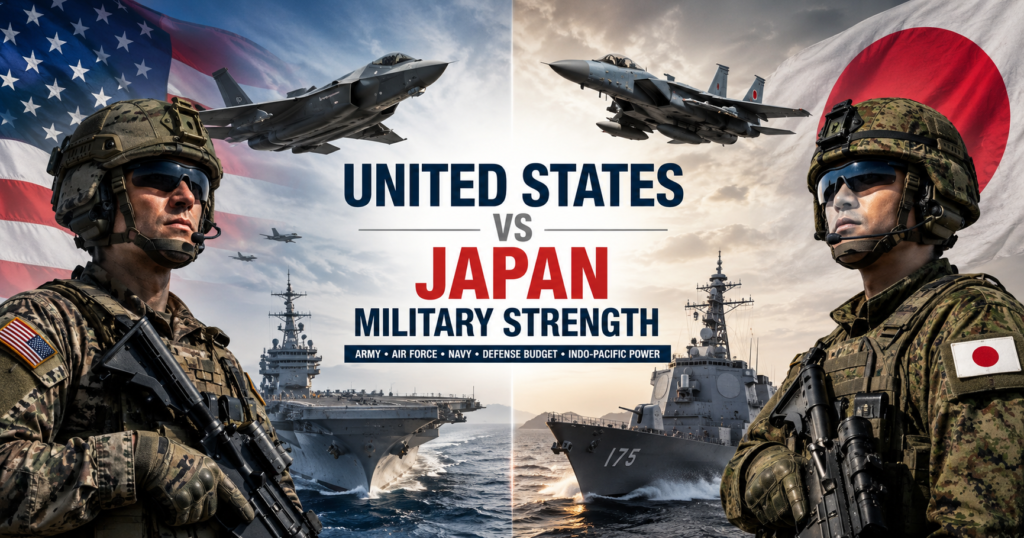
That makes the USA vs Japan military comparison in 2026 less about identifying a hypothetical winner and more about understanding two very different levels and models of military power.
☷On this pageJump to a section of this military guide
USA vs Japan Military Strength 2026 at a Glance
The broad statistics immediately establish the scale difference. The United States has far more personnel, aircraft, land equipment and overall naval assets, while its listed defense budget is more than fourteen times Japan’s.
Japan, however, remains unusually strong in several categories for a country with only about 251,500 listed active personnel. Its 1,429 aircraft, 135 special-mission aircraft, 23 submarines, 41 destroyers and 18 mine-warfare vessels point toward a military structured heavily around the air and maritime environment surrounding Japan.
| Military Category | United States | Japan |
|---|---|---|
| 2026 Military Rank | #1 | #7 |
| PowerIndex | 0.0741 | 0.1876 |
| Active Personnel | 1,333,030 | 251,500 |
| Reserve Personnel | 799,500 | 56,000 |
| Defense Budget | $831.5 billion | $58 billion |
| Total Aircraft | 13,032 | 1,429 |
| Fighter Aircraft | 1,791 | 217 |
| Special-Mission Aircraft | 611 | 135 |
| Aerial Tankers | 610 | 10 |
| Helicopters | 5,913 | 583 |
| Tanks | 4,666 | 734 |
| Armored Vehicles | 409,660 | 54,390 |
| Naval Assets | 465 | 158 |
| Aircraft Carriers* | 11 | 0 |
| Helicopter Carriers* | 9 | 4 |
| Submarines | 66 | 23 |
| Destroyers | 83 | 41 |
| Mine-Warfare Vessels | 4 | 18 |
The United States clearly possesses the larger overall military. But the more interesting takeaway is where Japan’s resources are concentrated. Japan’s submarine, destroyer, special-mission aircraft and maritime-support capabilities are far more important to understanding the Japan Self-Defense Forces than simply comparing its tank count with America’s.
*These are the classifications used in the supplied comparison dataset. Ship classifications alone do not fully describe aviation capability or operational roles.
United States vs Japan Military Ranking 2026
The United States military ranks #1 in 2026, while Japan ranks #7.
The difference in PowerIndex scores—0.0741 for the United States and 0.1876 for Japan—reflects America’s much greater overall military scale.
The United States maintains capabilities required for sustained operations across multiple regions simultaneously: strategic airlift, aerial refueling, carrier aviation, nuclear-powered submarines, long-range bombers, overseas facilities, space capabilities and a nuclear deterrent.
Japan’s military has historically been structured around a much narrower geographic mission: defending Japan and the surrounding air and maritime approaches.
That difference is essential when interpreting the rankings.
Being #7 does not mean Japan is simply a smaller version of the #1-ranked United States. Its equipment mix reflects different geography, constitutional history, security requirements and alliance arrangements.
Japan’s military development in the 2020s has also increasingly emphasized longer-range defense, missile capabilities, integrated air and missile defense, unmanned systems, stronger command structures and protection of its southwestern island chain.
So Japan’s #7 ranking is better understood as evidence of a high-capability regional defense force, rather than an attempt to reproduce America’s global military structure.
Why the United States and Japan Built Different Militaries
Geography explains a remarkable amount of the difference.
The continental United States is separated from the western Pacific by thousands of kilometers. American forces therefore need ships, aircraft, tankers, transports and overseas logistics to project military power into East Asia.
Japan is already located there.
Japan is an island country extending along the western Pacific, with a coastline listed at approximately 29,751 km. The supplied dataset actually gives Japan a longer coastline than the United States figure used in the same comparison.
Japan therefore has strong reasons to prioritize:
- Maritime surveillance
- Submarine warfare
- Anti-submarine warfare
- Destroyers
- Mine countermeasures
- Fighter aircraft
- Air and missile defense
- Island defense
- Maritime transport security
The United States needs all of these capabilities too—but must also maintain forces for Europe, the Middle East, the Americas, the Indo-Pacific and other global commitments.
This distinction appears repeatedly throughout the equipment data.
United States vs Japan Military Manpower
The United States has a much larger population and military personnel base.
The supplied 2026 figures list approximately 1.33 million active U.S. personnel, compared with 251,500 active Japanese personnel.
The reserve gap is even larger: about 799,500 for the United States compared with 56,000 for Japan.
But personnel numbers need to be understood in relation to military missions.
| Manpower Category | United States | Japan |
|---|---|---|
| Population | 341,963,408 | 123,201,945 |
| Available Manpower | 150,463,900 | 52,976,836 |
| Fit for Service | 124,816,644 | 42,874,277 |
| Reaching Military Age Annually | 4,445,524 | 1,108,818 |
| Active Personnel | 1,333,030 | 251,500 |
| Reserve Personnel | 799,500 | 56,000 |
America’s personnel base supports a global military divided among numerous services, commands and overseas deployments.
Japan’s Self-Defense Forces are much smaller and concentrated primarily on Japanese national defense.
The manpower gap therefore matters, but simply concluding that the U.S. has roughly five times as many active personnel misses the larger strategic difference.
Japan’s Personnel Challenge Is Different
Japan’s demographic situation makes manpower especially important.
Its military cannot rely on a population base comparable with that of the United States, and recruitment becomes increasingly important as Japan’s population ages.
That helps explain why technology, automation, unmanned systems and high-value maritime and air capabilities matter so much to Japan’s future force structure.
Japan does not necessarily need to maximize troop numbers to strengthen its defenses. It needs enough personnel to operate increasingly sophisticated ships, aircraft, missile systems, surveillance networks and joint commands.
United States Army vs Japan Ground Self-Defense Force
A direct U.S. Army vs Japanese Ground Self-Defense Force comparison produces enormous numerical gaps.
The United States has approximately 4,666 tanks and 409,660 listed armored vehicles, compared with Japan’s 734 tanks and 54,390 armored vehicles. The American advantage extends across self-propelled artillery, towed artillery and mobile rocket systems.
But this is one of the least useful places to stop the comparison.
| Land-Power Category | United States | Japan |
|---|---|---|
| Tanks | 4,666 | 734 |
| Armored Vehicles | 409,660 | 54,390 |
| Self-Propelled Artillery | 1,521 | 193 |
| Towed Artillery | 1,878 | 480 |
| Mobile Rocket Projectors | 1,731 | 99 |
The United States maintains heavy ground forces capable of deployment into very different theaters.
Japan has no land border. Its ground forces operate across an island nation where mobility, coastal defense, air defense and reinforcement between islands can matter as much as maintaining a very large heavy-armored fleet.
Why Japan Doesn’t Need an American-Sized Tank Force
Japan’s geography changes the value of land equipment.
A country expecting large-scale armored warfare across extensive continental frontiers has different requirements from an island state.
Japan does operate modern tanks, including the Type 10, which was developed with Japanese operating conditions and mobility requirements in mind.
But Japan’s defense challenge extends beyond stopping enemy tanks.
Protecting the archipelago can require forces capable of:
- Defending islands
- Moving units rapidly
- Protecting airfields
- Supporting coastal defenses
- Operating anti-ship missiles
- Providing air defense
- Retaking or reinforcing isolated territory
That is why a 4,666-vs-734 tank comparison tells only a small part of the story.
Japan’s Southwest Islands Have Changed Its Ground-Defense Priorities
Japan stretches southwest from its main islands toward the East China Sea.
That geography has made the southwestern island chain increasingly important to Japanese defense planning.
Instead of simply adding more heavy armor, Japan has been strengthening capabilities relevant to dispersed island defense, including mobile missile units, surveillance and rapid deployment.
This creates a force structure that looks different from a traditional continental army.
For Japan, a mobile anti-ship missile battery positioned on an island can have strategic importance that would never appear in a simple tank comparison.
This is exactly why equipment totals need context.
United States vs Japan Air Force 2026
Air power is one of the strongest areas for both countries, although the American fleet is vastly larger.
The United States has approximately 13,032 aircraft, compared with Japan’s 1,429.
The United States also leads 1,791 to 217 in fighter aircraft and 926 to 47 in dedicated attack aircraft.
Yet Japan’s total aircraft inventory ranks highly globally, and several supporting categories reveal a sophisticated air-defense structure.
| Air-Power Category | United States | Japan |
|---|---|---|
| Total Aircraft | 13,032 | 1,429 |
| Fighters | 1,791 | 217 |
| Dedicated Attack Aircraft | 926 | 47 |
| Transport Aircraft | 917 | 53 |
| Trainer Aircraft | 2,610 | 399 |
| Special-Mission Aircraft | 611 | 135 |
| Aerial Tankers | 610 | 10 |
| Helicopters | 5,913 | 583 |
| Attack Helicopters | 1,024 | 118 |
The U.S. advantage is not simply the 13,032-aircraft headline.
America’s 610 aerial tankers, 917 transports and 611 special-mission aircraft give it a level of reach and support infrastructure that Japan does not attempt to reproduce.
Japan’s strength is much more geographically concentrated.
F-35 Changes the U.S.–Japan Air-Power Relationship
The F-35 is particularly important because it illustrates how this comparison is also an alliance story.
The United States operates the F-35 on a very large scale alongside other major combat-aircraft families.
Japan is also building a substantial F-35 force as it modernizes its combat aviation.
For Japan, fifth-generation aircraft add more than stealth.
Modern fighters increasingly function as nodes inside wider sensor and information networks. Their value depends on communications, targeting, surveillance, electronic warfare and cooperation with other aircraft and ships.
This makes U.S.–Japan interoperability increasingly significant.
Instead of viewing American and Japanese F-35s as opposing fleets, the more realistic strategic question is how compatible aircraft, sensors and weapons improve combined Indo-Pacific air operations.
Japan’s F-15 Fleet Still Matters
Japan’s fighter force is not based exclusively on the F-35.
The F-15J has long formed an important part of Japan’s air-defense capability.
Japan also operates the F-2, a Japanese-developed multirole fighter closely associated with maritime and air-defense missions.
This mixture means Japan’s fighter force is undergoing a transition rather than an instant replacement.
Older aircraft remain important while F-35 numbers grow and future combat-aircraft development progresses.
That transition is a much more useful measure of Japanese air power than simply saying the U.S. has 1,574 more fighters.
Special-Mission Aircraft: One of Japan’s Most Interesting Strengths
Japan has 135 listed special-mission aircraft, placing it much closer to the top of this category than its overall military size might suggest. The United States has 611.
Special-mission aircraft can support functions such as:
- Airborne early warning
- Maritime patrol
- Intelligence
- Surveillance
- Reconnaissance
- Command and control
For an island country surrounded by major sea lanes and strategically important waters, these capabilities are particularly valuable.
Detecting aircraft, ships and submarines early can be more important than simply adding another squadron of conventional fighters.
This is one of the clearest examples of Japan tailoring its force to geography.
610 U.S. Tankers vs 10 Japanese Tankers
Aerial refueling demonstrates the difference between global reach and regional concentration.
The United States has approximately 610 tankers, while Japan has ten.
America requires hundreds because its aircraft routinely need to operate over enormous distances.
Japan’s combat aviation is primarily focused on the airspace and waters around the Japanese archipelago.
Japan still benefits from aerial refueling because the country extends over a long north-south and northeast-southwest axis, but it does not need a tanker fleet approaching American scale.
So this 61-to-1 difference should not simply be interpreted as Japanese weakness. It reveals different operating distances and strategic responsibilities.
United States vs Japan Navy 2026
Naval power is where the comparison becomes particularly interesting.
The United States has the world’s most extensive blue-water naval capabilities, while Japan maintains a highly capable maritime force built around the defense of an island nation.
The dataset lists 465 American naval assets compared with 158 Japanese assets.
Raw fleet size, however, hides Japan’s concentration in high-value naval categories.
| Naval Category | United States | Japan |
|---|---|---|
| Total Naval Assets | 465 | 158 |
| Aircraft Carriers | 11 | 0* |
| Helicopter Carriers | 9 | 4* |
| Submarines | 66 | 23 |
| Destroyers | 83 | 41 |
| Frigates | 0* | 8 |
| Mine-Warfare Vessels | 4 | 18 |
Japan has fewer ships overall, but 41 destroyers and 23 submarines represent substantial naval capability. It also has 18 listed mine-warfare vessels compared with four for the United States under this dataset’s classification.
*Ship-category labels vary between datasets and navies. A zero in a particular GFP category should not be interpreted as meaning a navy lacks all vessels performing related functions.
Why Japan Has So Many Destroyers
Japan’s large destroyer force makes sense when viewed through geography.
The country depends heavily on maritime trade and is surrounded by strategically important waters.
Japanese destroyers can contribute to:
- Fleet air defense
- Anti-submarine warfare
- Missile defense
- Maritime surveillance
- Surface warfare
- Escort operations
Some Japanese destroyers are equipped with the Aegis combat system, giving them an important role in integrated air and missile defense.
This helps explain why Japan can have only about one-third as many total naval assets as the United States in this dataset while possessing roughly half as many listed destroyers.
The force is concentrated around capabilities Japan considers especially important.
Japan’s 23 Submarines Are More Important Than Their Raw Number Suggests
The United States leads with 66 submarines, while Japan has 23.
But again, mission matters.
America’s submarine fleet includes nuclear-powered attack submarines and ballistic-missile submarines designed for long-endurance global operations and strategic nuclear deterrence.
Japan’s submarine fleet is conventionally powered and oriented toward the waters surrounding Japan.
Japanese submarine development has placed substantial emphasis on underwater endurance, sensors, quiet operation and regional sea-denial requirements.
Japan does not need a nuclear ballistic-missile submarine fleet because it does not maintain an independent nuclear arsenal.
Its submarines serve a different mission: protecting maritime approaches and complicating an adversary’s naval operations in waters important to Japanese defense.
Anti-Submarine Warfare Is Central to Japanese Naval Power
Japan’s maritime strategy cannot be understood without anti-submarine warfare (ASW).
Japan sits beside some of the world’s most strategically important western Pacific waters.
Tracking submarines requires an integrated system involving:
- Surface ships
- Maritime-patrol aircraft
- Helicopters
- Sonar
- Undersea sensors
- Intelligence
This helps explain why Japan’s combination of destroyers, submarines, helicopters and special-mission aircraft matters more than any single fleet total.
A simple ship-count comparison misses the network connecting these assets.
Does Japan Have Aircraft Carriers?
The supplied dataset lists the United States with 11 aircraft carriers and Japan with zero, while separately counting four Japanese helicopter carriers.
That classification requires context.
Japan operates large Izumo-class ships originally designed as helicopter-carrying destroyers. Japan has been modifying the class to support F-35B operations.
This does not make Japan’s naval aviation equivalent to America’s 11-carrier fleet.
American nuclear-powered carriers are much larger and are designed around substantial embarked air wings and sustained global power projection.
But Japan’s move toward operating F-35Bs from modified large-deck ships is strategically important.
It provides greater flexibility for aviation operations across an island-heavy maritime environment.
So a database entry showing 11 vs 0 aircraft carriers is technically useful within its classification system, but incomplete as an explanation of 2026 naval aviation.
Japan’s Mine-Warfare Capability Reflects Its Maritime Geography
One of the few categories where Japan has the larger number is mine warfare.
The dataset lists 18 Japanese mine-warfare vessels versus four American vessels.
This isn’t an accidental statistical curiosity.
Sea mines can threaten:
- Ports
- Shipping routes
- Naval bases
- Narrow passages
- Amphibious operations
For an island country dependent on maritime access, maintaining the ability to detect and clear mines has obvious strategic value.
Again, Japan’s equipment distribution reflects its geography.
Defense Budget: $831.5 Billion vs $58 Billion
The supplied figures list the United States defense budget at approximately $831.5 billion and Japan’s at $58 billion.
That produces an enormous nominal-dollar gap.
But Japan’s defense trajectory matters as much as the snapshot.
Japan has been increasing defense investment while pursuing major modernization programs involving missiles, aircraft, ships, ammunition, command systems, unmanned capabilities and infrastructure.
The United States must distribute its much larger budget across a correspondingly larger military establishment.
America funds:
- Global personnel
- Nuclear forces
- Aircraft carriers
- Submarines
- Strategic bombers
- Space systems
- Overseas operations
- Research and development
- Large aircraft fleets
- Worldwide logistics
Japan’s spending is concentrated far more heavily around national and regional defense.
That makes direct budget division useful for measuring scale but insufficient for measuring how efficiently each country can concentrate resources in the western Pacific.
Japan’s Growing Long-Range Strike Capability
One of the most important changes in Japanese defense policy is the move toward stronger stand-off and counterstrike capabilities.
Historically, Japan’s postwar defense posture placed particularly strong emphasis on defensive systems.
The security environment around Japan has driven a broader approach.
Longer-range weapons can allow Japanese forces to engage threats before those threats reach Japanese territory or operate freely around its islands.
Japan’s move toward systems such as Tomahawk cruise missiles is therefore significant.
It does not transform Japan into an American-style global strike power.
Instead, it expands the distance at which Japan can contribute to deterrence and defense in its own region.
Missile Defense Is Another Core Japanese Capability
Japan faces a security environment where ballistic and cruise missiles are major concerns.
That has encouraged investment in layered detection and interception capabilities.
Japanese missile defense involves both maritime and land-based components, with Aegis-equipped ships playing an important role.
The United States also provides extensive missile-warning, sensor and defense capabilities.
This is another area where the alliance itself becomes more important than a simple national equipment comparison.
Early warning, tracking and interception can benefit from shared sensors and information.
U.S.–Japan Military Alliance: The Context a Normal “Vs” Article Misses
The most important fact about USA vs Japan military strength is that these forces are not normally positioned against one another.
The U.S.–Japan security alliance changes how both countries plan military capability.
Japan hosts significant American military forces.
That gives the United States forward access in one of the world’s most strategically important regions while giving Japan access to the broader deterrent and military capabilities of the United States.
This arrangement means Japan does not have to reproduce every American capability independently.
For example, Japan does not maintain:
- An independent nuclear arsenal
- Strategic nuclear submarines
- A global bomber force
- Eleven large aircraft carriers
- Hundreds of tanker aircraft
- A worldwide military-base network
Its defense strategy exists alongside American capabilities.
This is one reason comparing raw inventories without alliance context can produce a misleading picture.
U.S. Forces in Japan Change the Regional Balance
Japan’s geographic importance to the United States is difficult to overstate.
American forces based in Japan reduce the distance between U.S. military assets and key parts of the western Pacific.
This improves access for:
- Air operations
- Naval operations
- Logistics
- Intelligence
- Maintenance
- Reinforcement
For Japan, American presence adds capabilities that the JSDF does not independently maintain at the same scale.
This makes Japan both a military power in its own right and a central geographic component of the wider U.S. Indo-Pacific posture.
Japan’s Geography Is a Strength and a Vulnerability
Japan has approximately 377,915 square kilometers of land area and about 29,751 km of coastline in the supplied dataset.
Its island geography provides natural maritime separation from continental neighbors.
But it also creates vulnerabilities.
Japan depends heavily on:
- Maritime trade
- Imported resources
- Ports
- Shipping routes
- Undersea infrastructure
Its islands also stretch across a considerable distance.
Defending that geography requires surveillance and the ability to move forces between locations.
That explains Japan’s emphasis on maritime and air capabilities.
Energy Security Is a Major Difference Between the United States and Japan
Natural resources reveal another important structural difference.
The supplied dataset lists U.S. oil production at approximately 20.953 million barrels compared with just 8,000 barrels for Japan under its methodology. Proven oil reserves are also vastly larger for the United States.
Whatever exact units and methodology are used for individual resource categories, the strategic contrast is clear:
The United States is a major domestic energy producer. Japan is heavily dependent on imported energy.
That makes secure maritime trade routes particularly important to Japan.
Energy dependence therefore connects directly to naval strategy.
Protecting sea lanes is not an abstract military requirement for an island economy—it is connected to national economic resilience.
Japan’s Merchant Marine Shows Why Maritime Security Matters
Interestingly, the supplied dataset lists 5,229 merchant vessels for Japan compared with 3,533 for the United States.
Japan also has 163 listed ports and terminals.
These figures reinforce its deep connection to maritime commerce.
Military security and economic security therefore intersect heavily in Japanese strategy.
Submarines, destroyers, mine countermeasures and maritime-patrol capabilities help protect the maritime environment on which the country depends.
United States vs Japan Logistics
The United States has a vastly larger domestic logistics base by most measures.
The dataset lists:
16,116 U.S. airports vs 280 in Japan
666 ports and terminals vs 163
6.59 million km of roads vs 1.22 million km
293,564 km of railways vs 27,311 km
Japan, however, has the larger merchant-marine figure in this dataset.
The numbers need geographical context.
America’s infrastructure supports a continental economy and a military with global responsibilities.
Japan’s infrastructure is compressed into a much smaller territory.
In a western Pacific context, Japan also has one advantage that America’s enormous domestic infrastructure cannot replace:
location.
A runway in Japan can be more immediately relevant to an East Asian contingency than thousands of airports located across the continental United States.
Defense Industry and Technology
Both countries possess sophisticated industrial and technological bases, but they occupy different positions in the defense ecosystem.
The United States produces major systems across virtually every military domain, including:
- Combat aircraft
- Missiles
- Submarines
- Aircraft carriers
- Armored vehicles
- Satellites
- Radars
- Electronic systems
Japan also possesses substantial advanced manufacturing, shipbuilding, electronics and aerospace capabilities.
Its defense industry has historically operated under different policy and export constraints, but Japan’s changing security posture has increased the importance of domestic production and international defense-industrial cooperation.
This matters because long-term military strength depends on more than buying equipment.
Countries must also be able to maintain, repair, upgrade and replenish critical systems.
GCAP and Japan’s Future Fighter Capability
Japan is also participating in the Global Combat Air Programme (GCAP) with the United Kingdom and Italy.
The project is strategically important because it demonstrates that Japan’s future combat-air strategy is not limited to purchasing American aircraft.
Japan is simultaneously deepening interoperability with the United States while developing future defense technology through other international partnerships.
That diversification can strengthen Japan’s aerospace industrial base and provide more domestic participation in future combat-air systems.
Japan’s Defense Is Becoming More Joint
Modern warfare increasingly punishes forces that operate as separate service silos.
Aircraft need information from ships.
Missile batteries need targeting information.
Air defenses need sensor networks.
Naval forces need air cover and intelligence.
Japan has therefore been moving toward stronger joint command and control across its Ground, Maritime and Air Self-Defense Forces.
This matters more than adding another isolated equipment category.
A smaller force can become substantially more useful when its sensors, commanders and weapons operate as one integrated system.
Space, Cyber and Electronic Warfare
The traditional Army–Air Force–Navy framework no longer captures the full military balance.
Both the United States and Japan increasingly depend on:
- Satellites
- Secure communications
- Cyber defense
- Electronic warfare
- Intelligence networks
- Positioning and navigation
- Data links
The United States has much greater overall scale in space and military information systems.
Japan, however, has strong technological capabilities and is increasing attention to these domains as part of national defense modernization.
Exact public comparisons are difficult because cyber and electronic-warfare capabilities cannot be counted like tanks.
For that reason, a credible article should avoid inventing a numerical “winner” for capabilities that are inherently difficult to measure publicly.
Nuclear Weapons: A Fundamental Difference
The United States and Japan have completely different nuclear postures.
The United States is a nuclear-armed state with a strategic triad based around land-based missiles, ballistic-missile submarines and strategic bombers.
Japan does not possess nuclear weapons.
Instead, Japan’s security relationship with the United States includes the broader concept of extended deterrence, under which American strategic capabilities contribute to deterrence supporting Japan.
This distinction is critical.
A simplistic nuclear comparison would say:
United States: nuclear weapons
Japan: none
But the strategic reality is more complex because Japan is a U.S. treaty ally rather than a strategically isolated non-nuclear state.
What the United States Does Better at Global Scale
The United States has the larger capability base across most measurable conventional categories.
Its major advantages include:
- Overall military scale
- Personnel
- Fighter numbers
- Stealth aviation scale
- Strategic bombers
- Aerial refueling
- Strategic airlift
- Heavy land forces
- Carrier aviation
- Nuclear-powered submarines
- Nuclear deterrence
- Space capabilities
- Global logistics
- Overseas deployment
- Defense spending
The connecting theme is global reach.
America has built not merely a collection of weapons but the infrastructure needed to move, supply and coordinate military forces far from North America.
Where Japan Is Particularly Strong
Japan’s strengths are more concentrated.
They include:
- Advanced air defense
- Modern fighter aviation
- Maritime surveillance
- Destroyers
- Submarines
- Anti-submarine warfare
- Mine countermeasures
- Missile defense
- Advanced industrial technology
- Island-defense capabilities
- Strategic location
- Integration with U.S. forces
Japan’s 41 destroyers, 23 submarines, 135 special-mission aircraft and 18 mine-warfare vessels are particularly revealing because these categories fit the security requirements of an advanced island country operating in the western Pacific.
The strength is in the combination rather than one spectacular headline number.
United States vs Japan: Which Military Is Stronger in 2026?
If the question is simply which country has the stronger military overall, the answer is the United States.
The United States ranks #1 globally and has much greater manpower, defense spending, air power, land power, carrier aviation, strategic logistics and global deployment capability.
Japan ranks #7 and possesses a much smaller force.
But describing that as a U.S. “victory” would misunderstand the real relationship.
The countries are military allies, and Japan has deliberately developed a force concentrated around its own security environment rather than attempting to reproduce every American capability.
The most useful comparison therefore looks like this:
| Capability | 2026 Assessment |
|---|---|
| Overall Military Scale | United States |
| Global Power Projection | United States |
| Active Personnel | United States |
| Heavy Land Forces | United States |
| Total Air Power | United States |
| Aerial Refueling | United States |
| Strategic Airlift | United States |
| Carrier Strike Capacity | United States |
| Submarine Fleet Scale | United States |
| Nuclear Deterrent | United States |
| Defense Budget | United States |
| Mine-Warfare Vessel Count | Japan in supplied dataset |
| Island-Defense Orientation | Central Japanese specialization |
| Western Pacific Location | Major Japanese strategic advantage |
| Maritime Defense Concentration | Major Japanese specialization |
| U.S.–Japan Interoperability | Shared alliance strength |
The table demonstrates why “winner” language is not useful here.
America’s force is substantially larger. Japan’s military is more geographically specialized, and the two forces are designed increasingly to operate together rather than against one another.
Why Japan Can Rank #7 With Only 251,500 Active Personnel
This is one of the most interesting questions raised by the data.
Japan’s active military is much smaller than that of several other major powers.
Yet military strength involves more than personnel.
Japan combines:
- A large modern aircraft inventory
- Advanced fighters
- Strong surveillance capability
- Numerous destroyers
- A substantial submarine fleet
- Missile defense
- Advanced infrastructure
- Large economic capacity
- Sophisticated industry
- Modern communications
- Strong maritime capabilities
The result is a force with considerable capability despite relatively modest manpower.
This is also why ranking systems should be interpreted as composite indicators rather than literal measures of battlefield outcomes.
Why Japan Doesn’t Need to Match America’s 13,032 Aircraft
The United States has 13,032 aircraft compared with Japan’s 1,429.
At first glance, that looks like a straightforward weakness for Japan.
But the U.S. fleet supports global missions spanning several military services and geographic commands.
Japan’s fleet is concentrated much more heavily around Japanese territory and nearby waters.
Japan also operates alongside American forces stationed in and around the Indo-Pacific.
The more relevant Japanese question is therefore not:
“Can Japan build 13,000 aircraft?”
It is:
“Can Japan maintain enough modern fighters, surveillance aircraft, tankers, transports and helicopters to defend its airspace and support joint operations across the Japanese archipelago?”
Those are fundamentally different requirements.
What Raw Military Numbers Cannot Tell Us
The 2026 figures provide a useful foundation, but inventory totals have limitations.
A database can count 217 fighters or 41 destroyers.
It cannot fully establish:
- How many are available on a particular day
- Maintenance condition
- Crew proficiency
- Ammunition stocks
- Mission-specific readiness
- Electronic-warfare effectiveness
- Classified capabilities
- Command quality
- Real-time intelligence
- Wartime attrition
- Political decisions
This distinction is especially important when comparing technologically sophisticated forces.
Inventory is not the same as operational readiness.
The data should therefore be used to understand force structure and scale rather than to manufacture certainty about hypothetical combat.
FAQs
Is the United States military stronger than Japan in 2026?
Yes. The United States ranks #1 globally, while Japan ranks #7 in the supplied 2026 comparison. The U.S. has substantially greater manpower, aircraft numbers, naval power, defense spending and global logistics.
What is Japan’s military ranking in 2026?
Japan ranks #7 out of 145 countries with a PowerIndex score of 0.1876 in the supplied 2026 ranking.
How many active military personnel does Japan have?
The supplied 2026 data lists approximately 251,500 active Japanese personnel, compared with about 1,333,030 for the United States.
How many fighter jets does Japan have in 2026?
The comparison lists 217 Japanese fighter aircraft, compared with 1,791 for the United States.
How many total military aircraft does Japan have?
Japan is listed with approximately 1,429 military aircraft.
Does Japan have F-35 fighter jets?
Yes. The F-35 is an important part of Japan’s fighter modernization, alongside existing aircraft such as the F-15J and F-2.
Does Japan have aircraft carriers?
The supplied dataset records Japan with zero conventional aircraft carriers and four helicopter carriers. Japan’s Izumo-class ships, however, are being adapted to support F-35B operations, so the simple zero-carrier figure does not fully describe Japanese naval aviation.
How many submarines does Japan have?
The supplied 2026 comparison lists 23 Japanese submarines, compared with 66 for the United States.
Why does Japan have so many destroyers?
As an island country, Japan places heavy emphasis on maritime defense, anti-submarine warfare, air defense, missile defense and protection of sea lanes. Destroyers are particularly useful across those missions.
How many destroyers does Japan have?
The supplied data lists 41 Japanese destroyers, compared with 83 for the United States.
Does Japan have nuclear weapons?
No. Japan does not maintain an independent nuclear-weapons arsenal. Its alliance with the United States includes U.S. extended deterrence.
How much does Japan spend on defense in 2026?
The supplied comparison uses a Japanese defense-budget figure of approximately $58 billion, compared with $831.5 billion for the United States.
Why is Japan increasing its military capabilities?
Japan’s defense modernization reflects growing concern about the security environment surrounding the country, including missile threats, maritime security, protection of remote islands and broader Indo-Pacific military developments.
Is Japan allowed to have a military?
Japan maintains the Japan Self-Defense Forces (JSDF). Japan’s postwar constitutional and legal framework has shaped the role and development of those forces, while defense policy has evolved significantly over time.
Are the United States and Japan military enemies?
No. The United States and Japan are treaty allies. A U.S.–Japan military comparison is useful for understanding their relative capabilities and complementary force structures, not because the two countries are current military adversaries.
Why are U.S. forces stationed in Japan?
Japan’s location makes it strategically important to American Indo-Pacific operations, while the U.S.–Japan security relationship contributes to Japan’s defense and wider regional deterrence.
What is Japan’s strongest military area?
There is no single definitive category, but maritime defense, submarines, destroyers, anti-submarine warfare, advanced aviation, surveillance and missile defense are particularly important components of Japanese military capability.
Conclusion
The United States vs Japan military strength comparison in 2026 reveals a large numerical gap but an even more important difference in military purpose.
The United States ranks #1 among 145 countries with a PowerIndex of 0.0741, while Japan ranks #7 with 0.1876. The United States fields approximately 1.33 million active personnel, 13,032 aircraft, 4,666 tanks, 465 naval assets and 66 submarines. Japan fields approximately 251,500 active personnel, 1,429 aircraft, 734 tanks, 158 naval assets and 23 submarines.
The United States is unquestionably the larger overall military power.
But Japan’s military should not be judged by how closely it reproduces the American force.
Japan is an island nation in the western Pacific. Its defense priorities place greater emphasis on fighter aviation, maritime surveillance, destroyers, submarines, anti-submarine warfare, missile defense, mine countermeasures, island defense and increasingly longer-range strike capability.
That specialization explains several otherwise surprising statistics. Japan has only a fraction of America’s active personnel but still operates 41 listed destroyers, 23 submarines and 135 special-mission aircraft.
The relationship between the countries makes the comparison even more distinctive.
The United States provides capabilities Japan does not independently maintain at comparable scale—global logistics, nuclear deterrence, strategic aviation and enormous carrier capacity. Japan provides something equally impossible to understand through an inventory table alone: strategic geography in the heart of the western Pacific, substantial national military capability and forces increasingly designed to operate alongside the United States.
So the most accurate conclusion is not that America “beats” Japan in a military comparison.
It is that the United States possesses much greater overall and global military power, while Japan has built one of the world’s strongest regionally focused air-and-maritime defense forces—and the two military systems are increasingly complementary because the countries are allies.
That is what makes USA vs Japan military strength in 2026 a far more interesting comparison than the raw numbers initially suggest.