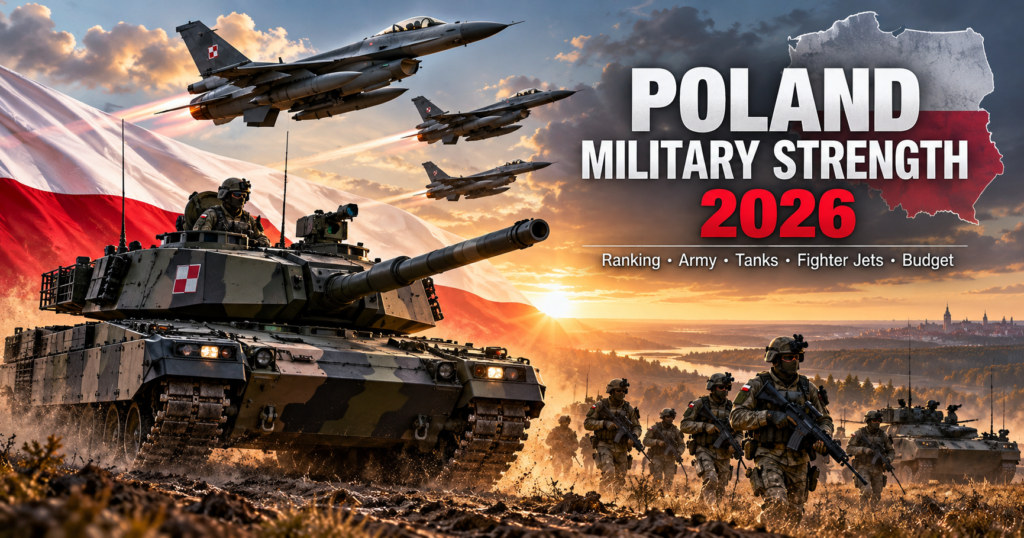
Poland is carrying out one of Europe’s most ambitious military expansions, replacing older equipment with modern tanks, advanced fighter jets, powerful artillery, and new air-defense systems. Its growing military has become a central part of NATO’s eastern defenses, particularly as security concerns remain high across Eastern Europe.
In the 2026 Global Firepower military ranking, Poland ranks 21st out of 145 countries, with a PowerIndex score of 0.3891. Its armed forces already possess substantial land and artillery capabilities, while record defense spending is accelerating the arrival of American Abrams tanks, South Korean K2 tanks, F-35 fighter aircraft, and other modern equipment.
What makes Poland’s military strength in 2026 especially noteworthy is the pace of this transformation. The country is expanding its armed forces while introducing several major weapons systems at once. Some are already serving in Polish units, while others are being delivered or remain under construction. Understanding that difference provides a clearer picture of how powerful Poland’s military is today and how its capabilities are developing.
☷On this pageJump to a section of this military guide
Poland Military Strength 2026: Key Statistics and Capabilities
Poland maintains a well-established conventional military with substantial land forces, fighter aircraft, helicopters, artillery, naval vessels, and territorial defense organizations.
The Polish Armed Forces comprise the Land Forces, Air Force, Navy, Special Forces, and Territorial Defence Forces. Each contributes to national defense, while NATO membership adds a wider framework for joint planning, training, and collective security.
The country’s major military indicators for 2026 are summarized below.
| Military Category | Poland in 2026 |
|---|---|
| World military rank | 21st of 145 |
| PowerIndex score | 0.3891 |
| Active personnel, comparative estimate | 250,000 |
| Reserve personnel, comparative estimate | 350,000 |
| Paramilitary personnel, comparative estimate | 50,000 |
| Total military aircraft | 457 |
| Fighter aircraft | 58 |
| Military helicopters | 224 |
| Tanks | 798 |
| Armored and military vehicles | 57,972 |
| Self-propelled artillery | 593 |
| Rocket artillery systems | 298 |
| Naval assets | 63 |
| Submarines | 1 |
| Comparative defense budget | $55.87 billion |
Poland’s strength is especially noticeable in its land equipment and artillery. The country ranks among the leading military powers for self-propelled artillery and maintains a large armored vehicle inventory.
Its aviation capabilities are undergoing major upgrades, while the navy remains more specialized in Baltic Sea responsibilities than the larger land and air forces.
The 2026 equipment figures provide a useful inventory snapshot, but Poland’s military is changing rapidly. New deliveries throughout the year mean that the number of weapons present in the country can differ from an annual ranking assembled earlier.
Poland Military Ranking 2026: Where Does It Stand Globally?
Poland is the 21st strongest military in the world in 2026 under the Global Firepower conventional military ranking.
Its PowerIndex score of 0.3891 places it immediately outside the global top 20. The assessment considers military manpower, equipment inventories, financial resources, logistics, geography, and other national capabilities.
Several category rankings are particularly revealing.
| Military Category | World Ranking |
|---|---|
| Overall military strength | 21st |
| Active personnel | 25th |
| Total military aircraft | 25th |
| Fighter aircraft | 32nd |
| Tanks | 24th |
| Armored vehicles | 15th |
| Self-propelled artillery | 10th |
| Rocket artillery | 17th |
| Naval assets | 47th |
| Defense budget | 11th |
Poland’s strongest positions are in self-propelled artillery, armored vehicles, and defense spending.
Its 10th-place ranking for self-propelled artillery reflects the scale of its artillery capabilities, while the 11th-place defense budget position highlights the resources supporting its expansion.
The relatively lower naval ranking is understandable given Poland’s military priorities. Unlike countries maintaining large ocean-going fleets, Poland concentrates heavily on continental defense while operating a navy focused on the Baltic Sea.
Poland’s ranking also measures national capabilities rather than the combined military resources of NATO. As an alliance member, Poland participates in collective defense arrangements that extend beyond its domestic equipment inventory.
Poland Army Strength 2026: Soldiers and Military Personnel
Poland is expanding its armed forces through professional recruitment, territorial defense, training programs, and reserve development.
The 2026 comparative ranking estimates 250,000 active military personnel, alongside 350,000 reserves and 50,000 paramilitary personnel.
Poland’s own military reporting provides a more detailed picture. By the end of June 2026, more than 220,000 service members were serving in the Polish Armed Forces, including professional soldiers, Territorial Defence Forces personnel, and people undertaking voluntary military service.
Polish Army Personnel and Manpower
| Manpower Category | Comparative Estimate |
|---|---|
| Population | 38,746,310 |
| Available manpower | 18,985,692 |
| Fit-for-service population | 15,576,017 |
| Reaching military age annually | 464,956 |
| Active personnel | 250,000 |
| Reserve personnel | 350,000 |
| Paramilitary personnel | 50,000 |
Poland’s reported population provides a considerable recruitment base, with nearly 465,000 people estimated to reach military age annually.
However, these demographic figures represent potential manpower, not trained soldiers.
The country’s military expansion depends on maintaining a steady flow of recruits while developing enough instructors, equipment, accommodation, and training infrastructure to support a larger force.
Professional Soldiers and Territorial Defence Forces
Poland’s mid-2026 military reporting recorded approximately 155,000 professional soldiers, nearly 39,000 Territorial Defence Forces members, and more than 14,000 people undergoing voluntary basic military service.
The Territorial Defence Forces, known as WOT, are an important element of the country’s military organization. They support territorial defense and can assist civilian authorities during emergencies.
Their duties differ from those of regular mechanized or armored formations, but they contribute to Poland’s wider military preparedness.
These service categories also explain why national personnel totals may differ from broad international manpower estimates.
Is Poland Building a 500,000-Person Military?
Poland has outlined a long-term ambition to develop an armed force structure totaling approximately 500,000 personnel by 2039, including operational forces and a significantly expanded reserve component.
That is a future objective, not the current number of active soldiers.
The challenge is not simply recruiting hundreds of thousands of people. A larger military requires training establishments, military instructors, vehicles, weapons, logistics, and recurring financial support.
Poland’s expansion is therefore a long-term organizational transformation alongside its equipment modernization.
Poland Tank Strength 2026: Abrams, K2 and Leopard 2
Poland’s armored forces are among the most important parts of its military modernization.
The 2026 comparative inventory lists 798 tanks, including equipment from different generations. Poland is replacing older Soviet-origin platforms and strengthening its armored units with American M1 Abrams and South Korean K2 Black Panther tanks.
The country also continues to operate Leopard 2 tanks.
Poland’s Tanks and Armored Vehicles
| Land Equipment | Reported Inventory |
|---|---|
| Tanks | 798 |
| Armored and military vehicles | 57,972 |
| Self-propelled artillery | 593 |
| Towed artillery | 0 recorded |
| Multiple-launch rocket systems | 298 |
The armored vehicle figure includes numerous equipment categories beyond tanks, such as protected personnel carriers, infantry fighting vehicles, support vehicles, and specialized military platforms.
Poland’s land forces are therefore supported by a much broader equipment base than their tank inventory alone suggests.
M1 Abrams Tanks in Poland
Poland has purchased American M1 Abrams tanks in two principal configurations: M1A1 and M1A2 SEPv3.
The country acquired 116 M1A1 tanks and separately ordered 250 M1A2 SEPv3 tanks.
The newer M1A2 SEPv3 variant introduces improvements in vehicle systems and equipment compared with earlier versions.
By September 2026, Poland had received 217 of the 250 ordered M1A2 SEPv3 tanks, following another delivery of 35 vehicles.
The Abrams program is an important addition to Poland’s armored forces, but its significance extends beyond acquiring new tanks.
Operating these platforms requires trained crews, maintenance technicians, spare parts, recovery vehicles, and logistical infrastructure. Poland must support these requirements alongside other tank types already in service.
K2 Black Panther Tanks and the K2PL Program
South Korea’s K2 Black Panther is another major element of Poland’s armored modernization.
Poland completed delivery of its first 180 K2 tanks in 2025. A second agreement covers another 180 tanks scheduled for delivery between 2026 and 2030.
The first 28 tanks from that second agreement arrived in August 2026, bringing the number delivered under the two agreements to 208 at that point.
A particularly important part of the program is the K2PL, a version adapted to Polish requirements and associated with domestic industrial participation.
The current agreement provides for 116 additional K2GF tanks and 64 K2PL tanks, with K2PL deliveries scheduled for a later stage.
Most of those K2PL vehicles are planned for final assembly in Poland.
This arrangement could strengthen domestic experience in military vehicle production, maintenance, and industrial support.
What Makes Poland’s Tank Modernization Important?
The country is introducing multiple modern tank families while replacing older equipment.
Abrams, K2, and Leopard 2 tanks offer different capabilities and depend on separate maintenance and logistical arrangements.
That creates both opportunities and challenges.
The new platforms provide more modern armored capabilities, but supporting several equipment families increases the need for specialized training, spare parts, and technical organization.
Poland’s tank strength should therefore be assessed through both its current inventory and its ability to integrate new vehicles into established military formations.
Poland Artillery Strength 2026: Krab, K9, HIMARS and Homar-K
Artillery is one of Poland’s strongest military categories.
With 593 self-propelled artillery systems and 298 rocket artillery launchers in the comparative inventory, Poland has a substantial collection of mobile fire-support platforms.
Its modernization programs are also changing the composition of that inventory.
Self-Propelled and Rocket Artillery Inventory
| Artillery Type | Reported Total |
|---|---|
| Self-propelled artillery | 593 |
| Towed artillery | 0 recorded |
| Rocket artillery | 298 |
Poland has invested heavily in self-propelled artillery rather than relying exclusively on older towed systems.
The Polish-built AHS Krab and South Korean K9 Thunder are particularly important examples.
Both are 155 mm self-propelled howitzers, but they come from different production and procurement programs.
The Krab represents an important element of Poland’s domestic defense industry, while the K9 program brings additional manufacturing and equipment cooperation with South Korea.
HIMARS and Homar-K Rocket Systems
Poland is also modernizing its rocket artillery with American HIMARS launchers and the South Korean-origin K239 Chunmoo system, known in Polish service as Homar-K.
These programs provide different equipment within the broader rocket artillery category.
Their importance is not limited to launcher numbers. They also involve associated vehicles, training, maintenance, ammunition arrangements, and integration into military units.
The 2026 inventory gives Poland a strong position in mobile artillery, while continuing deliveries are intended to expand and modernize these capabilities further.
Why Artillery Is a Major Polish Military Strength
Modern artillery requires coordinated training, support equipment, communications, and reliable maintenance.
Poland’s investment in several artillery systems reflects its emphasis on maintaining substantial conventional land forces.
Its domestic production capabilities also matter. Building and servicing military equipment within the country can contribute to long-term sustainment, although imported parts and international industrial relationships remain significant.
Artillery modernization is therefore one of the clearest examples of how Poland is combining existing military strength with future expansion.
Poland Air Force Strength 2026: Fighter Jets, F-35 and Helicopters
The Polish Air Force is undergoing a major transition as new aircraft enter service alongside older platforms.
Poland has operated F-16 Fighting Falcons and MiG-29 fighters, while the FA-50 and F-35 programs are changing its future combat aviation capabilities.
The 2026 comparative inventory lists 457 military aircraft, including 58 fighters.
Poland Military Aircraft Inventory
| Aircraft Category | Reported Number |
|---|---|
| Total military aircraft | 457 |
| Fighter aircraft | 58 |
| Dedicated attack aircraft | 12 |
| Transport aircraft | 44 |
| Trainer aircraft | 112 |
| Special-mission aircraft | 11 |
| Aerial refueling tankers | 0 |
| Helicopters | 224 |
| Attack helicopters | 29 |
The fleet includes aircraft operated across different military services.
Helicopters form a substantial portion of the reported inventory, while fighter aircraft represent a smaller but technologically important component.
The arrival of newer aircraft during 2026 also means that an earlier annual inventory snapshot may differ from the equipment physically present later in the year.
Poland’s F-16 Fighter Jets
The F-16 Fighting Falcon remains a central part of Poland’s established combat aviation fleet.
Poland acquired 48 F-16C/D Block 52+ aircraft, giving the country a Western multirole fighter capability integrated into NATO training and operating arrangements.
The aircraft support different military aviation responsibilities, including national air defense and allied activities.
Keeping the fleet effective requires continuing maintenance and upgrades, particularly as newer fighters are introduced.
How Many F-35 Fighter Jets Does Poland Have in 2026?
Poland ordered 32 F-35A Lightning II aircraft in January 2020 under a major fighter modernization agreement.
The first three aircraft arrived in Poland on May 22, 2026, at the 32nd Tactical Air Base in Łask.
Five additional F-35s arrived on August 28, bringing the number in Poland to eight aircraft.
This marked an important milestone in Poland’s transition toward fifth-generation combat aviation.
The F-35 combines low-observable design characteristics with advanced sensors and information-sharing capabilities.
However, eight aircraft having arrived in Poland does not mean all 32 ordered fighters are in the country or that the entire planned force has completed its introduction into service.
Pilot training, maintenance facilities, technical support, and integration with other military systems remain important parts of the process.
FA-50 Fighter Aircraft
Poland has also introduced South Korean FA-50 light combat aircraft.
These aircraft provide a different capability from the F-16 and F-35 and form part of the country’s broader modernization of military aviation.
The FA-50 program includes different configurations and delivery arrangements, which should be distinguished when assessing the fleet.
Its role within Poland’s aviation structure reflects the need for several aircraft types rather than one platform performing every task.
Helicopters and AH-64E Apache Modernization
Poland has 224 reported military helicopters, including 29 attack helicopters.
Helicopters support transportation, utility functions, and other military aviation requirements.
Poland has also ordered 96 AH-64E Apache attack helicopters from the United States.
That order represents a major future modernization program, not 96 additional helicopters already included in the current operational fleet.
The transition will require aircrew training, maintenance facilities, and support arrangements as the new aircraft are introduced.
Poland Air Defense Systems: Patriot, Wisła and Narew
Poland’s military modernization extends beyond fighter aircraft to ground-based air and missile defense.
The country has invested in systems that combine sensors, command arrangements, and defensive weapons to improve national airspace protection.
Two particularly important programs are Wisła and Narew.
The Wisła program incorporates Patriot-based air and missile defense capabilities, while Narew is associated with another layer of ground-based air defense.
The programs are intended to strengthen Poland’s national defenses and improve integration across military organizations.
Poland’s air-defense investments are closely connected to its wider aviation modernization and NATO commitments.
New fighter jets and ground-based defensive systems represent complementary elements of air defense, although their responsibilities and capabilities are different.
Poland Navy Strength 2026: Warships and Submarines
The Polish Navy is considerably smaller than the country’s land forces, but it has distinct responsibilities in the Baltic Sea.
These include maritime security, coastal defense, mine countermeasures, and cooperation with allied naval forces.
Poland’s 2026 comparative naval inventory includes 63 vessels and other naval assets.
Poland Naval Fleet Strength
| Naval Category | Reported Inventory |
|---|---|
| Total naval assets | 63 |
| Frigates | 2 |
| Corvettes | 2 |
| Submarines | 1 |
| Patrol vessels | 3 |
| Mine warfare vessels | 29 |
| Aircraft carriers | 0 |
| Destroyers | 0 |
The naval inventory is notable for its large mine warfare component.
Poland has 29 recorded mine warfare vessels, placing it among the leading countries in that particular category.
Mine countermeasure operations are important in the Baltic Sea because maritime transport routes, ports, and naval movements all depend on safe access to coastal waters.
Miecznik Frigates
Poland is building a new generation of frigates through the Miecznik program.
The project is intended to provide modern surface combatants that will eventually replace older naval capabilities.
New frigates can improve the navy’s maritime surveillance and defense capabilities, but ships still under construction should not be counted as fully operational assets.
The Miecznik program therefore represents future naval strength rather than an immediate addition to the 2026 fleet totals.
Poland’s Orka Submarine Program
Poland’s submarine modernization took an important step on June 29, 2026, when it signed an agreement to acquire three A26 submarines from Sweden.
The agreement forms part of the Orka program and includes associated training and support arrangements.
Poland also arranged to lease a Swedish submarine as an interim measure while the new A26 vessels are developed and delivered.
This is significant because the current comparative inventory lists only one submarine.
The three A26 vessels are not part of the existing 2026 fleet. Their planned introduction belongs to Poland’s longer-term naval modernization.
The agreement also includes industrial cooperation, giving the program importance beyond the purchase of ships alone.
Poland Defense Budget 2026: Why Military Spending Is So High
Poland’s rapid military expansion is supported by an exceptionally large defense spending commitment.
For 2026, the government planned approximately PLN 200 billion in combined defense expenditure, equivalent to about 4.8% of GDP.
The figure includes spending through the state budget and the Armed Forces Support Fund.
This places Poland among NATO’s leading defense spenders relative to the size of its economy.
Poland Military Budget and Financial Resources
| Financial Indicator | Figure |
|---|---|
| Comparative defense budget estimate | $55.87 billion |
| Planned 2026 defense expenditure | Approximately PLN 200 billion |
| Share of GDP | Approximately 4.8% |
| Purchasing power parity | $1.649 trillion |
| Foreign exchange and gold reserves | $223.12 billion |
| External debt | $425.64 billion |
The comparative dollar estimate and Poland’s domestic government expenditure plan are different accounting measures.
The government plan provides a clearer view of the financial commitment behind its military expansion, while the comparative estimate is useful within the international ranking framework.
Why Is Poland Increasing Defense Spending?
Poland’s geographical position is central to its defense planning.
It borders Ukraine, Belarus, and Russia’s Kaliningrad region, placing it close to important areas of European security concern.
Russia’s full-scale invasion of Ukraine in February 2022 intensified the emphasis on defense preparedness across the region.
Poland responded by accelerating military procurement and increasing investment in personnel, training, infrastructure, and equipment.
The resulting programs span multiple branches, from land forces and fighter aviation to naval modernization and air defense.
The Cost of Maintaining a Larger Military
Purchasing military equipment is only one part of defense spending.
Poland must also support new vehicles and aircraft throughout their service lives, train personnel, maintain facilities, and finance the expansion of its force structure.
Operating equipment from several countries creates a demanding logistical environment.
For example, Abrams, K2, and Leopard 2 tanks involve different support arrangements, while the air force must manage older fighters alongside new platforms.
Poland’s ability to sustain its expansion will depend on whether spending, industrial capacity, and personnel development keep pace with procurement.
Poland Military Modernization: Current Equipment vs Future Plans
One of the most important questions about Poland’s military is how much of its announced expansion has already been completed.
Major procurement programs often involve deliveries extending across several years. A contract for hundreds of weapons does not mean all those weapons are currently in operational units.
The following overview separates established capabilities from ongoing developments.
| Military Program | Status in 2026 |
|---|---|
| Abrams tanks | M1A1 delivered; M1A2 SEPv3 deliveries progressing |
| K2 Black Panther | First 180 delivered; further deliveries underway |
| K2PL tanks | Future deliveries and Polish production planned |
| Krab artillery | Established Polish system |
| K9 artillery | Deliveries and integration continuing |
| HIMARS and Homar-K | Rocket artillery modernization underway |
| F-16 | Established fighter fleet |
| F-35A | Eight aircraft in Poland by August |
| FA-50 | Aircraft introduction and development continuing |
| AH-64E Apache | Ordered for future introduction |
| Wisła and Narew | Air-defense modernization programs |
| Miecznik frigates | Shipbuilding program underway |
| Orka A26 submarines | Three submarines contracted in June 2026 |
The variety of programs illustrates how broad Poland’s modernization has become.
It is strengthening land forces while simultaneously improving aviation, air defense, naval equipment, and supporting institutions.
The real challenge is coordinating these programs so that delivered equipment is supported by trained personnel and sustainable maintenance arrangements.
Poland’s Geography, NATO Role and Military Logistics
Poland’s location gives it a significant role in the security of Central and Eastern Europe.
It borders seven countries: Germany, the Czech Republic, Slovakia, Ukraine, Belarus, Lithuania, and Russia through Kaliningrad.
The country also has access to the Baltic Sea and an extensive road and railway system connecting it with other parts of Europe.
Geography and Infrastructure
| Indicator | Reported Figure |
|---|---|
| Land area | 312,685 km² |
| Coastline | 440 km |
| Total land boundaries | 2,845 km |
| Usable waterways | 3,997 km |
| Road network | 427,580 km |
| Railway network | 19,461 km |
| Airports | 318 |
| Labor force | 18,245,000 |
Poland’s transport infrastructure is an important part of its wider national logistical capacity.
Roads, railways, industrial facilities, and access to neighboring countries support the movement of goods and the economy as a whole.
Its NATO membership adds another dimension through allied planning, training, and cooperation.
Poland joined NATO in 1999 and has become an important contributor to the alliance’s eastern security arrangements.
Its armed forces participate in a wider collective-defense system, while national military investments improve its own defense capabilities.
Natural Resources and Energy Security
Poland is a significant coal producer, while its domestic oil and natural gas production is smaller than national consumption.
The underlying military resource comparison lists the following figures.
| Energy Indicator | Reported Figure |
|---|---|
| Oil production | 24,000 barrels/day |
| Oil consumption | 743,000 barrels/day |
| Proven oil reserves | 113 million barrels |
| Natural gas production | 5.55 billion m³ |
| Natural gas consumption | 20.06 billion m³ |
| Coal production | 96.72 million metric tonnes |
| Coal consumption | 99.93 million metric tonnes |
| Proven coal reserves | 27.76 billion metric tonnes |
The difference between domestic energy production and consumption makes energy supply an important economic consideration.
Poland’s coal resources are substantial, while oil and natural gas imports contribute to meeting national demand.
Energy security matters to industrial capacity, transportation, and national resilience, although these resource figures are not direct measures of military readiness.
How Powerful Is Poland’s Military in 2026?
Poland is an established European military power undergoing unusually rapid expansion.
Its 21st-place global military ranking reflects a substantial conventional force, with particular strengths in armored vehicles, self-propelled artillery, and defense expenditure.
The country has approximately 798 tanks and 593 self-propelled artillery systems in its comparative inventory. Its air force is introducing F-35 aircraft, while the army is receiving modern Abrams and K2 tanks.
Poland is also expanding its personnel base and investing in air defense, military infrastructure, and naval modernization.
The most important distinction is between the capabilities already present and those being developed through contracts extending into the next decade.
Poland has made significant progress in modernizing its armed forces, but its long-term military strength will depend on the successful integration of new equipment, the development of trained personnel, and the ability to maintain a larger force.
Its combination of substantial current capabilities, high defense spending, and NATO membership makes Poland an increasingly important military power in European security.
Frequently Asked Questions
What is Poland’s military rank in 2026?
Poland ranks 21st out of 145 countries in the 2026 Global Firepower ranking, with a PowerIndex score of 0.3891.
How many soldiers does Poland have in 2026?
The comparative ranking estimates 250,000 active military personnel. Polish military reporting recorded more than 220,000 service members at the end of June 2026, including professional soldiers, Territorial Defence Forces personnel, and other service categories.
How many tanks does Poland have in 2026?
Poland has 798 tanks in the 2026 comparative military inventory. Its armored forces include Leopard 2, Abrams, and K2 tanks, with additional modern vehicles being delivered under major procurement programs.
How many fighter jets does Poland have?
The 2026 comparative inventory lists 58 fighter aircraft. Poland’s aviation fleet includes F-16 fighters, while F-35 aircraft are being introduced as part of a major modernization program.
Does Poland have F-35 fighter jets in 2026?
Yes. Poland received its first three F-35A aircraft in May 2026 and another five in August, bringing the number in the country to eight. Poland has ordered 32 F-35A aircraft in total.
How many Abrams tanks does Poland have?
Poland acquired 116 M1A1 Abrams tanks and ordered 250 M1A2 SEPv3 tanks. By September 2026, 217 of the M1A2 SEPv3 tanks had been delivered, with additional deliveries scheduled.
How many K2 tanks does Poland have?
Poland received the first 180 K2 Black Panther tanks by the end of 2025. Another 28 were delivered in August 2026, bringing the total to at least 208 at that stage, with more deliveries planned.
Does Poland have nuclear weapons?
Poland does not possess an independent national nuclear-weapons arsenal. It is a NATO member and participates in the alliance’s wider collective-defense framework.
How strong is the Polish Navy?
The 2026 comparative inventory lists 63 naval assets, including two frigates, two corvettes, one submarine, and 29 mine warfare vessels. Poland is also modernizing its fleet through new frigate and submarine programs.
What is Poland’s military budget in 2026?
Poland planned approximately PLN 200 billion in total defense expenditure for 2026, equivalent to about 4.8% of GDP. The comparative international military ranking separately uses a budget estimate of approximately $55.87 billion.
Why is Poland building such a large military?
Poland’s expansion reflects its defense priorities, proximity to areas of security concern in Eastern Europe, and its role within NATO. The government is investing in personnel, tanks, aircraft, artillery, air defense, and naval equipment to strengthen national military capabilities.