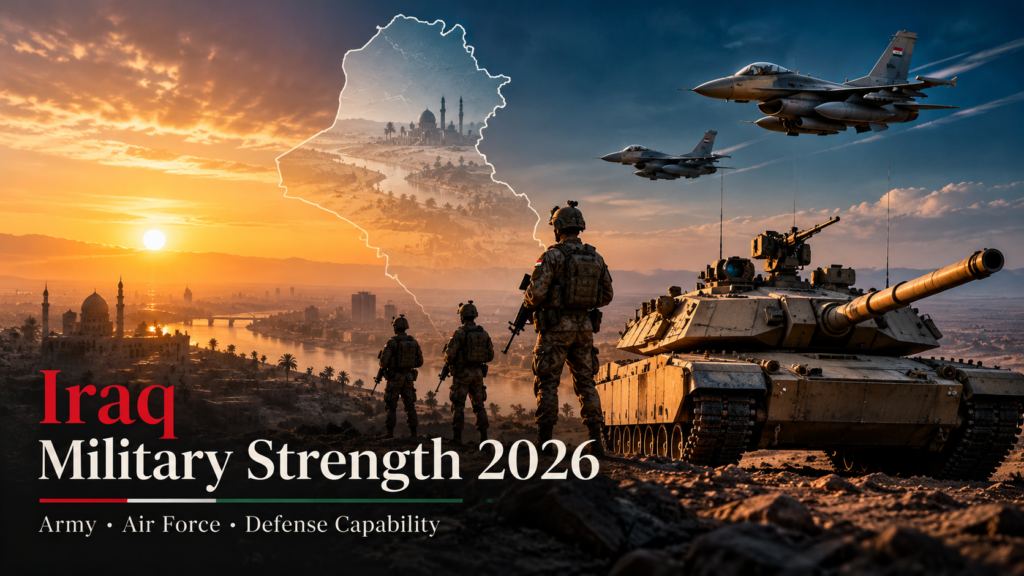
Iraq’s military has undergone a remarkable transformation since the collapse of large parts of its security forces during the Islamic State offensive in 2014. After years of rebuilding, counterterrorism operations, and foreign military support, the country now faces a different challenge: maintaining national security with Iraqi forces taking primary responsibility.
In 2026, Iraq ranks 44th out of 145 countries in the Global Firepower military strength ranking, with a PowerIndex score of 0.8115. Its armed forces possess substantial armored formations, fighter aircraft, attack helicopters, artillery, and a navy focused on protecting Iraq’s narrow access to the Persian Gulf.
What makes Iraq’s military strength in 2026 particularly interesting is the contrast between its conventional weapons and its complicated security structure. The Iraqi Army, Counter Terrorism Service, Popular Mobilization Forces, and Kurdish Peshmerga all contribute to security in different ways. Understanding how these organizations operate alongside Iraq’s tanks, aircraft, defense spending, and oil resources provides a much clearer picture of the country’s military power.
☷On this pageJump to a section of this military guide
Iraq Military Strength 2026: Overview and Key Statistics
Iraq maintains a sizeable conventional military, with particularly strong inventories of armored vehicles, tanks, artillery, and military helicopters. Its armed forces have been rebuilt over the past two decades, combining American, Russian, and other foreign military equipment.
The country’s national defense responsibilities include protecting its borders, securing important infrastructure, maintaining territorial integrity, and countering remaining security threats.
The following table summarizes Iraq’s military capabilities in the 2026 comparison.
| Military Category | Iraq in 2026 |
|---|---|
| Global military ranking | 44th of 145 |
| PowerIndex score | 0.8115 |
| Population in ranking dataset | 42,083,436 |
| Active military personnel | 193,000 |
| Reserve personnel | 0 separately recorded |
| Paramilitary personnel | 100,000 |
| Total military aircraft | 360 |
| Fighter aircraft | 26 |
| Dedicated attack aircraft | 36 |
| Military helicopters | 183 |
| Tanks | 1,188 |
| Armored and military vehicles | 37,496 |
| Self-propelled artillery | 434 |
| Towed artillery | 610 |
| Rocket artillery systems | 572 |
| Total naval assets | 67 |
| Estimated defense budget | $8 billion |
Iraq’s land forces form the strongest part of its conventional military inventory. The reported combination of 1,188 tanks, substantial armored vehicle resources, and more than 1,600 artillery and rocket systems demonstrates the country’s emphasis on ground-based military capabilities.
Military aviation provides another important element, although the aircraft fleet contains a relatively small fighter component compared with its large helicopter inventory.
The navy is more specialized. Iraq has only a short coastline, and its maritime responsibilities are concentrated on coastal security, ports, shipping routes, and offshore oil infrastructure.
The broader security picture is also shaped by organizations that do not fit neatly into a conventional army, navy, and air force structure.
Iraq Military Ranking 2026: Where Does It Stand Globally?
Iraq holds the 44th position in the 2026 Global Firepower ranking, placing it within the top 50 countries assessed for conventional military strength.
Its PowerIndex score of 0.8115 reflects the country’s combination of military manpower, equipment, financial resources, infrastructure, and geographical characteristics.
Iraq performs better in several individual equipment categories than its overall ranking might suggest.
| Military Category | Global Ranking |
|---|---|
| Overall military strength | 44th |
| Active military personnel | 31st |
| Total military aircraft | 29th |
| Fighter aircraft | 45th |
| Dedicated attack aircraft | 20th |
| Tanks | 18th |
| Armored vehicles | 23rd |
| Self-propelled artillery | 15th |
| Rocket artillery | 12th |
| Total naval assets | 45th |
| Defense budget | 44th |
The most notable positions are in tanks, artillery, and rocket systems.
Iraq ranks 18th in tank strength and 12th in rocket artillery, giving it substantial conventional land equipment resources.
Its air force has a more modest fighter ranking, while the navy reflects the country’s relatively limited maritime requirements.
These differences show why overall rankings provide only a starting point. Iraq’s military has a different balance of capabilities from countries whose defense forces place greater emphasis on large fighter fleets or ocean-going navies.
The ranking also does not fully capture the complexities of Iraq’s separate security institutions, regional military partnerships, and continuing counterterrorism responsibilities.
Iraq Army Strength 2026: Soldiers and Ground Forces
The Iraqi Army is the largest conventional branch of the country’s armed forces. Its responsibilities include territorial defense, protecting national borders, and maintaining ground formations equipped with tanks, armored vehicles, and artillery.
Iraq’s modern army was rebuilt after the 2003 invasion and underwent further changes following the Islamic State group’s rapid territorial gains in 2014.
The campaign to recover territory from ISIS placed significant demands on Iraqi military institutions. Since then, improving training, command structures, equipment maintenance, and organizational coordination has remained important.
How Many Active Soldiers Does Iraq Have in 2026?
Iraq has approximately 193,000 active military personnel in the 2026 comparative ranking, along with 100,000 personnel in its paramilitary category.
The broader manpower figures are as follows.
| Manpower Category | Iraq |
|---|---|
| Total population | 42,083,436 |
| Available manpower | 17,675,043 |
| Fit-for-service population | 14,308,368 |
| Reaching military age annually | 715,418 |
| Active military personnel | 193,000 |
| Reserve personnel | 0 separately recorded |
| Paramilitary personnel | 100,000 |
Iraq has a large potential recruitment population, with approximately 17.7 million people classified as available manpower.
More than 715,000 people are estimated to reach military age annually, giving the country a continuing potential pool of new recruits.
However, those figures describe demographic capacity rather than an existing trained military force.
The national active-personnel total also does not include every armed organization that participates in Iraqi security.
Iraqi Army Personnel and Military Organization
The comparative military inventory places the Iraqi Army’s personnel at approximately 180,000, alongside smaller estimates for the air force and navy.
These branch-level figures are approximate and should not be added together as though they form an independently verified complete force count.
The Iraqi Army includes infantry formations, armored units, artillery, engineers, and logistical support organizations.
Its equipment is drawn from different countries and periods, resulting in a mixture of modern and older military platforms.
The army’s experience in counterterrorism and urban fighting is an important part of its recent history, although those responsibilities differ from preparing for large-scale conventional warfare.
Popular Mobilization Forces and the Iraqi Security Structure
Iraq’s security establishment is larger and more complicated than the regular armed forces alone.
The Popular Mobilization Forces (PMF), also known as the Popular Mobilization Units or Hashd al-Shaabi, are an umbrella organization of armed formations that became prominent during the fight against ISIS.
The PMF received formal legal recognition as part of Iraq’s security structure, but its component groups vary in leadership, affiliations, and practical autonomy.
Independent assessments have placed PMF membership well above the 100,000 figure used in the conventional paramilitary comparison. Some estimates exceed 200,000 members.
That does not mean these different estimates should simply be added to the regular army’s personnel count.
There may be differences in institutional definitions, reporting periods, and the classification of individual units.
The relationship between PMF organizations and the Iraqi state also remains a significant political and security issue. In September 2026, Iraq’s government advanced further legislation addressing the PMF’s institutional organization.
The important distinction for understanding Iraq’s military is that its national security system includes powerful organizations beyond the traditional armed services.
Kurdish Peshmerga Forces
The Peshmerga are military and security forces associated with Iraq’s Kurdistan Region.
They have played an important role in regional defense and the fight against ISIS.
The Peshmerga are not simply another division of the federal Iraqi Army. Their organization and administration are associated with the Kurdistan Regional Government and its security institutions.
Efforts to reform and unify Peshmerga formations have been part of wider security-sector development.
Consequently, Iraq’s military capabilities should not be understood as a single personnel total without recognizing the different institutions responsible for security across the country.
Iraq Air Force Strength 2026: Fighter Jets, Attack Aircraft and Helicopters
Iraq’s military aviation combines multirole fighters, ground-attack aircraft, transport planes, surveillance platforms, trainers, and helicopters.
The air force has been rebuilt with considerable international assistance, while the Iraqi Army Aviation Command operates many of the country’s helicopters.
The 2026 comparative inventory lists 360 military aircraft, placing Iraq 29th globally in total aircraft strength.
Iraq Military Aircraft Inventory
| Aircraft Category | Reported Inventory |
|---|---|
| Total military aircraft | 360 |
| Fighter aircraft | 26 |
| Dedicated attack aircraft | 36 |
| Transport aircraft | 15 |
| Trainer aircraft | 111 |
| Special-mission aircraft | 17 |
| Aerial refueling tankers | 0 |
| Helicopters | 183 |
| Attack helicopters | 39 |
The inventory is notable for its large helicopter component.
Helicopters account for slightly more than half of the reported aircraft total, reflecting the importance of rotary-wing aviation within Iraq’s military structure.
The fixed-wing fighter fleet is comparatively small, but Iraq also possesses aircraft designed primarily for attack and other support functions.
The aircraft categories describe different missions, and attack helicopters are included within the broader helicopter total.
How Many Fighter Jets Does Iraq Have in 2026?
Iraq has 26 fighter aircraft listed in the 2026 conventional ranking.
The country’s most important modern fighter platform is the American-built F-16 Fighting Falcon, acquired to rebuild Iraq’s combat aviation capability.
Iraq originally purchased 36 F-16IQ aircraft, consisting of single-seat and twin-seat configurations. Two aircraft were lost before the delivery program was completed, leaving 34 in the fleet at that stage.
The difference between that historical fleet total and the 26 fighters recorded in the 2026 ranking reflects differences in reporting dates, categories, and how inventories are assessed.
The F-16 gives Iraq a modern multirole combat aircraft, but supporting the fleet requires trained pilots, technical personnel, spare parts, and continuing maintenance.
The number of aircraft listed in an inventory does not establish how many can fly at any particular moment.
Iraq’s Su-25 and L-159 Attack Aircraft
Beyond the F-16, Iraq has operated the Russian-designed Su-25 and Czech-built L-159.
The Su-25 is a dedicated ground-attack aircraft designed for a different role from the F-16.
The L-159 is a light combat aircraft associated with attack and training functions.
These platforms contribute to Iraq’s broader fixed-wing aviation capabilities, particularly its ability to maintain aircraft suited to different operational responsibilities.
The presence of multiple aircraft types also creates maintenance and training requirements because their parts, technical systems, and support arrangements differ.
Iraqi Military Helicopters and Attack Aviation
Iraq has 183 reported helicopters, including 39 attack helicopters within the comparative inventory.
Its helicopter fleet includes Russian-origin Mi-28 and Mi-35 attack helicopters, alongside transport and utility aircraft.
The country has also used American-origin Bell helicopters and other rotary-wing platforms.
Helicopters have played a significant role in Iraqi military operations because they provide capabilities different from fixed-wing aircraft.
Transport helicopters support personnel movement and military logistics, while attack helicopters form a separate category within the aviation inventory.
Iraq’s helicopter resources make rotary-wing aviation one of the more substantial components of its military airpower.
Iraq Tank Strength 2026: Abrams, T-90 and Armored Vehicles
Iraq’s land equipment inventory is one of its clearest conventional military strengths.
The country maintains 1,188 tanks in the 2026 comparison, ranking 18th globally for tank strength.
Its armored forces include American M1 Abrams tanks and Russian-origin T-90 tanks, alongside other armored vehicles acquired over different periods.
Iraqi Army Tanks and Land Equipment
| Land Equipment | Reported Total |
|---|---|
| Tanks | 1,188 |
| Armored and military vehicles | 37,496 |
| Self-propelled artillery | 434 |
| Towed artillery | 610 |
| Rocket artillery systems | 572 |
The reported 37,496 armored and military vehicles include a broader selection of platforms than tanks.
These categories may cover protected troop carriers, infantry fighting vehicles, reconnaissance vehicles, and military support equipment.
The figure therefore should not be interpreted as more than 37,000 main battle tanks.
M1 Abrams Tanks in Iraq
The M1A1 Abrams became an important part of Iraq’s armored modernization after the rebuilding of its armed forces.
Iraq acquired American Abrams tanks to strengthen conventional armored capabilities and replace some older equipment.
The platform combines heavy armor, a powerful main gun, and modern vehicle systems.
However, Iraq’s experience with the Abrams also illustrates the importance of maintaining a sophisticated support system.
Such tanks require specialized maintenance, spare parts, trained crews, and reliable logistical arrangements.
Acquiring advanced armored vehicles is only the beginning of sustaining a modern armored force.
Russian T-90 Tanks in the Iraqi Army
Iraq has also acquired Russian-built T-90 tanks, giving its armored forces a major platform from a different supplier.
The T-90 represents a newer generation of Russian tank design compared with older Soviet-origin vehicles that have served in Iraqi formations.
Operating both Abrams and T-90 tanks gives Iraq a diverse armored fleet, but it also requires separate technical and maintenance arrangements.
Training, vehicle recovery, parts availability, and logistical support all influence the practical value of the tank inventory.
Why Iraq’s Armored Inventory Matters
The country’s large tank and vehicle inventory provides a substantial equipment foundation for its land forces.
Iraq’s 18th-place global tank ranking is notably stronger than its 44th-place overall military ranking.
This difference indicates that heavy land equipment represents a greater proportion of Iraq’s conventional military resources than some other categories, such as fighter aviation or naval combatants.
It also reflects the importance of ground forces within Iraq’s national defense establishment.
Iraq Artillery Strength 2026: Howitzers and Rocket Systems
Artillery is another strong part of Iraq’s conventional military inventory.
The country has hundreds of self-propelled artillery systems, towed guns, and rocket artillery launchers.
In the 2026 ranking, Iraq stands 15th globally for self-propelled artillery and 12th for multiple-launch rocket systems.
Iraq’s Artillery Inventory
| Artillery Category | Reported Total |
|---|---|
| Self-propelled artillery | 434 |
| Towed artillery | 610 |
| Mobile rocket projectors | 572 |
The scale of these inventories demonstrates Iraq’s continued investment in conventional ground equipment.
Self-propelled artillery combines a weapon and mobile platform, while towed artillery requires separate transportation.
Rocket artillery forms another equipment category and is not equivalent to the country’s full inventory of guided missiles or other military weapons.
Iraq’s artillery holdings include equipment acquired from various international suppliers and inherited from different periods of military development.
The diversity of these systems presents both equipment availability and maintenance challenges.
What Do These Artillery Numbers Mean?
Iraq has a large number of conventional artillery platforms relative to its overall ranking.
Its inventory is not limited to one type of supporting weapon. It contains self-propelled systems, towed guns, and rocket launchers.
These categories support the country’s broader conventional land-force structure.
At the same time, artillery inventories say little about ammunition reserves, equipment condition, or the number of fully trained crews.
The more meaningful conclusion is that Iraq possesses a substantial artillery equipment base, while sustained military capability depends on organization and maintenance as well as ownership.
Iraq Navy Strength 2026: Warships, Patrol Boats and Gulf Security
Iraq has a much smaller navy than land force, largely because of its geography.
The country has a very short coastline at the northern end of the Persian Gulf, with access through waterways connected to the Shatt al-Arab and surrounding coastal areas.
Its naval responsibilities are therefore concentrated on protecting maritime approaches, ports, shipping, and offshore energy infrastructure.
Iraq Naval Fleet Inventory
| Naval Category | Reported Inventory |
|---|---|
| Total naval assets | 67 |
| Total naval tonnage | 32,565 tonnes |
| Aircraft carriers | 0 |
| Destroyers | 0 |
| Frigates | 0 |
| Corvettes | 1 |
| Submarines | 0 |
| Patrol vessels | 55 |
| Mine warfare vessels | 0 recorded |
The most important feature is the large patrol vessel component.
Iraq has 55 patrol vessels in the comparative inventory, accounting for most of its listed maritime combat platforms.
These vessels are more relevant to the navy’s coastal responsibilities than aircraft carriers or large ocean-going warships.
The remaining assets include naval and support equipment not fully represented by the principal categories shown in the table.
Why Iraq Has a Patrol-Focused Navy
Iraq’s maritime responsibilities are shaped by its short coastline and the economic importance of its southern waterways.
Ports around Umm Qasr and oil export facilities on the Gulf are significant to the country’s economy.
A navy operating in this environment requires equipment for maritime surveillance, patrol duties, and protecting important infrastructure.
The country’s naval structure therefore differs from countries maintaining large fleets of destroyers, submarines, and aircraft carriers.
Iraq’s relatively modest overall naval ranking does not make the security of its maritime access unimportant.
Its export economy depends heavily on maintaining reliable access to international shipping.
Iraq Defense Budget 2026: Military Spending and Oil Revenue
Iraq possesses major petroleum resources, but its military spending is considerably smaller than that of the world’s leading defense powers.
The 2026 comparative assessment estimates the country’s defense budget at approximately $8 billion.
This represents one measure of Iraq’s military financial resources rather than a complete account of all spending across its numerous security institutions.
Iraq Military Budget and Economic Indicators
| Financial Indicator | Reported Figure |
|---|---|
| Comparative defense budget | $8 billion |
| Purchasing power parity | $585.89 billion |
| Foreign exchange and gold reserves | $100.69 billion |
| External debt | $15.58 billion |
Iraq’s military funding must support regular personnel, equipment maintenance, training, infrastructure, and procurement.
However, the country’s wider security spending is distributed among different institutions.
The Ministry of Defence, Ministry of Interior, Counter Terrorism Service, and Popular Mobilization Forces do not necessarily operate under identical administrative or budget classifications.
As a result, the $8 billion comparative estimate should not be treated as an audited total covering every Iraqi security organization.
How Oil Revenue Supports Iraq’s Defense Resources
Iraq is one of the world’s major oil producers and a member of the Organization of the Petroleum Exporting Countries (OPEC).
Oil exports are central to government revenue and the national economy.
That creates an important relationship between petroleum production and the resources available for government services, infrastructure, and security.
However, oil wealth does not automatically translate into military strength.
Government budgets must cover numerous public responsibilities, and oil prices, production levels, and export conditions influence revenues.
Iraq’s military financing is therefore connected to the broader economic challenges of sustaining national institutions.
Iraq Oil Reserves and Natural Resources
Oil is one of Iraq’s most distinctive national resources.
The country possesses extensive petroleum reserves and has substantial production capacity relative to domestic oil consumption.
These resources contribute to Iraq’s economic importance and financial capacity.
Iraq’s Oil and Natural Gas Resources
| Natural Resource Indicator | Reported Figure |
|---|---|
| Oil production | 4.448 million barrels/day |
| Oil consumption | 1.043 million barrels/day |
| Proven oil reserves | 145.019 billion barrels |
| Natural gas production | 9.86 billion m³ |
| Natural gas consumption | 19.30 billion m³ |
| Proven natural gas reserves | 3.729 trillion m³ |
The comparison figures place Iraq among the world’s leading countries for petroleum production and proven oil reserves.
The country produces considerably more oil than it consumes domestically, highlighting the importance of exports.
Natural gas presents a different picture, with the reported consumption level exceeding domestic production in the underlying estimates.
This distinction matters because oil production, gas supply, electricity generation, and industrial development are separate elements of the country’s economic infrastructure.
Natural resources provide financial potential, but the ability to turn that potential into sustained national capabilities depends on infrastructure, policy, and economic conditions.
Iraq Military Geography and Infrastructure
Iraq occupies a strategically significant location in the Middle East, sharing borders with Turkey, Iran, Kuwait, Saudi Arabia, Jordan, and Syria.
Its territory includes northern mountainous regions, central plains, western desert areas, and the river systems of the Tigris and Euphrates.
This geographical diversity creates different transportation, infrastructure, and border-security requirements.
Iraq Geography and Logistics
| Indicator | Reported Figure |
|---|---|
| Land area | 438,317 km² |
| Coastline | 58 km |
| Total land boundaries | 3,809 km |
| Usable waterways | 5,279 km |
| Road network | 59,623 km |
| Railway network | 2,272 km |
| Airports | 73 |
| Ports and terminals | 6 |
| Merchant marine vessels | 74 |
Iraq has a much larger land territory than its short coastline might suggest.
Its road network, river systems, airports, and southern ports contribute to transportation and economic activity.
The Tigris and Euphrates are particularly important geographical features, supporting population centers, agriculture, and transportation-related infrastructure.
Iraq’s different landscapes also create varying logistical conditions.
Desert regions, mountain areas, population centers, and waterways present different challenges for transportation and public services.
These considerations are relevant to national security, although infrastructure totals are not direct measurements of military readiness.
Iraq Military Modernization and the End of the Coalition Mission in 2026
One of the most important developments in Iraq’s recent military history occurred on September 30, 2026, when the U.S.-led coalition’s Operation Inherent Resolve mission in Iraq formally concluded.
The transition followed an agreement to move away from the previous coalition military mission toward a different bilateral security relationship.
The Iraqi Security Forces and Kurdish Peshmerga are now expected to take primary responsibility for continuing counterterrorism efforts against remaining ISIS elements.
This development makes Iraq’s military modernization about more than acquiring new equipment.
Rebuilding Iraqi Military Capabilities
Iraq’s military has expanded and reorganized following the years of conflict against ISIS.
Its capabilities include modern aircraft, armored vehicles, helicopters, artillery, and specialized security formations.
Foreign military training and equipment support played an important role in rebuilding these institutions.
The next stage involves maintaining military capabilities under stronger Iraqi responsibility, while continuing selected international security partnerships.
Counter Terrorism Service and Specialized Security Forces
Iraq’s Counter Terrorism Service (CTS) has been one of the country’s notable specialized security institutions.
It played an important role in operations against ISIS and developed experience in demanding security operations.
The CTS is institutionally distinct from the regular army, which is one reason total military personnel estimates do not always capture the country’s entire security structure.
Its role also demonstrates that the quality and responsibilities of security organizations cannot be judged solely through tank or aircraft totals.
Remaining Security Challenges
The territorial defeat of ISIS did not eliminate every security threat.
Remaining militant networks, political disagreements over armed groups, and the coordination of separate security institutions continue to affect Iraq’s security environment.
The transition from international coalition operations to Iraqi-led responsibilities places greater emphasis on training, intelligence coordination, equipment maintenance, and effective government oversight.
These organizational questions are central to understanding Iraq’s future military strength.
How Strong Is Iraq’s Military in 2026?
Iraq is a significant conventional military power, ranking 44th globally in 2026.
Its strongest equipment categories include tanks, armored vehicles, self-propelled artillery, and rocket artillery.
The country has approximately 1,188 tanks, 37,496 military vehicles, and 360 military aircraft in the comparative inventory. Its helicopter fleet forms an important part of national military aviation, while the navy focuses primarily on coastal and maritime infrastructure security.
Iraq also has considerable petroleum resources that support its wider economy.
However, the country’s military strength cannot be understood through conventional equipment inventories alone.
The Iraqi Army, Counter Terrorism Service, Popular Mobilization Forces, and Kurdish Peshmerga represent different security institutions with separate responsibilities and organizational arrangements.
The conclusion of the international coalition’s military mission in Iraq during September 2026 marks another important turning point.
Iraq possesses substantial military resources, but its long-term strength will depend on sustaining equipment, training personnel, coordinating security institutions, and maintaining effective national defense under Iraqi leadership.
Frequently Asked Questions
What is Iraq’s military rank in 2026?
Iraq ranks 44th out of 145 countries in the 2026 Global Firepower military ranking, with a PowerIndex score of 0.8115.
How many soldiers does Iraq have in 2026?
The 2026 comparative ranking lists approximately 193,000 active military personnel and 100,000 paramilitary personnel. Iraq’s wider security establishment includes additional organizations, such as the Popular Mobilization Forces and Kurdish Peshmerga, whose personnel are counted differently.
How many tanks does Iraq have?
Iraq has 1,188 tanks in the 2026 comparative inventory. Its armored forces include American M1 Abrams and Russian T-90 tanks, alongside other equipment.
How many fighter jets does Iraq have in 2026?
The 2026 ranking records 26 fighter aircraft. Iraq has operated F-16IQ Fighting Falcons, while its wider combat aviation inventory includes other aircraft types used for attack and training.
How many aircraft does Iraq have?
Iraq has approximately 360 military aircraft, including fighter jets, dedicated attack aircraft, transport planes, trainers, special-mission aircraft, and helicopters.
Does Iraq have attack helicopters?
Yes. Iraq has 39 attack helicopters in the 2026 comparative inventory. Its aviation organizations have operated platforms including Mi-28 and Mi-35 helicopters.
How strong is Iraq’s navy?
The Iraqi Navy has 67 reported naval assets, including one corvette and 55 patrol vessels. Its primary responsibilities involve coastal security, maritime access, ports, and offshore oil infrastructure.
What is Iraq’s defense budget in 2026?
The 2026 comparative military assessment uses an estimated defense budget of $8 billion. This does not necessarily cover every security institution under the same accounting definition.
Does Iraq have nuclear weapons?
No. Iraq does not possess a publicly established nuclear-weapons arsenal.
Does Iraq still have American troops in 2026?
The U.S.-led Operation Inherent Resolve military mission in Iraq formally ended on September 30, 2026. The transition established a different bilateral defense relationship and continued international cooperation rather than the previous coalition mission structure.
What are the Popular Mobilization Forces in Iraq?
The Popular Mobilization Forces, or Hashd al-Shaabi, are an umbrella organization of armed groups formally recognized within Iraq’s security structure. Their organization, size, command relationships, and political affiliations differ from those of the regular Iraqi Army.