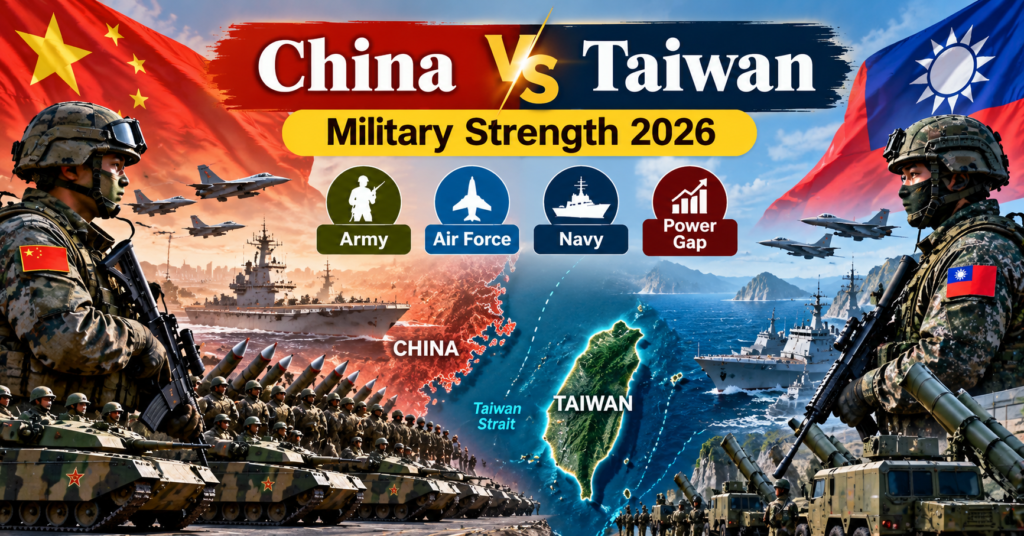
China vs Taiwan military strength 2026: Compare world rankings, army personnel, fighter jets, tanks, naval forces, defense budgets and military capabilities: China possesses one of the world’s most powerful militaries, yet its long-running confrontation with Taiwan remains among the most closely watched security issues in Asia. Beijing has spent decades developing advanced fighter jets, aircraft carriers, missile systems and a vast defense industry. Across the Taiwan Strait, Taiwan has built a much smaller military around protecting its territory, airspace and surrounding waters. The enormous difference in military resources raises an important question: how much does numerical superiority actually reveal about the balance of power?
The China vs Taiwan military strength comparison in 2026 shows a substantial conventional advantage for China. It ranks third in the world, compared with Taiwan’s 22nd position, and maintains far larger land, air and naval forces. China also has greater financial resources and an extensive domestic military manufacturing industry.
However, Taiwan is not attempting to build a military identical in scale to China’s. Its armed forces concentrate on territorial defense, modern fighter aircraft, air-defense systems, naval protection and reserve preparedness. That difference in purpose, combined with the geography of the Taiwan Strait, makes this one of the most distinctive military comparisons in the world.
☷On this pageJump to a section of this military guide
China vs Taiwan Military Strength 2026: Full Comparison
China’s People’s Liberation Army (PLA) maintains extensive conventional military capabilities across land, air and sea, together with specialized missile, information and supporting forces.
Taiwan operates a smaller military with significant defensive resources, including modern fighter jets, surface warships, submarines, armored vehicles and ground-based air-defense systems.
The following comparison brings together the major military indicators for 2026.
| Military Category | China | Taiwan |
|---|---|---|
| World military ranking | 3rd | 22nd |
| PowerIndex score | 0.0919 | 0.3927 |
| Active military personnel | 2,035,000 | 230,000 |
| Reserve personnel | 510,000 | 1,657,000 |
| Paramilitary personnel | 625,000 | 55,000 |
| Total military aircraft | 3,529 | 720 |
| Fighter aircraft | 1,443 | 258 |
| Military helicopters | 1,007 | 239 |
| Main battle tanks and other recorded tanks | 5,870 | 1,090 |
| Armored vehicles | 152,040 | 24,067 |
| Self-propelled artillery | 2,940 | 488 |
| Rocket artillery | 2,770 | 223 |
| Naval assets | 841 | 91 |
| Aircraft carriers | 3 | 0 |
| Submarines | 61 | 4 |
| Comparative defense budget | $303 billion | $31.18 billion |
China’s advantage is particularly large in fighter aircraft, naval vessels and heavy land equipment. It has approximately 5.6 times Taiwan’s fighter aircraft, 5.4 times its tanks and 9.2 times its recorded naval assets.
Taiwan’s reserve personnel figure is an important exception. Its reported reserve pool is larger than China’s separately classified reserves, reflecting different military personnel systems and Taiwan’s emphasis on mobilization.
The overall picture remains clear: China has a much larger conventional military establishment. The important question is how those resources compare with Taiwan’s more concentrated defense requirements.
China vs Taiwan Military Ranking 2026
China ranks 3rd out of 145 countries in the 2026 Global Firepower military ranking, behind the United States and Russia.
Taiwan holds 22nd position, placing it among the world’s top 25 countries in the same conventional military assessment.
The ranking uses a PowerIndex score calculated from military resources, including manpower, aircraft, land equipment, naval forces, logistics, finances and geography. Lower scores indicate stronger conventional military positions under this methodology.
| Ranking Indicator | China | Taiwan |
|---|---|---|
| Global position | 3 of 145 | 22 of 145 |
| PowerIndex | 0.0919 | 0.3927 |
| Active personnel ranking | 1st | 28th |
| Total aircraft ranking | 3rd | 13th |
| Tank strength ranking | 1st | 20th |
| Naval asset ranking | 1st | 39th |
China’s position is supported by its massive land forces, extensive aviation fleet, expanding navy and large domestic industrial base.
Taiwan’s position is notable for a different reason. Despite having a population of approximately 23.6 million, it maintains substantial equipment inventories relative to its size.
A military ranking is useful for comparing national resources, but it does not measure every factor that would influence a confrontation between two forces with such different geographical and organizational circumstances.
China vs Taiwan Army Strength 2026: Soldiers and Reserves
China’s manpower advantage is enormous, reflecting both its population and the size of the PLA.
Taiwan has a smaller standing force, but reserve training and military mobilization play an important part in its national defense system.
Active Military Personnel Comparison
| Manpower Category | China | Taiwan |
|---|---|---|
| Population | 1,415,043,270 | 23,595,274 |
| Available manpower | 764,123,366 | 12,269,542 |
| Reaching military age annually | 19,810,606 | 306,739 |
| Active personnel | 2,035,000 | 230,000 |
| Reserve personnel | 510,000 | 1,657,000 |
| Paramilitary personnel | 625,000 | 55,000 |
China maintains nearly nine times Taiwan’s reported active military personnel.
The population difference is much greater, providing China with significantly larger potential recruitment resources.
Taiwan’s large registered reserve pool partly reflects its smaller standing military and the importance of maintaining personnel who can be called upon under its mobilization system.
Neither country’s available manpower figure should be mistaken for an existing force of trained soldiers.
China’s People’s Liberation Army
The PLA has developed into a large military organization with extensive ground, air, naval and rocket forces.
Its modernization has involved replacing older equipment, improving training, restructuring military organizations and expanding technological capabilities.
China’s military responsibilities also extend far beyond the Taiwan Strait. Its armed forces operate across a vast mainland territory, extensive maritime regions and other national security areas.
Consequently, the total number of PLA personnel does not indicate how many soldiers are assigned to any particular mission.
Nevertheless, the PLA’s overall size and resources are substantially greater than those of Taiwan’s armed forces.
Taiwan’s Military and Reserve Reforms
Taiwan maintains an active military supported by conscription, professional service and a large reserve system.
In January 2024, compulsory military service was extended from four months to one year for eligible male conscripts born in 2005 or later.
The reform reflects Taiwan’s effort to strengthen personnel training and defense preparedness.
Its 1.657 million registered reservists represent potential manpower rather than soldiers continuously serving in active units.
Training standards, equipment availability and organizational arrangements influence the practical value of reserve forces.
China therefore has a decisive advantage in the size of its standing military, while Taiwan places greater emphasis on maintaining a substantial pool of reservists alongside its smaller regular force.
China vs Taiwan Air Force Strength 2026: Fighter Jets and Aircraft
Military aviation is one of the clearest examples of China’s numerical and technological advantage.
China operates a large range of fighters, attack aircraft, helicopters, transport aircraft and specialized aviation platforms.
Taiwan’s smaller air force includes modern combat aircraft and continues to receive upgrades and new equipment.
Fighter Jets and Military Aircraft Comparison
| Aircraft Category | China | Taiwan |
|---|---|---|
| Total aircraft | 3,529 | 720 |
| Fighter aircraft | 1,443 | 258 |
| Dedicated attack aircraft | 371 | 0 recorded |
| Transport aircraft | 287 | 19 |
| Trainer aircraft | 401 | 215 |
| Special-mission aircraft | 105 | 18 |
| Aerial refueling tankers | 9 | 0 |
| Helicopters | 1,007 | 239 |
| Attack helicopters | 281 | 91 |
China’s fleet is substantially larger across nearly every category.
Its 1,443 fighter aircraft compare with Taiwan’s 258, while the differences in transport and special-mission aircraft are also considerable.
Support aircraft matter because maintaining a modern air force requires more than combat jets. Transportation, surveillance, training and maintenance all contribute to sustained aviation capabilities.
China’s J-20, J-16 and J-10 Fighters
China operates several important domestically developed fighter aircraft.
The Chengdu J-20 is a fifth-generation stealth fighter and a major part of the country’s advanced aviation program.
The Shenyang J-16 is a multirole fighter developed from the Flanker aircraft family, while the J-10 serves as another substantial component of China’s fighter inventory.
China also operates H-6 bombers and a variety of transport, surveillance and supporting aircraft.
Its aviation industry can manufacture and develop several aircraft families domestically, giving China a significant industrial advantage.
Taiwan’s F-16V, Mirage 2000 and F-CK-1 Fighters
Taiwan’s fighter fleet includes the American-origin F-16, French-built Mirage 2000-5 and domestically developed F-CK-1 Ching-kuo Indigenous Defense Fighter.
The F-16 modernization program has been especially important. Approximately 140 existing F-16A/B aircraft were upgraded with newer systems under Taiwan’s F-16V program.
Taiwan also purchased 66 newly built F-16V Block 70 aircraft from the United States.
On October 2, 2026, the first two aircraft from that new order arrived at Chihhang Air Base in Taitung.
The delivery represents an important step toward modernizing Taiwan’s fighter fleet. However, an order for 66 aircraft is not equivalent to having 66 newly built aircraft already available in Taiwan.
This distinction matters when comparing actual aircraft inventories with planned modernization.
How Significant Is China’s Airpower Advantage?
China’s advantage combines aircraft numbers, a wider range of aircraft types and substantially greater domestic manufacturing capacity.
Taiwan maintains a modern fighter force, but its total aviation resources are much smaller.
The two sides also have different military responsibilities. China supports a large national military establishment, while Taiwan concentrates much of its aviation activity on air defense around the island.
Aircraft counts cannot tell readers how many planes are available on a particular day, but they clearly establish the enormous difference in the scale of the two aviation forces.
China vs Taiwan Naval Strength 2026: Warships and Submarines
The navy is one of the most important parts of this comparison because mainland China and Taiwan are separated by water.
China has developed a large navy that includes aircraft carriers, destroyers, frigates, corvettes, submarines and smaller vessels.
Taiwan operates a significantly smaller fleet focused primarily on surrounding maritime areas.
Naval Fleet Comparison
| Naval Category | China | Taiwan |
|---|---|---|
| Total naval assets | 841 | 91 |
| Aircraft carriers | 3 | 0 |
| Helicopter carriers | 4 | 0 |
| Destroyers | 53 | 4 |
| Frigates | 46 | 21 |
| Corvettes | 50 | 7 |
| Submarines | 61 | 4 |
| Patrol vessels | 150 | 36 |
| Mine warfare vessels | 36 | 10 |
China has approximately nine times Taiwan’s recorded naval assets.
The difference is particularly pronounced in destroyers, aircraft carriers and submarines.
Taiwan has a smaller fleet, but frigates, destroyers and coastal vessels remain important parts of its maritime defense structure.
China’s Aircraft Carriers: Liaoning, Shandong and Fujian
China operates three commissioned aircraft carriers: Liaoning, Shandong and Fujian.
Liaoning and Shandong employ ski-jump launch arrangements, while Fujian uses electromagnetic aircraft launch technology.
Fujian was commissioned on November 5, 2025, marking a significant development in China’s carrier modernization.
The new carrier provides a different technical foundation from China’s earlier ships, although commissioning and achieving full operational maturity are not identical milestones.
China’s three-carrier fleet represents a substantial investment in naval aviation and maritime power.
Taiwan has no aircraft carrier and does not maintain an equivalent carrier-based aviation program.
China’s Destroyers and Modern Surface Fleet
China’s navy includes major surface combatants such as the Type 055 and Type 052D destroyers.
The Type 055 is a large modern warship equipped for multiple naval roles, while the Type 052D forms an important part of China’s destroyer fleet.
These vessels are supported by a broad shipbuilding industry that has expanded China’s naval capabilities over recent decades.
Taiwan operates four destroyers in the comparative inventory, alongside 21 frigates and seven corvettes.
Its fleet includes Kee Lung-class destroyers and Cheng Kung- and Kang Ding-class frigates.
The difference is not limited to the total number of hulls. China maintains a much larger and more varied surface fleet, while Taiwan’s navy is designed around a smaller maritime area and defensive responsibilities.
China vs Taiwan Submarine Strength
China has 61 submarines, compared with Taiwan’s four in the 2026 comparative inventory.
China operates both nuclear-powered and conventionally powered submarines.
Taiwan’s longstanding submarine inventory includes two Hai Lung-class boats and two much older submarines primarily associated with training roles.
Taiwan is also developing its indigenous submarine program, beginning with the Hai Kun.
New submarines undergoing trials or further development should be distinguished from vessels that have completed their service-entry requirements.
China’s submarine fleet is overwhelmingly larger, though submarine numbers alone do not describe the condition or capabilities of every vessel.
China vs Taiwan Tank and Ground Forces Comparison
China’s ground forces operate a substantially larger inventory of tanks, armored vehicles and artillery.
Taiwan maintains armored formations and artillery for territorial defense, but its equipment base is far smaller.
Tanks, Armored Vehicles and Artillery
| Ground Equipment | China | Taiwan |
|---|---|---|
| Tanks | 5,870 | 1,090 |
| Armored vehicles | 152,040 | 24,067 |
| Self-propelled artillery | 2,940 | 488 |
| Towed artillery | 1,400 | 1,360 |
| Mobile rocket projectors | 2,770 | 223 |
China has more than five times Taiwan’s recorded tanks and six times its armored vehicle inventory.
The greatest difference within artillery is in rocket systems, where China has more than twelve times Taiwan’s recorded inventory.
Towed artillery is an unusual exception. The countries have similar listed totals, although these systems do not necessarily have identical technical characteristics or operational availability.
China’s Type 96 and Type 99 Tanks
China operates large numbers of domestically developed armored vehicles, including Type 96 and Type 99 main battle tanks.
The Type 99 is one of China’s more modern tank families, while the Type 96 remains a substantial part of the country’s armored equipment.
China also produces infantry fighting vehicles, armored personnel carriers and specialized support vehicles.
Its 152,040 recorded armored vehicles encompass many categories, not simply tanks.
Taiwan’s M60A3, CM11 and Abrams Tanks
Taiwan has historically relied on equipment including M60A3 tanks and locally developed CM11 armored platforms.
The country is modernizing its armored forces through the introduction of American M1A2T Abrams tanks.
These newer vehicles represent an improvement in parts of Taiwan’s armored inventory, while older systems remain relevant to its broader equipment profile.
Taiwan’s focus is not on matching China’s entire land-force inventory. Its military equipment is organized around defending a much smaller territory.
The tank comparison therefore establishes China’s numerical advantage without suggesting that both sides maintain identical military objectives.
China vs Taiwan Missile and Air Defense Capabilities
Missiles and air-defense systems are important components of both military establishments.
China maintains a large missile force supported by domestic technology and industrial production.
Taiwan operates defensive missile systems intended to protect its territory and important national infrastructure.
China’s Rocket Force
China’s People’s Liberation Army Rocket Force operates ballistic and cruise missile systems, including conventional and nuclear-capable weapons.
Its equipment includes multiple DF-series missile families.
China’s missile development is part of a wider effort to modernize military technology and strategic deterrence.
Exact missile inventory figures are not fully disclosed in public sources, making precise comparisons less dependable than some conventional equipment categories.
Taiwan’s Patriot, Sky Bow and Anti-Ship Missiles
Taiwan operates American-origin Patriot air-defense systems alongside domestically developed Sky Bow, also called Tien Kung, systems.
It also maintains the Hsiung Feng family of anti-ship missiles.
These weapons serve different roles from China’s much larger missile force.
Taiwan’s systems are part of its efforts to protect airspace, defend maritime interests and maintain security around the island.
The main difference is in scale and purpose: China maintains a broad missile establishment, while Taiwan concentrates on systems relevant to its territorial defense.
China vs Taiwan Nuclear Weapons
China possesses nuclear weapons, while Taiwan does not maintain a nuclear arsenal.
China’s nuclear capabilities form part of its strategic deterrent and are distinct from its conventional army, navy and air force resources.
Public estimates of China’s nuclear stockpile vary because complete official inventory information is not available.
Taiwan has no independent nuclear-weapons force.
This distinction is significant in the wider strategic balance, but nuclear weapons cannot be treated as ordinary military equipment whose numerical difference determines the outcome of a conventional confrontation.
China vs Taiwan Defense Budget 2026
China has a much larger military budget than Taiwan, reflecting the enormous difference in their economic size and defense responsibilities.
The 2026 comparative ranking lists $303 billion for China and $31.18 billion for Taiwan.
That places China’s comparative defense budget at approximately 9.7 times Taiwan’s.
However, official government allocations use different accounting definitions, making it useful to examine them separately.
Military Spending Comparison
| Financial Indicator | China | Taiwan |
|---|---|---|
| Comparative defense budget | $303 billion | $31.18 billion |
| Purchasing power parity | $33.598 trillion | $1.743 trillion |
| Foreign exchange and gold reserves | $3.456 trillion | $541.90 billion |
| Official 2026 defense plan | ¥1.94 trillion | NT$949.5 billion under broader accounting |
China’s official 2026 general public budget allocates approximately 1.94 trillion yuan to national defense, a 6.9% increase over the previous year’s executed expenditure.
Taiwan’s government outlined approximately NT$949.5 billion in defense-related spending for 2026 under a broader accounting approach, equivalent to about 3.32% of GDP.
The Taiwanese figure incorporates categories beyond the regular defense ministry budget, including relevant special spending and other defense-related costs.
These government figures are not directly interchangeable with the comparative dollar estimates because reporting definitions differ.
Nevertheless, the financial disparity remains substantial.
Why China’s Defense Industry Matters
China has an extensive domestic defense industry that manufactures fighter aircraft, missiles, warships, armored vehicles and military electronics.
Its shipyards and aerospace manufacturers support several large modernization programs simultaneously.
That industrial scale is a major part of China’s military strength.
Taiwan also has domestic defense industries, especially in military electronics, missile technology and shipbuilding.
However, it continues to rely on international procurement for several important platforms, including F-16V fighters and Abrams tanks.
The difference in industrial resources helps explain how China can support a much larger military equipment inventory.
Geography: Why the Taiwan Strait Makes This Comparison Different
Mainland China and Taiwan are separated by the Taiwan Strait, a waterway approximately 130 kilometers wide at its narrowest point.
That geographical separation distinguishes this military comparison from one involving two countries connected by a land border.
China has an extensive mainland territory and enormous transportation infrastructure, while Taiwan is a mountainous island with densely populated urban areas and a comparatively small land area.
China vs Taiwan Geography
| Geographical Category | China | Taiwan |
|---|---|---|
| Land area | 9,596,960 km² | 35,980 km² |
| Coastline | 14,500 km | 1,566 km |
| Total land borders | 22,457 km | None |
| Recorded inland waterways | 27,700 km | 0 km |
China’s territory is more than 260 times larger than Taiwan’s.
The countries therefore have very different geographical responsibilities.
China must support military and security requirements across a vast mainland territory and extensive maritime regions.
Taiwan’s armed forces concentrate on a much smaller island territory and the waters surrounding it.
The existence of the strait introduces distinct maritime and transportation considerations. It does not by itself determine any military outcome, but it helps explain why a simple comparison of army personnel and tanks cannot capture every relevant factor.
Military Logistics and Economic Resources
China’s enormous economy and transportation infrastructure contribute to its broader military resource base.
Taiwan’s economy is much smaller in absolute terms, but it has advanced manufacturing capabilities and is closely connected to international trade.
Infrastructure Comparison
| Infrastructure Category | China | Taiwan |
|---|---|---|
| Airports | 552 | 57 |
| Merchant marine vessels | 8,314 | 465 |
| Ports and terminals | 66 | 8 |
| Road network | 5,200,000 km | 43,206 km |
| Railway network | 150,000 km | 1,613 km |
China’s much larger infrastructure network reflects its population, territory and industrial scale.
Taiwan’s smaller infrastructure supports a highly developed island economy, including advanced electronics and semiconductor manufacturing.
These economic differences are relevant to national resilience and defense production.
However, national infrastructure figures should not be treated as direct counts of military facilities or military transport equipment.
Energy Resources and Trade Dependence
China produces substantial quantities of oil, natural gas and coal, although its enormous economy also depends on imported energy.
Taiwan has limited domestic fossil-fuel resources and relies heavily on imported energy supplies.
That difference affects the broader economic conditions under which both societies maintain their armed forces.
Taiwan’s manufacturing sector is internationally significant, particularly in semiconductors, while China has much larger domestic industrial and energy resources.
The two economies are also connected to extensive international trade networks.
These characteristics make economic resilience an important part of the wider security environment, alongside conventional military equipment.
China–Taiwan Military Tensions in 2026
The military comparison has immediate relevance because the Taiwan Strait remains an important area of political and security tension.
The People’s Republic of China claims Taiwan as part of its territory and has not ruled out the use of force to achieve unification.
Taiwan has its own elected government, military and political institutions, and has been governed separately from the mainland since 1949.
The Chinese government states that unification is a national objective, while Taiwan’s government emphasizes maintaining its existing democratic institutions and determining its future through its people.
These differing positions have shaped cross-strait relations for decades.
Chinese Military Exercises Around Taiwan
China has conducted military exercises involving aircraft and naval vessels around Taiwan.
These activities have included different forms of military training and demonstrations of military capabilities.
Taiwan monitors Chinese military movements and has continued investing in defense modernization.
The growing scale of China’s military and the frequency of activity around Taiwan have attracted attention from governments across the Indo-Pacific.
However, military exercises should not automatically be described as the beginning of a war or proof that a future confrontation is inevitable.
The United States and Taiwan’s Defense
The United States maintains unofficial relations with Taiwan and provides defensive military equipment under its domestic legal and policy framework.
The Taiwan Relations Act is an important foundation of this relationship.
It supports the provision of defensive arms and the maintenance of American capacity to resist force or coercion threatening Taiwan’s security.
The legislation does not establish an unconditional automatic commitment to intervene militarily in every possible crisis.
Therefore, the U.S. role is relevant to the broader military balance, but any future response should not be assumed.
China vs Taiwan Military Strength: Final Comparison
China has a substantially stronger conventional military than Taiwan in 2026.
Its advantages extend across almost every major category: active personnel, fighter aircraft, tanks, armored vehicles, artillery, warships, submarines and defense spending.
The gap is also industrial. China can manufacture a wide range of advanced military equipment domestically and maintain a much larger defense establishment.
Taiwan, meanwhile, has developed armed forces focused primarily on territorial defense. Its military includes modern fighter aircraft, substantial reserves, surface warships, submarines and layered defensive systems.
The difference in their military responsibilities is essential to interpreting the figures.
China’s armed forces operate across a vast mainland territory and multiple maritime regions. Taiwan’s forces concentrate on protecting a much smaller island and its surrounding waters.
The comparison establishes China’s overwhelming numerical and industrial military advantage, but the consequences of any future crisis would depend on far more than total equipment inventories.
China has the larger and more extensively equipped military. Taiwan maintains a smaller, defense-focused force whose readiness, geography and security relationships remain important to understanding the wider balance across the Taiwan Strait.
Frequently Asked Questions
Who has the stronger military, China or Taiwan, in 2026?
China has significantly greater conventional military resources, including active personnel, fighter aircraft, armored vehicles, artillery, naval ships and defense spending. Taiwan maintains a smaller military focused on territorial defense.
What is China’s military rank in 2026?
China ranks 3rd out of 145 countries in the 2026 Global Firepower military ranking, with a PowerIndex score of 0.0919.
What is Taiwan’s military rank in 2026?
Taiwan ranks 22nd out of 145 countries, with a PowerIndex score of 0.3927.
How many active soldiers do China and Taiwan have?
The comparative figures list approximately 2,035,000 active military personnel for China and 230,000 for Taiwan. The two countries also maintain reserve and paramilitary forces.
Does Taiwan have more military reservists than China?
The 2026 comparative dataset lists 1,657,000 reservists for Taiwan and 510,000 for China. These totals reflect different personnel classifications and do not establish the number immediately available for military service.
How many fighter jets does China have compared with Taiwan?
China has 1,443 recorded fighter aircraft, compared with Taiwan’s 258. Taiwan operates F-16, Mirage 2000 and F-CK-1 aircraft, while China operates platforms including the J-20, J-16 and J-10.
How many tanks does China have compared with Taiwan?
China has approximately 5,870 recorded tanks, compared with Taiwan’s 1,090. Taiwan has been modernizing its armored forces with M1A2T Abrams tanks.
How many aircraft carriers does China have?
China has three commissioned aircraft carriers: Liaoning, Shandong and Fujian. Taiwan does not operate an aircraft carrier.
How many submarines do China and Taiwan have?
China has 61 submarines and Taiwan has four in the 2026 comparative inventory. Their submarine fleets differ considerably in size, age and technical capabilities.
Does Taiwan have nuclear weapons?
No. Taiwan does not maintain an independent nuclear-weapons arsenal. China is a nuclear-armed state.
What is the China vs Taiwan military budget in 2026?
The comparative dataset lists $303 billion for China and $31.18 billion for Taiwan. Official national defense plans use different accounting frameworks, with China allocating approximately 1.94 trillion yuan and Taiwan outlining NT$949.5 billion under its broader 2026 defense spending definition.
Would China’s larger military guarantee victory in a war?
No. Numerical military superiority does not guarantee a particular outcome. Geography, logistics, readiness, political decisions and international developments would all influence the circumstances of any hypothetical conflict.
Read Also: https://militarycompare.com/china-military-strength/