
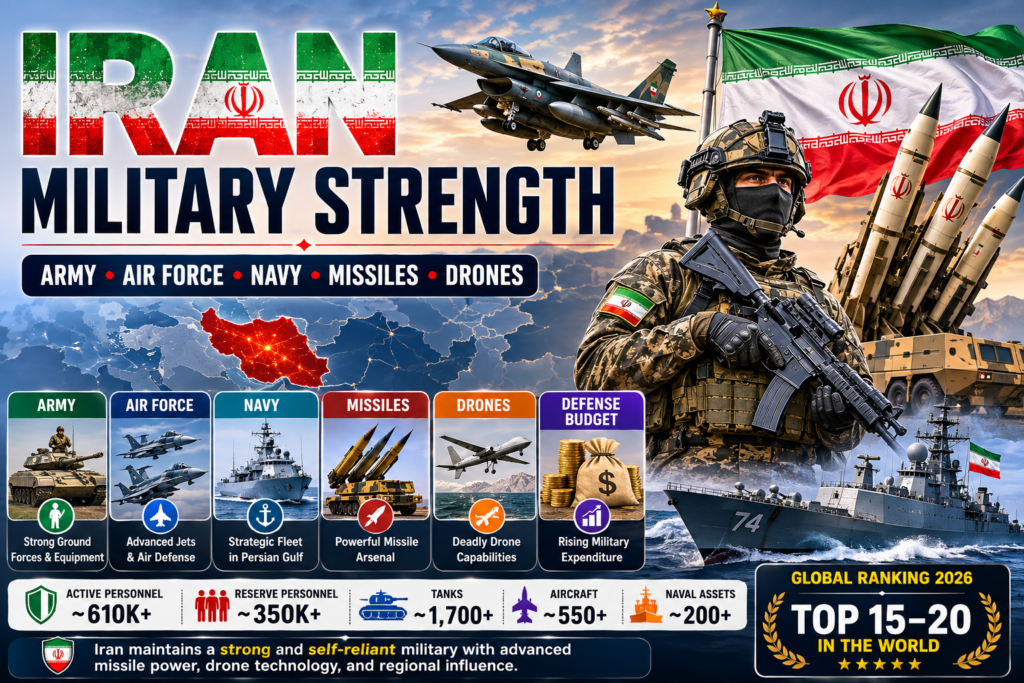
Iran remains one of the most powerful military states in the Middle East in 2026. Its strength does not come from a single branch or from having the region’s most modern fighter fleet. Instead, Iran military strength in 2026 is built around a large standing force, thousands of armored vehicles, heavy rocket artillery, submarines, missiles, drones, strategic geography and a defense industry shaped by decades of restricted access to foreign military equipment.
Iran ranks 16th out of 145 countries in the 2026 Global Firepower assessment with a Power Index score of 0.3199. Its military inventory includes approximately 610,000 active personnel, 350,000 reservists, 551 aircraft, 2,675 tanks, more than 75,000 armored vehicles, 1,550 rocket projectors and 25 submarines.
The conventional inventory is only one part of Iran military power. Ballistic missiles, cruise missiles, unmanned aircraft, coastal defenses and dispersed launch systems have become central to how Iran approaches deterrence and regional defense.
☷On this pageJump to a section of this military guide
Iran Military Strength 2026 at a Glance
Iran performs especially well in manpower, tanks, rocket artillery, submarines and strategic resources.
| Iran Military Category | 2026 Figure |
|---|---|
| Global Military Rank | 16th of 145 |
| Power Index Score | 0.3199 |
| Population | 88,386,937 |
| Active Personnel | 610,000 |
| Reserve Personnel | 350,000 |
| Paramilitary Personnel | 220,000 |
| Estimated Total Military Personnel | 1,180,000 |
| Defense Budget | $9.23 billion |
| Total Aircraft | 551 |
| Fighter Aircraft | 188 |
| Tanks | 2,675 |
| Armored Vehicles | 75,939 |
| Self-Propelled Artillery | 424 |
| Towed Artillery | 1,803 |
| Rocket Projectors | 1,550 |
| Naval Assets | 109 |
| Submarines | 25 |
Iran’s ranking is notable because its defense budget is much smaller than that of many other Top-20 militaries. The country compensates with manpower, long-established inventories, domestic production and a military strategy heavily focused on missiles, drones and lower-cost asymmetric systems.
Iran Military Ranking 2026
The Iran military ranking 2026 places the country at number 16 globally.
Several individual categories rank significantly higher than Iran’s overall position:
- Active military personnel: 8th
- Tank strength: 8th
- Armored vehicles: 11th
- Towed artillery: 7th
- Rocket artillery: 4th
- Fighter aircraft: 15th
- Transport aircraft: 7th
- Aerial tankers: 11th
- Submarines: 3rd
- Oil production: 9th
- Proven oil reserves: 3rd
- Natural-gas production: 3rd
- Proven natural-gas reserves: 2nd
These rankings explain why Iran remains militarily important despite limitations in some technology-intensive categories.
What Makes Iran’s Military Different?
Iran’s defense structure is different from militaries that depend mainly on advanced fighter aircraft, aircraft carriers or large expeditionary fleets.
The country has invested heavily in:
- Ballistic missiles
- Cruise missiles
- Long-range drones
- Tactical UAVs
- Rocket artillery
- Underground military facilities
- Dispersed launch systems
- Coastal anti-ship weapons
- Submarines
- Air-defense systems
- Electronic warfare
- Domestic weapons manufacturing
The result is a force designed to remain dangerous even when facing an opponent with superior conventional air power.
For Iran, military deterrence depends on the ability to distribute weapons across a large territory and maintain multiple ways to strike or defend without relying entirely on manned aviation.
Iran Armed Forces Structure
Iran’s military system includes two major organizations.
The regular armed forces, commonly known as the Artesh, operate conventional army, air force, navy and air-defense units.
Alongside the Artesh operates the Islamic Revolutionary Guard Corps, or IRGC, which maintains its own ground, aerospace and naval components.
The two structures serve overlapping but different purposes.
The regular armed forces are more closely associated with conventional territorial defense. The IRGC has developed major capabilities in areas such as missiles, drones and asymmetric maritime operations.
This dual structure gives Iran an unusually diversified military organization.
Iran Military Manpower 2026
Iran has a population of approximately 88.4 million and one of the largest military manpower pools in the region.
The 2026 figures show substantial active, reserve and paramilitary strength.
| Iran Manpower Category | 2026 Figure |
|---|---|
| Total Population | 88,386,937 |
| Available Manpower | 49,496,685 |
| Fit for Service | 41,541,860 |
| Reaching Military Age Annually | 1,414,191 |
| Active Personnel | 610,000 |
| Reserve Personnel | 350,000 |
| Paramilitary Personnel | 220,000 |
Approximately 1.41 million people reach military age annually, giving Iran a large potential recruitment base.
The active force alone places Iran eighth globally in the supplied manpower ranking.
How Large Is Iran’s Army?
The broader Iranian military includes approximately 610,000 active personnel, while the source separately estimates about 350,000 Army personnel.
Iran’s land forces are built around armored units, artillery, mechanized formations and rocket systems.
Their scale is substantial:
- 2,675 tanks
- 75,939 armored vehicles
- 424 self-propelled artillery systems
- 1,803 towed artillery pieces
- 1,550 MLRS and rocket projectors
The combination of armor and rocket artillery gives Iran Army strength a distinctly heavy conventional profile.
Iran Tank Strength 2026
Iran is listed with 2,675 tanks, ranking eighth globally in the supplied 2026 data.
Its tank inventory contains equipment from different generations and origins rather than one standardized fleet.
Iranian armored forces have historically included platforms such as:
- T-72 variants
- Karrar
- Zulfiqar
- Older legacy tanks
- Domestically upgraded vehicles
The value of Iran’s tank fleet lies partly in quantity.
However, tank numbers alone do not measure protection, fire-control systems, sensors, mobility or operational readiness.
Iran’s 2,675-tank inventory therefore represents significant armored depth, but the capability of individual vehicles can vary substantially.
Iran Armored Vehicles
The broader armored-vehicle category is even larger.
Iran is listed with approximately 75,939 armored vehicles.
This category can include:
- Armored personnel carriers
- Infantry fighting vehicles
- Protected mobility vehicles
- Armored cars
- Engineering vehicles
- Military support platforms
The large number reflects the logistics requirements of defending a country covering more than 1.6 million square kilometers.
Iran Artillery Strength
Iran possesses one of the most substantial artillery structures in the region.
Its 2026 inventory includes:
| Iran Artillery Category | Inventory |
|---|---|
| Self-Propelled Artillery | 424 |
| Towed Artillery | 1,803 |
| MLRS / Rocket Projectors | 1,550 |
Iran ranks seventh globally in towed artillery and fourth in rocket projectors.
The 1,550 MLRS figure is especially important because rocket artillery fits closely with Iran’s broader emphasis on mobile missile and strike systems.
Why Rocket Artillery Matters to Iran
Iran’s land forces are not built only around tanks and infantry.
Rocket artillery adds longer-range fire support and allows military units to deliver large volumes of fire without relying on combat aircraft.
Mobile rocket systems can also be dispersed across wide areas.
This supports Iran’s broader defense philosophy of spreading offensive and defensive assets rather than concentrating them into a small number of high-value platforms.
Iran Missile Strength in 2026
Missiles are one of the most important parts of Iranian military power.
Iran has spent decades developing multiple families of ballistic and cruise missiles with different ranges and mission profiles.
The missile force serves several purposes:
- Long-range deterrence
- Conventional strike capability
- Support for regional military strategy
- Reduced dependence on manned aircraft
- Distributed firepower
Iran’s missile program is particularly significant because its conventional fighter fleet contains many older aircraft.
Land-based missiles provide a way to conduct long-range strikes without first establishing air superiority.
Ballistic Missiles and Iran’s Defense Strategy
Iran’s ballistic missile force includes systems designed for different ranges.
Their military significance depends on more than maximum distance.
Important factors include:
- Accuracy
- Warhead size
- Mobility
- Launch preparation
- Survivability
- Stockpile size
- Ability to overcome missile defenses
Mobile launchers allow missile units to change position and reduce dependence on fixed launch sites.
That mobility is an important component of Iran missile strength.
Iran Drone Power 2026
Iran has also developed a major domestic drone industry.
Drones are not included in the supplied Global Firepower aircraft total, so Iran’s listed 551 military aircraft do not represent its full unmanned aviation capability.
Iranian drone development includes systems used for:
- Reconnaissance
- Surveillance
- One-way attack missions
- Tactical strike
- Long-range operations
- Battlefield support
The Shahed family of drones has become one of the most recognizable parts of Iran’s defense industry.
Why Drones Matter to Iran’s Military
Modern fighter aircraft are extremely expensive.
Drones offer a different economic model.
A country can produce larger quantities of unmanned systems for missions where using an advanced fighter aircraft would be unnecessary or too costly.
For Iran, drones also complement missiles.
Missiles provide speed and heavier strike capability, while UAVs can provide reconnaissance, persistence and lower-cost mass.
The combination of Iran missiles and drones has therefore become more important than either capability in isolation.
Iran Air Force Strength 2026
Iran’s conventional air force is sizeable but technologically uneven.
The 2026 inventory lists 551 aircraft, including 188 fighters.
| Iran Air Force Category | 2026 Figure |
|---|---|
| Total Aircraft | 551 |
| Fighter Aircraft | 188 |
| Dedicated Attack Aircraft | 21 |
| Transport Aircraft | 86 |
| Trainer Aircraft | 103 |
| Special-Mission Aircraft | 10 |
| Aerial Tankers | 6 |
| Helicopters | 129 |
| Attack Helicopters | 13 |
Iran ranks seventh globally in transport aircraft and 11th in aerial tanker numbers.
Its fighter fleet is large enough to be significant, but its composition remains one of the biggest limitations in Iranian conventional air power.
Iran Fighter Jets 2026
Iran is listed with 188 fighter aircraft.
The fighter inventory has historically included:
- F-14 Tomcat
- F-4 Phantom II
- F-5 family aircraft
- MiG-29
- Locally modified or produced platforms
The unusual feature of the Iranian fighter fleet is how long some aircraft types have remained operational.
Domestic refurbishment and engineering have allowed Iran to continue using platforms whose original designs date back decades.
That provides fleet continuity, but it also creates a technology gap against air forces operating newer stealth fighters, advanced sensors and modern electronic-warfare systems.
Iran Air Force Strengths and Weaknesses
Iran’s air force has several strengths.
Its transport fleet is relatively large, it maintains limited aerial-refueling capability and it has decades of experience operating and sustaining different aircraft families.
Its main weakness is the age of much of the combat fleet.
Older fighters may face disadvantages in:
- Radar technology
- Sensor fusion
- Electronic warfare
- Beyond-visual-range combat
- Weapons integration
- Maintenance availability
This is one reason Iran’s air defense, missile and drone programs play such an important role in national defense.
Iran Air Defense Capability
Iran’s large territory creates a difficult air-defense problem.
Military facilities, major cities, air bases, energy infrastructure and strategic sites are spread across a very wide geographic area.
Iran therefore maintains a mixture of domestic and foreign-origin air-defense systems designed to cover different ranges.
Air-defense modernization remains particularly important because protecting a country of Iran’s size requires more than a few high-end batteries.
Short-, medium- and long-range systems must work together to provide layered coverage.
Iran Navy Strength 2026
Iran’s navy is designed around the Persian Gulf, Gulf of Oman and nearby waters rather than global carrier operations.
The supplied 2026 inventory lists 109 naval assets.
| Iran Navy Category | 2026 Figure |
|---|---|
| Total Naval Assets | 109 |
| Total Tonnage | 283,516 tonnes |
| Aircraft Carriers | 0 |
| Helicopter Carriers | 0 |
| Destroyers | 0 |
| Frigates | 7 |
| Corvettes | 3 |
| Submarines | 25 |
| Patrol Vessels | 21 |
| Mine Warfare Vessels | 1 |
Iran does not operate conventional aircraft carriers or destroyers in the supplied classification.
Its most important naval strength is submarine quantity.
Iran Submarine Strength 2026
Iran is listed with approximately 25 submarines, placing it third globally by submarine count in the supplied dataset.
That figure needs context.
The category combines submarines of different sizes and capabilities. Iran’s fleet includes smaller coastal and midget submarines as well as larger conventional boats.
Smaller submarines may be particularly relevant in confined regional waters.
Iran’s submarine force can support:
- Coastal surveillance
- Sea denial
- Maritime deterrence
- Undersea operations
- Protection of strategic approaches
The Iran submarine fleet is therefore more important to regional defense than raw tonnage alone suggests.
Iran’s Surface Navy
Iran operates seven frigates and three corvettes in the supplied 2026 inventory.
These numbers are modest compared with major blue-water navies.
Iran instead relies more heavily on:
- Smaller naval craft
- Coastal weapons
- Submarines
- Drones
- Shore-based missiles
- Dispersed maritime forces
This produces a naval strategy very different from that of a carrier-focused power.
Strait of Hormuz and Iran’s Military Geography
Iran’s position near the Strait of Hormuz is one of its greatest strategic advantages.
The narrow waterway connects the Persian Gulf with the Gulf of Oman and wider Arabian Sea.
Iran’s coastline runs along the northern side of this maritime corridor.
That geography gives Iran the ability to concentrate several types of military capability near a strategically important shipping route:
- Coastal surveillance
- Anti-ship missiles
- Submarines
- Patrol craft
- Drones
- Land-based weapons
- Naval units
The importance of the Strait means Iran’s maritime capabilities can have consequences well beyond the size of its fleet.
Iran’s Navy Is Designed More for Sea Denial Than Sea Control
A useful distinction when assessing Iran Navy strength is the difference between sea control and sea denial.
Sea control means maintaining sustained freedom of action across a maritime area.
Sea denial focuses more on preventing an opponent from using an area freely.
Iran’s force structure fits the second model more closely.
Its submarines, coastal geography, smaller vessels and missile forces can create risk without requiring a large carrier or destroyer fleet.
Iran Defense Budget 2026
The supplied 2026 dataset estimates Iran’s defense budget at $9.23 billion.
| Iran Financial Category | 2026 Figure |
|---|---|
| Defense Budget | $9.23 billion |
| Purchasing Power Parity | $1.486 trillion |
| Foreign Exchange and Gold Reserves | $120.6 billion |
| External Debt | $6.76 billion |
Iran’s budget ranks only 36th globally in the supplied data, which appears low for a country ranked 16th in military strength.
The difference reflects several factors.
Much of Iran’s equipment has been accumulated over decades. Domestic production can also reduce some costs compared with importing equivalent foreign systems.
Iran additionally invests heavily in relatively lower-cost systems such as rockets, drones and small naval platforms rather than trying to duplicate every expensive capability used by wealthier militaries.
Iran Defense Industry
Restrictions on foreign military procurement have encouraged Iran to build a substantial domestic defense industry.
Iranian production includes areas such as:
- Missiles
- Drones
- Artillery
- Armored vehicles
- Air-defense systems
- Naval craft
- Radar
- Electronic systems
- Ammunition
Domestic production does not automatically mean every Iranian system is technologically equal to the world’s most advanced alternatives.
Its importance lies in supply independence.
Iran can continue producing or modifying many types of military equipment even when access to foreign suppliers is restricted.
Iran Natural Resources 2026
Iran’s energy resources are one of the strongest structural advantages supporting its long-term national power.
The supplied data places Iran among the world’s leading oil and gas states.
| Iran Energy Category | 2026 Figure |
|---|---|
| Oil Production | 4.112 million barrels |
| Oil Consumption | 2.415 million barrels |
| Proven Oil Reserves | 208.6 billion barrels |
| Natural Gas Production | 263.28 billion m³ |
| Natural Gas Consumption | 244.89 billion m³ |
| Proven Natural Gas Reserves | 33.987 trillion m³ |
| Coal Production | 2.209 million metric tons |
Iran ranks third globally in proven oil reserves and second in natural-gas reserves in the supplied assessment.
Its oil and gas production also gives the country a major domestic energy base.
Why Energy Resources Matter to Iran’s Military Power
Energy resources do not translate directly into military equipment.
They do provide economic and strategic depth.
Oil and natural gas can support:
- Government revenue
- Domestic industry
- Electricity generation
- Transportation
- Military production
- Export earnings
Sanctions and export restrictions can limit how efficiently Iran converts those resources into financial power, but the underlying resource base remains enormous.
Iran’s Geographic Depth
Iran covers approximately 1,648,195 square kilometers, ranking among the larger countries in the region.
Its geography includes mountains, deserts, long land borders and access to two important maritime zones.
Iran has approximately:
- 2,440 km of coastline
- 5,894 km of shared borders
- 850 km of usable waterways
The country’s large territory provides strategic depth that smaller regional states do not possess.
Military infrastructure can be distributed across a wide area, making complete geographic coverage difficult for both Iranian defenders and potential attackers.
Mountains and Dispersed Military Infrastructure
Iran’s mountainous terrain also shapes defense planning.
Mountain regions can complicate surveillance, transportation and military operations.
They also provide opportunities to disperse infrastructure.
For Iran, dispersal is important because a military dependent on a small number of exposed bases would be more vulnerable to concentrated attacks.
This geographic depth supports Iran’s broader strategy of distributed military capability.
Iran Military Logistics and Infrastructure
Iran’s domestic infrastructure supports movement across a very large country.
| Iran Infrastructure Category | 2026 Figure |
|---|---|
| Internet Coverage | 80% |
| Labor Force | 28.58 million |
| Merchant Marine Fleet | 965 |
| Ports and Terminals | 18 |
| Airports | 177 |
| Road Network | 223,485 km |
| Railway Network | 8,484 km |
| Usable Waterways | 850 km |
The country’s 965-vessel merchant fleet is particularly notable.
Iran also has 177 serviceable airports and more than 223,000 km of roadways.
These networks support civilian commerce but also contribute to the country’s ability to move military personnel and equipment across a geographically large territory.
Iran’s Biggest Military Strengths in 2026
Several capabilities define Iran military power in 2026 more clearly than any single ranking.
Large Military Manpower
Iran has 610,000 active personnel, 350,000 reserves and 220,000 paramilitary personnel.
Missile Capability
Ballistic and cruise missiles provide Iran with long-range strike options without depending entirely on combat aircraft.
Drone Production
Iran’s UAV industry supports reconnaissance, surveillance and attack missions.
Rocket Artillery
The 1,550 MLRS inventory ranks fourth globally in the supplied data.
Large Armored Force
Iran fields 2,675 tanks and more than 75,000 armored vehicles.
Submarine Fleet
Twenty-five submarines give Iran substantial undersea capability by regional standards.
Strategic Geography
Iran’s size and position near the Strait of Hormuz increase the strategic value of its maritime and missile forces.
Energy Resources
Iran’s oil and gas reserves provide exceptional long-term resource depth.
Iran Military Weaknesses in 2026
Iran’s military also has clear limitations.
Aging Fighter Fleet
Many aircraft in Iran’s conventional combat fleet are based on older designs.
Uneven Equipment Quality
Large inventories can contain platforms from multiple generations, so total numbers do not necessarily represent equal capability across all units.
Limited Modern Surface Fleet
Iran lacks conventional aircraft carriers and destroyers in the supplied naval classification.
Air-Defense Challenges
Defending a country as large as Iran requires a very extensive air-defense network.
Economic Pressure
Restrictions on trade and technology can complicate access to some advanced military components.
Dependence on Asymmetric Strengths
Iran’s missile, drone and sea-denial strategies are powerful partly because the country does not match the most technologically advanced militaries in every conventional category.
Why Iran Ranks 16th Despite a Relatively Small Defense Budget
Iran’s $9.23 billion defense budget is much smaller than the budgets of many countries ranked near it.
Its military ranking remains high because Iran already possesses large inventories across several categories.
The country has:
- 610,000 active personnel
- 2,675 tanks
- 75,939 armored vehicles
- 1,803 towed artillery pieces
- 1,550 rocket projectors
- 25 submarines
- Extensive natural resources
Iran also concentrates military investment in areas where domestic production can support large quantities.
This produces a different balance between spending and inventory than seen in militaries that rely heavily on imported high-end equipment.
Is Iran the Strongest Military in the Middle East?
Iran is one of the strongest military powers in the Middle East, but no single statistic can determine regional superiority.
Iran performs strongly in:
- Manpower
- Ballistic missiles
- Drones
- Rocket artillery
- Tanks
- Submarines
- Strategic depth
- Energy resources
Other Middle Eastern militaries may hold advantages in:
- Modern fighter aircraft
- Air-defense technology
- Defense spending
- Advanced electronics
- Intelligence integration
- Large modern surface warships
Iran’s strength therefore comes from the combination of conventional mass and asymmetric capabilities, rather than unquestioned superiority in every military domain.
Is Iran a Military Superpower?
Iran is better classified as a major regional military power.
A global military superpower normally possesses:
- Worldwide military bases
- Large carrier fleets
- Global strategic aviation
- Extensive overseas logistics
- Extremely large defense spending
Iran does not operate at that scale.
Its military influence is strongest in and around the Persian Gulf, Gulf of Oman and wider Middle East.
Iran Military Strength During an Active Conflict
Military inventories become especially difficult to measure accurately during an ongoing conflict.
Aircraft, missile systems, air-defense batteries, vehicles, ships and military infrastructure may be damaged, destroyed, repaired, relocated or replaced.
Production can also continue while losses occur.
This means a published Iran military inventory 2026 should be treated as a baseline estimate rather than a live count of every operational asset available on a particular day.
The distinction is especially important for rapidly changing categories such as:
- Missiles
- Drones
- Air-defense systems
- Aircraft
- Military infrastructure
- Mobile launchers
Future of Iran’s Military
Iran’s future defense development is likely to remain focused on systems that can be dispersed, produced domestically and deployed in meaningful numbers.
Important areas include:
- Ballistic missiles
- Cruise missiles
- Long-range UAVs
- One-way attack drones
- Air-defense systems
- Electronic warfare
- Underground military infrastructure
- Coastal missiles
- Submarines
- Domestic radar technology
Iran is unlikely to abandon conventional military forces, but missiles and unmanned systems are likely to remain central to its strategy.
How Strong Is Iran’s Military in 2026?
Iran is a Top-20 global military power and one of the strongest conventional and asymmetric militaries in the Middle East.
Its 2026 inventory includes:
- 610,000 active personnel
- 350,000 reserves
- 220,000 paramilitary personnel
- 551 aircraft
- 188 fighters
- 2,675 tanks
- 75,939 armored vehicles
- 1,803 towed artillery pieces
- 1,550 rocket projectors
- 109 naval assets
- 25 submarines
These figures explain much of Iran’s 16th-place military ranking.
But Iran’s most distinctive capabilities lie beyond traditional equipment counts.
Its real military profile combines manpower, missiles, drones, rocket artillery, submarines, strategic geography, domestic production and enormous energy reserves.
That combination makes Iran significantly more complex than a simple fighter-jet or tank comparison suggests.
FAQs
What is Iran’s military ranking in 2026?
Iran ranks 16th out of 145 countries in the 2026 Global Firepower assessment with a Power Index score of 0.3199.
Is Iran a Top-20 military power?
Yes. Iran is ranked 16th globally in the supplied 2026 assessment.
How many soldiers does Iran have in 2026?
Iran is listed with approximately 610,000 active military personnel, 350,000 reservists and 220,000 paramilitary personnel.
How many tanks does Iran have?
Iran has approximately 2,675 tanks in the supplied 2026 inventory.
How many armored vehicles does Iran have?
The source lists approximately 75,939 armored vehicles.
How many military aircraft does Iran have?
Iran has approximately 551 military aircraft in the supplied conventional aircraft inventory.
How many fighter jets does Iran have?
Iran is listed with approximately 188 fighter aircraft.
What fighter jets does Iran use?
Iran’s fighter fleet has included aircraft such as the F-14, F-4, F-5 and MiG-29, along with locally modified or produced platforms.
Does Iran have military drones?
Yes. Iran has developed a large domestic UAV industry covering surveillance, reconnaissance and attack drones.
Are Iranian drones included in the 551-aircraft total?
No. The supplied source specifically notes that UAVs are not included in its conventional aircraft count.
How many rocket launchers does Iran have?
Iran is listed with approximately 1,550 MLRS and rocket projectors, ranking fourth globally in that category.
Does Iran have ballistic missiles?
Yes. Ballistic missiles are a major component of Iran’s long-range defense and deterrence capability.
How many submarines does Iran have?
Iran has approximately 25 submarines in the supplied 2026 inventory.
Does Iran have an aircraft carrier?
No conventional aircraft carrier is listed for Iran in the supplied 2026 naval inventory.
What is Iran’s defense budget in 2026?
The supplied dataset estimates Iran’s defense budget at $9.23 billion.
Why is Iran militarily powerful despite its lower defense spending?
Iran combines large existing military inventories with domestic production, high manpower, missiles, drones, rocket artillery, submarines and strategic resources.
What is Iran’s biggest military strength?
Iran’s biggest overall strength is the combination of missile capability, drone production, manpower, rocket artillery, strategic geography and domestic defense manufacturing.
Conclusion
Iran military strength in 2026 reflects a defense system built around both conventional mass and asymmetric deterrence.
Iran ranks 16th globally, supported by 610,000 active military personnel, 2,675 tanks, 75,939 armored vehicles, 1,550 rocket projectors, 551 conventional aircraft and 25 submarines.
Its military power is not defined by those figures alone.
Missiles and drones provide long-range strike options. Rocket artillery gives Iran substantial land-based firepower. Submarines and coastal forces strengthen its position around the Persian Gulf, while the Strait of Hormuz gives Iranian maritime capabilities unusually high strategic importance.
Iran also possesses some of the world’s largest proven oil and natural-gas reserves, providing resource depth that many militaries do not have.
At the same time, Iran faces genuine limitations. Much of its conventional fighter fleet is old, equipment quality varies across its large inventory, and maintaining effective air defense across such a large territory is difficult.
For 2026, Iran is best described as a major regional military power with exceptional missile, drone, land-warfare and asymmetric capabilities, rather than a conventional global superpower.
Data & Accuracy Note
The military figures in this article are based on 2026 estimates and available defense inventory data. Some military information is classified, estimated or reported differently by individual sources, so exact operational numbers may vary.
Because Iran is involved in an active conflict, figures for aircraft, missiles, drones, air-defense systems, armored vehicles, naval assets, military facilities and other equipment can change rapidly due to combat losses, repairs, new production, replacement equipment and updated assessments.
The figures presented here should therefore be treated as informational estimates rather than a real-time battlefield inventory. The article may be updated when newer and more reliable information becomes available.

1 comment