The NATO phonetic alphabet is a standardized system of 26 code words used to spell letters and words clearly during radio communication. Each code word represents one of the 26 letters of the English alphabet: A is Alfa, B is Bravo, C is Charlie, and the sequence continues through Z for Zulu.
Often called the military alphabet, ICAO phonetic alphabet, or simply the NATO alphabet, the system helps prevent letters from being misheard when people communicate over noisy radio channels, across long distances, or between speakers with different accents.
You may also recognize it from the familiar phrase “Alpha Bravo Charlie.” However, the standardized international spelling is actually Alfa, not Alpha.
The system is formally a radiotelephony spelling alphabet. It does not encrypt messages or hide their meaning. Instead, it provides a consistent way to represent letters with distinctive words so important information can be understood correctly.
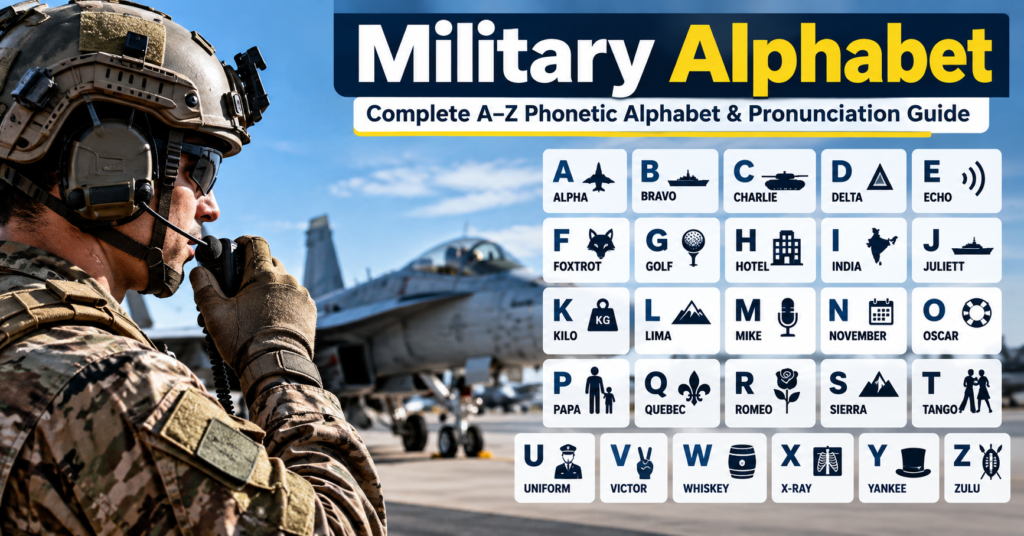
Military Alphabet A to Z
Here is the complete modern military phonetic alphabet from A to Z.
| Letter | NATO Code Word | Pronunciation |
|---|---|---|
| A | Alfa | AL-FAH |
| B | Bravo | BRAH-VOH |
| C | Charlie | CHAR-LEE |
| D | Delta | DELL-TAH |
| E | Echo | ECK-OH |
| F | Foxtrot | FOKS-TROT |
| G | Golf | GOLF |
| H | Hotel | HOH-TEL |
| I | India | IN-DEE-AH |
| J | Juliett | JEW-LEE-ETT |
| K | Kilo | KEY-LOH |
| L | Lima | LEE-MAH |
| M | Mike | MIKE |
| N | November | NO-VEM-BER |
| O | Oscar | OSS-CAH |
| P | Papa | PAH-PAH |
| Q | Quebec | KEH-BECK |
| R | Romeo | ROW-ME-OH |
| S | Sierra | SEE-AIR-RAH |
| T | Tango | TANG-GO |
| U | Uniform | YOU-NEE-FORM |
| V | Victor | VIK-TAH |
| W | Whiskey | WISS-KEY |
| X | X-ray | ECKS-RAY |
| Y | Yankee | YANG-KEY |
| Z | Zulu | ZOO-LOO |
Two spellings deserve special attention: Alfa and Juliett. They may look unusual to English speakers, but these spellings are intentional parts of the international system.
What Is the Military Phonetic Alphabet?
The military phonetic alphabet assigns a distinctive word to each letter.
Instead of saying:
A – B – C – D
a person can say:
Alfa – Bravo – Charlie – Delta
This makes individual letters much easier to recognize during spoken communication.
Consider these four letters:
B – D – P – T
They can sound surprisingly similar through a weak or noisy radio signal. Now compare them with:
Bravo – Delta – Papa – Tango
The second version gives the listener far more information for identifying the intended letters.
This becomes particularly useful when communicating names, callsigns, identifiers, abbreviations, coordinates, registration information, or combinations of letters and numbers.
The standardized code words also mean speakers do not have to invent examples such as “A for Apple” or “B for Boy” every time they need to spell something.
Why Does the Military Use a Phonetic Alphabet?
Clear communication becomes harder when background noise, weak signals, distance, equipment limitations, or different accents interfere with speech.
Individual letters create an additional problem. Short sounds such as B, D, E, G, P, T, and V can be difficult to distinguish.
Words such as Bravo, Delta, Echo, Golf, Papa, Tango, and Victor are much more distinctive.
The alphabet therefore reduces ambiguity when personnel need to spell words or transmit individual characters accurately.
Its usefulness is not limited to military forces. Aviation, maritime operations, and other forms of international communication face many of the same challenges.
How Does the NATO Phonetic Alphabet Work?
The NATO alphabet does not replace ordinary spoken language. Its code words are used when the identity of individual letters needs to be clear.
For example:
MAP
becomes:
Mike – Alfa – Papa
NAVY becomes:
November – Alfa – Victor – Yankee
And:
USA
becomes:
Uniform – Sierra – Alfa
A mixed identifier such as B7K can be communicated as:
Bravo – Seven – Kilo
The listener can then reconstruct the original sequence.
This is why the system is technically a spelling alphabet: the words represent individual letters rather than translating the meaning of the original word.
Alfa or Alpha: Which Is Correct?
People frequently search for the “Alpha Bravo Charlie alphabet.” That phrase refers to the correct system, but its standardized spelling contains an important difference.
The official sequence begins:
Alfa – Bravo – Charlie
rather than:
Alpha – Bravo – Charlie
Alfa is the standardized international spelling.
ICAO explains that the spelling was selected with international pronunciation in mind. English speakers naturally associate “ph” with an F sound, but that relationship does not work the same way across every language.
Using Alfa makes the intended pronunciation clearer internationally.
Another unusual standardized spelling is Juliett, with two Ts.
| Common English Form | Standardized Form |
|---|---|
| Alpha | Alfa |
| Juliet | Juliett |
“Alpha Bravo Charlie” will normally be understood in everyday use. For an accurate reference to the standardized NATO/ICAO alphabet, however, Alfa Bravo Charlie is the correct form.
Military Alphabet Numbers: 0–9
The alphabet provides standardized words for letters. Radiotelephony procedures also use distinctive pronunciations for numbers.
| Number | Spoken Form | Standard Pronunciation |
|---|---|---|
| 0 | Zero | ZEE-RO |
| 1 | One | WUN |
| 2 | Two | TOO |
| 3 | Three | TREE |
| 4 | Four | FOW-ER |
| 5 | Five | FIFE |
| 6 | Six | SIX |
| 7 | Seven | SEV-EN |
| 8 | Eight | AIT |
| 9 | Nine | NIN-ER |
Three forms are particularly recognizable:
3 → TREE
5 → FIFE
9 → NIN-ER
“Niner” is therefore not simply casual military slang for nine. It comes from standardized radiotelephony pronunciation designed to make numbers easier to distinguish during voice communication.
NATO Phonetic Alphabet vs International Phonetic Alphabet (IPA)
The NATO phonetic alphabet should not be confused with the International Phonetic Alphabet (IPA).
Despite the similar names, the two systems have completely different purposes.
| NATO Phonetic Alphabet | International Phonetic Alphabet (IPA) |
|---|---|
| Represents letters with code words | Represents speech sounds with symbols |
| A = Alfa | Uses phonetic symbols |
| B = Bravo | Represents consonant and vowel sounds |
| Used for clear spelling in voice communication | Used in linguistics and language study |
| Common in military and aviation communication | Used to document pronunciation across languages |
The NATO system is therefore more accurately described as a spelling alphabet.
The IPA represents the actual sounds people make when speaking, including consonants and vowel sounds. It can show how an English word—or a word from another language—is pronounced.
The NATO system has a narrower purpose: making individual letters unmistakable during spoken communication.
Why Not Just Say “A as in Apple”?
In an ordinary telephone conversation, saying “A as in Apple” often works.
The problem is consistency.
One person might say:
A for Apple
another:
A for America
and another:
A for Animal
A standardized system removes the need to improvise.
Everyone using the NATO alphabet knows:
A = Alfa
B = Bravo
C = Charlie
Alfa is not the only word capable of representing A. Its advantage is that everyone using the system already knows which word to expect.
That standardization is the real strength of the alphabet.
Military Alphabet and Morse Code
The military alphabet and Morse code both represent letters, but they work in completely different ways.
The NATO alphabet uses spoken code words. Morse code represents characters through combinations of dots and dashes.
| Letter | NATO Word | Morse Code |
|---|---|---|
| A | Alfa | .– |
| B | Bravo | –… |
| C | Charlie | –.–. |
| D | Delta | –.. |
| E | Echo | . |
| F | Foxtrot | ..–. |
| G | Golf | ––. |
| H | Hotel | …. |
| I | India | .. |
| J | Juliett | .––– |
| K | Kilo | –.– |
| L | Lima | .–.. |
| M | Mike | –– |
| N | November | –. |
| O | Oscar | ––– |
| P | Papa | .––. |
| Q | Quebec | ––.– |
| R | Romeo | .–. |
| S | Sierra | … |
| T | Tango | – |
| U | Uniform | ..– |
| V | Victor | …– |
| W | Whiskey | .–– |
| X | X-ray | –..– |
| Y | Yankee | –.–– |
| Z | Zulu | ––.. |
For example:
S = Sierra in the NATO spelling alphabet.
S = … in International Morse Code.
The systems are related only in the broad sense that both provide standardized ways of representing characters.
History of the Military Alphabet
The modern military alphabet developed through decades of efforts to improve spoken communication.
Early radio and telephone systems created an obvious problem: weak connections could make individual letters difficult to understand. International communication added another challenge because speakers could have different native languages and accents.
Different organizations therefore developed spelling alphabets before the modern international system emerged.
Early International Spelling Alphabets
International efforts to standardize radio and telecommunications developed during the early decades of the twentieth century.
The International Telecommunication Union (ITU) and its predecessors played an important role in international telecommunications standards. Earlier spelling alphabets differed considerably from the modern Alfa-to-Zulu sequence and sometimes relied heavily on geographical names.
As aviation and radio communication expanded across national borders, maintaining different alphabets became increasingly impractical.
The need grew for a single universal spelling alphabet that could work reliably across languages and countries.
The Military Alphabet During World War II
During World War II, the United States used the Joint Army/Navy phonetic alphabet, commonly called the Able Baker alphabet after its first two words.
Instead of today’s:
Alfa – Bravo – Charlie – Delta
the WWII-era system began:
Able – Baker – Charlie – Dog
Other code words included Easy, Fox, George, How, Item, Jig, King, Love, Mike, Nan, Oboe, Peter, Queen, Roger, Sugar, Tare, Uncle, Victor, William, X-ray, Yoke, and Zebra.
This explains why older military recordings, documents, and films may contain words that are unfamiliar to someone who knows only the modern NATO alphabet.
WWII Military Alphabet vs Modern NATO Alphabet
The move to the modern system changed most of the alphabet.
| Letter | WWII Able Baker | Modern NATO Alphabet |
|---|---|---|
| A | Able | Alfa |
| B | Baker | Bravo |
| C | Charlie | Charlie |
| D | Dog | Delta |
| E | Easy | Echo |
| F | Fox | Foxtrot |
| G | George | Golf |
| H | How | Hotel |
| I | Item | India |
| J | Jig | Juliett |
| K | King | Kilo |
| L | Love | Lima |
| M | Mike | Mike |
| N | Nan | November |
| O | Oboe | Oscar |
| P | Peter | Papa |
| Q | Queen | Quebec |
| R | Roger | Romeo |
| S | Sugar | Sierra |
| T | Tare | Tango |
| U | Uncle | Uniform |
| V | Victor | Victor |
| W | William | Whiskey |
| X | X-ray | X-ray |
| Y | Yoke | Yankee |
| Z | Zebra | Zulu |
A few terms survived, including Charlie, Mike, and Victor, while X-ray remained essentially unchanged.
Most others were replaced.
Why Was the WWII Alphabet Replaced?
The challenge was no longer simply creating an alphabet that worked well for American or British English speakers.
Military aviation, civil aviation, and telecommunications increasingly connected people from many countries.
A word that sounds distinctive to a native English speaker may not be equally clear to someone with another first language.
An effective international radiotelephony spelling alphabet therefore needed words that could perform reliably across different languages and accents.
That international requirement helped shape the alphabet used today.
Creation of the Modern ICAO Phonetic Alphabet
The International Civil Aviation Organization (ICAO) played a central role in developing the modern spelling alphabet.
International aviation needed code words that could work across countries, languages, and accents. Candidate words were therefore evaluated for their suitability in international voice communication.
The resulting system became the basis of the modern ICAO phonetic alphabet and NATO alphabet.
The modern alphabet became effective for NATO on March 1, 1956.
Broader adoption of the same system helped reduce the need for organizations to maintain completely different spelling alphabets for the same basic communication problem.
What Role Did the International Telecommunication Union (ITU) Play?
The International Telecommunication Union (ITU) forms part of the broader history of international communications standardization.
International spelling alphabets existed before the current NATO/ICAO version, and telecommunications organizations worked for decades on ways to make communication across borders more reliable.
The modern alphabet should therefore not be viewed simply as a collection of English spelling examples or as an exclusively American military invention.
It emerged from a much wider international effort to standardize voice communication.
NATO Alphabet vs Military Alphabet
In modern everyday usage, NATO alphabet, military alphabet, military phonetic alphabet, and ICAO phonetic alphabet often refer to the same Alfa-to-Zulu system.
There is, however, an important historical distinction.
“Military alphabet” is a broad informal description. Militaries have used several different spelling alphabets throughout history.
“NATO phonetic alphabet” usually identifies the modern standardized system specifically.
So not every military alphabet used historically was the NATO alphabet.
When someone searches for the military alphabet today, however, the modern NATO/ICAO system is normally what they mean.
Who Uses the NATO Phonetic Alphabet?
The alphabet is strongly associated with military communication, but its usefulness extends well beyond armed forces.
Military Communication
Standardized code words help military personnel communicate individual letters clearly when voice conditions make ordinary spelling unreliable.
Aviation
Pilots and air traffic controllers use the ICAO spelling alphabet extensively. Aviation is one of the most prominent civilian applications of the same Alfa-to-Zulu system.
Maritime Communication
Ships and maritime operators regularly communicate across national and linguistic boundaries. Standardized spelling can make individual letters easier to understand.
Emergency and Public-Safety Communication
Public-safety radio users may use phonetic spelling when distinguishing letters, although the exact alphabet can vary between organizations and jurisdictions.
Civilian Communication
Anyone can use the NATO alphabet.
It can help when spelling a difficult surname, email address, registration code, booking reference, serial number, or another letter-and-number combination over the phone.
The underlying principle remains the same: use a recognizable word when the letter itself might be misunderstood.
Military Alphabet Examples
Here are several practical examples of how the system works.
ARMY
Alfa – Romeo – Mike – Yankee
NAVY
November – Alfa – Victor – Yankee
MARINE
Mike – Alfa – Romeo – India – November – Echo
NATO
November – Alfa – Tango – Oscar
RADIO
Romeo – Alfa – Delta – India – Oscar
INDIA
India – November – Delta – India – Alfa
USA
Uniform – Sierra – Alfa
These examples show how the code words represent the letters rather than translate the meaning of the original word.
How to Spell Your Name Using the Military Alphabet
The process is straightforward.
Take the name:
DAVID
Break it into individual letters:
D – A – V – I – D
Then replace each letter with its corresponding NATO word:
Delta – Alfa – Victor – India – Delta
For JAMES:
J – A – M – E – S
becomes:
Juliett – Alfa – Mike – Echo – Sierra
And ROBERT becomes:
Romeo – Oscar – Bravo – Echo – Romeo – Tango
You can apply the same method to almost any name, word, or abbreviation.
Common Military Alphabet Phrases
Some NATO code words also appear in established military expressions.
These additional meanings come from combinations or abbreviations. They are not definitions of the alphabet words themselves.
Bravo Zulu
Bravo Zulu, commonly shortened to BZ, means “well done.”
The expression has a naval signaling history and became a recognized way to communicate approval.
Oscar Mike
Oscar Mike represents the letters O.M. and is commonly associated in U.S. military usage with “on the move.”
Lima Charlie
Lima Charlie represents L.C. and is associated with “loud and clear.”
Whiskey Tango Foxtrot
Whiskey Tango Foxtrot represents the initials W.T.F.
Its familiar meaning comes from those initials, not from separate definitions assigned to Whiskey, Tango, or Foxtrot.
This distinction matters:
Mike represents M.
Oscar represents O.
Bravo represents B.
Any additional meaning depends on how those letters are being used.
How to Memorize the Military Alphabet
Trying to memorize all 26 words at once can make the alphabet harder than necessary.
A simpler approach is to divide it into groups.
A–F
Alfa, Bravo, Charlie, Delta, Echo, Foxtrot
G–L
Golf, Hotel, India, Juliett, Kilo, Lima
M–R
Mike, November, Oscar, Papa, Quebec, Romeo
S–Z
Sierra, Tango, Uniform, Victor, Whiskey, X-ray, Yankee, Zulu
Once you know the sequence, stop practicing only from A to Z.
Pick random letters and recall their words. Then practice spelling familiar things such as your name, hometown, country, or common abbreviations.
This trains the useful skill: quickly matching an individual letter with its standardized code word.
Easy-to-Confuse Military Alphabet Words
A few entries deserve extra attention.
A — Alfa
The standardized spelling is Alfa, not Alpha.
J — Juliett
The standardized spelling has two Ts.
Q — Quebec
The modern Q word is Quebec. The WWII U.S. alphabet used Queen.
R — Romeo
The modern word is Romeo. The older WWII alphabet used Roger.
S — Sierra
Sierra replaced Sugar from the WWII alphabet.
U — Uniform
The older Able Baker system used Uncle.
W — Whiskey
Whiskey represents W.
Z — Zulu
The WWII alphabet used Zebra; the modern alphabet uses Zulu.
Is the Military Alphabet a Secret Code?
No.
Calling Alfa, Bravo, Charlie and the other terms code words does not mean the NATO alphabet provides encryption.
Suppose someone transmits:
Sierra – Echo – November – Delta
Anyone who knows the alphabet can reconstruct:
S – E – N – D
Nothing about the word has been concealed.
The alphabet improves communication accuracy, not secrecy. Encryption and secure military communications are separate subjects involving different systems and procedures.
Military Alphabet Quick Reference
For quick reference:
| Letter | Word | Letter | Word |
|---|---|---|---|
| A | Alfa | N | November |
| B | Bravo | O | Oscar |
| C | Charlie | P | Papa |
| D | Delta | Q | Quebec |
| E | Echo | R | Romeo |
| F | Foxtrot | S | Sierra |
| G | Golf | T | Tango |
| H | Hotel | U | Uniform |
| I | India | V | Victor |
| J | Juliett | W | Whiskey |
| K | Kilo | X | X-ray |
| L | Lima | Y | Yankee |
| M | Mike | Z | Zulu |
The complete sequence is:
Alfa, Bravo, Charlie, Delta, Echo, Foxtrot, Golf, Hotel, India, Juliett, Kilo, Lima, Mike, November, Oscar, Papa, Quebec, Romeo, Sierra, Tango, Uniform, Victor, Whiskey, X-ray, Yankee, Zulu.
Frequently Asked Questions
What is the military alphabet?
The military alphabet is a standardized spelling system that uses distinctive words to represent individual letters. The modern system runs from Alfa for A to Zulu for Z.
What is the NATO phonetic alphabet?
The NATO phonetic alphabet is the modern international radiotelephony spelling alphabet commonly associated with military and aviation communication. It uses 26 code words for the 26 letters of the English alphabet.
What is A to Z in the military alphabet?
The sequence is Alfa, Bravo, Charlie, Delta, Echo, Foxtrot, Golf, Hotel, India, Juliett, Kilo, Lima, Mike, November, Oscar, Papa, Quebec, Romeo, Sierra, Tango, Uniform, Victor, Whiskey, X-ray, Yankee, and Zulu.
Is it Alpha or Alfa in the NATO alphabet?
The standardized spelling is Alfa. “Alpha” remains common in ordinary English and search queries, but the standardized international radiotelephony spelling is Alfa.
Why is Alfa spelled with an F?
The spelling helps support consistent international pronunciation. The English “ph” spelling does not necessarily indicate an F sound to speakers of every language.
Why is Juliett spelled with two Ts?
The standardized spelling Juliett was chosen to help indicate the intended pronunciation internationally.
What is the difference between the NATO phonetic alphabet and IPA?
The NATO alphabet uses words such as Alfa and Bravo to communicate letters clearly. The International Phonetic Alphabet (IPA) uses symbols to represent actual speech sounds, including consonants and vowels.
Is the ICAO phonetic alphabet the same as the NATO alphabet?
The modern ICAO and NATO radiotelephony spelling systems use the same familiar Alfa-to-Zulu sequence.
What is the Alpha Bravo Charlie alphabet?
“Alpha Bravo Charlie alphabet” is a common search term for the NATO phonetic alphabet. The standardized spelling of its first word is Alfa, so the formal sequence begins Alfa, Bravo, Charlie.
What is Z in the military alphabet?
Z is Zulu.
What is R in the military alphabet?
R is Romeo.
What is N in the military alphabet?
N is November.
What is M in the military alphabet?
M is Mike.
What is P in the military alphabet?
P is Papa.
What is X in the military alphabet?
X is X-ray.
Why does the military say “niner”?
“Niner” is a standardized radiotelephony pronunciation associated with the number nine. Its distinctive pronunciation improves clarity during voice communication.
What is the military word for 9?
Nine is pronounced NIN-ER in standardized radiotelephony.
Was the military alphabet different during World War II?
Yes. The WWII-era U.S. Joint Army/Navy alphabet included words such as Able, Baker, Dog, Easy, Roger, Sugar, and Zebra. It was later replaced by the modern international system.
When was the modern NATO phonetic alphabet introduced?
The modern alphabet became effective for NATO on March 1, 1956, following international work to establish a standardized spelling system.
Is Morse code the same as the military alphabet?
No. Morse code represents letters through dots and dashes. The NATO spelling alphabet represents letters through spoken words.
Can civilians use the NATO alphabet?
Yes. Anyone can use it when exact letters need to be communicated clearly over a telephone, radio, or other voice connection.
Final Takeaway
The military alphabet, better known internationally as the NATO phonetic alphabet, provides a standardized solution to a simple but important problem: individual letters can be surprisingly easy to misunderstand during voice communication.
Instead of relying on short letter sounds, the system assigns distinctive code words to all 26 letters:
Alfa, Bravo, Charlie, Delta, Echo, Foxtrot, Golf, Hotel, India, Juliett, Kilo, Lima, Mike, November, Oscar, Papa, Quebec, Romeo, Sierra, Tango, Uniform, Victor, Whiskey, X-ray, Yankee, and Zulu.
Its development formed part of a broader international effort to improve military, aviation, and telecommunications communication. Earlier systems—including the WWII Able Baker alphabet—eventually gave way to the standardized international alphabet used today.
Its lasting value comes from consistency. Whether someone is communicating by radio, spelling an identifier in aviation, or simply clarifying a name over the telephone, both sides can use the same recognized words.
And despite the familiar search phrase “Alpha Bravo Charlie,” one detail is worth remembering:
The standardized alphabet starts with Alfa.
READ ALSO: https://militarycompare.com/mexico-military-strength/