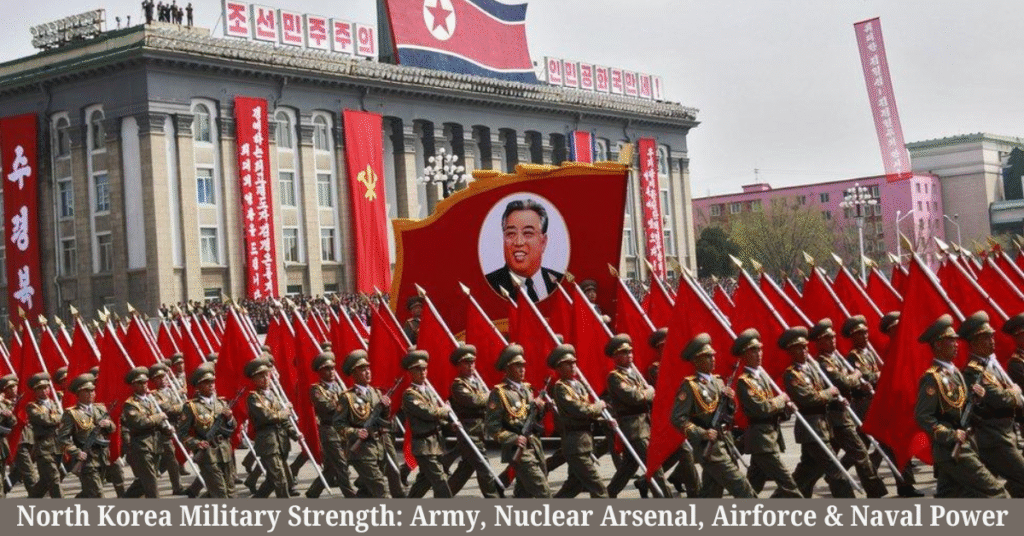
North Korea remains one of the most unusual military powers in the world in 2026. Its armed forces combine one of the world’s largest active-duty militaries with thousands of tanks and artillery systems, an extensive missile force, a growing nuclear weapons program, a large but mostly aging combat-aircraft inventory, and a navy dominated numerically by submarines and smaller coastal vessels.
In the 2026 Global Firepower ranking, North Korea is ranked 31st out of 145 countries, with a Power Index score of 0.5933.
That ranking does not fully explain North Korea’s military position.
Unlike countries whose military strength depends heavily on modern aircraft, blue-water naval forces, or overseas logistics, North Korea has developed a force primarily suited to deterrence, defense of the Korean Peninsula, massed ground firepower, missile strikes, nuclear capability, and asymmetric warfare.
This makes North Korea particularly important to examine beyond its overall global ranking.
☷On this pageJump to a section of this military guide
North Korea Military Strength 2026 at a Glance
Public information about the Korean People’s Army is limited, so many North Korean military figures should be treated as estimates rather than precise operational totals.
The 2026 comparative dataset gives the following picture:
| Category | North Korea 2026 |
|---|---|
| Global Firepower Rank | 31 of 145 |
| GFP Power Index | 0.5933 |
| Active Military Personnel | 1,320,000 |
| Reserve Personnel | 560,000 |
| Paramilitary Personnel | 100,000 |
| Total Estimated Military Personnel | 1,980,000 |
| Military Aircraft | 837 |
| Fighter Aircraft | 341 |
| Dedicated Attack Aircraft | 114 |
| Helicopters | 205 |
| Tanks | 4,895 |
| Armored Vehicles | 47,792 |
| Self-Propelled Artillery | 1,300 |
| Towed Artillery | 700 |
| MLRS / Rocket Artillery | 1,500 |
| Naval Assets | 332 |
| Submarines | 24 |
| Patrol Vessels | 227 |
| Defense Budget | $4.75 billion |
North Korea’s numbers reveal an important pattern immediately: its conventional strength is concentrated much more heavily in personnel, tanks, artillery, missiles, submarines, and coastal forces than in modern long-range air or naval power.
North Korea Military Ranking in 2026
North Korea holds the 31st position among 145 countries in the 2026 Global Firepower assessment.
Its 0.5933 Power Index places it well below the world’s largest conventional military powers in the overall ranking, but North Korea performs considerably better in several individual categories.
Its notable 2026 category positions include:
- #3 in tanks
- #4 in submarines
- #5 in active military personnel
- #5 in fighter aircraft
- #5 in dedicated attack aircraft
- #5 in self-propelled artillery
- #6 in MLRS / rocket artillery
- #6 in total naval assets
- #3 in patrol vessels
These rankings illustrate why North Korea should not be understood through its #31 overall position alone.
The country maintains particularly large quantities of equipment designed for land warfare and operations around the Korean Peninsula, while lacking many of the global-support capabilities possessed by the highest-ranked military powers.
North Korea Military Personnel
Manpower is one of North Korea’s clearest conventional military strengths.
The 2026 dataset estimates:
| Personnel Category | Estimated Strength |
|---|---|
| Active Personnel | 1,320,000 |
| Reserve Personnel | 560,000 |
| Paramilitary Personnel | 100,000 |
| Total Military Personnel | 1,980,000 |
With approximately 1.32 million active personnel, North Korea ranks fifth in the comparative active-duty manpower category.
This is especially significant considering the country’s estimated population of approximately 26.3 million.
The dataset estimates that active personnel alone represent roughly 5% of the country’s population, while the combined military personnel figure approaches 2 million.
Why North Korea Maintains Such a Large Military
North Korea’s military structure reflects the security environment of the Korean Peninsula.
Its forces have traditionally emphasized:
- Large ground formations
- Extensive artillery
- Armored forces
- Special operations
- Air defense
- Missile forces
- Coastal defense
- Rapid mobilization
The country’s geography also shapes its force structure. North Korea does not need the same type of intercontinental transport and expeditionary infrastructure required by militaries designed to operate worldwide.
Its principal conventional military requirements are concentrated much closer to home.
North Korean Army Strength 2026
The Korean People’s Army Ground Force forms the numerical backbone of North Korea’s conventional military.
The 2026 dataset estimates approximately 1.37 million Army personnel, although branch-level personnel figures are among the numbers that should be treated cautiously because reliable official information is limited.
North Korea nevertheless maintains one of the world’s largest inventories of land-warfare equipment.
North Korea Land Forces
| Land Capability | 2026 Inventory |
|---|---|
| Tanks | 4,895 |
| Armored Vehicles | 47,792 |
| Self-Propelled Artillery | 1,300 |
| Towed Artillery | 700 |
| MLRS / Rocket Artillery | 1,500 |
The 4,895-tank inventory ranks third in the 2026 comparative dataset.
But the size of the tank fleet requires context.
North Korea operates a mixture of older Soviet-derived designs and domestically developed vehicles. A large numerical inventory therefore does not mean that every North Korean tank offers capabilities comparable with the latest main battle tanks operated by technologically advanced militaries.
Age, protection, sensors, ammunition, maintenance, crew training, communications, and availability all affect actual battlefield usefulness.
Artillery: A Core North Korean Capability
Artillery is particularly important when evaluating North Korea.
The country possesses substantial numbers of:
- Self-propelled artillery
- Towed artillery
- Multiple-launch rocket systems
- Long-range rocket artillery
North Korea’s 2026 inventory includes approximately 1,300 self-propelled artillery systems and 1,500 MLRS/rocket systems in the categories tracked by the comparative dataset.
This land-based firepower fits North Korea’s geographic and strategic situation much more directly than aircraft carriers or long-range expeditionary forces would.
Artillery and rocket forces can support conventional operations without requiring the sophisticated aerial-refueling, transport, or blue-water naval networks necessary for global power projection.
North Korea Missile Strength in 2026
Missiles are one of the most important capabilities missing from simple comparisons of tanks, aircraft, and ships.
North Korea has spent decades developing a diverse missile force covering different ranges and missions.
Its missile programs include:
- Short-range ballistic missiles
- Medium- and intermediate-range ballistic missiles
- Intercontinental ballistic missiles
- Land-attack cruise missiles
- Submarine-launched systems under development
- Hypersonic-related missile programs
This gives North Korea military options that cannot be represented adequately by its conventional Global Firepower rank.
North Korean ICBMs
North Korea has developed intercontinental ballistic missile systems intended to extend its strategic deterrent beyond Northeast Asia.
Its missile development has increasingly emphasized solid-propellant technology.
Systems associated with this effort include the Hwasong-18, followed by newer developments such as the Hwasong-19 and subsequently displayed Hwasong-20 program.
Solid-propellant missiles have an important practical advantage over large liquid-fueled systems: they can generally be prepared and operated with a smaller logistical footprint.
North Korea’s ICBM development therefore represents not merely an attempt to increase range but also an effort to improve the survivability and flexibility of its strategic missile force.
Short-Range Ballistic Missiles
Short-range missiles are equally important—and potentially more directly relevant to conventional operations on the Korean Peninsula.
North Korea operates several newer-generation short-range systems, including the KN-23 and KN-25 families.
These systems contribute to a missile force designed to threaten military targets across South Korea and potentially complicate regional missile defenses.
In 2026, this part of North Korea’s military continued to receive significant attention.
The country’s Ninth Party Congress emphasized increasing nuclear weapons and expanding deployments of existing delivery systems, while specifically highlighting the KN-25 and other short-range ballistic missiles.
North Korea has also been expanding missile-production infrastructure, indicating that quantity as well as technological development remains an important part of its strategy.
North Korea Nuclear Weapons in 2026
North Korea’s nuclear weapons program fundamentally changes how its military strength must be interpreted.
A conventional ranking can compare manpower, tanks, aircraft, ships, finances, and logistics, but nuclear deterrence belongs to a different strategic category.
North Korea has conducted multiple nuclear tests and developed a growing range of potential nuclear delivery systems.
By 2026, its nuclear strategy is no longer centered solely on demonstrating that it can produce a nuclear explosive device. The broader effort includes:
- Increasing nuclear material production
- Expanding the number of nuclear weapons
- Developing tactical nuclear capabilities
- Improving ballistic-missile delivery systems
- Developing cruise-missile options
- Pursuing sea-based nuclear capabilities
- Strengthening nuclear command arrangements
Open-source estimates of the exact number of North Korean nuclear weapons vary considerably.
That uncertainty is important. MilitaryCompare.com therefore does not present a single nuclear-warhead estimate as a confirmed inventory.
What is much clearer is the direction of development: North Korea continues to expand rather than reduce its nuclear and missile capabilities in 2026.
Tactical Nuclear Weapons
North Korea has also emphasized tactical nuclear weapons, which differ conceptually from strategic weapons designed primarily for long-range deterrence.
Pyongyang publicly displayed the Hwasan-31 tactical nuclear warhead design in 2023 and has associated nuclear roles with multiple delivery systems.
Whether every publicly presented configuration has reached full operational deployment cannot be independently established.
Nevertheless, the combination of tactical nuclear messaging, short-range missile development, and increased fissile-material production makes this an increasingly important component of North Korea’s military posture.
North Korea Air Force Strength 2026
North Korea possesses a large aircraft inventory on paper, but air power is also one of the clearest examples of why quantity and capability are not the same thing.
The 2026 dataset lists:
| Air Capability | 2026 Inventory |
|---|---|
| Total Aircraft | 837 |
| Fighter Aircraft | 341 |
| Dedicated Attack Aircraft | 114 |
| Fixed-Wing Transports | 1 |
| Trainer Aircraft | 176 |
| Special-Mission Aircraft | 0 |
| Aerial Tankers | 0 |
| Helicopters | 205 |
| Attack Helicopters | 20 |
North Korea ranks #5 in fighter aircraft and #5 in dedicated attack aircraft in the dataset.
Those rankings look extremely strong until the composition of the fleet is considered.
The Main Limitation of North Korean Air Power
Much of North Korea’s combat-aircraft fleet consists of older Soviet- and Chinese-origin designs.
Aircraft associated with the inventory have historically included types from the:
- MiG-21 family
- MiG-23 family
- MiG-29 family
- Su-25 ground-attack fleet
- Older Chinese-derived fighter designs
The MiG-29 represents one of the more capable conventional fighters available to North Korea, while the Su-25 provides dedicated ground-attack capability.
However, North Korea does not possess a conventional air fleet comparable with modern air forces built around large numbers of fourth- and fifth-generation fighters, advanced airborne surveillance aircraft, aerial refueling, and extensive precision-strike support.
The 2026 dataset illustrates this imbalance particularly clearly: it lists zero aerial tankers and zero special-mission aircraft under the categories tracked.
That severely limits the usefulness of looking only at North Korea’s impressive fighter count.
Why North Korea Still Invests in Air Power
An aging aircraft fleet does not mean North Korea has abandoned the air domain.
Recent developments indicate continued interest in:
- Air-launched weapons
- Cruise missiles
- Unmanned systems
- Air defense
- Modernization of selected capabilities
- Integrating aviation into broader nuclear and missile planning
By late 2025 and into 2026, North Korea was also signaling a new strategic role for its air force, including possible participation in its nuclear deterrent structure.
This suggests Pyongyang may increasingly seek to improve what its air forces can contribute without attempting to build a Western-style modern fighter fleet across the entire inventory.
North Korean Navy Strength 2026
The Korean People’s Army Naval Force presents another unusual numerical picture.
The 2026 dataset lists 332 naval assets, giving North Korea the sixth-largest fleet by number of vessels in the comparative ranking.
But its estimated total tonnage is only about 143,304 tonnes.
That difference is crucial.
North Korea Naval Inventory
| Naval Category | 2026 Inventory |
|---|---|
| Total Naval Assets | 332 |
| Aircraft Carriers | 0 |
| Helicopter Carriers | 0 |
| Destroyers | 2 |
| Frigates | 2 |
| Corvettes | 8 |
| Submarines | 24 |
| Patrol Vessels | 227 |
| Mine-Warfare Vessels | 1 |
The overwhelming majority of this numerical fleet is therefore not composed of large blue-water warships.
Patrol and coastal vessels account for a major share.
This explains why North Korea can rank very highly in total ship numbers while possessing much less total tonnage than major ocean-going navies.
North Korea’s New Destroyers
One of the most important recent developments is North Korea’s movement toward larger and more heavily armed surface combatants.
The 2026 inventory lists two destroyers.
This represents a notable change for a navy historically dominated by submarines, missile boats, patrol vessels, and other smaller coastal platforms.
North Korea’s newer Choe Hyon-class destroyer program indicates an effort to introduce larger multi-role surface ships capable of carrying more advanced sensors and missile systems.
The significance is not that North Korea has suddenly become a major blue-water navy. It has not.
Rather, these ships potentially give Pyongyang a larger surface platform for combining anti-ship, air-defense, and land-attack capabilities, including cruise missiles.
North Korea Submarine Fleet
Submarines remain one of the more strategically important parts of the North Korean navy.
The 2026 comparative dataset lists 24 submarines, placing the country fourth in that particular numerical category.
As with aircraft and tanks, however, submarine numbers require context.
The dataset groups different submarine types together. Older diesel-electric submarines, smaller coastal submarines, experimental ballistic-missile submarines, and a future nuclear-powered submarine would represent very different capabilities.
Therefore, a simple statement such as “North Korea has the world’s fourth strongest submarine force” would be misleading.
Its numerical submarine position is high; its technological composition and missions are much more complicated.
North Korea’s Nuclear-Powered Submarine Project
North Korea is also pursuing what it describes as a nuclear-powered strategic guided-missile submarine.
Images released in late 2025 showed a substantially larger submarine under construction, reportedly around 8,700 tonnes.
This could eventually represent a major change in North Korea’s naval capability if the vessel becomes operational with a functioning nuclear propulsion system and strategic missile capability.
However, there is an important distinction between construction, testing, and operational deployment.
Publicly available information does not establish that North Korea has successfully fielded an operational nuclear-powered submarine in 2026.
It should therefore be treated as a developing capability rather than counted alongside proven operational nuclear submarines.
North Korea Defense Budget 2026
The 2026 comparative dataset assigns North Korea an estimated defense budget of approximately:
$4.75 billion
That places the country 59th among 145 countries in the dataset’s defense-spending category.
This figure requires particularly strong caution.
North Korea’s economy is highly opaque, and comparing its military spending directly with countries that publish detailed government budgets can create a false sense of precision.
Nominal U.S.-dollar spending also does not necessarily capture the actual quantity of domestic military labor, equipment, construction, or industrial output a state can obtain internally.
For this reason, North Korea’s $4.75 billion figure is best treated as a comparative estimate rather than a precise accounting of total military resources.
Military Industry and Missile Production
North Korea’s domestic defense industry is an important part of its military structure.
Its industrial system supports production or development of:
- Ballistic missiles
- Cruise missiles
- Rocket artillery
- Artillery ammunition
- Armored vehicles
- Small arms
- Naval vessels
- Unmanned systems
- Nuclear-related infrastructure
A particularly important development in 2026 is the push to expand missile production.
North Korean leadership announced plans to increase production capacity for various ballistic and cruise missiles by 2.5 times over the next five years.
The scale and eventual output of that expansion cannot yet be independently confirmed, but the policy direction is clear: Pyongyang is prioritizing larger missile inventories alongside continued nuclear development.
North Korea’s Asymmetric Military Strategy
North Korea’s most important capabilities do not fit neatly into conventional equipment tables.
Its military posture places substantial emphasis on systems that can offset disadvantages in modern aircraft, surveillance, logistics, and conventional technology.
These include:
Ballistic Missiles
Road-mobile ballistic missiles give North Korea the ability to distribute strike assets rather than depend entirely on fixed launch locations.
Cruise Missiles
Land-attack cruise missiles provide another strike route and fly differently from ballistic missiles, complicating air and missile defense.
Nuclear Weapons
Nuclear forces provide strategic deterrence that cannot be represented meaningfully by conventional equipment totals.
Submarines
Even older submarines can create surveillance and anti-submarine requirements for opposing naval forces.
Special Operations
North Korea has historically maintained substantial special-operations capabilities designed for infiltration, reconnaissance, sabotage, and other specialized missions.
Artillery and Rocket Forces
Large numbers of artillery and rocket systems provide substantial land-based firepower without depending on air superiority.
Cyber Capabilities
North Korea has also developed cyber capabilities that sit largely outside conventional military-strength rankings.
These areas explain why North Korea can present a serious military challenge despite substantial technological limitations in other parts of its conventional force.
Geography and the Korean Peninsula
Geography plays an unusually important role in North Korea’s military posture.
North Korea covers approximately 120,538 square kilometers, with about:
- 2,495 km of coastline
- 1,607 km of shared borders
- 2,250 km of usable waterways
Its military is principally structured around operations in and around the Korean Peninsula rather than worldwide deployment.
Mountainous terrain, fortified positions, underground facilities, short regional distances, and proximity to South Korea all affect military planning.
This environment helps explain North Korea’s emphasis on artillery, missiles, ground forces, air defense, coastal forces, and dispersed military infrastructure.
North Korea’s Major Military Strengths
1. Large Active Military
Approximately 1.32 million active personnel give North Korea one of the world’s largest standing armed forces by headcount.
2. Heavy Land Forces
Thousands of tanks, armored vehicles, artillery pieces, and rocket systems provide substantial conventional ground firepower.
3. Ballistic Missile Arsenal
North Korea operates an increasingly diverse family of short-, medium-, intermediate-, and intercontinental-range ballistic missile systems.
4. Nuclear Deterrent
Its nuclear program gives North Korea strategic significance far beyond what its conventional ranking alone suggests.
5. Rocket and Artillery Firepower
Artillery and MLRS systems remain central to its conventional military posture.
6. Large Coastal Fleet
Hundreds of patrol vessels and other smaller ships give the navy a substantial numerical presence around North Korean waters.
7. Submarine Capability
North Korea maintains a significant submarine inventory and continues pursuing more advanced sea-based strategic systems.
8. Domestic Weapons Production
The ability to manufacture missiles, ammunition, artillery, and other military systems domestically provides an important foundation for sustaining its force.
Major North Korean Military Limitations
North Korea’s military also faces significant structural limitations.
Aging Aircraft
A large portion of its combat-aircraft inventory consists of older designs.
Limited Aerial Support Infrastructure
The absence of a meaningful tanker fleet and limited specialized support aircraft restrict long-range air operations.
Limited Blue-Water Naval Power
Most North Korean naval vessels are smaller coastal platforms rather than large ocean-going warships.
Equipment Age
Large inventory totals include many systems based on older designs, making raw numerical comparisons potentially misleading.
Economic Constraints
North Korea does not possess an economic or financial base comparable with the world’s largest military spenders.
Limited Global Logistics
Its armed forces are optimized primarily for regional operations and deterrence rather than sustained expeditionary warfare across the world.
Information Uncertainty
Perhaps the biggest analytical limitation is simply the lack of reliable public information.
Personnel numbers, equipment inventories, readiness levels, production rates, nuclear stockpiles, and operational status can all carry substantial uncertainty.
What Makes North Korea Militarily Dangerous Despite Ranking #31?
North Korea is an excellent example of why an overall military ranking cannot answer every important question.
Its #31 position incorporates many categories in which the country performs poorly, including financial resources, modern logistics, specialized aviation, and global power projection.
But a potential opponent would also have to consider capabilities where North Korea is much stronger:
1.32 million active personnel + thousands of armored systems + extensive artillery + short-range missiles + ICBMs + cruise missiles + nuclear weapons + submarines + fortified geography + asymmetric capabilities.
These capabilities are concentrated around a relatively small geographic theater.
That creates a very different military problem from confronting a country whose forces are spread across global commitments.
Is North Korea a Powerful Military in 2026?
Yes—but the type of power matters.
North Korea is not a conventional global military power comparable with the United States. It lacks a comparable modern air force, carrier fleet, aerial-refueling network, strategic transport system, worldwide basing structure, and economic resources.
Nor should its thousands of tanks or hundreds of aircraft automatically be treated as equivalent to the newest systems fielded elsewhere.
But North Korea possesses several capabilities with disproportionate strategic importance.
Its combination of a very large standing military, extensive artillery, large armored force, expanding ballistic and cruise missile inventories, nuclear weapons, submarines, and asymmetric capabilities makes it a significant regional military power.
Its nuclear and missile forces, in particular, give North Korea strategic influence far beyond what a conventional #31 ranking might initially suggest.
FAQs
What is North Korea’s military rank in 2026?
North Korea ranks 31st out of 145 countries in the 2026 Global Firepower assessment, with a Power Index score of 0.5933.
How many soldiers does North Korea have in 2026?
The 2026 comparative dataset estimates approximately 1.32 million active military personnel, 560,000 reservists, and 100,000 paramilitary personnel.
How many tanks does North Korea have?
The 2026 dataset lists approximately 4,895 tanks, giving North Korea the third-highest tank inventory in that particular comparison. The fleet contains equipment of different ages and capabilities, so the total should not be interpreted as an operational-readiness figure.
How many fighter jets does North Korea have?
The 2026 inventory lists approximately 341 fighter aircraft. Many North Korean combat aircraft are older Soviet- or Chinese-derived designs, making fleet composition important when comparing the number with more modern air forces.
How many military aircraft does North Korea have?
Approximately 837 military aircraft are included in the 2026 comparative inventory, including fighters, attack aircraft, trainers and helicopters.
Does North Korea have nuclear weapons?
Yes. North Korea has conducted nuclear tests and maintains a nuclear weapons program alongside multiple potential delivery systems. Exact operational warhead numbers are uncertain and vary among open-source estimates.
Does North Korea have ICBMs?
Yes. North Korea has developed and tested multiple intercontinental ballistic missile designs, including newer solid-propellant systems intended to improve strategic missile capability.
How many submarines does North Korea have?
The 2026 comparative dataset lists 24 submarines. This number includes submarines of differing designs and capabilities and should not be interpreted as 24 equivalent modern strategic submarines.
Does North Korea have a nuclear-powered submarine?
North Korea is developing a vessel it describes as a nuclear-powered strategic guided-missile submarine, but publicly available evidence does not establish that an operational nuclear-powered submarine has entered service in 2026.
What is North Korea’s defense budget in 2026?
The comparative dataset estimates approximately $4.75 billion. Because North Korea publishes limited economic and military information, this should be treated as an estimate rather than an exact measure of total defense resources.
Why is North Korea’s military considered dangerous?
Its military significance comes from the combination of large manpower, artillery, armored forces, ballistic and cruise missiles, nuclear weapons, submarines, domestic weapons production, and asymmetric capabilities concentrated around the Korean Peninsula.
Is North Korea stronger than its #31 military ranking suggests?
In some strategic areas, yes. An overall conventional ranking does not fully capture the significance of nuclear weapons, missile forces, geography, fortified infrastructure, or other asymmetric capabilities. However, North Korea also has major limitations in modern aviation, global logistics, naval power projection, and economic resources.
Final Takeaway
North Korea’s military strength in 2026 cannot be understood from its #31 global ranking alone.
Its conventional force combines approximately 1.32 million active personnel, 4,895 tanks, 1,500 MLRS systems, 837 aircraft, 332 naval assets, and 24 submarines in the 2026 comparative dataset.
Those numbers are only the beginning of the picture.
North Korea has deliberately concentrated resources in areas that can provide disproportionate military and strategic effects: artillery, ballistic missiles, cruise missiles, nuclear weapons, submarines, domestic weapons production, and asymmetric capabilities.
At the same time, its military faces clear limitations. Much of its conventional equipment is older, its air force lacks the support infrastructure of leading air powers, its navy remains heavily weighted toward smaller vessels, and reliable information about readiness is limited.
The result is a military that is neither accurately described as a modern global superpower nor dismissed simply because it ranks outside the world’s top 30.
In 2026, North Korea remains a heavily militarized, nuclear-armed regional power whose missile and nuclear programs give it strategic importance well beyond its conventional military ranking.