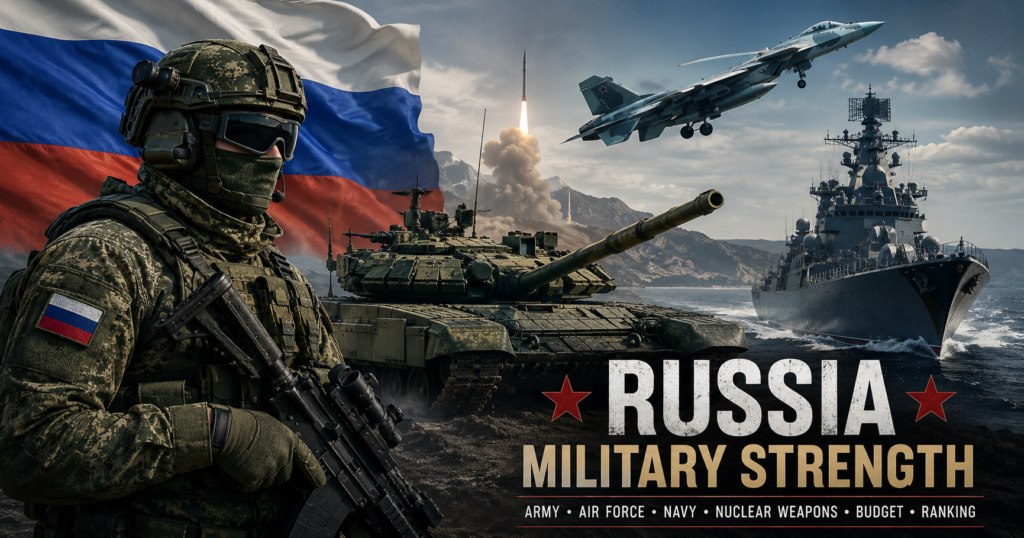
Russia remains the world’s second-highest-ranked military power in 2026, combining a very large ground force, extensive artillery and missile capabilities, one of the world’s largest military-aircraft inventories, a major submarine fleet, strategic nuclear forces, a large defense-industrial base and substantial natural-resource capacity.
In the 2026 Global Firepower ranking, Russia is ranked #2 out of 145 countries, with a PowerIndex score of 0.0791.
That position, however, needs more explanation than a simple ranking can provide.
Russia is fighting a prolonged war in Ukraine, which means its 2026 military strength is shaped simultaneously by combat losses, recruitment, weapons production, battlefield adaptation, drone warfare, missile expenditure, equipment refurbishment and wartime industrial output.
This makes Russia one of the hardest militaries in the world to assess using inventory figures alone.
☷On this pageJump to a section of this military guide
Russia Military Strength 2026 at a Glance
The 2026 comparative dataset gives Russia one of the strongest overall military profiles in the world.
| Category | Russia 2026 |
|---|---|
| Global Military Rank | #2 of 145 |
| PowerIndex | 0.0791 |
| Active Personnel | 1,320,000 |
| Reserve Personnel | 2,000,000 |
| Paramilitary Personnel | 250,000 |
| Total Estimated Military Personnel | 3,570,000 |
| Total Aircraft | 4,237 |
| Fighter Aircraft | 861 |
| Attack Aircraft | 698 |
| Helicopters | 1,643 |
| Attack Helicopters | 556 |
| Tanks | 5,630 |
| Armored Vehicles | 126,512 |
| Self-Propelled Artillery | 3,603 |
| Towed Artillery | 5,920 |
| MLRS / Rocket Artillery | 2,486 |
| Naval Assets | 747 |
| Submarines | 66 |
| Aircraft Carriers | 1 |
| Defense Budget | $212.64 billion |
Russia’s strongest areas remain land warfare, artillery, missiles, nuclear forces, combat aviation, submarines and military-industrial production.
But the 2026 picture is also heavily influenced by the ongoing war in Ukraine.
Russia Military Ranking in 2026
Russia ranks second globally, behind the United States and ahead of China in the 2026 Global Firepower assessment.
Its 0.0791 PowerIndex places it extremely close to the United States at the top of the ranking.
Russia also performs exceptionally well in several individual categories:
- #1 in self-propelled artillery
- #1 in towed artillery
- #1 in submarines
- #1 in corvettes
- #1 in mine-warfare vessels
- #2 in total aircraft
- #2 in dedicated attack aircraft
- #2 in transport aircraft
- #2 in helicopters
- #2 in attack helicopters
- #2 in tanks
- #2 in MLRS
- #2 in total naval assets
- #3 in defense spending
This explains why Russia remains near the top even after several years of intensive warfare.
Its military strength is spread across multiple domains rather than relying on one single category.
Russia Military Personnel in 2026
Russia’s military manpower has expanded substantially during the war period.
The 2026 dataset estimates:
| Personnel Category | Estimated Strength |
|---|---|
| Active Personnel | 1,320,000 |
| Reserve Personnel | 2,000,000 |
| Paramilitary Personnel | 250,000 |
| Total Estimated Military Personnel | 3,570,000 |
Russia therefore has one of the world’s largest military manpower pools.
Its population is estimated at approximately 140.8 million, while the broader available-manpower pool exceeds 69 million.
Why Russian Manpower Is Difficult to Measure
Personnel numbers are particularly fluid during an active war.
Russia’s military manpower can include or be affected by:
- Contract soldiers
- Conscripts
- Mobilized reservists
- Volunteers
- National Guard formations
- Reconstituted units
- Newly recruited personnel
- Personnel returning from medical recovery
- Losses and replacements
For that reason, the 1.32 million active-personnel figure is best understood as a broad comparative estimate rather than the exact number of combat-ready personnel available at any moment.
Russian Army Strength 2026
The Russian Ground Forces remain one of the central pillars of Russian military power.
Russia has historically emphasized large mechanized formations, artillery, air defense and missile support.
The 2026 inventory illustrates the scale:
| Land Capability | 2026 Inventory |
|---|---|
| Tanks | 5,630 |
| Armored Vehicles | 126,512 |
| Self-Propelled Artillery | 3,603 |
| Towed Artillery | 5,920 |
| MLRS | 2,486 |
Russia ranks #2 in tanks, but its artillery position is even stronger.
It ranks first in both self-propelled and towed artillery categories in the dataset.
Russia’s Tank Force
The Russian tank inventory includes several major families:
- T-72
- T-80
- T-90
- Older stored Soviet-era designs
- Limited newer-generation systems
The T-90M remains one of Russia’s more modern operational main battle tanks.
However, Russia’s tank inventory cannot be evaluated purely by counting hulls.
The war in Ukraine has caused major battlefield losses while also forcing Russia to:
- Repair damaged vehicles
- Restore tanks from storage
- Upgrade older models
- Increase new production
- Modify vehicles based on battlefield experience
This creates a constantly changing mixture of modern, upgraded and older platforms.
A figure such as 5,630 tanks therefore represents an inventory estimate, not 5,630 tanks guaranteed to be immediately deployable.
Artillery: One of Russia’s Strongest Areas
Artillery remains one of the defining elements of Russian land warfare.
The 2026 dataset lists:
- 3,603 self-propelled artillery systems
- 5,920 towed artillery systems
- 2,486 MLRS systems
Russia ranks first globally in both self-propelled and towed artillery counts within the dataset.
Common Russian artillery systems include:
- 2S19 Msta-S
- 2S3 Akatsiya
- 2S1 Gvozdika
- BM-21 Grad
- BM-27 Uragan
- BM-30 Smerch
- Tornado family rocket systems
Artillery has played a major role throughout the Ukraine war, reinforcing Russia’s longstanding emphasis on mass fires, rockets and long-range strike support.
Russia’s Drone Warfare in 2026
One of the biggest changes in Russian military power since 2022 has been the extraordinary expansion of drone warfare.
Traditional rankings usually count aircraft, tanks and ships more accurately than they capture thousands of small unmanned systems.
Yet drones now play an important role in:
- Reconnaissance
- Artillery spotting
- First-person-view attacks
- Long-range strike
- Electronic warfare targeting
- Battlefield surveillance
- Precision attack
- Damage assessment
Russia has increasingly integrated drones into everyday battlefield operations.
Long-range one-way attack drones have also become a major part of the strike campaign against Ukraine.
By August 2026, Russian missile and drone attacks remained frequent, demonstrating how central unmanned strike systems have become to Russian operations.
This capability is one reason a traditional “4,237 aircraft” figure does not capture Russia’s complete air-strike capability.
Russia Air Force Strength 2026
Russia possesses the second-largest military-aircraft inventory in the 2026 dataset.
The listed inventory includes:
| Air Capability | 2026 Inventory |
|---|---|
| Total Aircraft | 4,237 |
| Fighters | 861 |
| Dedicated Attack Aircraft | 698 |
| Transport Aircraft | 458 |
| Trainers | 530 |
| Special-Mission Aircraft | 137 |
| Tankers | 18 |
| Helicopters | 1,643 |
| Attack Helicopters | 556 |
Russia’s air arm is not just large. It includes a broad mix of tactical fighters, interceptors, strike aircraft, strategic bombers, transports and helicopters.
Major Russian Combat Aircraft
Important Russian combat aircraft include:
- Su-30SM
- Su-34
- Su-35S
- Su-57
- MiG-29 variants
- MiG-31
- Tu-22M3
- Tu-95MS
- Tu-160
The Su-34 has been especially important for strike missions.
The MiG-31 also plays a specialized role as a high-speed interceptor and missile carrier.
Russia continues to introduce the Su-57, but it still represents only a smaller portion of the overall combat-aircraft fleet compared with older fourth-generation platforms.
Strategic Bombers
Russia is one of the few countries maintaining a major long-range strategic bomber force.
Its principal strategic aircraft include:
Tu-95MS
A turboprop strategic bomber capable of carrying long-range cruise missiles.
Tu-160
A supersonic strategic bomber designed for long-range missile delivery.
Tu-22M3
A long-range strike aircraft used for conventional and potentially nuclear missions.
These aircraft contribute both to conventional long-range strike and Russia’s wider nuclear deterrent.
Russian Helicopter Strength
The dataset lists approximately 1,643 helicopters, including 556 attack helicopters.
Major types include:
- Ka-52
- Mi-28
- Mi-24 / Mi-35
- Mi-8 / Mi-17
- Mi-26
The Ka-52 and Mi-28 represent Russia’s newer attack-helicopter capability, while Mi-8-family helicopters remain critical for transport and battlefield support.
The large helicopter inventory gives Russia significant tactical aviation capacity, although combat losses and maintenance requirements mean inventory totals should again be separated from operational availability.
Russia Missile Forces
Missiles are another area where conventional equipment tables can understate Russia’s military strength.
Russia operates a wide range of strike systems, including:
- Iskander ballistic missiles
- Kalibr cruise missiles
- Kh-101 air-launched cruise missiles
- Kinzhal air-launched ballistic missiles
- Oniks anti-ship/land-attack missiles
- Zircon hypersonic missiles
- Strategic ballistic missiles
Russia has used ballistic and cruise missiles extensively during the Ukraine war.
This has provided combat experience but has also required sustained production to replace large numbers of expended weapons.
Russian Air Defense
Russia possesses one of the world’s most extensive ground-based air-defense networks.
Major systems include:
- S-400
- S-300 variants
- Buk family
- Tor family
- Pantsir systems
These systems are designed to defend against combinations of aircraft, helicopters, drones and missiles.
Air defense has become especially important as Ukraine has expanded long-range drone and missile strikes into Russian territory.
By late August 2026, Ukrainian drone attacks were causing substantial disruption to Russian oil-refining infrastructure, demonstrating that even a large air-defense network cannot protect every target across Russia’s enormous territory.
Russia Navy Strength 2026
Russia’s navy remains numerically one of the world’s largest.
The 2026 dataset lists:
| Naval Category | 2026 Inventory |
|---|---|
| Total Naval Assets | 747 |
| Total Tonnage | 1.43 million tonnes |
| Aircraft Carriers | 1 |
| Destroyers | 13 |
| Frigates | 12 |
| Corvettes | 79 |
| Submarines | 66 |
| Patrol Vessels | 70 |
| Mine Warfare Vessels | 45 |
Russia ranks #2 in total naval assets and #3 in total fleet tonnage in the dataset.
But the strongest part of Russian naval power is not necessarily its surface fleet.
It is the submarine force.
Russia Submarine Fleet
Russia ranks #1 in submarines in the 2026 comparative dataset with 66 submarines.
The fleet includes different types:
- Nuclear-powered ballistic missile submarines
- Nuclear-powered attack submarines
- Cruise-missile submarines
- Diesel-electric attack submarines
Important classes include:
- Borei
- Yasen
- Akula
- Oscar II
- Improved Kilo
Borei-Class SSBNs
Borei-class submarines form an important part of Russia’s strategic nuclear deterrent.
They carry submarine-launched ballistic missiles and are designed to provide a survivable second-strike capability.
Yasen-Class Submarines
Yasen-class nuclear-powered submarines are among Russia’s most capable attack and cruise-missile submarines.
Their roles can include:
- Anti-submarine warfare
- Anti-surface warfare
- Long-range cruise-missile attack
- Intelligence missions
This submarine force is one reason Russia’s naval power cannot be evaluated simply by surface-warship numbers.
Russia’s Aircraft Carrier
The 2026 GFP dataset counts one Russian aircraft carrier.
This refers to the Admiral Kuznetsov.
However, inventory status should not be confused with operational carrier capability.
The vessel has undergone a prolonged repair and modernization process and has not provided Russia with a continuously available carrier-strike capability comparable with active U.S. carrier groups.
For practical 2026 analysis, Russia’s strongest naval capabilities remain submarines, missile-equipped surface ships, coastal forces and long-range naval strike, rather than carrier aviation.
Russia Nuclear Weapons
Russia is one of the world’s two largest nuclear powers.
Its nuclear forces are organized around the traditional strategic triad:
Land-Based Ballistic Missiles
Russia operates silo-based and mobile intercontinental ballistic missiles.
Ballistic Missile Submarines
Nuclear-powered SSBNs provide a sea-based nuclear deterrent.
Strategic Bombers
Tu-95MS and Tu-160 bombers provide the air-based component.
Russia also maintains a broad range of shorter-range nuclear-capable delivery systems.
Exact numbers of operational warheads vary by definition and source, so it is better to distinguish between:
- Total nuclear stockpile
- Deployed strategic warheads
- Reserve warheads
- Retired warheads awaiting dismantlement
rather than presenting one large number as if every warhead had the same operational status.
Russia Defense Budget 2026
The 2026 comparative dataset assigns Russia a defense budget of approximately $212.64 billion, ranking it third globally behind the United States and China.
That figure reflects the huge financial demands of sustaining and modernizing a military engaged in prolonged warfare.
Major spending pressures include:
- Personnel
- Ammunition
- Missiles
- Drones
- Armored vehicles
- Aircraft
- Air defense
- Repair and refurbishment
- Military infrastructure
- Nuclear forces
- Defense-industry expansion
Russia’s own 2026 federal budget also includes classified defense-procurement allocations, which makes full outside accounting difficult.
That is why the $212.64 billion figure should be treated as a comparative estimate rather than the complete monetary value of every Russian military-related activity.
Russia’s Military-Industrial Capacity
One of Russia’s biggest strategic advantages is that it retains a very large domestic defense industry.
Russia can manufacture or refurbish:
- Tanks
- Armored vehicles
- Artillery
- Ammunition
- Missiles
- Aircraft
- Helicopters
- Air-defense systems
- Submarines
- Warships
- Drones
The Ukraine war has forced much of this industrial base into sustained wartime production.
That matters because military power is not just the equipment available on one specific day.
In a long conflict, the ability to replace damaged equipment, manufacture ammunition and produce new systems becomes increasingly important.
Natural Resources and Military Sustainability
Russia also benefits from one of the world’s largest natural-resource bases.
The 2026 dataset ranks Russia:
- #3 in oil production
- #2 in natural-gas production
- #1 in proven natural-gas reserves
- #5 in coal production
- #2 in proven coal reserves
That resource base supports both the wider economy and military-industrial activity.
However, resource abundance does not make logistics invulnerable.
Ukraine’s long-range strikes on Russian refineries in 2026 have demonstrated how energy infrastructure can itself become a military vulnerability. By late August, Reuters reported that refinery disruptions had reduced Russian gasoline output sharply enough to create domestic supply pressure and increased reliance on imports.
Russia’s Geography and Logistics
Russia is the largest country in the world by land area, at approximately 17.1 million square kilometers.
The same geography that provides enormous strategic depth also creates significant logistical demands.
The 2026 dataset lists:
- More than 1.28 million km of roads
- About 85,494 km of railways
- Around 905 serviceable airports
- 67 major ports and terminals
- Approximately 102,000 km of usable waterways
Rail transport is especially important for Russian military logistics.
Large quantities of:
- Tanks
- Artillery
- Ammunition
- Fuel
- Personnel
- Heavy equipment
can be moved across long distances through the railway network.
This helps Russia sustain large continental military operations, although logistics closer to active battlefields can face very different pressures.
Combat Experience
Russia’s military in 2026 has something that cannot be represented easily in an equipment table:
several years of sustained large-scale combat experience.
The war in Ukraine has exposed major weaknesses but has also forced adaptation in areas such as:
- Drone employment
- Electronic warfare
- Counter-drone operations
- Artillery coordination
- Small-unit tactics
- Battlefield communications
- Fortifications
- Long-range strike
- Logistics
- Equipment modification
Combat experience therefore cuts both ways.
It reveals vulnerabilities while simultaneously creating institutional learning.
Russia’s Major Military Strengths
1. Scale of Ground Forces
Russia retains one of the world’s largest inventories of armored vehicles, artillery and rocket systems.
2. Artillery
Its artillery strength remains exceptional, particularly in self-propelled and towed systems.
3. Missile Forces
Russia possesses extensive ballistic, cruise and hypersonic missile capabilities.
4. Nuclear Deterrent
Its land-, sea- and air-based strategic nuclear forces place it in the highest category of nuclear powers.
5. Large Air Force
More than 4,200 aircraft in the comparative dataset provide a substantial aviation base.
6. Submarine Fleet
Russia’s 66-submarine inventory includes strategically important nuclear-powered boats.
7. Domestic Defense Industry
Russia can produce many major weapons domestically rather than relying completely on foreign suppliers.
8. Natural Resources
Oil, gas, coal and other resources give Russia considerable economic and strategic depth.
9. Wartime Adaptation
Years of fighting in Ukraine have accelerated development and deployment of drones, electronic warfare and other battlefield systems.
Russia’s Major Military Limitations
Heavy Wartime Losses
Years of combat have caused significant personnel and equipment losses.
By late August 2026, Western assessments cited in current reporting suggested Russian personnel losses were continuing at a very high rate relative to recruitment. Those figures remain contested and should not be treated as independently verified totals.
Aging Equipment
Russia maintains large quantities of Soviet-era equipment alongside newer systems.
Large inventory totals therefore hide major differences in quality and condition.
Limited Carrier Aviation
Russia does not possess an operational carrier fleet comparable with the United States.
Smaller Tanker Fleet
Its 18 aerial tankers are substantial but much smaller than the American refueling fleet, limiting equivalent global air-power projection.
Economic Pressure
Long-term warfare, sanctions, military spending and infrastructure attacks create costs across the broader economy.
Infrastructure Vulnerability
The enormous size of Russia makes defending every refinery, airfield, railway facility, storage depot and industrial site impossible.
Russia Military Strength vs Inventory Numbers
Russia is one of the clearest examples of why inventory should not be confused with readiness.
A table may list:
5,630 tanks
but those tanks can include systems that are:
- Active
- Stored
- Under repair
- Undergoing modernization
- Assigned to training
- Awaiting refurbishment
- Recently produced
Similarly, aircraft may be undergoing maintenance, ships may be in repair, and stored vehicles may require substantial work before deployment.
The same applies to every major military.
This article therefore uses equipment figures as comparative inventory estimates, not as claims about how many systems Russia could deploy immediately.
Why Russia Is Ranked #2 in 2026
Russia’s second-place ranking comes from the unusual breadth of its military capability.
It combines:
large manpower + huge land forces + artillery + missiles + air power + submarines + nuclear forces + natural resources + geographic depth + domestic weapons production.
Few countries possess all of those elements simultaneously.
Russia is not necessarily second-best in every individual military capability.
For example, the United States has much greater carrier aviation, aerial refueling and global logistics, while China has a much larger economy and rapidly expanding naval-industrial capacity.
Russia nevertheless remains exceptionally strong across enough categories to retain the #2 overall position in the 2026 comparative ranking.
Is Russia the Second Strongest Military in the World?
According to the 2026 Global Firepower assessment, yes.
Russia ranks second out of 145 countries.
But that does not mean Russia would automatically defeat every military ranked below it.
A real conflict depends on:
- Geography
- Objectives
- Allies
- Readiness
- Logistics
- Air superiority
- Intelligence
- Training
- Industrial capacity
- Ammunition
- Political decisions
- Nuclear deterrence
- Duration
A ranking is therefore best viewed as a broad comparison of national military capacity, not a war-outcome calculator.
FAQs
What is Russia’s military rank in 2026?
Russia ranks #2 out of 145 countries in the 2026 Global Firepower ranking with a PowerIndex of 0.0791.
How many active soldiers does Russia have?
The 2026 comparative dataset estimates approximately 1.32 million active military personnel.
How many reserve soldiers does Russia have?
The same dataset estimates approximately 2 million reserve personnel.
How many tanks does Russia have in 2026?
Approximately 5,630 tanks are listed in the 2026 inventory. This should not be interpreted as the number immediately operational.
How many military aircraft does Russia have?
The dataset lists approximately 4,237 aircraft, including 861 fighters and 698 dedicated attack aircraft.
How many helicopters does Russia have?
Russia is listed with approximately 1,643 military helicopters, including 556 attack helicopters.
How many submarines does Russia have?
The 2026 dataset lists 66 submarines, placing Russia first in that numerical category.
Does Russia have an aircraft carrier?
The inventory lists one carrier, Admiral Kuznetsov, but its long repair history means Russia should not be treated as having continuously available carrier aviation comparable with major active carrier fleets.
What is Russia’s defense budget in 2026?
The comparative dataset lists approximately $212.64 billion, placing Russia third worldwide.
Does Russia have nuclear weapons?
Yes. Russia is a recognized nuclear-weapon state and maintains a strategic triad of land-based missiles, ballistic-missile submarines and strategic bombers.
Why is Russia still ranked second after years of war?
Russia retains a very large military-industrial base, extensive manpower, massive artillery and armored inventories, a large air force, major missile forces, submarines, nuclear weapons and substantial natural resources. However, wartime losses and equipment availability remain important limitations.
Does Russia have the world’s largest tank force?
No. In the 2026 GFP dataset Russia ranks second in tank inventory, with approximately 5,630 tanks.
What is Russia’s strongest military capability?
There is no single answer, but artillery, missiles, nuclear forces, submarines, land forces and domestic weapons production are among Russia’s strongest military areas.
Final Takeaway
Russia remains one of the world’s most powerful militaries in 2026, but its strength is more complicated than its #2 ranking suggests.
The 2026 comparative dataset lists approximately 1.32 million active personnel, 4,237 aircraft, 5,630 tanks, 3,603 self-propelled artillery systems, 2,486 MLRS systems, 747 naval assets and 66 submarines.
Those numbers establish extraordinary scale.
But Russia’s real 2026 military profile is being shaped by something a static ranking cannot fully measure: years of sustained warfare.
The conflict in Ukraine has consumed personnel and equipment while simultaneously pushing Russia to expand recruitment, ammunition production, missile manufacturing, drone use, vehicle refurbishment and military-industrial output.
Russia therefore enters 2026 neither as an untouched peacetime force nor as a military accurately described only through battlefield losses.
It is a large nuclear power operating a wartime military system, with considerable conventional strength, major industrial depth, extensive combat experience and significant continuing constraints.
That combination explains why Russia remains #2 in the 2026 Global Firepower ranking, while also showing why equipment totals alone cannot tell the whole story.