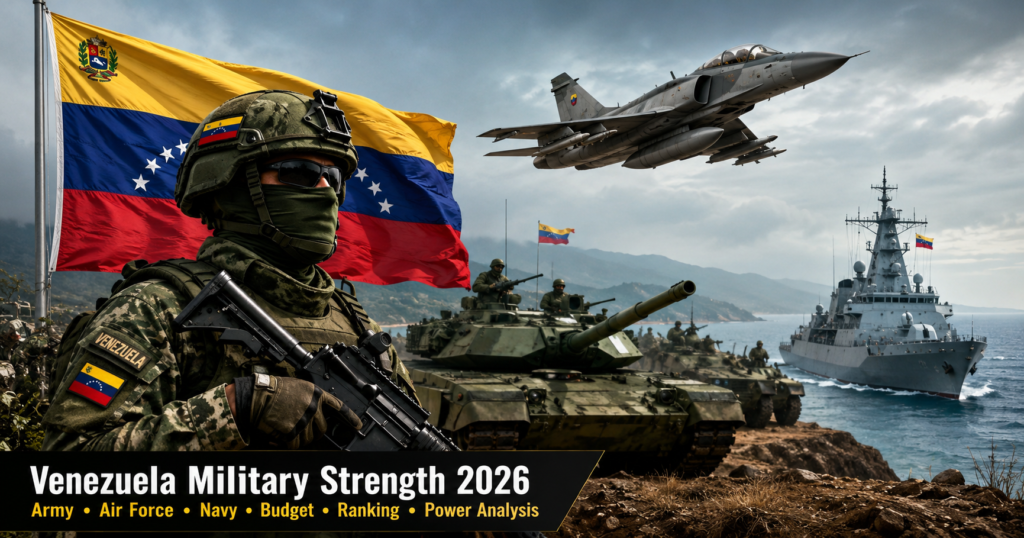
Venezuela remains one of the more notable military powers in South America in 2026, but its strength is very different from that of larger regional forces such as Brazil. The Venezuelan military is built around a sizeable army, Russian-origin fighter aircraft, armored forces, coastal defense, submarines, a large paramilitary component and the world’s largest proven oil reserves.
In the 2026 Global Firepower assessment, Venezuela ranks 51st out of 145 countries with a Power Index score of 0.9106.
The headline ranking, however, does not fully explain Venezuela’s military position. The country has only 109,000 active personnel in the supplied dataset, but it also maintains around 220,000 paramilitary personnel, 224 military aircraft, 282 tanks, more than 15,000 armored vehicles, 41 naval assets and three submarines.
Venezuela’s military profile is therefore best understood as a mid-level regional defense force with significant energy resources, strong paramilitary depth and selected high-value systems, rather than a large global expeditionary military.
☷On this pageJump to a section of this military guide
Venezuela Military Strength 2026 at a Glance
The core Venezuela military strength 2026 figures show a force that is relatively balanced across land, air and naval categories but does not dominate any major conventional military branch.
| Venezuela Military Category | 2026 Figure |
|---|---|
| Global Military Rank | 51st of 145 |
| Power Index | 0.9106 |
| Population | 31.25 million |
| Active Personnel | 109,000 |
| Reserve Personnel | 8,000 |
| Paramilitary Personnel | 220,000 |
| Estimated Total Military Personnel | 337,000 |
| Defense Budget | $6.06 billion |
| Total Aircraft | 224 |
| Fighter Aircraft | 30 |
| Tanks | 282 |
| Armored Vehicles | 15,168 |
| Self-Propelled Artillery | 60 |
| Rocket Projectors | 56 |
| Naval Assets | 41 |
| Submarines | 3 |
| Frigates | 1 |
Venezuela’s most unusual advantage is not equipment quantity. It is the combination of large oil reserves, strategic Caribbean access, paramilitary manpower and selected modern Russian-origin systems.
Venezuela Military Ranking 2026
Venezuela ranks 51st globally in the supplied 2026 Global Firepower assessment.
Its individual rankings vary considerably.
Venezuela performs relatively well in:
- Paramilitary manpower: 9th
- Airports: 16th
- Aerial tankers: 16th
- Transport aircraft: 17th
- Frigates: 18th
- Submarines: 14th
- Oil reserves: 1st
- Natural-gas reserves: 10th
It ranks much lower in several conventional categories such as active personnel, tanks, artillery and overall naval fleet size.
This explains why Venezuela military power is more significant in some strategic areas than its 51st-place overall ranking might imply.
Venezuela Military Manpower 2026
Venezuela has a population of approximately 31.25 million.
The supplied 2026 manpower figures include:
| Venezuela Manpower Category | 2026 Figure |
|---|---|
| Total Population | 31,250,306 |
| Available Manpower | 15,625,153 |
| Fit for Service | 12,812,625 |
| Reaching Military Age Annually | 625,006 |
| Active Personnel | 109,000 |
| Reserve Personnel | 8,000 |
| Paramilitary Personnel | 220,000 |
The standout number is the paramilitary force.
Venezuela has more paramilitary personnel than active military personnel in the supplied dataset.
That significantly changes the Venezuela military manpower picture because the country’s broader security structure is larger than the 109,000-person active force suggests.
Venezuela Army Strength 2026
The Venezuelan Army is the largest conventional component of the armed forces.
The supplied source separately estimates around 300,745 Army personnel under its branch-level calculation, although the main active-personnel total for the entire armed forces is listed at 109,000 because the source uses different estimation methods.
The land inventory includes:
| Venezuela Land Force Category | Inventory |
|---|---|
| Tanks | 282 |
| Armored Vehicles | 15,168 |
| Self-Propelled Artillery | 60 |
| Towed Artillery | 92 |
| MLRS / Rocket Projectors | 56 |
Venezuela’s army is much smaller than those of the world’s leading land powers, but it retains a meaningful armored and artillery structure for regional defense.
Venezuela Tank Strength 2026
Venezuela is listed with approximately 282 tanks.
Its tank force has been strongly influenced by Russian and Soviet-origin equipment.
The most recognizable modern platform in the Venezuelan armored fleet is the T-72B1V main battle tank.
These tanks provide Venezuela with a heavier armored capability than many smaller Latin American militaries.
The 282-tank total does not place Venezuela among the world’s major armored powers, but it remains significant in a regional context.
Venezuela Armored Vehicles
Venezuela has approximately 15,168 armored vehicles in the supplied 2026 dataset.
This category includes far more than tanks.
It can include:
- Armored personnel carriers
- Infantry fighting vehicles
- Protected patrol vehicles
- Armored cars
- Engineering vehicles
- Support vehicles
The armored-vehicle inventory gives the Venezuelan Army greater mobility than the tank figure alone would suggest.
Venezuela Artillery Strength
Venezuela’s artillery force is more modest.
It has approximately:
- 60 self-propelled artillery systems
- 92 towed artillery pieces
- 56 rocket projectors
The Venezuela artillery strength profile therefore supports the army but does not represent one of the country’s strongest global military categories.
Rocket artillery remains useful for mobile fire support, while self-propelled systems can support mechanized formations.
Venezuela Air Force Strength 2026
The Venezuelan Air Force is one of the more interesting parts of the country’s military because its fighter fleet includes Russian-origin combat aircraft.
The supplied dataset lists 224 total aircraft.
| Venezuela Air Power Category | 2026 Inventory |
|---|---|
| Total Aircraft | 224 |
| Fighter Aircraft | 30 |
| Dedicated Attack Aircraft | 0 |
| Transport Aircraft | 47 |
| Trainer Aircraft | 75 |
| Special-Mission Aircraft | 3 |
| Aerial Tankers | 1 |
| Helicopters | 85 |
| Attack Helicopters | 10 |
Venezuela ranks 17th globally in transport aircraft and 16th in the aerial-tanker category in the supplied ranking.
Venezuela Fighter Jets 2026
The supplied inventory lists 30 fighter aircraft.
Venezuela’s most notable combat aircraft include the Su-30MK2, a Russian-built multirole fighter.
The Su-30 gives Venezuela a comparatively advanced heavy fighter capability within Latin America.
The country has also operated older F-16 aircraft, although fleet availability and operational readiness can vary over time.
For the search query Venezuela fighter jets 2026, the key point is that the country has a small fighter fleet by global standards but includes some high-capability platforms.
Why the Su-30 Matters to Venezuela
The Su-30MK2 gives the Venezuelan Air Force:
- Long-range combat capability
- Air-to-air capability
- Strike capability
- Maritime attack potential
- Heavy weapons carriage
A fleet of 30 fighters does not create the numerical depth of a major air power.
But the presence of Su-30 aircraft makes Venezuela’s air force more capable than a simple aircraft total might suggest.
Venezuela Transport Aircraft Strength
Venezuela operates 47 transport aircraft, ranking relatively well in this category.
Transport aircraft support:
- Personnel movement
- Cargo transport
- Military logistics
- Humanitarian missions
- Long-distance resupply
For a country with large internal distances and remote regions, transport aviation has practical military value.
Venezuela Helicopter Fleet
The supplied dataset lists 85 helicopters, including 10 attack helicopters.
Helicopters are especially useful in Venezuela because of its varied terrain, including:
- Mountain regions
- Jungle
- Urban areas
- Remote border zones
Rotary-wing aircraft support troop movement, logistics, reconnaissance and battlefield support.
Venezuela Navy Strength 2026
The Venezuelan Navy is relatively small but includes submarines and a limited number of major surface vessels.
The supplied 2026 fleet contains 41 naval assets.
| Venezuela Naval Category | 2026 Figure |
|---|---|
| Total Naval Assets | 41 |
| Aircraft Carriers | 0 |
| Helicopter Carriers | 0 |
| Destroyers | 0 |
| Frigates | 1 |
| Corvettes | 0 |
| Submarines | 3 |
| Patrol Vessels | 26 |
| Mine Warfare Vessels | 0 |
The fleet is heavily focused on patrol operations.
Venezuela’s three submarines represent its most important conventional naval capability beyond coastal patrol.
Venezuela Submarine Strength
Venezuela is listed with three submarines.
Submarines allow a navy to conduct:
- Maritime surveillance
- Sea denial
- Coastal defense
- Underwater patrols
For Venezuela, submarine capability is particularly relevant because of the country’s long Caribbean coastline and maritime approaches.
Venezuela’s Caribbean Maritime Role
Venezuela has approximately 2,800 km of coastline, giving the country extensive access to the Caribbean Sea and Atlantic approaches.
Its maritime priorities include:
- Coastal security
- Offshore energy infrastructure
- Commercial shipping
- Naval surveillance
- Protection of territorial waters
The country’s navy therefore focuses more on regional maritime defense and patrol operations than on global blue-water power projection.
Venezuela Defense Budget 2026
The supplied 2026 data estimates Venezuela’s defense budget at $6.06 billion.
| Venezuela Financial Category | 2026 Figure |
|---|---|
| Defense Budget | $6.06 billion |
| Purchasing Power Parity | $110.94 billion |
| Foreign Exchange and Gold Reserves | $9.94 billion |
| External Debt | $121.36 billion |
The defense-budget figure ranks Venezuela 51st globally in the supplied dataset.
This creates constraints for modernization, maintenance and procurement, especially when operating imported aircraft, armored vehicles and naval systems.
Venezuela’s Biggest Strategic Resource: Oil
No discussion of Venezuela military strength is complete without its oil reserves.
The supplied 2026 data places Venezuela first globally in proven oil reserves.
| Venezuela Energy Category | 2026 Figure |
|---|---|
| Oil Production | 801,000 barrels |
| Oil Consumption | 203,000 barrels |
| Proven Oil Reserves | 303.806 billion barrels |
| Natural Gas Production | 17.696 billion m³ |
| Proven Natural Gas Reserves | 5.674 trillion m³ |
| Coal Production | 149,000 metric tons |
Venezuela’s proven oil reserves are larger than those of any other country in the supplied dataset.
That resource base gives the country enormous theoretical economic and strategic potential.
Why Oil Reserves Do Not Automatically Equal Military Power
Venezuela’s oil reserves are extraordinary, but military power depends on more than what exists underground.
Turning natural resources into national military strength requires:
- Stable production
- Refining capacity
- Export infrastructure
- Investment
- Government revenue
- Industrial capacity
The difference between oil reserves and oil production is particularly important in Venezuela’s case.
The country possesses the world’s largest proven reserves in the source, but current production is far below the levels achieved by the world’s largest active oil producers.
Venezuela Natural Gas Strength
Venezuela also has substantial natural-gas reserves.
The supplied dataset lists approximately 5.674 trillion cubic meters of proven natural gas reserves, placing the country 10th globally.
This gives Venezuela another major strategic-energy asset beyond oil.
Venezuela’s Geography and Military Defense
Venezuela covers approximately 912,050 square kilometers.
It has:
- 2,800 km of coastline
- 5,267 km of shared borders
- 7,100 km of usable waterways
The country’s large territory includes coastal areas, mountains, forests and major river systems.
That terrain creates both advantages and challenges.
Large geographic depth makes national defense more complex for any attacker, but it also forces Venezuela to spread military forces across a broad area.
Venezuela Military Logistics and Infrastructure
The supplied 2026 logistics figures include:
| Venezuela Infrastructure Category | Figure |
|---|---|
| Internet Coverage | 62% |
| Labor Force | 11.14 million |
| Merchant Marine Fleet | 272 |
| Ports and Terminals | 31 |
| Airports | 509 |
| Road Network | 96,189 km |
| Railway Network | 447 km |
| Usable Waterways | 7,100 km |
The 509 serviceable airports are one of Venezuela’s strongest infrastructure figures, ranking 16th globally in the supplied dataset.
Its long network of usable waterways is also significant for internal transportation.
Venezuela’s 509 Airports
For a country with difficult terrain and large distances, airports are strategically useful.
They can support:
- Military transport
- Cargo movement
- Emergency operations
- Internal mobility
- Logistics
Not all 509 facilities are major military air bases, but the overall network provides geographic flexibility.
Venezuela Paramilitary Strength
One of the least discussed parts of Venezuela military power 2026 is its paramilitary manpower.
The source lists 220,000 paramilitary personnel, ranking Venezuela ninth globally in this category.
That total is more than twice the size of the active military figure.
Paramilitary organizations can support:
- Internal security
- Territorial defense
- Infrastructure protection
- Mobilization
- Support functions
This makes Venezuela’s overall security manpower significantly larger than the regular armed forces alone.
Venezuela’s Main Military Strengths in 2026
Venezuela’s strongest advantages are concentrated in selected areas.
Oil Reserves
The country holds the largest proven oil reserves in the world in the supplied dataset.
Paramilitary Manpower
Around 220,000 paramilitary personnel provide substantial additional manpower.
Su-30 Fighter Capability
The Su-30 gives Venezuela one of the more capable heavy fighter platforms in Latin America.
Submarines
Three submarines add an undersea component to Venezuela’s Caribbean defense posture.
Geographic Depth
A large national territory and long coastline provide defensive depth.
Airport Infrastructure
More than 500 serviceable airports improve geographic mobility.
Venezuela’s Main Military Weaknesses
The Venezuelan military also has clear structural limitations.
Small Active Force
The 109,000-person active military is modest compared with larger regional and global powers.
Limited Fighter Numbers
Only 30 fighters are listed in the supplied 2026 inventory.
Small Surface Navy
Venezuela has only one frigate and no destroyers or aircraft carriers in the supplied classification.
Limited Artillery Depth
Its artillery and MLRS inventories are much smaller than those of major land powers.
Financial Constraints
A $6.06 billion defense budget limits modernization options.
Maintenance and Readiness
Operating imported aircraft, tanks and naval systems can create long-term maintenance challenges if spare parts or upgrades are difficult to obtain.
Why Venezuela Ranks 51st Despite Huge Oil Reserves
Venezuela’s first-place oil-reserve ranking might suggest much greater national power.
Military indexes, however, measure actual force structure rather than resource potential alone.
Venezuela’s overall ranking is held down by factors such as:
- Limited active manpower
- Small fighter fleet
- Modest tank numbers
- Limited surface navy
- Relatively low defense spending
- Small railway network
- Limited reserve force
Oil provides strategic potential, but it does not automatically create aircraft, warships or trained personnel.
Is Venezuela a Strong Military Power in South America?
Venezuela remains a meaningful regional military power, especially because of its fighter aircraft, armored forces, paramilitary manpower and energy resources.
However, it does not possess the overall force size or modernization depth of South America’s strongest military power, Brazil.
Venezuela is better understood as a mid-level regional military with selected high-capability systems rather than a continental military superpower.
Does Venezuela Have a Strong Air Force?
Venezuela’s air force is modest by global standards but relatively notable within its region.
The country has:
- 224 total aircraft
- 30 fighters
- 47 transports
- 75 trainers
- 85 helicopters
The Su-30 fleet is the most strategically significant part of Venezuelan combat aviation.
Does Venezuela Have a Strong Navy?
The Venezuelan Navy is primarily a regional coastal-defense force.
Its strengths include:
- Three submarines
- One frigate
- 26 patrol vessels
It does not possess aircraft carriers, destroyers or a large blue-water surface fleet.
Venezuela Military Power: Overall Assessment
Venezuela’s military does not rely on overwhelming numbers.
Its 2026 force is built around 109,000 active personnel, 220,000 paramilitary personnel, Su-30 fighters, a moderate armored force, submarines and strong geographic defense potential.
The country’s enormous oil reserves add another layer of strategic importance.
But economic strength, industrial capacity and operational readiness ultimately determine how effectively those resources can support military modernization.
How Strong Is Venezuela’s Military in 2026?
Venezuela is a mid-ranking global military power and a significant South American defense force.
Its supplied 2026 inventory includes:
- 109,000 active personnel
- 220,000 paramilitary personnel
- 224 aircraft
- 30 fighters
- 282 tanks
- 15,168 armored vehicles
- 56 rocket projectors
- 41 naval assets
- 3 submarines
- $6.06 billion defense budget
The strongest non-military statistic is even more striking: Venezuela holds approximately 303.8 billion barrels of proven oil reserves, the largest total in the supplied dataset.
That resource base gives Venezuela substantial strategic potential, but its current conventional military remains much smaller than the world’s leading powers.
FAQs
What is Venezuela’s military ranking in 2026?
Venezuela ranks 51st out of 145 countries in the supplied 2026 Global Firepower assessment with a Power Index score of 0.9106.
How many active soldiers does Venezuela have?
Venezuela is listed with approximately 109,000 active military personnel.
How many paramilitary personnel does Venezuela have?
The supplied dataset lists approximately 220,000 paramilitary personnel.
How many tanks does Venezuela have?
Venezuela has approximately 282 tanks.
What tanks does Venezuela use?
The Venezuelan armored force includes T-72B1V main battle tanks among its better-known platforms.
How many military aircraft does Venezuela have?
Venezuela is listed with approximately 224 military aircraft.
How many fighter jets does Venezuela have?
The supplied 2026 inventory lists 30 fighter aircraft.
Does Venezuela have Su-30 fighter jets?
Yes. The Su-30MK2 is one of the most important combat aircraft in Venezuela’s fighter fleet.
How many helicopters does Venezuela have?
Venezuela is listed with approximately 85 helicopters, including 10 attack helicopters.
How many submarines does Venezuela have?
The supplied 2026 naval inventory lists three submarines.
Does Venezuela have an aircraft carrier?
No conventional aircraft carrier is listed for Venezuela.
How many naval ships does Venezuela have?
The supplied dataset lists approximately 41 naval assets.
What is Venezuela’s defense budget in 2026?
The supplied data estimates Venezuela’s defense budget at approximately $6.06 billion.
Does Venezuela have the world’s largest oil reserves?
The supplied 2026 dataset ranks Venezuela first globally in proven oil reserves, with approximately 303.8 billion barrels.
Is Venezuela a military superpower?
No. Venezuela is better described as a regional military power with selected high-value capabilities and exceptional energy resources.
What is Venezuela’s biggest military strength?
Its strongest combination is paramilitary manpower, Su-30 combat aircraft, geographic depth, submarines and enormous oil reserves.
Conclusion
Venezuela military strength in 2026 reflects a country with meaningful regional capability but clear limits in overall conventional scale.
Venezuela ranks 51st globally with 109,000 active personnel, 220,000 paramilitary personnel, 224 aircraft, 282 tanks, more than 15,000 armored vehicles and 41 naval assets.
Its Su-30 fighter fleet gives the air force a capable multirole platform, while three submarines provide Venezuela with an undersea naval capability that many similarly ranked militaries do not possess.
The country’s most extraordinary strategic advantage lies outside the armed forces themselves.
Venezuela holds the largest proven oil reserves in the supplied 2026 dataset, giving it enormous long-term resource potential. That advantage, however, does not automatically translate into military strength without sustained production, investment, maintenance and modernization.
For 2026, Venezuela is best described as a mid-level South American military power with notable fighter, paramilitary, submarine and energy-resource strengths, rather than a global military heavyweight.
Data & Accuracy Note
The military figures in this article are based on 2026 estimates and available defense inventory data. Some military equipment totals are estimated, classified or reported differently between sources, so exact operational numbers may vary.
Aircraft, armored vehicles, naval assets and other equipment may also move in and out of service because of maintenance, modernization, replacement or changing readiness levels.
The figures in this guide should therefore be treated as informational estimates rather than a guaranteed real-time operational inventory.