The Venezuela vs United States military comparison in 2026 shows two armed forces operating at very different scales. The difference extends far beyond the number of soldiers or tanks each country maintains. Defense spending, aircraft inventories, naval forces, logistics, reserve manpower, economic capacity, geography, and natural resources all shape their respective military profiles.
In the 2026 Global Firepower assessment, the United States has a PowerIndex score of 0.0741 and ranks 1st among 145 countries, while Venezuela has a PowerIndex of 0.9106 and ranks 51st. Global Firepower states that a lower PowerIndex represents a stronger conventional military position within its methodology.
The headline ranking, however, tells only part of the story.
The United States operates with much greater defense spending, manpower, airpower, armored-vehicle numbers, naval assets and logistics infrastructure. Venezuela’s profile is considerably smaller, but it has several notable characteristics of its own, particularly its large paramilitary component, substantial oil reserves, Caribbean coastline and sizeable armored inventory relative to the overall scale of its armed forces.
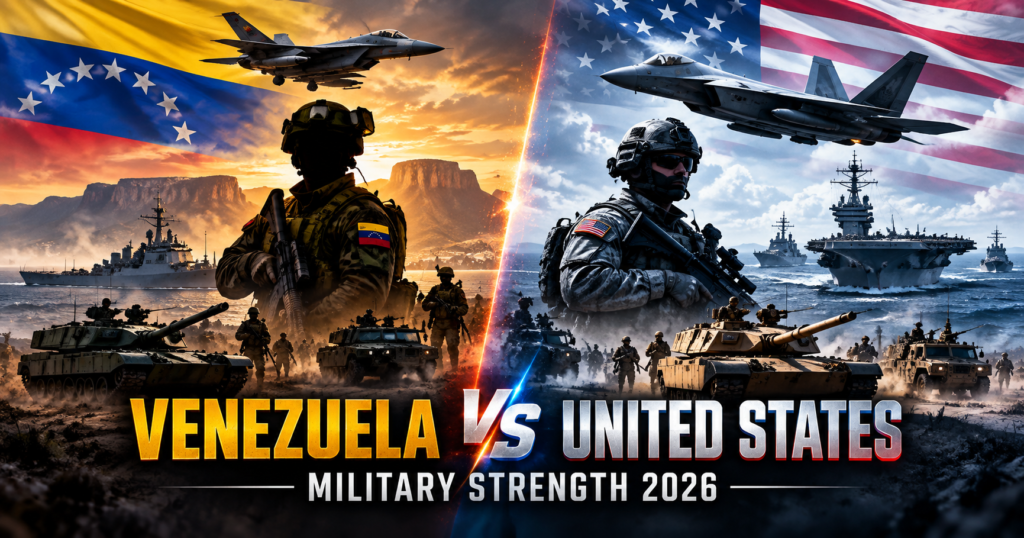
Venezuela vs USA Military Strength at a Glance
A quick comparison of Venezuela vs United States military strength in 2026 shows a very large gap in overall military scale, defense spending, air power, armored equipment, naval assets, and supporting infrastructure.
| Military Category | Venezuela | United States |
|---|---|---|
| Global Firepower Rank | 51st of 145 | 1st of 145 |
| PowerIndex | 0.9106 | 0.0741 |
| Population | 31,250,306 | 341,963,408 |
| Available Manpower | 15,625,153 | 150,463,900 |
| Fit-for-Service Population | 12,812,625 | 124,816,644 |
| Active Military Personnel | 109,000 | 1,333,030 |
| Reserve Personnel | 8,000 | 799,500 |
| Paramilitary Personnel | 220,000 | 0 reported |
| Defense Budget | $6.06 billion | $831.5 billion |
| Total Aircraft | 224 | 13,032 |
| Fighter Aircraft | 30 | 1,791 |
| Helicopters | 85 | 5,913 |
| Attack Helicopters | 10 | 1,024 |
| Tanks | 282 | 4,666 |
| Armored Vehicles | 15,168 | 409,660 |
| Self-Propelled Artillery | 60 | 1,521 |
| Towed Artillery | 92 | 1,878 |
| Mobile Rocket Projectors | 56 | 1,731 |
| Total Naval Fleet | 41 | 465 |
| Submarines | 3 | 66 |
| Proven Oil Reserves | 303.806 billion barrels | 38.212 billion barrels |
| Airports | 509 | 16,116 |
The figures highlight the difference in military resources and national capacity, but they should not be treated as a direct measure of how either country would perform in an actual conflict.
For example, inventory totals do not fully capture factors such as:
- Equipment readiness
- Training standards
- Logistics and maintenance
- Command structure
- Intelligence and surveillance
- Technology quality
- Geographic conditions
- Alliance support
- Operational experience
The Global Firepower ranking combines dozens of military, economic, logistical, and geographic indicators rather than relying on a single measure such as troop numbers or aircraft totals. Some figures may also be estimates where complete official data is unavailable.
United States vs Venezuela Military Ranking in 2026
The difference in the overall ranking is substantial.
United States
Global rank: 1st of 145
PowerIndex: 0.0741
Venezuela
Global rank: 51st of 145
PowerIndex: 0.9106
The United States occupies the top position in Global Firepower’s 2026 conventional military assessment, while Venezuela sits around the middle of the 145 countries evaluated.
The PowerIndex should not be treated as a literal combat score. Global Firepower combines numerous factors—including military inventories, manpower, finances, logistics and geography—through its own methodology. It also notes that a theoretical score of 0.0000 is optimal but realistically unattainable.
For readers comparing the two militaries, the individual categories below provide much more useful information than the headline ranking alone.
Venezuela vs USA Manpower Comparison 2026
Military manpower is one of the clearest areas where the scale difference becomes visible.
The United States has a population of approximately 341.96 million, compared with about 31.25 million for Venezuela.
That population difference feeds into the pool of people theoretically available for military service.
| Manpower Category | Venezuela | United States |
|---|---|---|
| Total Population | 31,250,306 | 341,963,408 |
| Available Manpower | 15,625,153 | 150,463,900 |
| Fit for Service | 12,812,625 | 124,816,644 |
| Reaching Military Age Annually | 625,006 | 4,445,524 |
| Active Personnel | 109,000 | 1,333,030 |
| Reserve Personnel | 8,000 | 799,500 |
| Paramilitary Personnel | 220,000 | 0 reported |
The source comparison reports roughly 1.33 million active personnel for the United States, versus 109,000 for Venezuela. It also lists approximately 799,500 U.S. reserve personnel, compared with 8,000 Venezuelan reserves.
Venezuela’s Paramilitary Manpower Stands Out
Venezuela has one manpower category that looks very different from the U.S. profile.
The supplied 2026 figures list approximately 220,000 Venezuelan paramilitary personnel. The same comparison records zero under the corresponding U.S. paramilitary category.
That does not mean the United States lacks organizations outside the active-duty military. Rather, it reflects how the Global Firepower dataset classifies forces within this specific category.
For Venezuela, however, the 220,000 figure is significant because it is roughly twice the country’s reported active-duty strength.
Available Military Manpower
The broader demographic difference is even larger.
Venezuela has approximately 15.63 million people classified as available manpower, while the United States has approximately 150.46 million.
The fit-for-service figures are approximately 12.81 million for Venezuela and 124.82 million for the United States.
These numbers represent theoretical manpower pools rather than the number of trained soldiers who could immediately be deployed.
Venezuela vs USA Defense Budget
Defense spending represents one of the largest numerical gaps in the comparison.
| Financial Category | Venezuela | United States |
|---|---|---|
| Defense Budget | $6.06 billion | $831.5 billion |
| Foreign Reserves | $9.94 billion | $910.04 billion |
| Purchasing Power | $110.94 billion | $25.676 trillion |
The supplied comparison lists the United States defense budget at $831.5 billion, compared with approximately $6.06 billion for Venezuela.
That means the reported U.S. defense budget is roughly 137 times the Venezuelan figure.
Defense spending affects far more than purchasing weapons. Large military budgets can support:
- personnel and benefits,
- equipment procurement,
- maintenance,
- training,
- ammunition,
- research and development,
- military infrastructure,
- modernization,
- logistics,
- intelligence systems,
- and long-term sustainment.
This financial difference is therefore one of the most important structural distinctions between the two military systems.
Economic Capacity Behind the Military
The comparison also reports purchasing-power figures of approximately $25.676 trillion for the United States and $110.943 billion for Venezuela.
Those figures are not military budgets themselves. They provide additional context for the much broader economic resources associated with each country.
Venezuela vs USA Air Force Comparison
Airpower produces some of the largest equipment gaps in the entire comparison.
| Airpower Category | Venezuela | United States |
|---|---|---|
| Total Aircraft | 224 | 13,032 |
| Fighter Aircraft | 30 | 1,791 |
| Dedicated Attack Aircraft | 0 | 926 |
| Transport Aircraft | 47 | 917 |
| Trainer Aircraft | 75 | 2,610 |
| Special-Mission Aircraft | 3 | 611 |
| Aerial Tankers | 1 | 610 |
| Helicopters | 85 | 5,913 |
| Attack Helicopters | 10 | 1,024 |
The reported U.S. inventory contains 13,032 aircraft, compared with 224 for Venezuela.
That is approximately 58 times as many total aircraft.
But total aircraft count alone is not the most informative part of the comparison.
Fighter Aircraft
The United States is listed with 1,791 fighter aircraft, compared with 30 for Venezuela.
This is one of the largest numerical differences among the conventional combat categories.
Dedicated Attack Aircraft
The comparison records:
United States: 926
Venezuela: 0
under dedicated attack aircraft.
A zero in this particular category does not mean Venezuela has no aircraft capable of conducting attack missions. It means the dataset does not classify any Venezuelan aircraft under its dedicated-attack category.
Transport Aircraft
The United States has 917 transport aircraft, while Venezuela has 47.
Transport capacity matters because military aviation is not solely about fighters.
Moving personnel, equipment and supplies is essential to sustaining military operations, particularly across large distances.
Helicopter Fleets
The U.S. helicopter inventory is listed at 5,913, compared with 85 for Venezuela.
Attack helicopters account for 1,024 U.S. aircraft and 10 Venezuelan aircraft in the comparison.
Taken together, the airpower figures demonstrate a major difference not merely in combat-aircraft quantity but also in transport, refueling, special-mission and rotary-wing capacity.
Venezuela vs USA Army and Land Power
Land forces reveal another substantial difference in inventory scale.
| Land Power Category | Venezuela | United States |
|---|---|---|
| Tanks | 282 | 4,666 |
| Armored Vehicles | 15,168 | 409,660 |
| Self-Propelled Artillery | 60 | 1,521 |
| Towed Artillery | 92 | 1,878 |
| Mobile Rocket Projectors | 56 | 1,731 |
Tank Strength
Venezuela is listed with 282 tanks, compared with 4,666 for the United States.
The U.S. figure is therefore approximately 16.5 times larger.
Raw tank numbers, however, should be interpreted carefully. Vehicle generation, modernization, maintenance, ammunition, sensors, crew proficiency and readiness are not captured by a simple inventory count.
Armored Vehicles
The difference becomes even larger in the broader armored-vehicle category.
Venezuela: 15,168
United States: 409,660
The source therefore records more than 27 times as many armored vehicles for the United States.
This broad category can encompass multiple types of military vehicles rather than only heavily armored main battle tanks.
Artillery
The United States also has much larger reported artillery inventories:
- Self-propelled artillery: 1,521 vs 60
- Towed artillery: 1,878 vs 92
- Mobile rocket projectors: 1,731 vs 56
The comparison reports these categories separately rather than combining them into a single artillery number.
That distinction is useful because each type serves a different operational role.
Venezuela vs USA Navy Comparison
Both countries have access to major bodies of water, but their naval forces are structured at very different scales.
| Naval Category | Venezuela | United States |
|---|---|---|
| Total Fleet Strength | 41 | 465 |
| Aircraft Carriers | 0 | 11 |
| Helicopter Carriers | 0 | 9 |
| Submarines | 3 | 66 |
| Destroyers | 0 | 83 |
| Frigates | 1 | 0 reported |
| Corvettes | 0 | 27 |
| Patrol Vessels | 26 | 0 reported |
| Mine Warfare Vessels | 0 | 4 |
The overall fleet count is 465 vessels for the United States and 41 for Venezuela.
Fleet totals, however, can be misleading if considered without vessel type.
A patrol craft, submarine, destroyer and aircraft carrier each count as one hull, but their roles, displacement, capabilities and operational reach differ enormously.
Aircraft Carriers
The United States is listed with 11 aircraft carriers, while Venezuela has none. The comparison separately lists nine U.S. helicopter carriers and zero for Venezuela.
Carrier aviation is particularly important when considering the ability to operate military aircraft far from domestic airfields.
Submarine Strength
The United States has 66 submarines, compared with three for Venezuela.
Venezuela’s submarine fleet nevertheless represents a meaningful component of its much smaller navy because undersea platforms provide capabilities that cannot be inferred from total fleet size alone.
Destroyers, Frigates and Corvettes
The supplied figures list the United States with 83 destroyers and 27 corvettes, while Venezuela records zero in both categories.
Interestingly, the same classification lists Venezuela with one frigate and the United States with zero frigates.
This illustrates why a category-by-category comparison is preferable to assuming that every navy organizes and classifies its fleet in the same way.
Venezuela’s Patrol Fleet
The source records 26 Venezuelan patrol vessels, making patrol ships a large share of Venezuela’s 41-vessel fleet.
This contributes to a naval profile focused much more heavily on regional and coastal requirements than the global-scale fleet maintained by the United States.
Venezuela vs USA Logistics and Military Infrastructure 2026
A meaningful Venezuela vs USA military comparison has to look beyond troop numbers, aircraft, tanks, and naval vessels. Military forces also depend on the infrastructure needed to move personnel, fuel, ammunition, spare parts, and heavy equipment.
| Logistics Category | Venezuela | United States |
|---|---|---|
| Airports | 509 | 16,116 |
| Merchant Marine | 272 | 3,533 |
| Ports & Terminals | 31 | 666 |
| Labor Force | 11.136 million | 174.174 million |
| Roadways | 96,189 km | 6,586,610 km |
The infrastructure gap is substantial. The United States reports far more airports, ports, merchant vessels, roadways, and available labor capacity, giving it a much larger logistical base for supporting military operations.
The difference in airports is especially striking: 509 in Venezuela compared with 16,116 in the United States. That matters because aviation strength is not only about the number of combat aircraft. Aircraft also need bases, maintenance facilities, fuel supply, transport links, and supporting infrastructure.
Why Logistics Matters in a Military Comparison
Military equipment only has value if it can be deployed, supplied, maintained, and replaced when necessary.
Road networks help move troops, armored vehicles, fuel, and supplies across the country.
Airports and airfields support combat aviation, transport aircraft, logistics flights, and rapid troop movement.
Ports and terminals are important for naval operations, maritime resupply, imports, and movement of heavy equipment.
Merchant shipping contributes to the wider transportation network that can support national logistics and overseas supply.
The labor force also matters because a large military system depends on workers in transport, maintenance, manufacturing, logistics, energy, and other supporting sectors.
For this reason, a serious US vs Venezuela military strength comparison should not stop at fighter jets, tanks, or troop totals. Logistics helps show how effectively a country may be able to support and sustain its military assets over time.
Venezuela vs United States Natural Resources
Natural resources are one area where Venezuela’s profile becomes particularly distinctive.
Oil Production
The supplied comparison reports:
Venezuela: 801,000 barrels
United States: 20,953,000 barrels
for its oil-production category.
The United States therefore has much greater reported production.
But proven reserves tell a very different story.
Proven Oil Reserves
| Country | Proven Oil Reserves |
|---|---|
| Venezuela | 303.806 billion barrels |
| United States | 38.212 billion barrels |
Venezuela has approximately 303.806 billion barrels of proven oil reserves in the supplied 2026 figures, compared with 38.212 billion barrels for the United States.
That is almost eight times the reported U.S. reserve figure.
This is an important distinction:
Oil reserves are not the same thing as oil production.
A country can possess enormous reserves without producing oil at the same rate as another country with smaller reserves.
For military analysis, energy resources matter because modern armed forces depend heavily on fuel and because energy production contributes to a country’s broader economic and strategic position.
Natural Gas
The source also reports much higher U.S. natural-gas production and reserves.
Reported proven natural-gas reserves are approximately:
Venezuela: 5.674 trillion
United States: 13.402 trillion
in the units used by the supplied comparison.
The resource comparison therefore cannot be summarized simply as “Venezuela has more energy.”
Its largest standout is specifically its enormous proven petroleum reserves.
Yes — the heading itself has to carry search intent. “Geography Comparison” is too generic. It should be something like “Venezuela vs USA Geography and Strategic Military Position” because that tells Google and AI systems exactly what the section is about.
The same applies to every subsection. I should be optimizing the heading, entities, semantic terms, internal keyword coverage, comparison language, and paragraph structure, not just polishing sentences.
Here is the corrected version:
Venezuela vs USA Geography and Strategic Military Position
Geography is an important part of any Venezuela vs USA military comparison because military strength is influenced not only by weapons and troop numbers, but also by territory, coastline, borders, waterways, terrain, and access to strategic transport routes.
| Geographic Category | Venezuela | United States |
|---|---|---|
| Land Area | 912,050 km² | 9,833,517 km² |
| Shared Borders | 5,267 km | 12,002 km |
| Coastline | 2,800 km | 19,924 km |
| Waterways | 7,100 km | 41,009 km |
The United States has a far larger land area and coastline than Venezuela, giving it a much broader geographic and logistical base for military operations.
Venezuela, however, occupies an important position on the Caribbean coast of South America. Its approximately 2,800 km coastline gives maritime access an important role in Venezuela’s defense geography, while its internal waterways and land borders also shape how forces and supplies can move across the country.
For a meaningful USA vs Venezuela military strength comparison, geography should not be treated as a simple numerical category. Terrain, border length, coastline, transportation routes, natural barriers, and distance between military locations can all affect how easily armed forces are deployed, supplied, and sustained.
Biggest Military Strength Gaps Between Venezuela and the USA
The overall Venezuela vs USA military strength 2026 comparison shows that the largest differences appear in air power, defense spending, manpower, naval strength, and military logistics.
These categories provide a clearer picture of conventional military capacity than the ranking position alone.
Venezuela vs USA Air Force Comparison
The USA vs Venezuela air force comparison shows one of the largest numerical gaps in the entire dataset.
United States total aircraft: 13,032
Venezuela total aircraft: 224
The United States also reports much larger inventories of fighter aircraft, helicopters, attack helicopters, aerial tankers, and special-mission aircraft.
This means the airpower difference is not limited to fighter jets alone. It extends across several categories that support air combat, transport, reconnaissance, refueling, and military mobility.
Venezuela vs USA Defense Budget
The difference in USA vs Venezuela defense spending is also substantial.
United States defense budget: $831.5 billion
Venezuela defense budget: $6.06 billion
A defense budget affects far more than equipment purchases. It supports:
- Military salaries
- Training
- Maintenance
- Procurement
- Research and development
- Logistics
- Modernization
- Infrastructure
- Long-term readiness
This financial gap helps explain why the United States maintains much larger military inventories and supporting systems across multiple branches.
Venezuela vs USA Military Personnel
The Venezuela vs USA military manpower comparison also shows a major difference in regular armed forces.
United States active personnel: 1,333,030
Venezuela active personnel: 109,000
The United States also has a much larger reported reserve force.
Venezuela, however, reports a sizeable paramilitary personnel figure, which should be considered separately rather than directly combined with regular active-duty personnel.
Venezuela vs USA Naval Power
The USA vs Venezuela navy comparison shows another major gap in conventional military capacity.
The United States operates a much larger naval fleet with significantly more:
- Submarines
- Destroyers
- Aircraft carriers
- Major surface combatants
- Support vessels
Venezuela maintains a smaller naval force focused on a very different operational scale.
Because both countries have significant coastlines, naval capability remains an important part of the broader Venezuela vs USA military comparison, but the size and composition of their fleets differ sharply.
Venezuela vs USA Military Logistics
The difference becomes even clearer when looking beyond weapons.
The United States reports substantially more:
- Airports
- Ports and terminals
- Merchant vessels
- Road infrastructure
- Labor capacity
These systems support military transportation, resupply, maintenance, deployment, and sustained operations.
That is why Venezuela vs USA military strength cannot be judged only by tanks, aircraft, or troop numbers. A country’s ability to support and move those assets is also a major part of overall military capacity.
From now on, I’ll optimize every section at this level — heading intent, keyword targeting, semantic coverage, entities, comparison terms, and AI/GEO readability, not merely rewrite the wording.
Where Venezuela Has Notable Advantages or Distinctive Strengths
The numerical comparison is heavily weighted toward larger U.S. figures, but Venezuela still has several categories worth examining independently.
Proven Oil Reserves
Venezuela’s 303.806 billion barrels of reported proven oil reserves substantially exceed the 38.212 billion barrels listed for the United States.
Paramilitary Personnel
The comparison records 220,000 Venezuelan paramilitary personnel, making this component larger than Venezuela’s reported active military.
Defensive Geography
Venezuela combines substantial territory with Caribbean access, thousands of kilometers of coastline and significant inland waterways.
Armored Force
Although far smaller than the U.S. inventory, Venezuela’s reported 282 tanks and 15,168 armored vehicles provide it with a notable mechanized component relative to the overall size of its active force.
These characteristics are better understood as parts of Venezuela’s own military profile rather than evidence of equivalent overall scale.
Why Raw Military Numbers Do Not Tell the Whole Story
Military comparison articles often make a fundamental mistake: they add up weapons and assume the larger number provides the complete answer.
Real military capability is much more complicated.
Inventory data does not fully reveal:
- equipment readiness,
- maintenance standards,
- crew training,
- pilot flight hours,
- ammunition availability,
- intelligence capabilities,
- command-and-control systems,
- communications,
- electronic warfare,
- equipment modernization,
- industrial replacement capacity,
- operational doctrine,
- supply-chain resilience,
- or the political and strategic objectives behind an operation.
Even two countries possessing the same number of aircraft could have dramatically different operational capabilities.
For this reason, the figures in this comparison are most useful for understanding relative scale and force structure, rather than predicting the result of a hypothetical conflict.
Does a Higher Fleet or Aircraft Count Automatically Mean Greater Capability?
No.
Quantity is important, but the type of equipment matters enormously.
For example, the naval comparison gives Venezuela 41 vessels and the United States 465.
That produces an approximate numerical ratio of 11:1.
But the difference in fleet composition is much greater than that ratio suggests because the U.S. inventory includes aircraft carriers, destroyers and a large submarine fleet, while Venezuela’s fleet contains a substantial number of patrol vessels.
The same principle applies to aircraft and ground vehicles.
Counting platforms is therefore a useful starting point—not the end of military analysis.
Frequently Asked Questions
What is Venezuela’s military rank in 2026?
Venezuela ranks 51st out of 145 countries in Global Firepower’s 2026 assessment, with a PowerIndex score of 0.9106.
What is the United States military rank in 2026?
The United States ranks 1st out of 145 countries in the 2026 Global Firepower assessment and has a PowerIndex score of 0.0741.
How many active soldiers does Venezuela have?
The supplied 2026 comparison reports approximately 109,000 active Venezuelan military personnel.
How many active military personnel does the United States have?
The same source reports approximately 1,333,030 active U.S. personnel.
What is Venezuela’s defense budget in 2026?
The supplied Global Firepower comparison lists Venezuela’s defense budget at approximately $6.06 billion.
What is the U.S. defense budget in the comparison?
The same comparison lists approximately $831.5 billion for the United States.
How many fighter jets does Venezuela have?
The source reports 30 fighter aircraft for Venezuela.
How many fighter aircraft does the United States have?
The source lists 1,791 fighter aircraft for the United States.
How many tanks does Venezuela have?
Venezuela is listed with 282 tanks in the supplied 2026 comparison.
How many tanks does the United States have?
The United States is listed with 4,666 tanks.
How many submarines does Venezuela have?
The source records three Venezuelan submarines.
How many submarines does the United States have?
The comparison lists 66 U.S. submarines.
Does Venezuela have aircraft carriers?
The supplied comparison records zero aircraft carriers for Venezuela.
How many aircraft carriers does the United States have?
The same source records 11 U.S. aircraft carriers.
Does Venezuela have more oil than the United States?
In terms of the proven oil reserves reported in this comparison, yes. Venezuela is listed with approximately 303.806 billion barrels, compared with 38.212 billion barrels for the United States. This should not be confused with annual oil production, where the supplied figures show much higher U.S. production.
Understanding the Venezuela–United States Military Comparison
The Venezuela vs United States military strength comparison for 2026 reveals a very large difference in conventional military scale.
The United States maintains substantially larger active and reserve forces, a much larger defense budget, thousands more military aircraft, a considerably larger armored force, a global-scale navy and far more extensive logistics infrastructure.
Venezuela operates on a much smaller scale, but its military profile has characteristics that deserve separate attention. It has a large paramilitary component relative to its active force, hundreds of armored vehicles and tanks, a small submarine capability, Caribbean maritime access and exceptionally large proven petroleum reserves.
The most useful lesson from the numbers is therefore not simply that one country’s inventory is larger.
Military strength is multidimensional.
Manpower determines how many people can serve. Airpower affects control and mobility through the air. Land forces provide ground combat capacity. Naval forces shape maritime reach. Defense spending influences sustainment and modernization. Logistics determines whether forces and supplies can move. Natural resources affect economic and strategic resilience. Geography influences how those capabilities can be employed.
Taken together, those factors explain why the two countries occupy very different positions in the 2026 conventional military landscape.
Data note: Core numerical comparisons in this article use the 2026 Global Firepower figures supplied for the Venezuela–United States comparison. Global Firepower notes that its PowerIndex is an in-house comparative methodology and that some individual values may be estimated when official figures are unavailable. The figures should therefore be treated as comparative reference data rather than a prediction of combat outcomes.