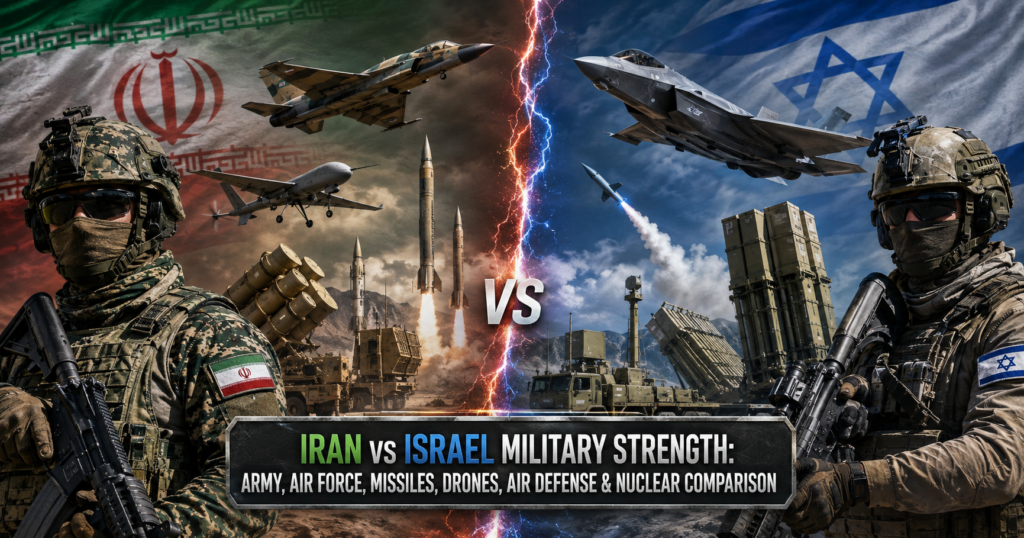
The Iran vs Israel military strength comparison in 2026 cannot be understood by simply placing their troop, tank, aircraft and ship totals next to each other.
The two countries have built fundamentally different military systems.
Iran has the much larger population, territory, active-duty force, tank fleet, artillery inventory, missile arsenal, energy-resource base and overall geographic depth. Its military strategy places major emphasis on ballistic missiles, cruise missiles, drones, dispersed forces, hardened infrastructure and asymmetric capabilities, alongside its conventional Army, Air Force and Navy.
Israel is much smaller geographically and has far fewer active-duty personnel, yet its armed forces are structured around a highly mobilized reserve system, a technologically advanced Air Force, integrated intelligence and surveillance, precision strike, sophisticated electronic systems and one of the world’s most developed layered air- and missile-defense architectures.
The 2026 conventional ranking illustrates how close the broad numerical assessment is.
Israel ranks #15 out of 145 countries with a PowerIndex score of 0.2707, while Iran ranks #16 with 0.3199.
That one-position difference is important—but it does not mean the two militaries have almost identical capabilities.
Iran’s advantages are concentrated heavily in manpower, missiles, land equipment, geographic depth, naval numbers and natural resources.
Israel’s advantages are concentrated more heavily in combat aviation, reserve mobilization, precision weapons, missile defense, sensors, intelligence integration and defense spending.
That makes Iran vs Israel military power in 2026 a comparison of two different approaches to deterrence rather than two mirror-image armed forces.
☷On this pageJump to a section of this military guide
Iran vs Israel Military Strength 2026 at a Glance
Before going deeper, the headline figures establish just how differently the two countries distribute military power.
Iran is vastly larger in manpower and conventional land inventory. Israel, however, spends much more on defense and maintains the stronger numerical fighter fleet despite having a population only a fraction of Iran’s.
| Military Category | Iran | Israel |
|---|---|---|
| Global Military Rank | #16 | #15 |
| PowerIndex | 0.3199 | 0.2707 |
| Active Personnel | 610,000 | 169,500 |
| Reserve Personnel | 350,000 | 465,000 |
| Paramilitary Personnel | 220,000 | 35,000 |
| Defense Budget | $9.23 billion | $34.6 billion |
| Total Aircraft | 551 | 597 |
| Fighter Aircraft | 188 | 239 |
| Dedicated Attack Aircraft | 21 | 45 |
| Transport Aircraft | 86 | 14 |
| Aerial Tankers | 6 | 13 |
| Attack Helicopters | 13 | 48 |
| Tanks | 2,675 | 1,300 |
| Armored Vehicles | 75,939 | 62,380 |
| Self-Propelled Artillery | 424 | 323 |
| Towed Artillery | 1,803 | 171 |
| Mobile Rocket Projectors | 1,550 | 228 |
| Naval Assets | 109 | 82 |
| Submarines | 25 | 6 |
The table already shows why assigning one country an overall “equipment winner” would provide very little insight.
Iran dominates many quantity-based land categories. Israel’s military model depends far more heavily on air power, technology, precision, reserves and integrated defenses.
The most strategically important areas—missiles, drones, air defense and nuclear deterrence—also cannot be understood from this basic inventory table alone.
Iran vs Israel Military Ranking in 2026
Israel’s #15 ranking and Iran’s #16 ranking place the two countries almost next to each other in the 2026 conventional assessment.
Their scores are:
Israel: 0.2707
Iran: 0.3199
This is a particularly useful example of why military rankings need interpretation.
Iran has:
- More active troops
- More tanks
- Far more artillery
- More rocket launchers
- More submarines
- Much greater territory
- A much larger population
- Vast oil and natural-gas resources
Yet Israel remains slightly higher in the overall ranking.
That reflects the fact that military capability cannot be measured purely through mass.
Israel fields fewer personnel and much less heavy equipment but concentrates substantial resources in aircraft, advanced weapons, reserve mobilization, sensors, air defense and other technologically intensive capabilities.
The ranking also does not fully capture several defining features of this matchup.
Iran’s ballistic-missile and drone forces are strategically more important than its tank inventory when considering Israel.
Israel’s layered missile-defense system is similarly more relevant to an Iran comparison than the number of Israeli towed artillery pieces.
That’s why the rest of this article focuses on how each country would actually generate military power, not merely which column contains the larger number.
Iran and Israel Do Not Share a Border
This may be the single most important geographic fact in the entire comparison.
Unlike India and Pakistan, Iran and Israel do not share a direct land frontier.
That changes the military balance immediately.
Large formations of tanks and infantry cannot simply cross directly from Iran into Israel.
Any direct military confrontation therefore places much more emphasis on:
- Long-range aircraft
- Ballistic missiles
- Cruise missiles
- Drones
- Air defense
- Intelligence
- Electronic warfare
- Long-range surveillance
- Aerial refueling
This is precisely why Iran’s 2,675 tanks versus Israel’s 1,300 tanks does not carry the same significance that tank numbers might have in a neighboring-country comparison.
For Iran vs Israel, distance shifts military importance away from conventional border warfare and toward long-range strike and interception.
Iran vs Israel Military Manpower 2026
Iran has the overwhelming demographic and active-duty manpower advantage.
Iran’s population is listed at approximately 88.4 million, compared with about 9.4 million for Israel.
The military gap is similarly large in active personnel.
Iran is listed with approximately 610,000 active personnel, while Israel has about 169,500.
Israel, however, has the larger listed reserve force.
| Manpower Category | Iran | Israel |
|---|---|---|
| Active Personnel | 610,000 | 169,500 |
| Reserve Personnel | 350,000 | 465,000 |
| Paramilitary Personnel | 220,000 | 35,000 |
| Available Manpower | 49,496,685 | 3,949,099 |
| Fit for Service | 41,541,860 | 3,281,513 |
| Reaching Military Age Annually | 1,414,191 | 131,637 |
Iran therefore has far greater long-term demographic depth.
Israel compensates partly through a military structure in which reserve mobilization plays an unusually important role.
That difference is central to understanding both armed forces.
Iran can sustain a much larger standing manpower structure.
Israel maintains a smaller active force relative to its security requirements and relies heavily on trained reservists when forces need to expand rapidly.
Israel’s Reserve System Changes the Manpower Comparison
Looking only at active personnel makes the Iranian advantage appear more than three-and-a-half times larger.
But Israel’s reserve figure is 465,000, exceeding Iran’s listed 350,000.
That is strategically significant for a country with Israel’s population.
Israel’s military model has historically relied on maintaining a relatively compact active force supported by a much larger trained reserve pool that can be mobilized when required.
This provides additional manpower for:
- Ground formations
- Air defense
- Logistics
- Intelligence
- Territorial security
- Support roles
It also creates challenges.
Large-scale reserve mobilization pulls people out of the civilian economy and cannot be treated as a cost-free permanent expansion of the active military.
That makes mobilization speed, duration and economic sustainability important parts of Israeli military power that raw personnel statistics do not show.
Iran’s Two Major Armed Structures: Regular Forces and IRGC
Iran’s military structure is also unusual.
Its defense system is not centered on only one conventional armed force.
Iran maintains the regular Artesh, which includes conventional land, air and naval forces, alongside the Islamic Revolutionary Guard Corps (IRGC).
The two structures have overlapping but different roles.
The conventional military provides traditional capabilities such as:
- Ground forces
- Fighter aircraft
- Armor
- Artillery
- Conventional naval forces
The IRGC is particularly important in areas including:
- Missile forces
- Drones
- Asymmetric warfare
- Regional military networks
- Strategic deterrence
This dual structure means simply counting “Iranian Army personnel” does not fully explain how Iran organizes military power.
It also explains why missiles and unmanned systems deserve far more attention in an Iran comparison than they would in a generic country profile.
Iran vs Israel Army Strength 2026
On paper, Iran has the larger conventional land force by a substantial margin.
Iran is listed with:
- 2,675 tanks
- 75,939 armored vehicles
- 424 self-propelled artillery systems
- 1,803 towed artillery pieces
- 1,550 mobile rocket projectors
Israel is listed with:
- 1,300 tanks
- 62,380 armored vehicles
- 323 self-propelled artillery systems
- 171 towed artillery pieces
- 228 mobile rocket projectors
Iran therefore leads every major land-inventory category in the supplied dataset.
But this is exactly where superficial comparisons become misleading.
Iran Has More Tanks—but Tanks Are Not the Core Iran–Israel Question
Iran has approximately 2,675 listed tanks, compared with Israel’s 1,300.
That is more than twice Israel’s inventory.
Iran’s armored force includes a mixture of locally developed, upgraded and imported-origin platforms representing different generations.
Israel’s armored force is centered heavily around the Merkava family, complemented by armored personnel carriers and other protected vehicles.
If Iran and Israel shared a direct border, this difference would deserve greater strategic weight.
They do not.
Iranian armored formations cannot simply drive directly into Israeli territory without crossing other countries and facing enormous political, logistical and military complications.
Therefore, Iran’s larger tank fleet certainly contributes to its overall conventional land power, but it is not the primary capability governing direct Iran–Israel deterrence.
Missiles and aircraft matter much more.
Artillery and Rocket Forces: Iran’s Huge Numerical Advantage
Iran’s land-fire inventory is much larger.
The difference in towed artillery is particularly striking:
Iran: 1,803
Israel: 171
Iran also has:
1,550 mobile rocket projectors vs Israel’s 228
and
424 self-propelled artillery systems vs Israel’s 323.
Those numbers reflect Iran’s much larger conventional land structure.
But again, range matters.
Traditional artillery is optimized mainly for battlefield operations across dozens of kilometers, not direct strikes between Iran and Israel.
Iran’s truly important long-range strike advantage comes when the comparison moves beyond artillery and into ballistic missiles, cruise missiles and drones.
That is where the Iran–Israel comparison becomes fundamentally different from an ordinary Army comparison.
Iran vs Israel Air Force 2026
Air power strongly favors Israel in several strategically important areas.
The total aircraft fleets are relatively close numerically:
Israel: 597
Iran: 551
But Israel leads in fighter aircraft:
Israel: 239
Iran: 188
It also has more dedicated attack aircraft, aerial tankers, trainer aircraft, special-mission aircraft and attack helicopters.
Iran’s major numerical aviation advantage appears in transport aircraft.
| Air-Power Category | Iran | Israel |
|---|---|---|
| Total Aircraft | 551 | 597 |
| Fighters | 188 | 239 |
| Dedicated Attack Aircraft | 21 | 45 |
| Transport Aircraft | 86 | 14 |
| Trainers | 103 | 148 |
| Special-Mission Aircraft | 10 | 19 |
| Aerial Tankers | 6 | 13 |
| Helicopters | 129 | 127 |
| Attack Helicopters | 13 | 48 |
The difference in total aircraft—only 46—does not describe the real technology gap between the fleets.
That is why the aircraft types, age, sensors, weapons and support systems matter so much.
Israeli Air Force: F-35I, F-15 and F-16
The Israeli Air Force is one of the central pillars of Israel’s military strategy.
Its combat fleet includes aircraft from three particularly important families:
- F-35I Adir
- F-15
- F-16
The F-35I gives Israel a fifth-generation stealth capability.
Stealth does not make an aircraft invisible, but it can reduce detection ranges and complicate enemy air-defense planning.
The F-15 provides long-range performance and substantial weapons capacity, while Israel’s large F-16 fleet contributes multirole capability across air-defense and strike missions.
Israel’s air power also benefits from systems beyond fighters.
These include:
- Aerial refueling
- Airborne surveillance
- Electronic warfare
- Intelligence
- Precision-guided weapons
- Integrated mission planning
This combination matters particularly against Iran because the countries are separated by considerable distance.
Iranian Air Force: Larger Than Often Assumed, but Older
Iran’s Air Force remains sizeable by regional standards, with 188 listed fighters.
Its inventory includes aircraft representing several different generations and origins.
Iran has historically operated fighter types including:
- F-14
- F-4
- F-5-derived aircraft
- MiG-29
- Su-24
- Locally modified or developed aircraft
A notable challenge has been the age of significant portions of this fleet.
Maintaining older aircraft under years of sanctions requires domestic repair, component production and adaptation.
Iran has demonstrated an ability to keep older systems operational longer than might otherwise be expected, but age can influence:
- Availability
- Sensors
- Weapons integration
- Maintenance demands
- Electronic warfare capability
This is one reason Iran has invested so heavily in missiles and drones rather than attempting to match Israel aircraft-for-aircraft through conventional combat aviation alone.
Why Fighter Count Alone Favors the Wrong Question
Israel has 239 listed fighters against Iran’s 188.
That sounds like a difference of only 51 aircraft.
But 239 vs 188 does not mean their air forces are nearly equivalent.
Modern air combat depends on:
- Radar
- Electronic warfare
- Data links
- Beyond-visual-range weapons
- Stealth
- Airborne warning
- Tankers
- Pilot training
- Maintenance
- Intelligence
- Precision targeting
- Mission integration
Israel has structured much of its military around sophisticated air operations.
Iran has responded to limitations in conventional aviation by developing alternative means of long-range strike.
That creates perhaps the defining contrast of this comparison:
Israel emphasizes high-end aircraft and precision aviation; Iran emphasizes missiles and drones to achieve some long-range effects without relying solely on its fighter fleet.
Aerial Refueling Is Crucial for Israel
The supplied figures list:
Israel: 13 aerial tankers
Iran: 6
The difference looks small beside an aircraft fleet of several hundred, but tankers are strategically important.
Iran and Israel are not neighboring states.
Long-distance combat-air operations require fuel.
Aerial refueling can allow fighters to:
- Extend their operational range
- Remain airborne longer
- Carry out distant missions
- Return without relying on intermediate bases
For Israel, tanker capability is therefore much more strategically relevant in an Iran scenario than attack-helicopter or tank totals.
This is another example of why support aircraft can matter more than larger headline inventories.
Iran’s Missile Force Is the Centerpiece of Its Long-Range Military Power
If Israel’s Air Force is one pillar of its long-range capability, Iran’s ballistic and cruise missile force is the equivalent centerpiece of Iranian strategic power.
Iran has invested extensively in missile development.
Its arsenal includes multiple families spanning:
- Short-range ballistic missiles
- Medium-range ballistic missiles
- Cruise missiles
- Precision-improved systems
- Solid- and liquid-fueled designs
These provide Iran with a means of conducting long-range strikes without requiring aircraft to penetrate opposing air defenses.
That distinction is fundamental.
Iran does not need an F-35 equivalent to create a long-range threat if it can deliver payloads through missiles launched from Iranian territory.
Iranian Ballistic Missiles
Iran operates several ballistic-missile families intended for different ranges and missions.
Publicly known Iranian missile programs have included systems in families such as:
- Shahab
- Ghadr
- Emad
- Fateh
- Sejjil
- Khorramshahr
Different missiles vary substantially in range, propulsion, payload, accuracy and mobility.
Mobile launchers can also complicate targeting because they can relocate rather than remain fixed permanently at one known launch site.
For Israel, this makes missile detection, early warning and interception a central defense requirement.
For Iran, missiles provide a way to offset weaknesses in traditional combat aviation.
Iran’s Drone Strategy
Drones have become another major component of Iranian military capability.
Iran has spent years developing multiple classes of unmanned aerial systems for:
- Surveillance
- Reconnaissance
- One-way attack
- Strike
- Target acquisition
Unmanned systems offer several advantages.
They can be considerably cheaper than manned combat aircraft and can be produced in larger quantities.
A drone also does not place a pilot at risk.
More importantly, missiles and drones can potentially be combined in complex attacks designed to approach from different directions, speeds and altitudes.
This changes the defender’s problem.
The challenge is no longer simply “intercept one ballistic missile.”
It may involve detecting and prioritizing ballistic missiles, cruise missiles and drones simultaneously.
Israel’s Layered Air and Missile Defense
Israel’s response to missile and rocket threats has been the development of a multi-layered defensive architecture.
Different systems are intended to address different categories and ranges of threat.
Prominent parts of Israel’s defensive structure include:
- Iron Dome
- David’s Sling
- Arrow family
- Additional air-defense capabilities
These systems are not interchangeable.
Iron Dome
Iron Dome is particularly associated with interception of shorter-range rockets and related threats.
It is designed around detecting trajectories and prioritizing threats that are assessed as heading toward populated or protected areas.
David’s Sling
David’s Sling occupies another layer of the defensive architecture and is intended for more demanding threats at greater ranges than those normally associated with Iron Dome.
Arrow
The Arrow system is associated particularly with ballistic-missile defense.
That makes it especially relevant to the Iran vs Israel missile comparison.
The importance of the layered approach is that one interceptor system does not have to solve every problem.
Different layers can address different threat profiles.
Can Missile Defense Stop Every Iranian Missile or Drone?
No air- or missile-defense network should be treated as an impenetrable shield.
Interception depends on:
- Detection
- Tracking
- Threat identification
- Interceptor availability
- Attack size
- Flight path
- Countermeasures
- System readiness
Large or mixed attacks can also place pressure on defensive capacity.
Interceptor inventories matter because defensive missiles are not unlimited.
This creates an economic as well as operational competition.
The attacker may attempt to use cheaper drones or missiles to force the defender to expend more expensive interceptors.
Therefore the Iran–Israel missile balance is not simply:
Iran launches → Israel intercepts.
It is an ongoing contest involving offensive volume, accuracy, intelligence, interception rates, stockpiles and replenishment.
Iran vs Israel Drones and Counter-Drone Warfare
Drones deserve their own section because they fill a space between traditional aircraft and missiles.
Iran’s drone capability provides relatively low-cost long-range options and can complement missile strikes.
Israel also possesses substantial unmanned-aircraft expertise across surveillance and combat-support roles.
The defensive side is equally important.
Counter-drone operations may involve:
- Radar
- Electro-optical sensors
- Electronic warfare
- Fighter aircraft
- Surface-to-air missiles
- Short-range defenses
Different drones create different problems.
A slow unmanned aircraft may be relatively easy to detect in some conditions but still force a defender to spend time and resources tracking it.
A large wave of low-cost systems can also stress defenses in ways very different from a small number of high-end missiles.
This makes drones increasingly important to the Iran vs Israel military balance in 2026.
Iran vs Israel Air Defense
Both countries operate air-defense systems, but their requirements differ.
Israel’s system is heavily shaped around protecting a small, densely populated country against:
- Rockets
- Drones
- Cruise missiles
- Ballistic missiles
- Aircraft
Iran must defend an enormously larger territory containing:
- Cities
- Military bases
- Missile facilities
- Nuclear-related facilities
- Energy infrastructure
- Industrial sites
Iran operates a mixture of domestic and foreign-origin air-defense systems.
Its network includes long-range and shorter-range systems intended to create overlapping coverage around important areas.
A larger territory, however, creates a major challenge.
Even a country possessing many air-defense batteries cannot protect every square kilometer equally.
This creates a fundamental geographic difference:
Israel has less territory to defend but highly concentrated critical infrastructure; Iran has enormous strategic depth but far more territory and potential targets to cover.
Geography Creates Strategic Depth for Iran
Iran covers approximately 1.648 million square kilometers, while Israel is listed at about 21,937 square kilometers.
That is an extraordinary difference.
Iran is roughly 75 times larger by land area using those figures.
This creates strategic depth.
Iran can disperse:
- Missile units
- Aircraft
- Storage facilities
- Air defenses
- Military bases
- Industrial infrastructure
over a vast territory.
Mountains and rugged terrain add further geographic complexity.
Israel faces almost the opposite challenge.
Its territory is narrow and relatively compact.
That allows forces and infrastructure to be connected over shorter distances, but it also reduces geographic depth.
Critical facilities and population centers can be geographically concentrated.
This helps explain why early warning, air superiority and missile defense are so important to Israeli defense planning.
Iran’s Underground and Dispersed Military Infrastructure
Strategic depth is more useful when military assets can be dispersed and protected.
Iran has invested heavily in hardened and underground facilities for selected military capabilities.
The logic is straightforward.
An asset inside a protected facility is more difficult to locate and destroy than one permanently exposed at a known open site.
Mobile launch systems create another problem for an attacker.
Even highly capable intelligence systems must repeatedly identify and track a launcher that can move.
This creates a continuous contest between:
Iranian concealment and mobility
and
Israeli surveillance, intelligence and precision targeting.
That competition is far more relevant to an Iran–Israel scenario than merely comparing their armored-vehicle totals.
Intelligence and Surveillance
Intelligence is another area conventional equipment tables cannot quantify effectively.
Long-range military operations depend on finding and identifying targets.
For Israel, intelligence is especially important for locating:
- Missile launchers
- Air-defense systems
- Command nodes
- Weapons facilities
- Aircraft
- Military infrastructure
Iran similarly needs surveillance and intelligence for accurate long-range targeting.
Modern intelligence can involve:
- Satellites
- Aircraft
- Drones
- Signals intelligence
- Radar
- Cyber capabilities
- Human intelligence
Much of the most sensitive information in this field is classified.
For that reason, assigning a numerical “intelligence winner” would be misleading.
What can be said is that intelligence, surveillance and target identification are essential to both countries’ long-range military models.
Iran vs Israel Cyber and Electronic Warfare
Cyber capability is difficult to compare publicly for the same reason.
A tank is visible and countable.
A cyber capability may remain secret until it is used.
Both countries operate in a security environment where cyber operations can affect:
- Communications
- Military networks
- Government systems
- Infrastructure
- Intelligence
- Command systems
Electronic warfare can similarly affect radar, navigation, communications and drones.
These capabilities become increasingly important when missiles, aircraft and unmanned systems depend heavily on electronic sensors and networked command.
No responsible comparison can determine their full cyber capabilities from public inventories alone.
Iran vs Israel Navy 2026
Iran has the larger Navy by total listed fleet size.
The 2026 comparison gives Iran approximately 109 naval assets, compared with 82 for Israel.
Iran also has a considerably larger listed submarine fleet:
Iran: 25
Israel: 6
But this naval comparison needs even more geographic context than the land comparison.
| Naval Category | Iran | Israel |
|---|---|---|
| Total Naval Assets | 109 | 82 |
| Aircraft Carriers | 0 | 0 |
| Submarines | 25 | 6 |
| Frigates | 7 | 0 |
| Corvettes | 3 | 7 |
| Patrol Vessels | 21 | 66 |
| Mine-Warfare Vessels | 1 | 0 |
Iran’s maritime strategy is heavily influenced by the Persian Gulf, Gulf of Oman and Strait of Hormuz.
Israel’s Navy operates around a very different set of maritime requirements in the Mediterranean and Red Sea approaches.
Again, comparing ship totals without mission context would be misleading.
Iran’s Naval Strategy and the Strait of Hormuz
Iran’s geography gives it a highly significant position near the Strait of Hormuz, one of the world’s most important maritime energy routes.
Iran’s naval capabilities are not structured around matching major blue-water navies ship-for-ship.
Instead, its maritime strategy includes combinations of:
- Small fast craft
- Missiles
- Submarines
- Mines
- Coastal defenses
- Drones
This creates an asymmetric naval approach.
The goal of such a force structure is not necessarily to dominate an ocean conventionally.
It can instead attempt to complicate access, create risk and threaten maritime traffic or larger naval forces in constrained waters.
This is another area where raw vessel count understates how Iran’s forces are designed to operate.
Israel’s Navy Has Different Priorities
Israel’s Navy is smaller in total vessel count but is structured around different requirements.
Its roles include:
- Coastal defense
- Protection of maritime infrastructure
- Surveillance
- Missile defense support
- Special operations
- Submarine operations
Israel’s six listed submarines are far fewer than Iran’s 25.
But submarine count alone does not determine undersea capability.
Submarine size, endurance, sensors, weapons, acoustic performance and mission all matter.
The Iranian and Israeli submarine fleets therefore should not be treated as equivalent units simply because they share the label “submarine.”
Iran vs Israel Defense Budget 2026
Israel spends much more on defense in nominal-dollar terms.
The supplied comparison lists:
Israel: $34.6 billion
Iran: $9.23 billion
Israel’s listed budget is therefore approximately 3.7 times larger.
That is striking because Iran’s population is nearly ten times larger.
Israel’s defense spending supports a force structure involving expensive technologies such as:
- Modern combat aircraft
- Precision weapons
- Missile-defense interceptors
- Intelligence systems
- Satellites
- Electronic warfare
- Advanced armored vehicles
- Domestic weapons development
Iran spends much less in nominal dollars but operates in a different domestic cost environment and produces many weapons domestically.
That makes simple dollar-to-dollar comparisons imperfect.
Still, Israel’s much higher spending relative to its population helps explain the technology intensity of its armed forces.
Iran’s Defense Industry: Missiles, Drones and Self-Reliance
Years of restricted access to many foreign weapons markets have pushed Iran toward domestic development and adaptation.
Iran’s defense industry has become particularly notable in:
- Ballistic missiles
- Cruise missiles
- Drones
- Rockets
- Air-defense systems
- Small naval craft
- Armored upgrades
- Electronics
This creates an unusual military model.
Iran may struggle to replace older Western-origin fighter aircraft with equivalent modern imported fleets, yet it can produce large numbers of systems in areas where domestic programs have matured.
The result is not technological equality across every military field.
Rather, Iran has concentrated resources in areas where it can create deterrence and long-range strike at costs lower than building an Israel-style combat-air fleet.
Israel’s Defense Industry: Precision, Air Defense and Electronics
Israel has one of the world’s most technologically developed defense sectors relative to its size.
Its domestic military industry produces or contributes to capabilities involving:
- Missile defense
- Drones
- Radars
- Precision-guided weapons
- Electronic warfare
- Armored vehicles
- Sensors
- Communications
- Intelligence systems
Israel also has extensive access to U.S.-origin military technology.
This allows the Israeli military to combine imported high-end platforms—particularly aircraft—with domestically developed weapons, sensors and electronic systems.
That integration is one of the defining characteristics of Israeli military power.
Natural Resources: Iran’s Enormous Advantage
Iran has an overwhelming advantage in domestic hydrocarbon resources.
The supplied data lists approximately 4.112 million barrels of oil production for Iran compared with only 15,000 for Israel.
Iran is also listed with approximately 208.6 billion barrels of proven oil reserves and very large natural-gas reserves.
Natural resources do not automatically translate into military superiority.
But they contribute to:
- Energy security
- Government revenue
- Industrial capacity
- Strategic resilience
Israel has a much smaller domestic resource base in the categories reflected by these particular figures.
Iran therefore has far greater resource depth, while Israel compensates with a more technologically intensive economy and military structure.
Iran’s Much Larger Physical Infrastructure
Iran’s larger territory naturally gives it a much larger infrastructure network.
The supplied comparison lists:
- 177 usable airports for Iran vs 40 for Israel
- 965 merchant vessels vs 41
- 18 ports and terminals vs 5
- 223,485 km of roadways vs 20,391 km
- 8,484 km of railways vs 1,497 km
This provides Iran with more physical locations from which military and economic activity can potentially be distributed.
But large infrastructure also creates more assets to protect.
Israel’s smaller network is geographically compressed, allowing shorter internal transportation distances but giving the country far less territorial depth.
This is a recurring theme:
Iran’s scale provides depth and dispersion. Israel’s compact geography supports rapid internal movement but increases concentration.
The Nuclear Question Makes Iran vs Israel Especially Sensitive
Nuclear capability is one area where an ordinary equipment table is particularly inappropriate.
Israel maintains a long-standing policy of nuclear ambiguity and does not publicly confirm possessing nuclear weapons.
Outside assessments have widely treated Israel as possessing an undeclared nuclear deterrent, but exact operational details are not publicly confirmed.
Iran, by contrast, has maintained a nuclear program while publicly stating non-nuclear-weapon purposes and has not publicly declared possession of a nuclear weapon.
Because of the political and technical sensitivity of this subject, a responsible comparison should not present uncertain estimates as confirmed operational facts.
The key distinction is therefore:
Israel is widely assessed externally as possessing an undeclared nuclear arsenal; Iran is not publicly acknowledged as a nuclear-armed state.
That is very different from an India–Pakistan comparison, where both countries openly possess nuclear weapons.
Why Iran vs Israel Is Really Missiles vs Air Power and Missile Defense
If the entire military comparison had to be summarized into one structural difference, it would be this:
Iran relies heavily on missiles, drones, geographic depth and dispersed military infrastructure.
Israel relies heavily on advanced air power, intelligence, precision strike and layered missile defense.
That doesn’t mean the countries possess only those capabilities.
Iran still maintains large conventional land, air and naval forces.
Israel still operates tanks, artillery, submarines and ground formations.
But when considering direct Iran–Israel military interaction, distance pushes the strategic focus toward long-range systems.
This makes the comparison fundamentally different from neighboring military powers.
Where Iran Has the Larger 2026 Capability Base
Iran leads the supplied conventional dataset in several major numerical categories:
- Population
- Available manpower
- Active personnel
- Paramilitary personnel
- Tanks
- Armored vehicles
- Self-propelled artillery
- Towed artillery
- Mobile rocket projectors
- Transport aircraft
- Total naval assets
- Submarine numbers
- Land area
- Road and rail coverage
- Merchant marine
- Oil production
- Oil reserves
- Natural-gas production
- Natural-gas reserves
Outside these basic inventory statistics, Iran’s most important strengths include ballistic missiles, cruise missiles, drones, strategic depth and asymmetric military options.
Where Israel Has the Stronger 2026 Position
Israel leads in other highly consequential areas:
- Overall conventional ranking
- Reserve personnel
- Defense budget
- Total aircraft
- Fighter aircraft
- Dedicated attack aircraft
- Trainer aircraft
- Special-mission aircraft
- Aerial tankers
- Attack helicopters
Its broader military structure also emphasizes:
- Fifth-generation combat aviation
- Precision strike
- Layered missile defense
- Advanced sensors
- Electronic warfare
- Rapid reserve mobilization
- High-end intelligence integration
These capabilities explain why Israel can rank slightly above a country that is dramatically larger in population, territory and land-force inventory.
Iran vs Israel: Which Military Is Stronger in 2026?
There is no useful answer that simply says “Iran” or “Israel” without specifying the capability being compared.
For overall conventional ranking, Israel is slightly higher at #15 versus Iran’s #16.
For manpower and land-force mass, Iran is clearly larger.
For combat aviation and technology-intensive air power, Israel holds the stronger position.
For ballistic missile quantity and long-range land-based strike, Iran’s missile force is one of its defining military strengths.
For layered missile defense, Israel has built a particularly sophisticated multi-tier architecture.
For strategic geographic depth, Iran has an enormous advantage.
For reserve mobilization relative to population, Israel’s system is unusually significant.
For nominal defense spending, Israel spends far more.
A more useful comparison therefore looks like this:
| Capability Area | Broader 2026 Position |
|---|---|
| Overall Conventional Ranking | Israel, narrowly |
| Active Personnel | Iran |
| Reserve Personnel | Israel |
| Population & Manpower Depth | Iran |
| Tank Inventory | Iran |
| Artillery Inventory | Iran |
| Rocket Artillery | Iran |
| Total Aircraft | Israel, narrowly |
| Fighter Aircraft | Israel |
| Modern High-End Combat Aviation | Israel |
| Aerial Refueling | Israel |
| Ballistic & Cruise Missile Emphasis | Iran |
| Long-Range Drone Emphasis | Iran |
| Layered Missile Defense | Israel |
| Naval Vessel Count | Iran |
| Submarine Numbers | Iran |
| Geographic Depth | Iran |
| Nominal Defense Budget | Israel |
| Oil & Gas Resource Depth | Iran |
| Rapid Reserve Mobilization | Israel |
| Nuclear Status | Not directly comparable as two declared nuclear powers |
That summary captures the military relationship much better than simply counting who leads more rows.
Could Iran Defeat Israel or Israel Defeat Iran?
A military inventory cannot responsibly predict the outcome of a direct conflict.
That is especially true here because Iran and Israel do not share a border.
Any prolonged confrontation would depend on factors such as:
- Missile stockpiles
- Air-defense interception
- Fighter availability
- Tanker capacity
- Drone production
- Intelligence
- Target identification
- Electronic warfare
- Cyber operations
- Airbase survivability
- Missile-launcher mobility
- Logistics
- Foreign military support
- Duration
- Industrial replenishment
- Political objectives
The enormous geographic distance between the countries would also place very different demands on aircraft and missiles.
A short exchange of long-range strikes would be fundamentally different from a prolonged regional conflict.
For those reasons, “who wins?” is much less informative than understanding what military tools each country can bring to the confrontation and what limitations those tools face.
FAQs
Which country has the stronger military in 2026, Iran or Israel?
Israel ranks slightly higher in the supplied 2026 conventional ranking at #15 compared with Iran at #16. Iran has much greater manpower and land-force scale, while Israel has stronger combat aviation, greater nominal defense spending and a highly developed missile-defense architecture.
How many soldiers does Iran have compared with Israel?
Iran is listed with approximately 610,000 active personnel, compared with about 169,500 for Israel. Israel, however, has the larger listed reserve force at 465,000 versus Iran’s 350,000.
Does Iran have more tanks than Israel?
Yes. Iran is listed with approximately 2,675 tanks, while Israel has about 1,300.
Why doesn’t Iran’s larger Army automatically make it stronger against Israel?
Iran and Israel do not share a border. Direct military interaction therefore depends much more heavily on missiles, aircraft, drones, air defense and intelligence than on moving large armored formations across a common frontier.
Which country has more fighter jets, Iran or Israel?
Israel. The supplied 2026 comparison lists approximately 239 Israeli fighters and 188 Iranian fighters.
What fighter aircraft does Israel operate?
Important Israeli combat aircraft include the F-35I, F-15 and F-16 families.
Why does Iran rely so heavily on missiles?
Iran’s missile force gives it long-range strike capability without requiring its conventional Air Force to match more technologically advanced opponents aircraft-for-aircraft.
What are Iran’s main military strengths?
Iran’s major strengths include large manpower, missiles, drones, artillery, strategic depth, natural resources, dispersed infrastructure and asymmetric military capabilities.
What are Israel’s main military strengths?
Israel’s military strengths include advanced combat aviation, precision weapons, layered missile defense, reserve mobilization, intelligence, sensors, electronic systems and high defense spending relative to its size.
What missile-defense systems does Israel use?
Israel’s layered defensive architecture includes prominent systems such as Iron Dome, David’s Sling and the Arrow family, designed to address different classes of airborne and missile threats.
Can Iron Dome intercept Iranian ballistic missiles?
Iron Dome is primarily associated with shorter-range threats. Israel’s broader defense against ballistic missiles relies on other layers, particularly systems in the Arrow family and additional supporting defenses.
Does Iran have more submarines than Israel?
Yes. The supplied dataset lists approximately 25 Iranian submarines and six Israeli submarines. The vessels differ significantly in design and mission, so quantity does not directly measure undersea capability.
Which country spends more on defense?
Israel. The supplied figures list approximately $34.6 billion for Israel compared with $9.23 billion for Iran.
Does Iran have more missiles than Israel?
Publicly available information indicates that missile forces are a much more central and numerically extensive element of Iran’s military structure. Exact operational inventories are difficult to confirm and should not be treated as precise public totals.
Is Iran a nuclear-armed country?
Iran has not publicly declared possession of nuclear weapons. Its nuclear program has been the subject of extensive international scrutiny, but that should not be presented as the same status as a confirmed nuclear-armed state.
Does Israel have nuclear weapons?
Israel maintains a policy of nuclear ambiguity and does not publicly confirm possessing nuclear weapons. Outside assessments widely regard Israel as having an undeclared nuclear deterrent, but exact operational details are not publicly confirmed.
Why are drones important in an Iran vs Israel comparison?
Drones can provide surveillance and strike capability at considerably lower cost than manned aircraft. They can also be combined with missiles to create complex attacks that place additional pressure on air-defense systems.
Why is Iran’s geography important militarily?
Iran’s territory is vastly larger than Israel’s, providing far greater room to disperse missile units, air defenses, bases and infrastructure. Israel has much less strategic depth and therefore places great emphasis on early warning and interception.
Who has the stronger Air Force, Iran or Israel?
Israel has the stronger overall position in modern combat aviation. It operates more fighters in the supplied dataset and fields advanced aircraft including the F-35I, while Iran relies on a significantly older and more varied fighter fleet.
Conclusion
The Iran vs Israel military strength comparison in 2026 demonstrates why raw military inventories can be deeply misleading when countries have completely different force structures.
Iran is the larger military power by physical scale.
It has approximately 610,000 active personnel, 2,675 tanks, 1,803 towed artillery systems, 1,550 mobile rocket projectors, 109 naval assets and 25 submarines. It also possesses vast territory, major oil and gas resources and a much larger population.
Those conventional advantages are reinforced by capabilities that matter much more directly against Israel: ballistic missiles, cruise missiles, drones, mobile launch systems, geographic dispersion and strategic depth.
Israel’s military is much smaller in manpower and territory.
But it combines approximately 239 fighter aircraft, advanced F-35I/F-15/F-16 combat aviation, 465,000 listed reserves, aerial refueling, precision strike, sophisticated intelligence and a layered missile-defense architecture. Its listed defense budget of $34.6 billion is also almost four times Iran’s $9.23 billion.
That creates two very different military models.
Iran builds deterrence heavily around mass, missiles, drones, geographic depth and the ability to disperse military capability across a very large country.
Israel builds military power heavily around advanced aviation, intelligence, rapid mobilization, precision strike and the ability to detect and intercept threats before they reach critical targets.
And because Iran and Israel do not share a direct border, that distinction matters more than almost every conventional Army statistic.
The most useful conclusion is therefore not that Iran has more tanks or that Israel has more fighters.
It is that Iran and Israel have developed different solutions to the same strategic problem: how to deter and strike an adversary located beyond their immediate borders.
In 2026, Israel holds the slightly higher overall conventional ranking and the stronger high-end air-power position, while Iran retains overwhelming advantages in manpower, land-force mass, missile-oriented deterrence, geographic depth and natural-resource capacity.
Neither side can be reduced to a single ranking.
For anyone trying to understand Iran vs Israel military power in 2026, the real balance lies in the interaction between Iranian missiles and drones, Israeli air power and missile defense, intelligence and countermeasures, strategic depth and precision strike—not in a simple tank-versus-tank table.