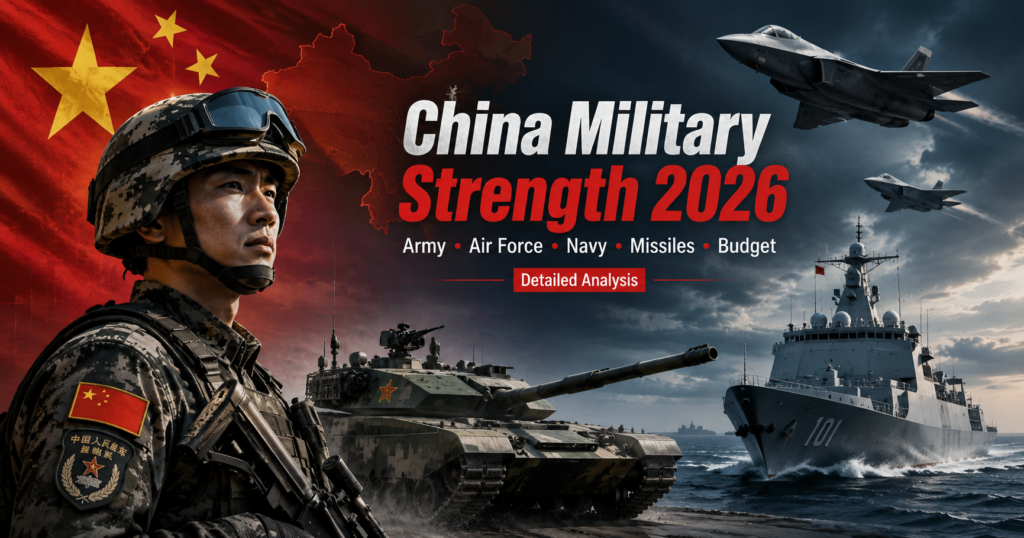
China has firmly established itself as one of the most powerful militaries in the world. By 2026, it is ranked 3rd globally among 145 nations, standing just behind the United States and Russia in overall defense strength. With a Power Index score of 0.0788 (closer to 0.0000 being considered perfect), China continues to rise as a top-tier global force with unmatched manpower and rapidly advancing defense technology.
What sets China apart is its massive military manpower, backed by the world’s largest pool of active soldiers, reserve forces, and paramilitary units. Alongside its strong human resources, China’s naval expansion has been unprecedented, building one of the largest fleets on the planet, including aircraft carriers, destroyers, and advanced submarines.
In the air, China continues to modernize at a fast pace with fifth-generation fighter jets, stealth aircraft, long-range bombers, and drone technology. Combined with advancements in missile systems, cyber warfare, and space defense programs, China’s military strength in 2026 is unmatched in its growth trajectory and capability to challenge traditional superpowers.
With continuous investments in technology and infrastructure, China has transformed into a global military giant that is not only defending its borders but also projecting power on an international scale.
China’s Military Ranking in 2026
China has become one of the world’s strongest military powers, reflecting its industrial strength, advanced defense systems, and growing global influence. By 2026, China’s armed forces have reached a level where they are not only modern but also expanding at a speed unmatched by many nations. The country’s ongoing modernization plan, which is expected to continue until 2027, has already reshaped its army, navy, and air force.
China now builds more warships and submarines each year than the United States, showing its clear intention to dominate the Indo-Pacific region. With massive manpower, cutting-edge weapons, and one of the largest defense budgets in the world, China has placed itself among the top three strongest militaries globally.
Key Military Facts of China in 2026
| Category | Details (2026) |
|---|---|
| Global Rank | 3rd among 145 countries |
| Power Index | 0.0788 |
| Defense Spending | $266.8 Billion |
| Total Personnel | Around 3.2 Million |
| Active Soldiers | 2.03 Million |
| Reserve Troops | 5.1 Lakh (510,000) |
| Paramilitary Units | 6.25 Lakh (625,000) |
China’s combination of huge manpower, rising naval strength, and rapid technological progress makes it a dominant force not just in Asia but also on the global stage. Its investment in advanced aircraft, missile defense, cyber warfare, and space programs highlights its ambition to rival traditional superpowers like the USA and Russia.
China’s Manpower Strength 2026
In 2026, China stands out as the world’s largest source of military manpower, powered by its massive population of more than 1.4 billion people. This unmatched demographic advantage gives Beijing the ability to mobilize millions of trained soldiers if a long-term conflict were to occur.
China’s manpower edge is not only about numbers—it also reflects its ability to field a highly organized and well-prepared fighting force. With millions of citizens fit for service and a steady stream of new recruits reaching military age every year, the country enjoys a constant flow of fresh manpower to strengthen its armed forces.
Estimated Military Manpower of China in 2026
| Category | Figures (2026) |
|---|---|
| Total Population | 1.41 Billion |
| Manpower Available | 764 Million |
| Fit for Service | 626 Million |
| New Recruits Annually | 19.8 Million |
| Combined Military Personnel | 3.17 Million |
| Active Duty Soldiers | 2.03 Million |
| Reserve Troops | 510,000 |
| Paramilitary Staff | 625,000 |
With this scale of manpower, China remains one of the only nations capable of sustaining a prolonged large-scale conflict while still having the resources to modernize its army, navy, and air force. By 2026, its manpower strength is not just a number—it is a powerful symbol of China’s ability to secure its borders, project influence abroad, and compete with the biggest military powers in the world.
China’s Air Force Power in 2026
By 2026, China’s People’s Liberation Army Air Force (PLAAF) has emerged as one of the largest and most technologically advanced air forces in the world. Equipped with cutting-edge fighter jets like the J-20 stealth aircraft, a growing fleet of drones, and modern transport and attack helicopters, China has significantly strengthened its air dominance across the Asia-Pacific region.
The PLAAF’s scale and modern capabilities give China the ability to project power far beyond its borders. With rapid modernization, continuous production of advanced aircraft, and a strategic focus on both offensive and defensive air operations, China is now a formidable air power rivaling the United States and Russia.
Air Force Strength of China in 2026
| Category | Estimated Count (2026) |
|---|---|
| Total Aircraft | 3,309 |
| Fighter Jets | 1,212 |
| Attack Aircraft | 371 |
| Transport Planes | 289 |
| Training Aircraft | 402 |
| Total Helicopters | 913 |
| Attack Helicopters | 281 |
China’s air power ranking of 3rd in the world highlights its growing strategic reach, allowing it to secure its national airspace, respond quickly to regional conflicts, and maintain influence over critical parts of the Indo-Pacific. With ongoing investment in advanced aviation technology, the PLAAF is set to continue expanding both its fleet size and operational capabilities.
China’s Land Forces Strength in 2026
China’s army remains the backbone of its military power, with the largest and most advanced ground forces in the world. By 2026, the People’s Liberation Army Ground Force (PLAGF) has strengthened its position with thousands of tanks, artillery systems, and armored vehicles, making it a dominant force on land.
The scale and modernization of China’s land forces give it the capability to respond to conflicts quickly, defend vast territories, and maintain a powerful presence in Asia and beyond. Its combination of sheer numbers and technological upgrades makes the Chinese army one of the most formidable ground forces globally, able to rival traditional military powers.
Estimated Land Force Strength of China in 2026
| Category | Estimated Count (2026) |
|---|---|
| Tanks | 6,800 |
| Armored Vehicles | 144,000+ |
| Self-Propelled Guns | 3,490 |
| Towed Artillery | 1,000 |
| Rocket Launchers (MLRS) | 2,750 |
China ranks 1st globally in tank strength, highlighting the country’s dominance in armored warfare. With a massive and highly organized land force, backed by advanced artillery and armored systems, China is well-positioned to secure its borders, project power regionally, and maintain one of the strongest armies in the world.
China’s Naval Power in 2026: Indo-Pacific Dominance
By 2026, China’s People’s Liberation Army Navy (PLAN) has become one of the fastest-growing and most powerful naval forces in the world. With rapid shipbuilding programs, the PLAN now produces more warships and submarines annually than the United States, demonstrating China’s ambition to dominate the Indo-Pacific region.
China’s expanding navy is designed for strategic control, power projection, and maritime security, giving it the ability to secure vital sea routes, protect its interests in the South China Sea, and strengthen its position near Taiwan. The PLAN’s combination of aircraft carriers, destroyers, submarines, and advanced patrol vessels makes it a formidable force on the water.
Estimated Naval Strength of China in 2026
| Category | Estimated Count (2026) |
|---|---|
| Total Naval Assets | 754 |
| Aircraft Carriers | 3 |
| Helicopter Carriers | 4 |
| Destroyers | 50 |
| Frigates | 47 |
| Corvettes | 72 |
| Submarines | 61 |
| Patrol Vessels | 150 |
| Mine Warfare Ships | 36 |
China’s naval modernization and expansion ensure unmatched maritime dominance in Asia, allowing it to protect key trade routes, maintain a strong military presence, and assert power across critical strategic waters. By 2026, the PLAN is not just a regional force—it is a global naval power capable of challenging traditional maritime giants.
China’s Defense Budget 2026
China’s military strength is backed by its powerful economy, which allows it to maintain rapid growth and modernization. In 2026, China’s defense budget reaches $266.8 billion, ranking it second in the world after the United States. This massive funding supports the development of advanced weapons systems, expansion of the navy, air force, and ground forces, and ongoing technological upgrades.
China’s industrial and energy resources, including coal, oil, and natural gas, provide a strong foundation to sustain long-term military modernization. With a combination of economic power and strategic planning, China continues to invest in cutting-edge technology and infrastructure that reinforce its global military presence.
Modernization Plans and Future Goals
China’s military growth is not just about numbers—it’s about technology and global influence. By 2027, Beijing aims to:
- Fully modernize its armed forces across land, air, and naval branches.
- Expand the use of artificial intelligence, cyber warfare, and unmanned drones.
- Strengthen its nuclear deterrent to maintain strategic balance.
- Build additional aircraft carriers and submarines to increase global reach.
With these plans, China is positioning itself as a high-tech military powerhouse capable of competing with and challenging traditional superpowers. Its combination of budget, manpower, and modernization strategy ensures it remains a top global military power in 2026 and beyond.
China vs USA Military Strength 2026
A frequent question among defense analysts and enthusiasts is how China’s military compares to the United States in 2026. Both nations are global superpowers, but they differ in strategy, size, and capabilities.
Key Comparison of China and USA Military Strength in 2026
| Factor | China (2026) | USA (2026 Estimate) |
|---|---|---|
| Defense Budget | $266.8 Billion | $876+ Billion |
| Active Military Personnel | 2.03 Million | 1.38 Million |
| Total Aircraft | 3,309 | 13,200+ |
| Naval Assets | 754 | 484 |
| Aircraft Carriers | 3 | 11 |
| Submarines | 61 | 68 |
Analysis and Insights
While the United States maintains superiority in air power, advanced aircraft, and aircraft carriers, China surpasses the US in total manpower and the number of naval vessels, including destroyers, frigates, and patrol ships.
China’s industrial capacity, large population, and fast-growing military technology give it an edge in sustaining long-term operations, particularly in the Asia-Pacific region. In a prolonged conflict scenario, China’s manpower advantage and naval strength could play a decisive role, while the United States relies on its advanced technology and global reach.
China’s strategic focus on modernizing its air force, navy, and missile systems, combined with growing defense investments, makes it a serious contender to US military dominance by 2026, reshaping the global balance of power.
Strategic Importance of Taiwan and the Indo-Pacific Region
China’s primary strategic focus in 2026 remains Taiwan, which plays a crucial role in its regional ambitions. The country’s rapid naval expansion and modernization are closely tied to controlling the South China Sea and projecting military power into the wider Pacific Ocean.
The Indo-Pacific is a critical region for global trade and military influence. By strengthening its naval presence, China aims to secure key sea lanes, maintain territorial claims, and enhance its ability to respond to regional conflicts. This strategic push also explains why the United States is reinforcing alliances with countries like Japan, India, and Australia, seeking to counterbalance China’s growing influence in the region.
China’s focus on Taiwan and the Indo-Pacific highlights its long-term goal to establish dominance in Asia, expand its maritime reach, and challenge the strategic influence of the United States and its allies. With advanced naval fleets, missile systems, and air capabilities, China continues to shape the balance of power in one of the most important regions in the world.
Conclusion: China’s Military Power in 2026
By 2026, China’s military has reached unprecedented strength, combining massive manpower, advanced technology, and a robust defense budget to secure its position as a global superpower. While the United States remains the top-ranked military, China’s rapid growth in air, naval, and land forces, along with its strategic modernization programs, shows that it could soon rival — and in some areas surpass — American military dominance.
Currently, China ranks as the world’s third most powerful military, but with ongoing modernization continuing until 2027, its capabilities are set to expand even further. This rapid rise in military strength could reshape the global balance of power, particularly in the Indo-Pacific region, signaling a future where China becomes an even more influential force in global defense and security.
China’s focus on technological advancement, naval expansion, and strategic manpower deployment ensures that it remains a top contender on the world stage, making its military developments essential for analysts, policymakers, and defense enthusiasts worldwide.
FAQs on China Military Strength 2026
Q1. What is China’s military ranking in 2026?
China ranks among the top 3 military powers globally in 2026.
Q2. How many active soldiers does China have?
China has around 2.03 million active military personnel.
Q3. How strong is China’s naval fleet?
China’s navy includes 754 ships, with 3 aircraft carriers and 61 submarines.
Q4. How many tanks and armored vehicles does China have?
China operates 6,800 tanks and over 144,000 armored vehicles.
Q5. What is China’s air force strength?
China’s air force has over 3,300 aircraft, including 1,212 fighter jets and 913 helicopters.
Q6. What is China’s defense budget in 2026?
China spends approximately $266.8 billion on defense in 2026.
Q7. How does China compare with the USA militarily?
China has more naval ships and manpower, while the USA leads in aircraft and carrier strength.
Q8. What are China’s military modernization goals?
China aims for advanced technology, AI, drones, and stronger naval and cyber capabilities by 2027.
Q9. How big is China’s mobilization potential?
China can mobilize over 81 million personnel in a long-term conflict.
Q10. Why is China’s military focused on the Indo-Pacific region?
China targets the South China Sea and Taiwan, strengthening its regional influence and defense.