The Turkiye Military Strength 2026 has rapidly grown into one of the most powerful and strategically important military forces in the world. Over the past decade, Turkiye has aggressively modernized its armed forces through advanced defense technology, domestic weapons production, drone warfare innovation, and large-scale military expansion programs.
Today, Turkiye is considered not only one of the strongest members of NATO but also one of the most influential military powers across the Middle East, Eastern Mediterranean, Black Sea region, and nearby strategic zones.
The Turkish Armed Forces are widely recognized for:
- Large active military manpower
- Powerful and experienced land forces
- Advanced drone warfare capability
- Rapidly expanding naval power
- Strong indigenous defense industry
- Strategic geographic location
- Extensive real combat experience
One of the biggest advantages of the Turkish military is its growing self-reliance in defense production. Unlike many countries that depend heavily on foreign military imports, Turkiye has rapidly expanded its domestic defense manufacturing sector and now produces a large portion of its military equipment locally.
Today, the country manufactures:
- Combat drones and UAVs
- Armored vehicles
- Missile systems
- Naval warships
- Infantry rifles
- Military helicopters
- Next-generation fighter aircraft projects
Turkiye’s defense industry has become one of the fastest-growing military manufacturing sectors globally, helping the country reduce dependence on foreign suppliers while strengthening its export capabilities.
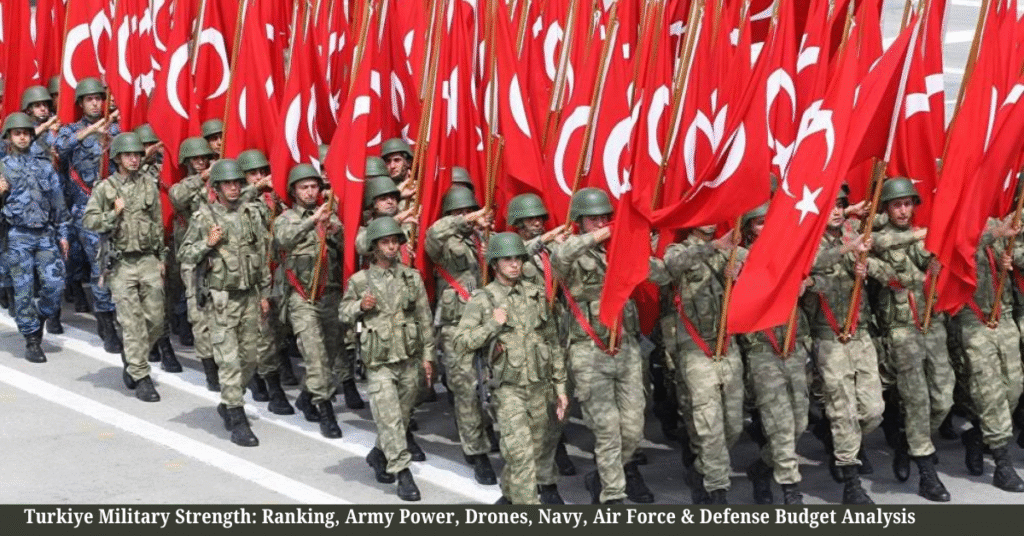
The Turkish Armed Forces have also gained significant operational experience through regional military operations, counterterrorism missions, border security operations, and overseas deployments. This real-world combat experience has further improved the country’s military readiness and battlefield capabilities.
According to the 2026 Global Firepower Index, Turkiye Military Ranking 2026 places the country among the world’s top 10 military powers, reflecting its growing influence in regional and international security affairs.
Turkiye Military Ranking 2026
According to the 2026 Global Firepower Index, the Turkiye Military Ranking 2026 stands at 9th position out of 145 countries worldwide. The country holds a strong Power Index score of 0.1975, placing it among the world’s top military powers and highlighting its growing strategic influence across Europe, Asia, and the Middle East.
Over the past decade, Turkiye has significantly strengthened its armed forces through military modernization, domestic defense production, advanced drone warfare systems, and expansion of its naval and land combat capabilities.
This strong ranking places Turkiye ahead of many advanced military nations because of its:
- Large active military manpower
- Strong armored warfare capability
- Rapidly expanding drone fleet
- Powerful artillery systems
- Strategic NATO role
- Fast-growing defense modernization programs
Turkiye Military Overview 2026
| Category | Details |
|---|---|
| Global Military Rank | 9th |
| Power Index Score | 0.1975 |
| Defense Budget | $51.4 Billion |
| Active Military Personnel | 481,000 |
| Reserve Personnel | 380,000 |
| Paramilitary Personnel | 150,000 |
| Total Aircraft | 1,101 |
| Naval Assets | 192 |
| Tanks | 2,284 |
| Submarines | 14 |
One of the biggest strengths of the Turkish Armed Forces is the balance between large manpower and modern military technology. Unlike some countries that rely mostly on either troop numbers or advanced systems, Turkiye combines both effectively to maintain a highly capable defense structure.
The country’s military power is supported by advanced drones, modern armored vehicles, growing naval strength, missile systems, and increasing self-reliance in domestic weapons manufacturing.
With its strategic location between Europe, Asia, and the Middle East, the Turkiye Military Strength 2026 continues to play a major role in NATO operations, regional security, counterterrorism missions, and geopolitical stability across multiple regions.
Overview of the Turkish Armed Forces
The Turkish Armed Forces are among the largest and most combat-experienced militaries in the world in 2026. Over the years, Turkiye has transformed its military into a highly modern and operationally active force capable of handling regional conflicts, counterterrorism missions, border security operations, and NATO responsibilities.
The military structure of Turkiye is divided into three primary branches:
| Military Branch | Primary Role |
|---|---|
| Turkish Land Forces | Ground combat operations, armored warfare, and border defense |
| Turkish Naval Forces | Maritime security, naval warfare, and protection of sea routes |
| Turkish Air Force | Air defense, aerial combat, surveillance, and strategic air operations |
In addition to its regular armed forces, Turkiye also maintains powerful paramilitary and internal security organizations that support national defense, border protection, and domestic security operations.
The Turkish military mainly focuses on:
- Border security operations
- Counterterrorism missions
- NATO military operations
- Regional power projection
- Drone warfare capabilities
- Naval security
- Air defense systems
- Domestic defense manufacturing
One of the biggest strengths of the Turkish Armed Forces is their extensive real-world combat experience. Over the past decade, Turkiye has conducted multiple military operations and security campaigns in different regions, including:
- Syria
- Iraq
- Libya
- Counterterrorism operations
- Border security missions
These operations have provided Turkish forces with valuable battlefield experience in urban warfare, drone operations, cross-border missions, intelligence coordination, and modern combat tactics.
Compared to many other regional militaries, the Turkiye Military Strength 2026 benefits greatly from active operational experience, which has significantly improved military readiness, tactical coordination, and rapid-response capability.
Combined with growing domestic defense production, modern military technology, and strategic geographic positioning, the Turkish Armed Forces continue to strengthen their role as one of the most influential military powers in the region.
Turkish Army Strength 2026
The Turkish Army Strength 2026 remains one of the largest and most powerful land forces in NATO. With its massive manpower, strong armored formations, advanced artillery systems, and extensive combat experience, the Turkish Army continues to play a major role in regional military operations and national defense.
Over the years, Turkiye has modernized its ground forces by integrating advanced battlefield technology, drone warfare systems, mobile combat units, and domestic military equipment production into its military structure.
The military doctrine of the Turkish Army focuses heavily on:
- Heavy armored warfare
- Mobile infantry operations
- Drone-supported battlefield tactics
- Artillery-based firepower
- Rapid deployment capability
Turkiye’s ground forces are particularly strong in conventional land warfare, cross-border operations, and regional combat missions. The army has gained significant battlefield experience through operations in Syria, Iraq, and counterterrorism campaigns, making it one of the most operationally active militaries in the region.
Turkish Army Personnel and Equipment
| Army Category | Numbers |
|---|---|
| Army Personnel | 401,500 |
| Main Battle Tanks | 2,284 |
| Armored Vehicles | 98,193 |
| Self-Propelled Artillery | 1,045 |
| Towed Artillery | 635 |
| Rocket Artillery Systems | 237 |
The Turkish Army operates a large inventory of armored vehicles, artillery systems, and modern battlefield equipment, including:
- Leopard 2 tanks
- M60 tanks
- Altay main battle tank program
- ACV armored vehicles
- T-155 Firtina artillery systems
One of the most important strengths of the Turkish land forces is their powerful artillery capability. Turkiye operates one of the largest artillery inventories in the region, which plays a major role in providing battlefield fire support during military operations.
The T-155 Firtina self-propelled artillery system is especially important for long-range firepower, mobility, and rapid battlefield response. Combined with drone surveillance and precision targeting systems, Turkish artillery units have become highly effective in modern combat operations.
With its combination of large manpower, armored strength, drone integration, and advanced artillery systems, the Turkish Army Strength 2026 remains one of the strongest conventional land warfare forces in Europe and the Middle East.
Turkiye Drone Warfare Power
One of the biggest reasons behind the rapid rise of Turkiye Military Strength 2026 is the country’s major success in drone warfare technology. Over the past few years, Turkiye has become one of the world’s leading producers of advanced military drones, transforming the way modern battlefield operations are conducted.
Turkish drones gained global attention after demonstrating strong performance in multiple regional conflicts and military operations. Their effectiveness in surveillance, precision targeting, intelligence gathering, and low-cost combat operations has significantly increased Turkiye’s military influence and defense exports worldwide.
Today, the Turkish defense industry manufactures several highly advanced unmanned aerial systems that are used by both the Turkish Armed Forces and many foreign militaries.
Famous Turkish Military Drones
Some of the most well-known Turkish military drones include:
- Bayraktar TB2
- Bayraktar Akinci
- Anka UAV
- Kizilelma unmanned fighter drone
The Bayraktar TB2 became internationally famous for its successful use in modern combat operations, while the more advanced Bayraktar Akinci provides longer range, heavier payload capacity, and enhanced strike capability.
Meanwhile, the Kizilelma unmanned fighter drone represents Turkiye’s next-generation combat drone project and highlights the country’s ambitions in advanced autonomous aerial warfare technology.
Turkish drones are now exported to multiple countries across Europe, Asia, Africa, and the Middle East, making drone production one of the most important sectors of Turkiye’s growing defense industry.
Uses of Turkish Military Drones
Turkish drones are widely used for:
- Reconnaissance missions
- Precision air strikes
- Battlefield surveillance
- Border monitoring operations
- Naval and maritime missions
One of the major advantages of the Turkish drone warfare strategy is the integration of drones with artillery systems, intelligence networks, and real-time battlefield coordination. This combination has significantly improved operational effectiveness during regional military operations.
Today, Turkiye is widely considered one of the global leaders in combat drone technology, and its continued investment in unmanned warfare systems is expected to further strengthen the Turkiye Military Strength in the coming years.
Turkish Air Force Strength 2026
The Turkish Air Force Strength 2026 remains one of the most powerful air forces in NATO in terms of aircraft numbers, operational flexibility, and regional combat capability. Over the years, Turkiye has significantly strengthened its air power through fighter jet modernization, drone integration, electronic warfare systems, and domestic aerospace development programs.
The Turkish Air Force plays a critical role in protecting national airspace, supporting military operations, conducting surveillance missions, and maintaining regional deterrence across multiple strategic areas.
The air force mainly focuses on:
- Air superiority operations
- Border and airspace defense
- Precision strike missions
- Drone warfare integration
- Electronic warfare capabilities
Turkish Air Force Aircraft Inventory
| Air Force Category | Total |
|---|---|
| Total Aircraft | 1,101 |
| Fighter Aircraft | 201 |
| Transport Aircraft | 84 |
| Trainer Aircraft | 301 |
| Special Mission Aircraft | 27 |
| Tanker Aircraft | 7 |
| Helicopters | 509 |
| Attack Helicopters | 111 |
The Turkish Air Force operates a large and diverse fleet of fighter jets, helicopters, surveillance aircraft, drones, and transport systems that support both national defense and overseas military operations.
Main Fighter Jets of Turkiye
Turkiye currently operates several important combat aircraft and military aviation platforms, including:
- F-16 Fighting Falcon
- F-4 Phantom variants
- T129 ATAK helicopters
- Bayraktar combat drones
The F-16 Fighting Falcon continues to serve as the backbone of Turkish air combat capability, while the domestically developed T129 ATAK attack helicopter provides strong close-air support and battlefield strike capability.
One of the most important future projects for the Turkish aerospace sector is the development of the TF Kaan fifth-generation fighter aircraft. This next-generation stealth fighter program is part of Turkiye’s long-term strategy to reduce dependence on foreign defense suppliers and strengthen its domestic military aviation industry.
The TF Kaan project is expected to include advanced stealth technology, modern radar systems, artificial intelligence integration, electronic warfare capability, and high-performance air combat systems.
Combined with its growing drone fleet, modern fighter aircraft, and expanding domestic aerospace industry, the Turkish Air Force Strength 2026 continues to strengthen Turkiye’s position as one of the leading military air powers in the region.
Turkish Air Defense Systems
The Turkish Air Defense Systems have expanded rapidly in recent years as Turkiye continues strengthening its national security and regional defense capabilities. Facing growing regional tensions, missile threats, and evolving aerial warfare challenges, the country has invested heavily in building a more advanced and layered air defense network.
The modern Turkish air defense structure combines domestic missile systems, advanced radar technology, drone surveillance, and electronic warfare capabilities to improve early threat detection and rapid response.
Turkiye has strengthened its air defense network through:
- Indigenous missile defense systems
- Advanced radar modernization
- Electronic warfare infrastructure
- Drone-supported reconnaissance
- Layered air defense strategy
One of the biggest priorities of the Turkish military is reducing dependence on foreign defense systems by increasing local production of radar, missile, and electronic warfare technologies. The country’s growing domestic defense industry now plays a major role in supporting air defense modernization programs.
Turkiye also integrates combat drones and surveillance UAVs into its air defense network, allowing better battlefield awareness, intelligence gathering, and border monitoring operations.
A major topic of international attention in recent years was Turkiye’s purchase of the Russian S-400 missile defense system. The acquisition generated significant geopolitical debate because of Turkiye’s position as a NATO member and concerns regarding compatibility with Western defense systems.
Despite the controversy, the S-400 system significantly strengthened Turkiye’s long-range air defense capability and highlighted the country’s efforts to build a more independent military defense strategy.
Today, the Turkish Air Defense Capability 2026 continues evolving through investments in missile interception systems, electronic warfare, drone integration, radar technology, and domestic defense production, making it one of the most advanced air defense structures in the region.
Turkish Navy Strength 2026
The Turkish Navy Strength 2026 has expanded rapidly over the past decade, transforming Turkiye into one of the most important naval powers in the Eastern Mediterranean and nearby strategic waters. Through aggressive naval modernization, domestic warship production, and expanding maritime operations, the Turkish Navy continues strengthening its regional and international influence.
As a country surrounded by critical maritime regions including the Mediterranean Sea, Aegean Sea, and Black Sea, Turkiye places major strategic importance on naval security and maritime defense capability.
The Turkish Navy mainly focuses on:
- Maritime security operations
- Regional naval dominance
- Amphibious warfare capability
- Submarine warfare
- Blue-water naval operations
Turkish Naval Fleet Overview
| Naval Category | Total |
|---|---|
| Total Naval Assets | 192 |
| Helicopter Carrier | 1 |
| Frigates | 17 |
| Corvettes | 9 |
| Submarines | 14 |
| Patrol Vessels | 40 |
| Mine Warfare Ships | 11 |
One of the biggest strengths of the Turkish Navy is its rapidly growing domestic shipbuilding capability. Turkiye has invested heavily in locally designed warships, modern naval systems, and indigenous maritime defense technology to reduce dependence on foreign suppliers.
TCG Anadolu and Naval Expansion
One of the most important developments in the Turkish Navy is the introduction of TCG Anadolu, a large amphibious assault ship that significantly expands Turkiye’s naval operational reach.
The addition of TCG Anadolu greatly improves Turkiye’s:
- Naval power projection capability
- Drone carrier operations
- Amphibious warfare strength
- Overseas military deployment capability
The ship is designed to support helicopter operations, amphibious assault missions, troop transportation, and advanced unmanned combat drone deployments. This gives Turkiye greater flexibility in conducting regional military operations and humanitarian missions.
The Turkish Navy is also continuing large-scale naval modernization under the MILGEM naval program, one of the country’s most important domestic defense initiatives. Through this program, Turkiye is developing and producing advanced frigates, corvettes, and other warships using local defense technology and domestic shipbuilding expertise.
The expansion of submarine forces, drone-supported naval systems, missile-equipped warships, and indigenous naval platforms continues to strengthen the Turkish Navy Strength 2026 as one of the fastest-growing maritime forces in the region.
Turkiye Defense Budget 2026
The Turkiye Defense Budget 2026 continues to increase as the country expands military modernization programs and strengthens its domestic defense industry. Over the past several years, Turkiye has focused heavily on becoming more self-reliant in military production while improving its overall combat capability across land, air, naval, cyber, and drone warfare sectors.
The Turkish government is investing aggressively in advanced defense technology, indigenous weapons systems, and next-generation military platforms to reduce dependence on foreign suppliers and strengthen long-term strategic independence.
Turkiye Military Budget 2026
| Budget Category | Amount |
|---|---|
| Defense Budget | $51.4 Billion |
| Purchasing Power | $3.01 Trillion |
| Foreign Exchange Reserves | $154 Billion |
| Global Military Rank | 9th |
A significant portion of the Turkish military budget is now directed toward modernization and domestic military production programs.
Major areas of defense spending include:
- Domestic weapons manufacturing
- Combat drone development
- Missile systems
- Naval modernization
- Next-generation fighter jet projects
- Border security operations
- Defense exports and military technology
The increasing defense budget reflects Turkiye’s long-term strategy to build a stronger, more independent, and technologically advanced military force capable of operating effectively across multiple conflict environments.
Turkiye’s Domestic Defense Industry
One of the biggest strengths behind the rapid rise of Turkiye Military Strength 2026 is its fast-growing domestic defense industry. Over the past decade, Turkish defense manufacturers have become major players in the global military market by producing advanced military systems locally.
Today, Turkish defense companies manufacture:
- Combat drones
- Missile systems
- Naval warships
- Armored vehicles
- Smart precision munitions
- Military helicopters
- Communication and electronic warfare systems
Major Turkish Defense Companies
Some of the leading companies driving Turkiye’s defense expansion include:
- Baykar
- ASELSAN
- Roketsan
- Turkish Aerospace Industries
These companies play a major role in developing advanced military technology for both domestic use and international export markets. Turkish defense exports have also increased rapidly in recent years, especially in the drone warfare sector.
One of the biggest strategic advantages of the Turkish defense industry is that it reduces reliance on foreign military suppliers and allows Turkiye greater flexibility in defense planning, weapons production, and military operations.
With continued investment in local manufacturing, advanced military technology, and defense exports, the Turkiye Defense Industry 2026 is becoming one of the fastest-growing military production sectors in the world.
Turkiye Military Strength Compared to Greece
The military rivalry between Turkiye and Greece continues to remain one of the most important strategic issues in the Eastern Mediterranean region. Both countries are NATO members, but long-standing tensions over maritime boundaries, airspace disputes, energy exploration rights, and regional influence continue to shape their defense strategies.
While Greece operates several advanced Western military systems and maintains a capable armed force, Turkiye Military Strength 2026 holds major advantages in manpower, drone warfare capability, artillery systems, and domestic defense production.
The Turkish military has rapidly expanded its combat capability through indigenous weapons manufacturing, advanced drone programs, naval modernization, and large-scale military modernization projects.
Major Advantages of Turkiye
Turkiye maintains significant advantages in:
- Military manpower
- Combat drone technology
- Artillery firepower
- Tank and armored vehicle inventory
- Domestic defense industry capability
Turkiye vs Greece Military Comparison
| Category | Turkiye | Greece |
|---|---|---|
| Global Rank | 9 | Lower |
| Active Personnel | Much Larger | Smaller |
| Drone Capability | Extremely Advanced | Limited |
| Tanks | 2,284 | Lower |
| Naval Power | Strong | Strong |
| Defense Industry | Rapidly Growing | Smaller |
One of the biggest strengths of the Turkish military is its rapidly growing domestic defense industry, which allows the country to produce drones, missiles, warships, armored vehicles, and advanced military systems locally. This provides Turkiye with greater long-term strategic independence and flexibility compared to many regional militaries.
Turkiye also possesses one of the world’s most advanced combat drone programs, which has become a major force multiplier in modern battlefield operations. Its drone integration with artillery systems and battlefield intelligence networks gives the Turkish Armed Forces a significant operational advantage.
Meanwhile, Greece continues investing in modern fighter jets, naval modernization, and Western defense systems to strengthen its military capability and maintain regional deterrence.
Overall, the Turkiye Military Strength 2026 benefits greatly from larger military size, strong defense manufacturing capability, expanding naval power, and advanced drone warfare systems, providing important long-term strategic advantages in the region.
Strengths of Turkiye Military
The Turkiye Military Strength 2026 continues to grow rapidly due to its combination of large military manpower, advanced drone warfare systems, expanding naval capability, and strong domestic defense production. Over the past decade, Turkiye has transformed its armed forces into one of the most influential military powers in the Middle East and surrounding regions.
One of the biggest advantages of the Turkish Armed Forces is their ability to combine traditional military strength with modern indigenous defense technology. This balance gives Turkiye strong operational flexibility in both conventional warfare and modern technology-driven combat environments.
Major Strengths of Turkiye Military
- Large active military manpower
- Advanced combat drone capability
- Powerful artillery systems
- Massive armored vehicle inventory
- Strategic NATO geographic position
- Rapidly growing defense exports
- Expanding naval capability
- Strong domestic weapons production
The country’s highly successful drone warfare programs, especially the development of the Bayraktar series, have become one of the biggest symbols of Turkiye’s rising military power. These systems have significantly improved battlefield intelligence, surveillance, and precision strike capability.
Turkiye also benefits from its strategic geographic location between Europe, Asia, and the Middle East, giving the country major importance in NATO operations and regional security dynamics.
The rapid expansion of the domestic defense industry further strengthens Turkiye’s long-term military independence and export potential.
Weaknesses of Turkiye Military
Despite its rapid military growth and modernization, the Turkish military still faces several important operational and strategic challenges.
Major Weaknesses of Turkiye Military
- Dependence on some foreign aircraft technology
- Economic pressure from defense spending
- Regional geopolitical tensions
- Air force modernization challenges
- Sanctions-related procurement limitations
One of the main challenges for Turkiye is reducing reliance on certain foreign aerospace technologies and military components. International sanctions and procurement restrictions have also created obstacles for some military modernization projects.
The country also faces ongoing geopolitical tensions in nearby regions, which continue to influence defense planning and military spending priorities.
To address these vulnerabilities, Turkiye is aggressively investing in indigenous fighter aircraft programs, domestic missile systems, advanced naval platforms, and local aerospace manufacturing capabilities.
Future of Turkiye Military
The future of the Turkiye Military is expected to focus heavily on advanced technology, domestic defense production, and next-generation warfare systems.
Turkiye aims to become increasingly self-sufficient in military manufacturing while also expanding its position as a global defense exporter.
Future Focus Areas of Turkiye Military
- Indigenous fighter jet development
- AI-powered warfare systems
- Naval drone operations
- Long-range missile programs
- Space technology and satellite systems
- Cyber warfare capability
- Drone carrier operations
Projects such as the TF Kaan fifth-generation fighter aircraft, advanced drone carrier concepts, and indigenous missile development programs are expected to play a major role in shaping the future of Turkish military power.
Turkiye is also likely to continue strengthening naval modernization, cyber defense infrastructure, artificial intelligence integration, and autonomous warfare capabilities over the coming years.
Military analysts believe the Turkiye Military Strength 2026 will continue rising steadily over the next decade, making the country an even more influential regional military power across Europe, the Middle East, and the Eastern Mediterranean region.
Is Turkiye Military Strong in 2026?
Yes, the Turkiye Military Strength 2026 is considered one of the strongest and fastest-growing military powers in the world. Over the past decade, Turkiye has rapidly modernized its armed forces through advanced military technology, large-scale domestic defense production, expanding naval power, and highly successful drone warfare programs.
Today, the Turkish Armed Forces combine both large military manpower and modern battlefield technology, making them one of the most balanced and operationally active militaries in Europe, Asia, and the Middle East.
The country’s military strength is built on:
- Large active military manpower
- Powerful armored warfare capability
- Advanced combat drone technology
- Strong NATO integration
- Rapidly expanding naval power
- Growing domestic defense industry
One of the biggest reasons behind the rise of the Turkish military is its increasing self-reliance in defense production. Turkiye now manufactures many of its own drones, missiles, armored vehicles, naval warships, helicopters, and advanced military systems through its expanding domestic defense industry.
The country has also gained significant combat experience through regional military operations, counterterrorism missions, and border security campaigns, which has improved battlefield readiness and operational capability.
Turkiye’s advanced drone warfare systems, especially the globally recognized Bayraktar series, have become one of the country’s most important military advantages and have significantly increased its international defense influence.
At the same time, Turkiye continues strengthening naval modernization, missile programs, air defense systems, cyber warfare capabilities, and next-generation fighter aircraft projects such as the TF Kaan stealth fighter program.
With its combination of manpower, military modernization, domestic weapons production, and strategic geographic location, the Turkiye Military Strength 2026 has become highly influential across Europe, the Middle East, Eastern Mediterranean, and surrounding regions.
Turkiye Military Strength 2026 FAQs
What is Turkiye military ranking in 2026?
According to the 2026 Global Firepower Index, Turkiye Military Ranking 2026 stands at 9th position among the world’s strongest military powers.
How strong is Turkiye military in 2026?
The Turkish military is considered one of the world’s most powerful armed forces, with strong land warfare capability, advanced combat drones, massive artillery systems, and a rapidly expanding domestic defense industry.
What is Turkiye defense budget in 2026?
The Turkiye defense budget in 2026 is estimated at approximately $51.4 billion.
Does Turkiye produce military drones?
Yes, Turkiye is one of the global leaders in combat drone production and manufactures advanced drones such as:
- Bayraktar TB2
- Bayraktar Akinci
- Anka UAV
- Kizilelma unmanned fighter drone
How many tanks does Turkiye have?
The Turkish Army operates around 2,284 tanks, making it one of the strongest armored forces in the region.
Is Turkiye part of NATO?
Yes, Turkiye is an active member of NATO and possesses one of the alliance’s largest and most powerful military forces.
What is Turkiye’s strongest military branch?
The strongest areas of the Turkish military are its land forces, advanced drone warfare capability, powerful artillery systems, and rapidly growing domestic defense industry.