The Germany Military Strength 2026 continues to rank among the most influential and technologically advanced military forces in Europe. While Germany is widely known for its economic power and industrial leadership, the country is also undertaking one of the largest military modernization efforts in its post-Cold War history.
As Europe’s largest economy and a key member of NATO, Germany plays a critical role in continental security, military logistics, defense manufacturing, and multinational alliance operations. The German Armed Forces, officially known as the Bundeswehr, are being strengthened through increased defense spending, equipment modernization, infrastructure upgrades, and improved military readiness.
In recent years, Germany has accelerated defense reforms in response to changing security conditions in Europe, growing geopolitical tensions, and the need to strengthen NATO’s collective defense capabilities.
Unlike some military powers that rely primarily on large troop numbers, Germany’s military strength is built on:
- Advanced military technology
- Highly trained professional personnel
- Strong industrial and manufacturing capacity
- Strategic location in Europe
- Deep NATO integration
- Modern defense infrastructure
Germany is also home to one of the world’s most advanced defense industries, producing military vehicles, submarines, electronic systems, armored platforms, and other high-tech defense equipment used by armed forces around the globe.
The country continues investing in next-generation combat systems, cyber defense, air defense networks, armored warfare modernization, and multinational European security initiatives aimed at strengthening long-term military capability.
With its powerful economy, advanced defense sector, and expanding military modernization programs, the Germany Military Strength 2026 remains one of the most capable and strategically important defense forces in Europe and a key pillar of Western security.
Germany Military Ranking 2026
According to the 2026 Global Firepower Index, the Germany Military Ranking 2026 places the country among the world’s strongest military powers. Germany continues to maintain one of Europe’s most advanced and well-funded armed forces, supported by a powerful economy, modern military infrastructure, and deep integration within NATO.
As Europe’s largest economy, Germany has the financial and industrial capacity to sustain large-scale defense modernization programs while supporting both national security and alliance commitments.
Germany Military Overview
| Category | Details |
|---|---|
| Global Military Rank | 12th |
| Power Index Score | 0.2463 |
| Active Personnel | 184,324 |
| Reserve Personnel | 860,000 |
| Defense Budget | $127.4 Billion |
| Total Aircraft | 569 |
| Naval Assets | 96 |
| Main Battle Tanks | 296 |
| Population | 84.1 Million |
The Germany Military Strength 2026 is built on a combination of advanced military technology, professional personnel, strong defense industries, and extensive logistical capability. Unlike many countries that rely heavily on manpower, Germany emphasizes quality, modernization, and operational efficiency.
One of Germany’s greatest advantages is its ability to combine military capability with economic strength. The country’s powerful industrial base supports the development and production of advanced military equipment, armored vehicles, naval systems, aircraft components, and defense electronics.
Germany also serves as a major logistical hub for NATO operations across Europe, allowing rapid movement of personnel, equipment, and support resources throughout the alliance.
With substantial defense spending, modern military assets, and a strategic position at the center of Europe, the Germany Military Strength 2026 remains one of the most important pillars of NATO and European security.
Why Germany Matters in European Security
Germany occupies a unique and highly strategic position within Europe. Located at the heart of the continent, the country serves as a vital transportation, logistics, and operational hub for NATO and European defense activities.
Sharing borders with nine countries, Germany acts as a key link between Western, Central, and Eastern Europe. This geographic advantage allows the country to support military deployments, coordinate alliance operations, and facilitate the rapid movement of troops and equipment across the region.
Germany contributes significantly to:
- NATO collective defense
- European Union security initiatives
- Military logistics and transportation
- Defense technology development
- International peacekeeping missions
- Joint military exercises
One of Germany’s biggest strategic advantages is its ability to support multiple military operations simultaneously through its advanced infrastructure, transportation networks, and defense coordination systems.
As a leading NATO member, Germany regularly participates in multinational exercises, peacekeeping operations, and regional security initiatives designed to strengthen collective defense and maintain stability across Europe.
Its central location also makes the Germany Military Strength 2026 a critical component of NATO’s rapid-response capability and overall European security architecture.
Germany’s Military Transformation
One of the most significant developments in European defense over the past several years has been the ongoing transformation of the German Armed Forces (Bundeswehr).
For much of the post-Cold War era, Germany maintained relatively restrained military spending and focused heavily on diplomacy, economic development, and international cooperation. However, changing security conditions in Europe and rising geopolitical tensions have led to a major shift in defense policy.
The German government has launched large-scale military modernization programs designed to improve readiness, strengthen defense capability, and enhance support for NATO operations.
The Bundeswehr modernization program focuses heavily on:
- Air defense systems
- Armored warfare modernization
- Cybersecurity capabilities
- Military communication networks
- Ammunition production capacity
- Battlefield digitization
- NATO interoperability
A key goal of this transformation is to improve operational readiness and ensure that German forces can respond quickly and effectively to emerging security threats.
Germany is also investing in modern armored vehicles, advanced military technology, digital command systems, electronic warfare capabilities, and next-generation defense infrastructure.
This ongoing modernization effort is expected to strengthen the Germany Military Strength 2026 and reinforce the country’s position as one of the most important military powers in Europe.
With increased defense spending, advanced industrial capacity, and a renewed focus on military readiness, Germany is becoming an even more important pillar of European and NATO security in the years ahead.
Germany Defense Budget 2026
One of the biggest strengths behind the Germany Military Strength 2026 is the country’s enormous economic and financial capacity. As Europe’s largest economy, Germany can support long-term military modernization programs, defense research, infrastructure development, and advanced weapons procurement on a scale that few countries can match.
In recent years, Germany has significantly increased military spending to strengthen national defense, improve military readiness, and meet growing NATO commitments. This increase reflects Berlin’s broader strategy of enhancing European security and modernizing the Bundeswehr for future challenges.
Germany Defense Spending
| Financial Category | Value |
|---|---|
| Defense Budget | $127.4 Billion |
| Purchasing Power Parity | $5.24 Trillion |
| Foreign Exchange Reserves | $377.9 Billion |
With a defense budget exceeding $127 billion, Germany now operates one of the largest military spending programs in the world.
This defense investment supports:
- New military equipment procurement
- Aircraft modernization programs
- Advanced air defense systems
- Defense research and development
- Military infrastructure upgrades
- NATO operational commitments
Germany’s strong economy provides a major strategic advantage by allowing the country to sustain military modernization over the long term without placing excessive strain on national resources.
The combination of industrial strength, financial stability, and technological expertise continues to strengthen the Germany Military Strength 2026 and its role within NATO.
Bundeswehr Structure
The Bundeswehr, Germany’s armed forces, consists of several specialized branches responsible for protecting national security and supporting both domestic and international military operations.
Each branch has a distinct role while working together as part of an integrated defense structure capable of operating across multiple domains.
Main Military Branches
| Branch | Primary Role |
|---|---|
| German Army | Land warfare and armored operations |
| Luftwaffe | Air superiority and air defense |
| German Navy | Maritime security and naval operations |
| Cyber and Information Domain Service | Cyber warfare and digital security |
| Joint Support Service | Logistics and operational support |
This organizational structure allows Germany to maintain effective military capability across:
- Land warfare
- Air operations
- Maritime security
- Cyber defense
- Strategic logistics
One of the most notable developments in recent years has been the expansion of Germany’s Cyber and Information Domain Service, reflecting the growing importance of cyber warfare, digital infrastructure protection, and information security in modern military operations.
The Joint Support Service also plays a crucial role by coordinating logistics, transportation, communications, and operational support for both national missions and NATO deployments.
Together, these branches form a highly professional and technologically advanced military structure that enables the Germany Military Strength 2026 to operate effectively across land, air, sea, and cyber domains while supporting both national defense and alliance security objectives.
Germany Army Strength 2026
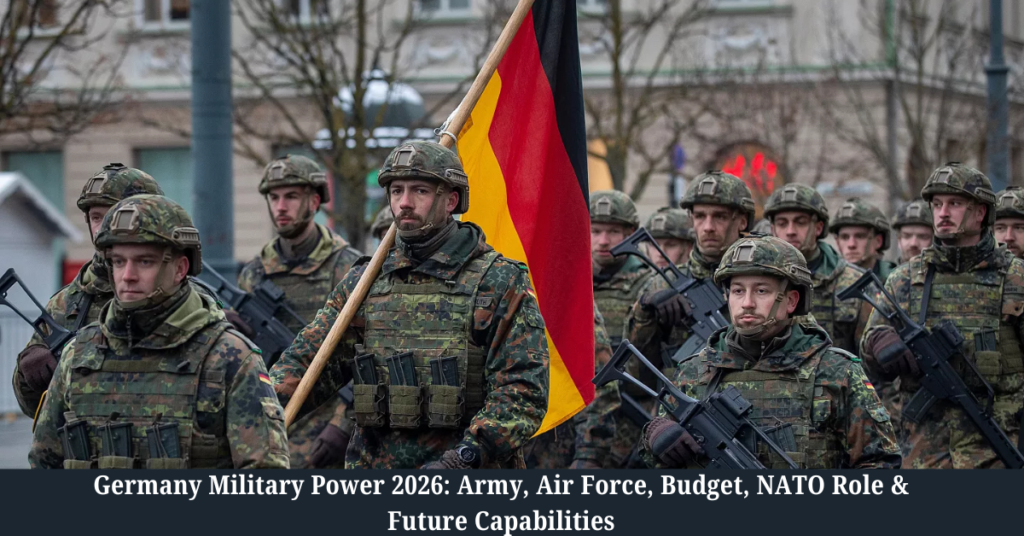
The Germany Army Strength 2026 remains one of the most capable and respected mechanized land forces in Europe. The German Army (Heer) is built around advanced armored warfare, professional training standards, modern battlefield technology, and strong NATO interoperability.
Unlike some military powers that prioritize large troop numbers, Germany focuses on maintaining a highly skilled force supported by modern tanks, armored vehicles, artillery systems, and digital battlefield networks. This approach allows the German Army to achieve high operational effectiveness while maintaining rapid deployment capability.
The army’s military doctrine emphasizes:
- Mechanized warfare
- Armored mobility
- Rapid response operations
- NATO joint operations
- Battlefield digitization
- Combined-arms warfare
Germany Army Equipment
| Category | Total |
|---|---|
| Army Personnel | 63,000+ |
| Main Battle Tanks | 296 |
| Armored Vehicles | 87,338 |
| Self-Propelled Artillery | 134 |
| Rocket Artillery Systems | 33 |
The German Army maintains a powerful fleet of armored vehicles and artillery systems designed to support high-intensity combat operations and alliance defense missions.
One of Germany’s greatest strengths is its large inventory of armored platforms, which provide excellent battlefield mobility, protection, and operational flexibility across different combat environments.
The army continues investing in modernization programs that focus on:
- Advanced armored vehicle upgrades
- Digital command-and-control systems
- Precision artillery capabilities
- Battlefield communications technology
- Enhanced mobility and logistics
Germany’s mechanized forces are regularly integrated into NATO exercises and multinational deployments, helping maintain high readiness levels and operational coordination with allied militaries.
With its combination of professional personnel, advanced armored warfare capability, and ongoing modernization efforts, the Germany Army Strength 2026 remains one of the strongest mechanized military forces in Europe and a key component of NATO’s land defense capability.
Leopard Tanks: Germany’s Most Famous Military Asset
One of the most recognized symbols of the Germany Military Strength 2026 is the Leopard tank family, which has earned a global reputation as one of the most successful armored vehicle platforms ever developed.
The Leopard 2 Main Battle Tank is widely regarded as one of the best tanks in the world due to its outstanding combination of firepower, protection, mobility, and battlefield technology. Over the years, it has become a cornerstone of NATO armored warfare and is operated by numerous allied countries.
The Leopard 2 is respected for its:
- Powerful firepower
- Excellent mobility
- Strong armor protection
- High reliability
- Advanced targeting systems
Because many NATO members operate Leopard tanks, Germany continues to play a major role in European armored warfare planning, logistics support, and military cooperation.
The widespread use of the Leopard platform has also strengthened Germany’s influence within NATO defense modernization efforts.
Germany’s Armored Warfare Capability
The German Army remains one of Europe’s leading mechanized forces thanks to its strong emphasis on modern armored warfare doctrine.
Rather than relying solely on tanks, Germany follows a combined-arms warfare approach, where multiple military capabilities work together to maximize battlefield effectiveness.
German forces integrate:
- Main battle tanks
- Mechanized infantry
- Artillery systems
- Air support assets
- Reconnaissance platforms
- Electronic warfare capabilities
This highly coordinated approach allows the Bundeswehr to respond rapidly to changing battlefield conditions while maintaining flexibility, mobility, and operational efficiency.
Modern German military doctrine focuses on integrating advanced technology, real-time communications, and battlefield intelligence to support faster decision-making and more effective combat operations.
Puma Infantry Fighting Vehicle
The Puma Infantry Fighting Vehicle (IFV) represents one of the most advanced armored combat vehicles currently in military service.
Designed to support modern mechanized warfare operations, the Puma combines strong protection, advanced technology, and high battlefield mobility.
Key advantages of the Puma include:
- High crew survivability
- Advanced sensor systems
- Digital battlefield integration
- Enhanced firepower
The vehicle plays a crucial role in supporting infantry units during combat operations while maintaining close coordination with tanks and other armored formations.
As Germany continues modernizing its land forces, the Puma IFV remains a key component of the country’s future armored warfare strategy.
Boxer Armored Vehicle
Another major asset within the Germany Army Strength 2026 is the highly versatile Boxer Armored Vehicle.
The Boxer has become one of Europe’s most successful armored vehicle platforms due to its modular design and ability to perform multiple battlefield roles using a common vehicle base.
The Boxer can be configured for:
- Troop transportation
- Command and control operations
- Medical evacuation missions
- Reconnaissance and surveillance tasks
This flexibility allows military units to adapt quickly to different operational requirements while simplifying maintenance and logistics support.
The Boxer’s combination of mobility, protection, and mission adaptability makes it one of the most versatile armored vehicles currently used by European armed forces.
Together, the Leopard 2, Puma IFV, and Boxer Armored Vehicle form the backbone of Germany’s modern mechanized warfare capability and play a major role in strengthening the overall Germany Military Strength 2026.
German Air Force Strength 2026
The German Air Force Strength 2026, known as the Luftwaffe, remains one of the most technologically advanced and capable air forces in Europe. As a key component of NATO’s air defense structure, the Luftwaffe plays a vital role in protecting German airspace, supporting alliance operations, and maintaining regional security across Europe.
Germany continues to modernize its air force through investments in advanced fighter aircraft, air defense systems, surveillance technology, and strategic transport capabilities.
The primary responsibilities of the Luftwaffe include:
- Air defense operations
- Air superiority missions
- Strategic air transport
- Electronic warfare
- NATO air policing
German Air Force Inventory
| Category | Total |
|---|---|
| Total Aircraft | 569 |
| Fighter Aircraft | 127 |
| Attack Aircraft | 63 |
| Transport Aircraft | 55 |
| Tanker Aircraft | 3 |
| Helicopters | 292 |
| Attack Helicopters | 49 |
The German Air Force maintains a balanced fleet capable of conducting combat operations, strategic transport missions, reconnaissance activities, and alliance support operations throughout Europe and beyond.
Germany continues investing heavily in next-generation aviation technology to improve operational readiness and long-term combat capability.
Eurofighter Typhoon
The Eurofighter Typhoon serves as the backbone of Germany’s modern fighter aircraft fleet and remains one of the most capable combat aircraft currently operating in Europe.
Designed for both air superiority and multirole combat missions, the Typhoon provides Germany with a highly flexible platform capable of responding to a wide range of security challenges.
The aircraft offers:
- Air-to-air combat capability
- Precision strike missions
- Advanced radar systems
- NATO interoperability
The Eurofighter Typhoon is regularly deployed for NATO air policing missions and multinational exercises, helping strengthen collective defense and alliance readiness.
Its combination of speed, maneuverability, advanced sensors, and modern weapons systems makes it a critical asset within the Germany Military Strength 2026.
Germany’s Air Defense Expansion
Recent conflicts and emerging security threats have highlighted the growing importance of modern air and missile defense systems.
In response, Germany has significantly increased investment in strengthening national and NATO air defense capabilities.
Current modernization efforts focus on:
- Integrated air defense networks
- Advanced radar systems
- Missile interception technologies
- Counter-drone capabilities
Germany is working to build a more comprehensive air defense architecture capable of detecting, tracking, and intercepting a wide range of threats, including aircraft, cruise missiles, ballistic missiles, and unmanned aerial systems.
The country is also investing in digital command systems and improved coordination with NATO air defense infrastructure to enhance response speed and operational effectiveness.
As security challenges continue evolving, air defense modernization is expected to remain one of the highest priorities for the Germany Military Strength 2026 and the broader modernization of the Bundeswehr.
With its advanced fighter fleet, expanding missile defense systems, and strong NATO integration, the German Air Force Strength 2026 remains one of Europe’s most important pillars of air security and collective defense.
Germany Navy Strength 2026
The Germany Navy Strength 2026, officially known as the German Navy (Deutsche Marine), plays a vital role in protecting national maritime interests and supporting NATO security operations across Europe. While Germany is not traditionally focused on global naval power projection, it maintains a highly modern and capable naval force designed for regional defense, maritime security, and alliance cooperation.
Germany’s strategic maritime responsibilities are concentrated around the Baltic Sea, North Sea, and key NATO maritime zones, making naval readiness an important part of the country’s overall defense strategy.
The German Navy primarily focuses on:
- Baltic Sea security
- North Sea operations
- NATO maritime missions
- Submarine warfare
- Mine countermeasure operations
Germany Navy Inventory
| Naval Asset | Total |
|---|---|
| Naval Assets | 96 |
| Frigates | 11 |
| Corvettes | 6 |
| Submarines | 6 |
| Patrol Vessels | 54 |
| Mine Warfare Ships | 12 |
The German Navy is structured to support regional security missions, maritime surveillance, alliance operations, and protection of critical sea routes rather than maintaining a large global naval presence.
Its modern fleet allows Germany to contribute effectively to NATO naval exercises, maritime patrol operations, and multinational security missions throughout European waters.
Germany’s Naval Strategy
Unlike some major naval powers that focus on worldwide force projection, Germany’s naval strategy emphasizes:
- Regional maritime defense
- Alliance cooperation
- Sea lane protection
- Maritime surveillance
- NATO operational support
This approach allows Germany to maximize its effectiveness within the European security environment while supporting broader alliance objectives.
The German Navy also plays an important role in protecting trade routes, monitoring strategic waterways, and maintaining maritime stability in Northern Europe.
Germany’s Submarine Expertise
One of the most respected aspects of the Germany Military Strength 2026 is the country’s long-standing expertise in submarine technology and underwater warfare systems.
Germany is internationally recognized for producing some of the world’s most advanced conventional submarines, many of which are operated by allied and partner nations around the globe.
German submarine technology is known for its focus on:
- Stealth capability
- Operational reliability
- Fuel efficiency
- Extended underwater endurance
These advanced design features allow German submarines to conduct surveillance, intelligence gathering, maritime security operations, and deterrence missions with a high degree of effectiveness.
Germany’s submarine industry has become a major export success, helping strengthen the country’s influence within global defense markets while supporting NATO maritime capabilities.
With its modern frigates, advanced submarines, mine warfare expertise, and strong alliance integration, the Germany Navy Strength 2026 remains one of Europe’s most capable regional naval forces and a key contributor to maritime security in the Baltic and North Sea regions.
Germany’s Defense Industry
One of the most important pillars of the Germany Military Strength 2026 is its world-class defense manufacturing sector. Germany possesses one of the most advanced and technologically sophisticated defense industries in Europe, providing the country with a significant strategic advantage in military modernization and long-term defense readiness.
The German defense sector supports both national security requirements and international defense exports, helping strengthen NATO capabilities while maintaining Germany’s position as a leading military technology producer.
The country manufactures a wide range of advanced military equipment, including:
- Main battle tanks
- Artillery systems
- Air defense technologies
- Naval platforms
- Military electronics
- Ammunition and weapons systems
This strong industrial foundation gives Germany greater strategic independence and allows the country to sustain military modernization programs without relying heavily on foreign suppliers.
The German defense industry also plays a major role in research, innovation, and next-generation military technology development.
Major German Defense Companies
Several leading defense companies form the backbone of Germany’s military-industrial sector and contribute significantly to the country’s overall defense capability.
Rheinmetall
Rheinmetall is one of Germany’s largest defense manufacturers and a major supplier of advanced military equipment.
The company produces:
- Armored vehicles
- Artillery systems
- Ammunition
- Air defense technologies
Rheinmetall plays a key role in supporting Bundeswehr modernization efforts and supplying military equipment to allied nations around the world.
Krauss-Maffei Wegmann (KMW)
Krauss-Maffei Wegmann (KMW) is internationally recognized for its expertise in armored warfare systems and military vehicle development.
The company is best known for:
- Leopard main battle tanks
- Advanced armored vehicle development
KMW has helped establish Germany’s reputation as one of the world’s leading producers of armored combat platforms.
Hensoldt
Hensoldt specializes in advanced military electronics and defense technology solutions.
Its key areas of expertise include:
- Radar systems
- Sensor technologies
- Surveillance and reconnaissance systems
The company plays an increasingly important role in modern air defense, intelligence gathering, and battlefield awareness programs.
Thyssenkrupp Marine Systems
Thyssenkrupp Marine Systems (TKMS) is one of the world’s leading naval technology companies and a major contributor to Germany’s maritime defense capability.
The company produces:
- Advanced submarines
- Naval combat systems
- Maritime defense technologies
German submarine designs developed by TKMS are widely respected for their stealth, reliability, and advanced engineering.
Strategic Importance of Germany’s Defense Industry
The strength of Germany’s defense sector provides long-term advantages that extend beyond military hardware production.
Key benefits include:
- Technological independence
- Sustainable military modernization
- Advanced research and development capability
- Strong defense export potential
- Reliable support for NATO operations
As Germany continues increasing defense spending and modernizing the Bundeswehr, its industrial base will remain one of the most important factors behind the continued growth of the Germany Military Strength 2026.
Germany’s Logistics Advantage
Military strength is not determined by weapons and personnel alone. In modern warfare, the ability to move troops, equipment, fuel, ammunition, and supplies quickly can be just as important as battlefield firepower. This is one area where the Germany Military Strength 2026 holds a significant advantage.
Germany possesses one of the most advanced transportation and logistics networks in Europe, allowing the Bundeswehr to rapidly deploy forces both within the country and across NATO operational areas.
As a central European nation, Germany serves as a major military logistics hub connecting Western, Central, Northern, and Eastern Europe. This strategic position makes the country essential for NATO troop movements, military exercises, and alliance reinforcement operations.
Germany Logistics Infrastructure
| Infrastructure | Total |
|---|---|
| Airports | 840 |
| Railways | 39,379 km |
| Road Network | 830,000 km |
| Waterways | 7,300 km |
| Merchant Fleet | 595 Ships |
| Ports and Terminals | 35 |
This extensive infrastructure network provides Germany with exceptional operational mobility and logistical flexibility.
Germany’s transportation system supports:
- Rapid troop deployment
- Military equipment transportation
- Supply chain operations
- NATO reinforcement missions
- Strategic logistics support
- Humanitarian and disaster response operations
One of Germany’s biggest advantages is its highly developed railway and highway network, which allows military units to move quickly between different regions and support large-scale multinational operations.
The country’s extensive airport infrastructure further strengthens air mobility, enabling rapid transport of personnel, equipment, and emergency supplies both domestically and internationally.
Germany’s waterways, ports, and merchant fleet also play an important role in supporting maritime logistics, commercial transportation, and military resupply operations.
Germany’s Role as NATO’s Logistics Hub
Because of its central location and world-class infrastructure, Germany is often considered the logistical backbone of NATO operations in Europe.
The country regularly supports:
- NATO troop movements
- Military equipment transfers
- Joint military exercises
- Alliance reinforcement operations
- Strategic transportation planning
Many NATO deployments moving between Western Europe and Eastern Europe pass through German transportation corridors, highlighting the country’s critical role in alliance defense planning.
Germany’s ability to efficiently move personnel, vehicles, ammunition, and supplies across large distances significantly strengthens both national defense and NATO operational readiness.
Combined with its powerful economy, advanced military infrastructure, and strategic location, this logistics advantage remains one of the most important pillars of the Germany Military Strength 2026.
Germany and NATO
Germany remains one of the most influential and strategically important members of NATO in 2026. As Europe’s largest economy and a central military logistics hub, Germany plays a crucial role in supporting the alliance’s defense posture, operational readiness, and long-term security planning.
The Bundeswehr regularly contributes personnel, equipment, infrastructure, and operational support to NATO missions across Europe and beyond. Germany is also heavily involved in alliance modernization efforts and multinational defense initiatives.
Germany contributes to NATO through:
- Large-scale military exercises
- Rapid reaction forces
- Strategic logistics support
- Defense planning and coordination
- Military equipment contributions
One of Germany’s greatest advantages within NATO is its geographic location. Situated at the center of Europe, the country serves as a critical transit and support hub for allied forces moving across the continent.
Germany’s Strategic Importance to NATO
Germany’s central position allows NATO to efficiently deploy personnel, vehicles, supplies, and military equipment between Western and Eastern Europe.
This strategic role supports:
- Alliance reinforcement operations
- Military mobility across Europe
- Joint training exercises
- Crisis response missions
- Collective defense planning
Germany also hosts important NATO facilities, command structures, training activities, and military infrastructure that support alliance operations.
As security challenges continue evolving, Germany’s ability to provide logistics, transportation networks, and operational coordination has become increasingly valuable to NATO’s overall defense strategy.
The Germany Military Strength 2026 is closely tied to NATO’s collective defense framework. German forces regularly participate in multinational deployments, air policing missions, naval operations, and rapid-response activities designed to strengthen alliance readiness.
Germany’s Contribution to Collective Defense
Germany also plays a major role in:
- Supporting Eastern European security
- Strengthening NATO deterrence
- Improving military interoperability
- Expanding joint defense capabilities
- Enhancing European security cooperation
The country’s ongoing military modernization program is further increasing its contribution to NATO by improving readiness, expanding defense capabilities, and strengthening operational effectiveness.
With its strategic location, advanced military infrastructure, strong economy, and growing defense investments, Germany remains an indispensable pillar of NATO and one of the most important contributors to European security in 2026.
Germany vs France Military Comparison
Germany and France are widely regarded as the two most influential military powers within the European Union. Both countries maintain highly advanced armed forces, strong defense industries, and major leadership roles in European security.
However, their military strengths are built on different foundations. Germany benefits from enormous economic resources, industrial capacity, and logistics infrastructure, while France possesses nuclear weapons, overseas military bases, and greater global military reach.
Germany vs France Military Comparison
| Category | Germany | France |
|---|---|---|
| Defense Budget | Higher | High |
| Nuclear Weapons | No | Yes |
| Industrial Capacity | Excellent | Strong |
| Tank Strength | Strong | Strong |
| Global Reach | Moderate | Higher |
One of France’s biggest military advantages is its independent nuclear deterrent, which provides strategic capabilities that Germany does not possess.
Germany, on the other hand, benefits from:
- Europe’s largest economy
- Massive industrial production capacity
- Advanced logistics infrastructure
- Strong NATO integration
- Large-scale defense modernization programs
France maintains a stronger global military presence through overseas territories, expeditionary forces, aircraft carriers, and international deployments.
Germany’s strength lies more in its ability to sustain long-term military production, support alliance operations, and provide logistical support across Europe.
Both countries remain essential pillars of European security and play complementary roles within NATO and European defense initiatives.
Germany vs United Kingdom Military Comparison
Germany and the United Kingdom are among Europe’s most powerful military nations, but they differ significantly in strategic focus and military structure.
While Germany emphasizes industrial strength, logistics, and continental defense, the United Kingdom maintains a stronger focus on global military operations, naval power, and strategic deterrence.
Germany vs United Kingdom Military Comparison
| Category | Germany | United Kingdom |
|---|---|---|
| Defense Budget | Higher | High |
| Nuclear Weapons | No | Yes |
| Aircraft Carriers | No | Yes |
| Industrial Capacity | Excellent | Strong |
| NATO Role | Major | Major |
The United Kingdom possesses several strategic advantages, including:
- Nuclear weapons capability
- Aircraft carriers
- Global deployment capability
- Worldwide military presence
- Powerful submarine fleet
Germany’s key advantages include:
- Larger industrial base
- Stronger manufacturing capability
- Greater economic resources
- Advanced logistics networks
- Central role in European defense
The UK’s military is optimized for rapid global response and expeditionary operations, while Germany focuses more heavily on NATO collective defense, continental security, and military readiness within Europe.
Both nations are critical to NATO’s defense structure and remain among the most influential military powers on the continent.
Together with France, Germany and the United Kingdom form the core of Europe’s military capability, each contributing unique strengths that enhance the overall security of the region.
Germany Military Strengths
The Germany Military Strength 2026 is built on a combination of economic power, technological innovation, industrial capability, and strong NATO integration. Rather than relying solely on military manpower, Germany has developed a highly modern defense structure capable of supporting long-term security operations and alliance commitments.
As Europe’s largest economy, Germany possesses the financial resources and industrial foundation needed to sustain major military modernization programs while supporting advanced defense research and development.
Key Strengths of Germany Military
- Massive defense budget
- Strong defense industry
- Major NATO leadership role
- Advanced military technology
- Powerful logistics infrastructure
- Large reserve force
- Strong national economy
- Modern armored warfare capability
One of Germany’s biggest advantages is its world-class defense manufacturing sector, which produces tanks, armored vehicles, naval systems, sensors, ammunition, and advanced military technologies used by armed forces worldwide.
Germany also benefits from one of the most advanced transportation and logistics networks in Europe, allowing rapid movement of personnel, equipment, and supplies across NATO operational areas.
Combined with strong economic resources and ongoing modernization efforts, these strengths make the Bundeswehr one of Europe’s most capable military forces.
Germany Military Weaknesses
Despite its many advantages, the German military continues to face several challenges that affect operational readiness and long-term force development.
Key Weaknesses of Germany Military
- Recruitment shortages
- Equipment readiness concerns
- Procurement delays
- Growing security responsibilities
- Dependence on alliance coordination
One of the most significant challenges facing the Bundeswehr is attracting and retaining sufficient military personnel in an increasingly competitive labor market.
Germany has also faced criticism regarding equipment availability and readiness levels within certain military units. While major modernization programs are underway, replacing older systems and upgrading existing equipment takes time and significant investment.
Procurement procedures can also slow the delivery of new military capabilities, creating delays in modernization efforts.
As Germany takes on greater responsibility within NATO and European security initiatives, managing these challenges remains a key priority for defense planners.
Future of Germany Military
The future of the Germany Military Strength 2026 will be heavily shaped by technology, modernization, and enhanced alliance readiness.
Germany is investing in next-generation defense capabilities designed to address evolving threats across conventional, cyber, space, and digital battlefields.
Future Focus Areas of Germany Military
- Artificial intelligence
- Drone warfare systems
- Cybersecurity capabilities
- Air and missile defense
- Digital battlefield networks
- Space-based surveillance
- NATO rapid-response operations
Germany is expected to continue expanding investments in advanced military technologies, modern communication systems, integrated defense networks, and battlefield automation.
The country is also strengthening cooperation with NATO allies and European defense partners to improve collective security and operational effectiveness.
These modernization efforts will play a major role in shaping Germany’s military capabilities throughout the coming decade.
Is Germany Military Strong in 2026?
Yes, the Germany Military Strength 2026 remains one of the strongest and most technologically advanced military forces in Europe.
While Germany does not possess nuclear weapons or aircraft carriers like some other major military powers, it compensates through its powerful economy, advanced defense industry, highly developed infrastructure, and growing military investment.
Germany’s military strength comes from:
- Advanced military technology
- Strong economic power
- World-class defense manufacturing
- Modern armored forces
- Extensive logistics networks
- Large reserve manpower
- Deep NATO integration
As defense spending continues to rise and modernization programs advance, Germany is expected to play an even larger role in European security, NATO operations, and international defense cooperation.
With its combination of industrial strength, technological capability, strategic location, and military modernization, the Germany Military Strength 2026 remains a cornerstone of European defense and one of the most influential armed forces in the Western world.
Germany Military Strength 2026 FAQs
What is Germany’s military ranking in 2026?
According to the 2026 Global Firepower Index, Germany ranks 12th among 145 countries, making it one of the strongest military powers in Europe and the world.
How much does Germany spend on defense?
The Germany Defense Budget 2026 is estimated at approximately $127.4 billion, placing the country among the world’s top defense spenders.
Is Germany rebuilding its military?
Yes. Germany is currently undergoing one of the largest military modernization programs in its modern history, with major investments in equipment, infrastructure, air defense systems, cyber capabilities, and NATO readiness.
What tanks does Germany use?
The German Army primarily operates the Leopard 2 Main Battle Tank, which is widely regarded as one of the best and most capable tanks in the world.
How many active military personnel does Germany have?
Germany has approximately 184,324 active military personnel supported by a reserve force of around 860,000 personnel.
Does Germany have nuclear weapons?
No. Germany does not possess its own nuclear weapons. However, it participates in NATO nuclear-sharing arrangements as part of the alliance’s collective defense strategy.
What fighter jets does Germany operate?
The German Air Force (Luftwaffe) operates advanced combat aircraft including:
- Eurofighter Typhoon
- Panavia Tornado
These aircraft play important roles in air defense, NATO missions, and strike operations.
Is Germany part of NATO?
Yes. Germany is one of NATO’s most important and influential members and plays a major role in alliance defense planning, logistics, and military operations.
How many submarines does Germany have?
The German Navy currently operates six submarines, known for their advanced technology, stealth capabilities, and operational reliability.
What is Germany’s strongest military branch?
The German Army (Heer) and the Luftwaffe (German Air Force) are generally considered the strongest branches of the Bundeswehr because of their advanced equipment, modernization programs, and key role in NATO operations.
Why is Germany important to NATO?
Germany serves as a critical logistics, transportation, and operational hub for NATO. Its central location in Europe allows the alliance to rapidly move troops, equipment, and supplies across the continent.