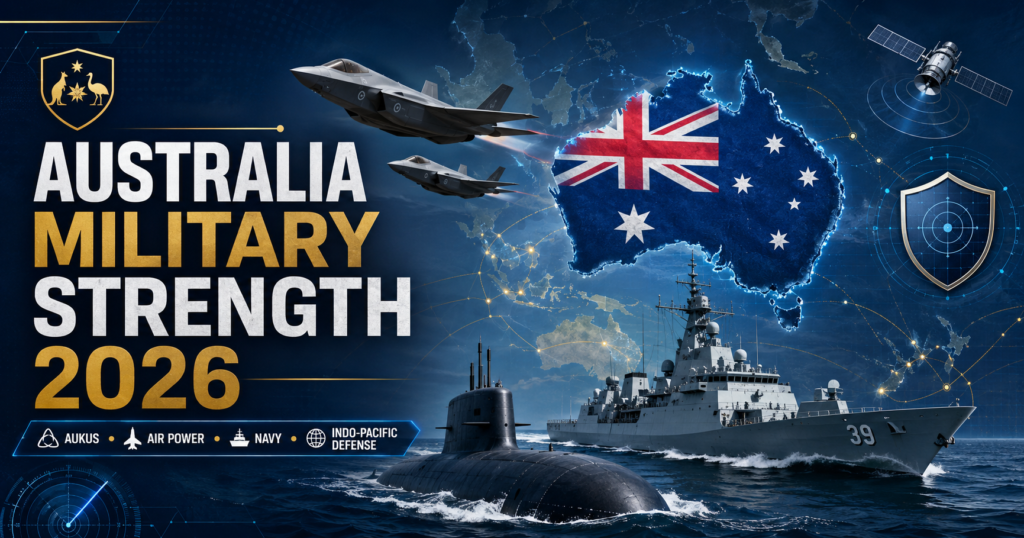
Australia enters 2026 with a military that is relatively small in personnel numbers but unusually strong in technology, funding, air power, maritime reach and alliance support. The Australian Defence Force (ADF) is built less around mass mobilization and more around operating sophisticated aircraft, warships, submarines, surveillance systems and long-range weapons across the enormous distances of the Indo-Pacific.
Australia ranks 17th among 145 countries in the 2026 Global Firepower assessment, with a Power Index score of 0.3208. Its defense budget is estimated at about $57.35 billion, placing Australia among the world’s higher military spenders despite a population of only around 26.8 million.
That combination explains an important feature of Australia’s military strength in 2026: the country cannot compete with China, India or the United States through manpower or equipment quantity. Instead, Australian defense planning increasingly emphasizes technological advantage, maritime control, intelligence, long-range operations and the ability to fight alongside powerful allies.
AUKUS is pushing that strategy even further. Nuclear-powered submarines, advanced undersea warfare, long-range strike capabilities and deeper technological cooperation with the United States and United Kingdom could reshape Australia’s military position over the coming decades.
Australia Military Strength 2026 at a Glance
The raw numbers show the unusual structure of Australian military power. Australia ranks much higher in defense spending and several air, infrastructure and resource categories than it does in active manpower or heavy land equipment.
| Australia Military Category | 2026 Figure |
|---|---|
| Global Military Rank | 17th of 145 |
| Power Index | 0.3208 |
| Population | 26,768,598 |
| Active Military Personnel | 58,910 |
| Reserve Personnel | 33,270 |
| Estimated Total Military Personnel | 92,180 |
| Defense Budget | $57.35 billion |
| Total Aircraft | 348 |
| Armored Vehicles | 17,118 |
| Tanks | 46 |
| Total Naval Assets | 45 |
| Submarines | 6 |
| Destroyers | 3 |
| Frigates | 7 |
| Helicopter Carriers | 2 |
These figures also show why judging Australia purely by troop or tank numbers can be misleading. Its strongest advantages lie elsewhere, particularly in defense funding, modern air operations, naval capability, infrastructure and access to allied military technology.
Why Australia’s Military Is Different From Other Top-20 Powers
Australia has no land border to defend. Instead, it sits between the Indian and Pacific Oceans, with an enormous coastline and strategic interests extending across Southeast Asia, the South Pacific and wider Indo-Pacific.
This geography changes what Australia needs from its armed forces.
A military designed mainly for continental land warfare might prioritize huge armored formations, artillery and large numbers of soldiers. Australia needs aircraft that can cover long distances, ships capable of sustained deployments, submarines that can remain at sea, surveillance assets that can monitor enormous areas and logistics systems capable of moving forces across a continent.
This is why Australia’s military can look modest in categories such as tanks while remaining highly capable in areas that matter to Australian defense strategy.
Australian Defence Force Personnel and Manpower
Australia’s population of roughly 26.77 million gives it a much smaller manpower base than most major Asian military powers.
The 2026 manpower figures include approximately:
| Australian Manpower Category | Estimated Strength |
|---|---|
| Total Population | 26,768,598 |
| Available Manpower | 11,242,811 |
| Fit for Service | 9,208,398 |
| Reaching Military Age Annually | 294,455 |
| Active Personnel | 58,910 |
| Reserve Personnel | 33,270 |
| Paramilitary Personnel | 0 |
The active force therefore represents only a small fraction of Australia’s population.
This is both a characteristic and a limitation of the ADF. Australia operates a professional military capable of handling advanced systems, but it does not possess the enormous standing manpower available to countries such as China, India, Russia, Pakistan or Indonesia.
For Australia, maintaining sufficient trained personnel for submarines, ships, aircraft, cyber operations, intelligence and increasingly sophisticated weapons is consequently more important than simply maximizing troop numbers.
Australian Army Strength in 2026
The Australian Army is the land component of the ADF and is structured around professional, mobile and increasingly networked forces rather than a huge heavy-armored army.
Australia’s 2026 land-force inventory includes:
| Australian Land Equipment | 2026 Inventory |
|---|---|
| Tanks | 46 |
| Armored Vehicles | 17,118 |
| Self-Propelled Artillery | 0 |
| Towed Artillery | 48 |
| Multiple Launch Rocket Systems | 8 |
The 46-tank inventory is small by global standards. Australia is not attempting to maintain the kind of mass armored formations associated with large continental militaries.
The much larger armored-vehicle category better reflects Australia’s emphasis on protected mobility, troop transport, reconnaissance, engineering and support vehicles.
Australian land modernization is also increasingly connected to the broader requirement for longer-range fires, better air defense, battlefield networking and cooperation between land, sea and air forces.
Why Australia Does Not Need Thousands of Tanks
Australia’s geography provides the answer.
There is no neighboring land army sitting directly across an Australian border. Any major conventional attack against the Australian mainland would first have to overcome enormous maritime and air distances.
That places considerable strategic importance on detecting and disrupting threats before they reach Australian territory.
Tanks remain useful for land combat and expeditionary operations, but air power, submarines, surface warships, missiles, intelligence and surveillance can have greater strategic importance to Australia’s national defense than maintaining thousands of main battle tanks.
Royal Australian Air Force Strength in 2026
The Royal Australian Air Force (RAAF) is one of the most important components of Australian military power.
Australia has 348 military aircraft across multiple categories. More significant than the overall number is the mixture of combat aircraft, transports, tankers, special-mission platforms and training aircraft that supports operations over very long distances.
The 2026 air inventory is estimated as follows:
| Australian Air Power Category | Aircraft |
|---|---|
| Total Aircraft | 348 |
| Fighters | 24 |
| Attack Types | 71 |
| Fixed-Wing Transports | 37 |
| Trainers | 107 |
| Special-Mission Aircraft | 31 |
| Tankers | 6 |
| Helicopters | 72 |
| Attack Helicopters | 22 |
Australia’s air fleet ranks far below the United States or China in raw numbers, but several categories reveal capabilities that are especially valuable for an island-continent.
F-35A and Australia’s Combat-Air Advantage
The F-35A Lightning II is central to Australia’s modern combat-air capability.
The F-35 is designed around stealth, advanced sensors, information sharing and networked warfare rather than simply speed or weapons load. For Australia, that makes the aircraft valuable not only as a fighter but also as a sensor and information node within a larger joint force.
Australia also operates the F/A-18F Super Hornet, giving the RAAF another mature multirole combat platform.
Together, modern combat aircraft allow Australia to maintain a much higher level of air capability than the country’s population size might suggest.
Surveillance and Special-Mission Aircraft
Australia’s 31 special-mission aircraft are another important part of the military balance.
Modern conflict depends heavily on detecting threats, gathering intelligence, tracking aircraft and ships, coordinating friendly forces and sharing battlefield information.
Platforms such as Australia’s E-7A Wedgetail airborne early-warning aircraft and maritime surveillance capabilities extend the effectiveness of fighters and naval forces.
This is a good example of why simply counting fighters does not fully describe Australian air power.
Tankers Give Australia Something It Needs: Range
Australia’s geography creates enormous operational distances.
Its fleet of aerial refueling aircraft allows combat aircraft to remain airborne longer and operate farther from their home bases. Tankers become particularly important when operations stretch north toward Southeast Asia or farther into the Indian and Pacific Oceans.
For Australia, aerial refueling is therefore not merely a support function. It directly increases the useful reach of the combat fleet.
Royal Australian Navy Strength in 2026
If geography determines military priorities, the Royal Australian Navy (RAN) sits at the center of Australia’s long-term defense challenge.
Australia’s economy depends heavily on maritime trade, while the country must defend a huge coastline and operate across two major oceans.
The 2026 naval inventory totals approximately 45 assets with combined tonnage approaching 199,898 tonnes.
| Royal Australian Navy Category | 2026 Fleet |
|---|---|
| Total Naval Assets | 45 |
| Aircraft Carriers | 0 |
| Helicopter Carriers | 2 |
| Destroyers | 3 |
| Frigates | 7 |
| Submarines | 6 |
| Offshore Patrol Vessels | 13 |
| Mine Warfare Vessels | 3 |
Australia does not operate a conventional aircraft carrier. Instead, its surface fleet combines destroyers, frigates, amphibious ships and patrol vessels with an important submarine force.
Australia’s Two Large Amphibious Ships
Australia’s two Canberra-class landing helicopter dock ships, HMAS Canberra and HMAS Adelaide, substantially expand the ADF’s ability to move troops, helicopters, vehicles and supplies by sea.
These ships are especially useful for Australia because military operations in the Pacific do not always involve conventional warfare.
The same amphibious capacity can support:
- regional military deployments;
- evacuation operations;
- humanitarian assistance;
- disaster relief;
- helicopter operations;
- movement of troops and vehicles; and
- multinational exercises.
This gives Australia a form of regional reach that cannot be understood simply by looking at destroyer or submarine numbers.
Australia’s Submarine Force
Australia operates six Collins-class conventional submarines, but the submarine story is much larger than the current fleet.
Undersea warfare is becoming one of the defining elements of Australia’s future defense strategy.
Submarines are particularly useful across the Indo-Pacific because they can conduct surveillance, intelligence gathering and combat operations while remaining difficult for an opponent to locate.
The existing Collins class provides this capability today, while AUKUS is intended to move Australia toward a much more capable nuclear-powered submarine force.
AUKUS and the Future of Australian Military Power
The AUKUS security partnership between Australia, the United Kingdom and the United States is one of the most consequential defense developments affecting Australia.
Its most visible element is the plan to give Australia a nuclear-powered submarine capability.
These are nuclear-powered, not nuclear-armed, submarines. The distinction matters: nuclear propulsion provides endurance and performance advantages without automatically meaning that the submarine carries nuclear weapons.
Why Nuclear-Powered Submarines Matter to Australia
The Indo-Pacific is enormous. Conventional diesel-electric submarines can be highly effective, but nuclear propulsion offers major advantages for long-distance operations.
Nuclear-powered attack submarines can provide:
- substantially greater endurance;
- sustained high underwater speeds;
- longer-range operations;
- less dependence on surfacing or snorkeling;
- greater flexibility across distant patrol areas; and
- stronger undersea surveillance and deterrence.
These characteristics align unusually well with Australia’s geography.
A submarine leaving Australia may need to travel thousands of kilometers before reaching an operational area. Endurance and transit speed therefore have strategic value that would be less significant for a country defending a much smaller maritime zone.
What Is SSN-AUKUS?
Australia’s long-term plan includes a new class of nuclear-powered attack submarine commonly known as SSN-AUKUS.
The broader pathway also involves cooperation with the United States and United Kingdom as Australia develops the infrastructure, workforce, regulatory system and technical knowledge required to operate nuclear-powered submarines.
This will not transform the Australian Navy overnight. Building a sustainable nuclear-submarine capability requires decades of investment, specialized personnel, shipyard infrastructure, maintenance capacity and technical expertise.
Nevertheless, if successfully delivered, the program could represent one of the largest increases in Australian undersea capability in the country’s military history.
Australia Defense Budget 2026
Australia’s $57.35 billion defense budget is one of the clearest indicators of why the ADF performs above what its manpower numbers alone would suggest.
The country ranks around 10th globally in the defense-spending category used in the 2026 Global Firepower assessment.
Australia’s broader financial indicators include:
| Financial Category | Estimated Value |
|---|---|
| Defense Budget | $57.35 billion |
| Purchasing Power Parity | $1.635 trillion |
| Foreign Exchange and Gold Reserves | $60.404 billion |
Large defense spending relative to the size of the armed forces allows Australia to devote substantial resources to expensive capabilities such as modern combat aircraft, submarines, warships, sensors, communications, missiles, intelligence systems and military infrastructure.
The challenge is that many of Australia’s future programs are also exceptionally expensive. Nuclear-powered submarines, shipbuilding, long-range weapons and advanced technology will compete for funding over decades rather than a single budget cycle.
Australia’s Geographic Defense Advantage
Australia covers approximately 7.74 million square kilometers, making it one of the world’s largest countries by land area.
It also has about 25,760 kilometers of coastline and no international land borders.
| Geographic Factor | Australia |
|---|---|
| Land Area | 7,741,220 km² |
| Coastline | 25,760 km |
| Shared Land Borders | None |
| Usable Waterways | 2,000 km |
Australia’s isolation provides a degree of natural strategic depth, but it creates a different problem: distance.
Military aircraft, ships, personnel, fuel, ammunition and supplies may need to travel enormous distances even within Australian territory.
Northern bases and maritime approaches are therefore particularly important because they connect the Australian mainland with the wider Indo-Pacific operating environment.
Australia’s Military Logistics and Infrastructure
Australia possesses unusually strong civilian infrastructure for a country with a relatively small population.
The 2026 dataset includes:
| Australian Infrastructure | Scale |
|---|---|
| Serviceable Airports | 2,257 |
| Road Network | 873,573 km |
| Railway Network | 32,606 km |
| Ports and Trade Terminals | 66 |
| Merchant Marine Fleet | 604 |
| Internet Coverage | 97% |
The number of serviceable airports is especially notable, placing Australia very high internationally in that category.
Infrastructure does not automatically translate into combat power, but it influences how quickly personnel, equipment and supplies can be moved and sustained.
For a country as geographically large as Australia, logistics is itself a strategic capability.
Natural Resources and Australia’s Ability to Sustain National Power
Australia is also unusually well positioned in several strategic-resource categories.
It is a major producer of natural gas and coal, while possessing significant reserves of both.
The 2026 figures include approximately:
| Strategic Resource | Australian Position |
|---|---|
| Natural Gas Production | 153.783 billion m³ |
| Proven Natural Gas Reserves | 3.228 trillion m³ |
| Coal Production | 445.077 million metric tons |
| Proven Coal Reserves | 149.472 billion metric tons |
| Oil Production | 386,000 barrels |
| Proven Oil Reserves | 2.446 billion barrels |
Australia ranks among the world’s leading producers of natural gas and coal.
Energy resources and a large mining sector strengthen national economic resilience and give Australia strategic importance beyond the size of its armed forces.
There is, however, an interesting contrast in petroleum. The dataset estimates oil consumption at around 1.151 million barrels against production of roughly 386,000 barrels, highlighting that resource abundance does not mean complete self-sufficiency across every fuel category.
Australia’s Alliance Advantage
Another part of Australian military strength cannot be represented properly in a simple equipment table.
Australia maintains exceptionally close defense relations with the United States, while AUKUS has deepened strategic and technological cooperation with both the United States and United Kingdom.
Australia also works closely with Japan and other regional partners.
These relationships matter because modern warfare depends on much more than national equipment inventories. Intelligence sharing, communications, logistics, joint exercises, technology access and interoperability can significantly affect what a military can accomplish.
Australia therefore operates within a much larger network of security relationships than its national force totals suggest.
Australia’s Biggest Military Strengths in 2026
Australia’s strongest military advantages are not concentrated in a single branch.
Advanced air power gives the ADF sophisticated combat, surveillance, transport and aerial-refueling capabilities.
Maritime capability allows the Royal Australian Navy to operate submarines, destroyers, frigates and large amphibious ships across Australia’s ocean approaches.
Defense spending supports equipment quality and modernization despite limited personnel numbers.
Strategic alliances provide access to intelligence, exercises, technology and interoperability with some of the world’s most capable armed forces.
Geography and infrastructure provide strategic depth and extensive logistics networks.
AUKUS offers a pathway toward a significantly more capable undersea force and deeper advanced-technology cooperation.
Together, these factors make Australia more formidable than a simple count of soldiers or tanks would imply.
Australia’s Main Military Limitations
Australia also faces genuine constraints.
Small Active Force
With around 58,910 active personnel, Australia cannot generate the mass available to larger military powers.
Sustaining multiple major operations simultaneously would place substantial pressure on personnel.
Huge Territory
Australia’s size is both an advantage and a burden. Defending critical infrastructure and operating across thousands of kilometers requires significant airlift, sealift, surveillance and logistics.
Limited Heavy Land Forces
Australia has only dozens of tanks and relatively modest artillery numbers compared with large continental armies.
Expensive Modernization
Advanced submarines, warships, combat aircraft, missiles and military infrastructure require enormous long-term expenditure.
Long AUKUS Timeline
Nuclear-powered submarines could eventually transform Australia’s undersea reach, but developing the full capability is a generational project rather than an immediate increase in fleet strength.
How Strong Is Australia Compared With Other Indo-Pacific Powers?
Australia occupies an unusual position in the regional military balance.
It does not have China’s scale, India’s manpower, Japan’s industrial weight or Indonesia’s population. What Australia brings instead is a combination of sophisticated Western military technology, substantial defense spending, strategic geography and exceptionally strong alliance integration.
Against a much larger major power acting alone, Australia’s limited manpower and equipment numbers would become important constraints.
Within an allied Indo-Pacific security network, however, Australian bases, submarines, aircraft, surveillance systems, ports, logistics infrastructure and geography become considerably more valuable.
That distinction is essential when assessing how powerful Australia’s military really is.
Is Australia a Military Superpower?
Australia is better described as a high-capability regional military power than a global military superpower.
A military superpower normally combines enormous defense spending with global basing, large strategic forces, substantial manpower, extensive power-projection assets and the ability to conduct major operations independently across multiple regions.
Australia does not possess that scale.
What it does possess is a highly modern military with capabilities that can have an impact far beyond its relatively small population.
Can Australia Defend Itself?
Australia has substantial natural and military defensive advantages.
Any conventional opponent attempting to project major forces toward the Australian mainland would face immense distances and the requirement to operate across contested maritime and air approaches.
Australia can combine combat aircraft, submarines, surface warships, surveillance systems, land forces and geographically dispersed infrastructure in its defense.
At the same time, Australia’s enormous coastline and relatively small population mean that complete self-reliance would be difficult in a prolonged high-intensity conflict against a much larger major power.
This helps explain why deterrence, long-range capability and alliances remain central to Australian defense planning.
What Australia’s Military Could Look Like in the 2030s
The most important question surrounding Australian military strength is not simply where the country ranks in 2026, but what kind of force it is building.
Australia is moving toward a defense model with greater emphasis on:
- nuclear-powered submarines;
- long-range strike;
- undersea warfare;
- advanced missiles;
- intelligence and surveillance;
- autonomous systems;
- cyber capabilities;
- space-based support;
- stronger northern infrastructure; and
- deeper interoperability with allies.
The direction is clear: Australia wants threats to be detectable and contestable at greater distances from the mainland.
If these programs are delivered successfully, the Australian Defence Force of the 2030s and 2040s could have considerably greater strategic reach than today’s force even without becoming dramatically larger in personnel.
FAQs
What is Australia’s military ranking in 2026?
Australia ranks 17th out of 145 countries in the 2026 Global Firepower assessment, with a Power Index score of 0.3208.
How many active military personnel does Australia have?
Australia has approximately 58,910 active military personnel, supported by around 33,270 reserve personnel.
How large is Australia’s defense budget in 2026?
The 2026 Global Firepower dataset estimates Australia’s defense budget at approximately $57.35 billion.
How many military aircraft does Australia have?
Australia’s total military aircraft inventory is estimated at 348 aircraft, including fighters, attack aircraft, transports, trainers, tankers, helicopters and special-mission platforms.
Does Australia have F-35 fighter jets?
Yes. The Royal Australian Air Force operates the F-35A Lightning II, which forms a central part of Australia’s modern combat-air capability.
How many submarines does Australia have in 2026?
Australia operates six Collins-class conventional submarines. The country is pursuing nuclear-powered attack submarines through its AUKUS submarine pathway.
Does Australia have nuclear submarines?
Australia does not yet operate its planned nuclear-powered submarine fleet. AUKUS establishes a long-term pathway for Australia to acquire and eventually operate nuclear-powered attack submarines.
Will Australian nuclear submarines carry nuclear weapons?
The AUKUS submarine program concerns nuclear propulsion rather than nuclear armament. Nuclear-powered attack submarines use nuclear reactors for propulsion but are not automatically nuclear-armed.
Does Australia have an aircraft carrier?
Australia does not operate a conventional aircraft carrier. The Royal Australian Navy does operate two large Canberra-class landing helicopter dock ships.
How many tanks does Australia have?
The 2026 dataset lists approximately 46 tanks. Australia’s military strategy places considerably greater emphasis on mobility, air power, maritime capability and long-range operations than on maintaining a huge tank fleet.
What is Australia’s strongest military advantage?
There is no single answer, but Australia’s combination of advanced air power, submarines, maritime capability, high defense spending, strategic geography and strong alliances gives it considerable military strength relative to its population.
Why is AUKUS important for Australia?
AUKUS provides a pathway toward nuclear-powered submarines and deeper cooperation with the United States and United Kingdom in advanced defense technologies. It could significantly expand Australia’s ability to conduct sustained long-range undersea operations.
Is Australia one of the strongest militaries in the world?
Australia is a Top-20 military power in the 2026 Global Firepower ranking. It lacks the numerical scale of the largest powers but performs strongly in technology, funding, infrastructure, air capability and strategic partnerships.
Is Australia’s military stronger than its ranking suggests?
Rankings are useful for comparing measurable categories, but they cannot perfectly capture training quality, alliance integration, intelligence access, technology or strategic geography. Those factors are particularly important when assessing Australia.
Final Assessment: How Powerful Is Australia in 2026?
Australia’s military strength in 2026 is built around quality, reach and partnerships rather than sheer numbers.
The country has fewer than 60,000 active military personnel and only a modest heavy land force, yet it supports a sophisticated air force, an increasingly important navy, extensive military infrastructure and one of the larger defense budgets in the world.
Its geography makes maritime and air power especially important. Its alliances provide access to technology, intelligence and interoperability that raw equipment counts cannot fully represent. And its AUKUS submarine program points toward a future force designed to operate much farther from Australia’s coastline.
Australia is therefore neither a manpower giant nor a military superpower. It is a technologically advanced Indo-Pacific military power whose strategic influence is considerably larger than the size of its standing armed forces suggests.
The biggest transformation is still ahead. If Australia successfully combines nuclear-powered submarines, long-range weapons, modern combat aircraft, surveillance systems and stronger regional infrastructure, its military of the 2030s could possess substantially greater deterrence and operational reach than the force reflected in today’s rankings.