The United States military remains the world’s highest-ranked armed force in 2026, combining a large professional force with extensive air power, a nuclear-powered carrier fleet, strategic nuclear forces, long-range logistics, overseas bases, space capabilities, and one of the world’s largest defense budgets.
In the 2026 Global Firepower ranking, the United States ranks 1st among 145 countries, with a Power Index score of 0.0741.
That ranking, however, tells only part of the story.
What most clearly distinguishes U.S. military power is not simply the number of soldiers, tanks, aircraft, or ships it possesses. The United States has built its force around the ability to combine air, land, sea, space, cyber, intelligence, logistics, and nuclear capabilities while operating far beyond North America.
This makes the U.S. military structurally different from armed forces designed primarily for territorial defense.
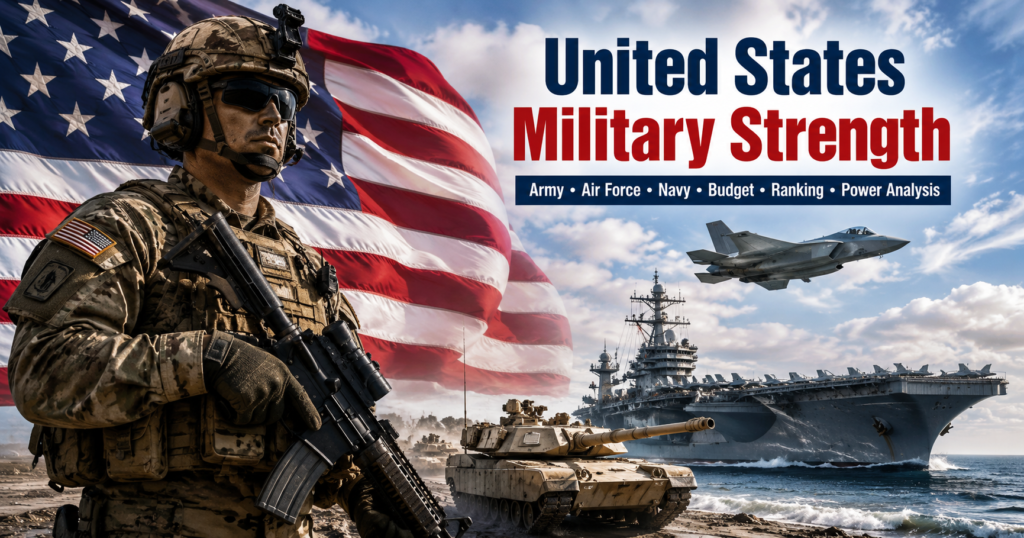
United States Military Strength 2026 at a Glance
The figures below provide a useful overview of the scale of U.S. military power. Inventory totals should not be interpreted as exact numbers of systems immediately available for combat.
| Category | United States 2026 |
|---|---|
| Global Firepower Rank | 1 of 145 |
| GFP Power Index | 0.0741 |
| Active Military Personnel | 1,333,030 |
| Reserve Personnel | 799,500 |
| Total Military Aircraft | 13,032 |
| Fighter Aircraft | 1,791 |
| Military Helicopters | 5,913 |
| Attack Helicopters | 1,024 |
| Tanks | 4,666 |
| Armored Vehicles | 409,660 |
| Self-Propelled Artillery | 1,521 |
| Towed Artillery | 1,878 |
| MLRS / Rocket Artillery | 1,731 |
| Naval Assets | 465 |
| Aircraft Carriers | 11 |
| Submarines | 66 |
These numbers demonstrate the enormous scale of the U.S. force, but the more important advantage is how different capabilities are integrated. Tank totals, for example, reveal much less about American global military reach than its combination of airlift, aerial refueling, carrier aviation, submarines, satellites, overseas infrastructure, and logistics.
United States Military Ranking in 2026
The United States ranks #1 in the 2026 Global Firepower index, ahead of every other country included in that assessment.
Its 2026 Power Index score is 0.0741, where a lower score represents a stronger overall position under the GFP methodology.
The United States also ranks particularly high in individual categories including:
- Total military aircraft
- Fighter aircraft
- Transport aircraft
- Special-mission aircraft
- Aerial tankers
- Helicopters
- Attack helicopters
- Aircraft carriers
- Submarines
- Defense spending
- Logistics and transportation infrastructure
A #1 ranking should not be interpreted as meaning the United States leads every military category.
Other countries maintain larger forces in certain areas, including particular types of land equipment or personnel. What supports the U.S. position is the combination of capabilities available across multiple domains.
United States Military Personnel
The United States operates an all-volunteer professional military supported by substantial reserve components.
For 2026, the comparative figures used in this guide put U.S. military manpower at approximately:
| Personnel Category | Estimated Strength |
|---|---|
| Active Personnel | 1,333,030 |
| Reserve Personnel | 799,500 |
| Active + Reserve | 2.13 million+ |
The active force is distributed across the U.S. Army, Navy, Air Force, Marine Corps, Space Force, and Coast Guard, with reserve and National Guard components providing additional capacity.
Raw personnel numbers are not the main reason the United States holds such a high position globally. Several countries have very large populations and mobilization pools.
The U.S. advantage lies more in the combination of its professional personnel with advanced equipment, training systems, logistics, communications, intelligence, joint-force integration, and large support infrastructure.
United States Army Strength 2026
The U.S. Army forms the largest land-warfare component of the American armed forces.
Its role extends well beyond conventional infantry operations. The Army operates armored formations, artillery, aviation, air and missile defense, engineering units, logistics networks, intelligence systems, and long-range fires.
Major U.S. land systems include the:
- M1 Abrams main battle tank family
- Bradley infantry fighting vehicle
- Stryker family of armored vehicles
- M109 Paladin self-propelled artillery
- HIMARS rocket artillery system
- Patriot air and missile defense system
- Apache attack helicopter
- Black Hawk utility helicopter
- Chinook heavy-lift helicopter
U.S. Land Forces by Numbers
| Land Capability | 2026 Inventory Figure |
|---|---|
| Tanks | 4,666 |
| Armored Vehicles | 409,660 |
| Self-Propelled Artillery | 1,521 |
| Towed Artillery | 1,878 |
| MLRS / Rocket Systems | 1,731 |
The exceptionally large armored-vehicle figure should be interpreted carefully because broad inventory categories can include many different vehicle types and roles.
Similarly, the listed tank inventory does not mean that every tank is assigned to an immediately deployable combat formation. Military inventories can include active equipment as well as systems in reserve, storage, maintenance, training, or modernization pipelines.
What Makes the U.S. Army Powerful?
The Army’s strength is not based primarily on possessing the world’s largest tank fleet.
Its more distinctive capabilities include:
Combined-arms operations: Armor, infantry, aviation, artillery, air defense, intelligence, engineering, and logistics can operate as parts of larger formations.
Army aviation: Large fleets of Apache, Black Hawk, Chinook and other rotorcraft give U.S. ground forces substantial mobility and aviation support.
Long-range fires: HIMARS and other precision-fire systems have increased the importance of long-range ground-based strike capabilities.
Logistics: Moving a large land force across oceans requires transportation, pre-positioned equipment, supply networks, ports, airlift, sealift, maintenance, and allied access.
Modernization is also changing the force. The FY2026 defense program includes investment in the M1E3 Abrams and XM30 Mechanized Infantry Combat Vehicle, among other land-power programs.
United States Air Force and Air Power 2026
Air power is one of the clearest areas where the United States separates itself from most other militaries.
The broader U.S. military aircraft inventory includes aircraft operated not only by the Air Force but also by the Navy, Marine Corps and Army.
U.S. Military Aircraft Inventory
| Aircraft Category | 2026 Inventory |
|---|---|
| Total Aircraft | 13,032 |
| Fighters | 1,791 |
| Dedicated Attack Aircraft | 926 |
| Fixed-Wing Transports | 917 |
| Trainer Aircraft | 2,610 |
| Special-Mission Aircraft | 611 |
| Aerial Tankers | 610 |
| Helicopters | 5,913 |
| Attack Helicopters | 1,024 |
The United States ranks #1 in the GFP comparison for total aircraft, fighters, attack aircraft, transports, trainers, special-mission aircraft, tankers, helicopters and attack helicopters.
But the composition of this fleet matters more than the total alone.
Why U.S. Air Power Is Different
The American air-power structure includes capabilities that many smaller air forces possess only in limited numbers—or not at all.
Stealth Fighters
The F-22 Raptor and F-35 Lightning II provide fifth-generation capabilities built around stealth, advanced sensors, networking, and precision weapons.
The F-35 also operates with the U.S. Navy and Marine Corps in different variants and is increasingly important across allied air forces.
Strategic Bombers
The United States maintains a dedicated long-range bomber force built around aircraft including:
- B-52H Stratofortress
- B-1B Lancer
- B-2 Spirit
The B-21 Raider represents the next generation of U.S. penetrating bomber capability.
Aerial Refueling
The tanker fleet is one of the most important—and often overlooked—elements of U.S. military strength.
Aircraft such as the KC-135 Stratotanker and KC-46A Pegasus allow combat and support aircraft to operate at much greater distances.
A fighter fleet without sufficient tankers is far more geographically constrained.
Strategic Airlift
Aircraft such as the C-17 Globemaster III, C-5M Super Galaxy and C-130 family allow personnel, equipment, vehicles, supplies, and humanitarian cargo to move over long distances.
This transport capacity is a major part of America’s ability to deploy forces internationally.
Surveillance and Special-Mission Aircraft
The U.S. inventory also contains extensive intelligence, surveillance, reconnaissance, command-and-control, electronic-warfare, and other specialized aircraft.
These support systems help turn individual combat aircraft into part of a much larger military network.
U.S. Navy Strength 2026
The United States Navy is central to America’s ability to maintain a military presence across multiple oceans.
A simple ship count can be misleading when comparing navies because a patrol craft, destroyer, nuclear submarine, amphibious assault ship, and aircraft carrier contribute very different capabilities.
For the United States, fleet composition and tonnage are therefore more informative than the total number of hulls alone.
U.S. Naval Strength by Numbers
| Naval Category | 2026 Figure |
|---|---|
| Total Naval Assets | 465 |
| Total Tonnage | 8.26 million+ tonnes |
| Aircraft Carriers | 11 |
| Helicopter / Amphibious Aviation Carriers | 9 |
| Destroyers | 83 |
| Submarines | 66 |
These comparative inventory figures place the United States particularly strongly in carrier aviation, destroyers, submarines and overall fleet tonnage.
Aircraft Carriers and Carrier Strike Groups
The United States operates 11 nuclear-powered aircraft carriers, built around the Nimitz and Gerald R. Ford classes.
The significance of these ships goes far beyond their hull count.
A U.S. carrier normally operates as part of a carrier strike group, combining the carrier and its embarked air wing with surface escorts and other supporting capabilities.
This allows the United States to deploy a substantial mobile aviation capability without relying entirely on nearby land bases.
The Navy’s 2026 operations continue to demonstrate this global deployment model, with carrier strike groups operating across multiple fleet areas.
U.S. Submarine Force
Submarines are another major component of American naval power.
The U.S. operates nuclear-powered:
- Attack submarines (SSNs)
- Ballistic-missile submarines (SSBNs)
- Guided-missile submarine capabilities
Attack submarines perform missions including anti-submarine warfare, anti-surface warfare, intelligence collection, special-operations support, and land attack.
Ballistic-missile submarines perform a very different role: they form the sea-based component of the U.S. nuclear triad.
That distinction is important because counting every submarine as if it performs the same mission would misrepresent actual naval capability.
United States Marine Corps
The U.S. Marine Corps gives the United States a specialized expeditionary force capable of operating from naval platforms and forward locations.
Its role includes:
- Amphibious operations
- Expeditionary warfare
- Forward deployment
- Aviation
- Air defense
- Long-range fires
- Rapid crisis response
The Marine Corps is also changing its force structure for operations in contested maritime environments, placing greater emphasis on mobility, sensors, unmanned systems, and long-range precision fires.
This gives the United States another layer of capability between conventional land forces and naval power.
United States Space Force and Space Capabilities
A major difference between modern military power and older equipment-based comparisons is the importance of space systems.
The United States created the U.S. Space Force as a separate military service in 2019.
Military space capabilities support functions including:
- Satellite communications
- Missile warning
- Positioning and navigation
- Space-domain awareness
- Intelligence support
- Command and control
GPS alone illustrates why space infrastructure matters: modern aircraft, ships, ground formations, precision weapons, logistics systems, and communications can depend heavily on satellite-enabled services.
The FY2026 U.S. defense request includes roughly $34 billion for space capabilities, reflecting the growing importance of this domain.
U.S. Cyber and Information Capabilities
Cyber capability has also become an important part of military competition.
The FY2026 defense request includes approximately $15.1 billion for cyberspace activities, including cybersecurity, resilient networks, and related capabilities.
Cyber power is difficult to rank accurately because many capabilities, vulnerabilities, and operations are not publicly disclosed.
For that reason, MilitaryCompare.com does not assign the United States an invented numerical cyber-strength score.
The important point is that cyber operations now operate alongside traditional air, land, naval, and space capabilities rather than as a completely separate form of military power.
United States Nuclear Weapons and Strategic Deterrence
The United States is one of the world’s recognized nuclear-weapon states under the Nuclear Non-Proliferation Treaty.
Its strategic deterrent is structured around a nuclear triad:
- Land-based intercontinental ballistic missiles
- Ballistic-missile submarines
- Nuclear-capable strategic bombers
Maintaining three delivery paths is intended to make the deterrent more survivable and flexible than dependence on a single system.
The sea-based component is particularly important because ballistic-missile submarines can remain concealed at sea.
Nuclear forces should be considered separately from conventional military rankings. A country’s nuclear arsenal does not translate directly into additional tanks, fighters, ships, or conventional battlefield strength.
United States Defense Budget 2026
The size of the American defense budget is another defining feature of U.S. military power, but the meaning of a “2026 defense budget” depends on what is being counted.
The official FY2026 U.S. national defense budget request totals approximately $1.012 trillion when Department of Defense funding and other national-defense components in the request are combined.
Within that framework:
| FY2026 Budget Measure | Approximate Amount |
|---|---|
| DoD Discretionary | $848.3 billion |
| DoD Total Including Planned Reconciliation Funding | $961.6 billion |
| National Defense Grand Total | $1.012 trillion |
This distinction matters because a single figure quoted as “the U.S. military budget” can refer to different budget definitions.
The FY2026 request includes funding for personnel, operations and maintenance, procurement, research and development, military construction, shipbuilding, aircraft, missiles, space, cyber capabilities, autonomous systems, and the defense industrial base.
Military Modernization in 2026
The United States is simultaneously maintaining a very large existing force and replacing major systems designed decades ago.
Important modernization areas include:
B-21 Raider
The B-21 is intended to become a major part of the future long-range bomber force.
F-35 Expansion
The F-35 continues to become increasingly important across the Air Force, Navy, Marine Corps and allied forces.
Columbia-Class Submarine
The Columbia class is being developed to replace the Ohio-class ballistic-missile submarine fleet and preserve the sea-based nuclear deterrent.
Next-Generation Land Systems
Army modernization includes development of the M1E3 Abrams and XM30 as the service prepares future armored formations.
Long-Range Weapons
FY2026 investment includes systems such as JASSM-ER, LRASM, Tomahawk, SM-6 and several hypersonic programs.
Autonomous Systems
The FY2026 request also includes significant investment in autonomous and remotely operated systems across air, land and maritime domains.
Modernization therefore involves much more than simply purchasing additional tanks or fighter aircraft.
Logistics: One of America’s Biggest Military Advantages
One of the most important differences between having military equipment and being able to employ it globally is logistics.
The United States maintains extensive:
- Military airlift
- Aerial refueling
- Sealift
- Ports
- Airfields
- Transportation infrastructure
- Overseas installations
- Pre-positioned equipment
- Supply networks
It also operates with allies and partners across NATO, the Indo-Pacific and other regions.
This means the U.S. can move personnel and equipment across intercontinental distances in a way few militaries can replicate at comparable scale.
However, global logistics also creates requirements of its own. Long supply lines require protection, maintenance, fuel, transportation capacity, access agreements, and functioning infrastructure.
U.S. Military Alliances and Overseas Presence
Military power cannot always be evaluated as if every country operates alone.
The United States is a founding member of NATO and maintains extensive defense relationships with countries across Europe and the Indo-Pacific.
It also maintains military forces and infrastructure outside the continental United States.
This overseas network can provide:
- Forward presence
- Regional logistics
- Training locations
- Air and naval access
- Faster crisis response
- Interoperability with allied militaries
This is one reason a direct comparison based only on domestic troop and equipment totals misses an important part of U.S. military capability.
Major Strengths of the United States Military
1. Air Power
The United States combines fighters, bombers, transports, tankers, helicopters, surveillance aircraft, and specialized support fleets at enormous scale.
2. Naval Aviation
Eleven nuclear-powered aircraft carriers provide a level of carrier-based aviation capacity that is not matched by another single navy.
3. Global Logistics
Airlift, refueling, sealift, overseas infrastructure, and allied access allow U.S. forces to operate far from North America.
4. Nuclear Deterrence
The land-, sea-, and air-based nuclear triad provides a diversified strategic deterrent.
5. Technology and Support Systems
Satellites, communications, surveillance, cyber capabilities, electronic systems, and precision weapons support conventional forces.
6. Joint Operations
The Army, Navy, Air Force, Marine Corps, Space Force, and supporting organizations are designed to operate together rather than as isolated forces.
7. Defense Resources
The scale of American defense spending supports personnel, operations, research, procurement, infrastructure, and long-term modernization simultaneously.
Limitations and Challenges
Being ranked first does not mean the U.S. military has no constraints.
High Operating Costs
Advanced aircraft, ships, submarines, weapons, bases, and personnel are expensive to acquire and maintain.
Aging Systems
Some major platforms—including strategic bombers, aerial tankers, helicopters, ships, and nuclear systems—require replacement or extensive modernization.
Industrial Capacity
Building submarines, ships, missiles, aircraft, and munitions quickly enough has become an increasingly important defense-industrial challenge.
Global Commitments
Maintaining forces across several regions creates substantial demands on personnel, equipment, maintenance, logistics, and readiness.
Inventory Is Not Readiness
Perhaps most importantly, large equipment totals should not be mistaken for real-time combat availability.
Public inventory databases cannot tell readers exactly how many U.S. aircraft, tanks, ships, or other systems would be available for a particular operation on a particular day.
For that reason, this guide deliberately does not calculate artificial readiness totals by multiplying inventories by a fixed percentage.
Why the United States Ranks #1 in 2026
The United States does not rank first simply because it possesses more equipment than every other country in every category—it does not.
Its position is better explained by the combination of:
large professional forces + enormous air power + carrier aviation + nuclear submarines + strategic nuclear forces + global logistics + aerial refueling + transport capacity + space systems + advanced technology + defense spending + overseas infrastructure + alliances.
Few countries combine all of these capabilities at comparable scale.
That is the central distinction between the United States and militaries that may equal or exceed it in an individual category.
Is the United States the Most Powerful Military in the World in 2026?
By the 2026 Global Firepower ranking, yes: the United States is ranked #1 among 145 countries.
But “most powerful” should still be understood carefully.
No ranking can fully measure classified capabilities, real-time readiness, leadership, wartime decisions, geography, alliance participation, industrial mobilization, or the circumstances of a particular conflict.
The most defensible conclusion is that the United States maintains the broadest combination of high-end conventional capability, global power projection, strategic deterrence, logistics, and military support infrastructure among the countries assessed in the 2026 ranking.
That is more meaningful than simply saying the United States has the most tanks or soldiers—because it does not.
FAQs
What is the United States military rank in 2026?
The United States ranks #1 out of 145 countries in the 2026 Global Firepower assessment, with a Power Index score of 0.0741.
How many active military personnel does the United States have in 2026?
The 2026 comparative data used for this guide lists approximately 1.33 million active personnel, supported by about 799,500 reserve personnel.
How many military aircraft does the United States have in 2026?
The broad 2026 military-aircraft inventory used in this guide totals approximately 13,032 aircraft across the U.S. armed forces, including fighters, transports, trainers, helicopters and special-mission aircraft.
How many fighter jets does the U.S. have in 2026?
The 2026 inventory dataset lists approximately 1,791 fighter aircraft. Inventory totals should not be interpreted as the number immediately operational at any given time.
How many aircraft carriers does the United States have in 2026?
The United States operates 11 nuclear-powered aircraft carriers, giving the U.S. Navy an unusually large carrier-aviation capability.
How many submarines does the U.S. have?
The comparative 2026 inventory used here lists 66 submarines. The fleet includes different types designed for attack, strategic nuclear deterrence, and other missions.
What is the U.S. defense budget for 2026?
The official FY2026 request includes approximately $848.3 billion in DoD discretionary funding, while the broader requested national-defense total reaches approximately $1.012 trillion when additional defense components are included.
Why is the U.S. military so powerful?
Its main advantage is the combination of air power, naval aviation, nuclear forces, logistics, technology, transportation, space capabilities, global infrastructure, alliances, and defense resources, rather than superiority in every individual equipment category.
Does having 13,000 military aircraft mean all are combat-ready?
No. An inventory total can include aircraft in different operational, maintenance, training, reserve, or modernization conditions. Public inventory figures should not be treated as exact real-time readiness numbers.
Can military rankings predict whether the United States would win a war?
No. Rankings compare measurable factors, but actual conflicts depend on objectives, geography, opponents, alliances, logistics, readiness, political decisions, intelligence, industrial capacity, and many other variables.
Final Takeaway
The United States military in 2026 remains the world’s highest-ranked force in the Global Firepower assessment, but its real distinction is broader than the #1 position.
America’s military model combines a large professional force with extensive air power, nuclear-powered carrier aviation, submarines, strategic nuclear forces, long-range transport and refueling, space and cyber capabilities, global logistics, overseas infrastructure, and major defense investment.
At the same time, raw inventory numbers have limits. They cannot show exact operational readiness, and they should not be converted automatically into predictions about battlefield performance.
For that reason, the best way to understand U.S. military strength in 2026 is not to focus on a single number. It is to examine how the country’s air, land, naval, nuclear, technological, logistical, and alliance capabilities work together.