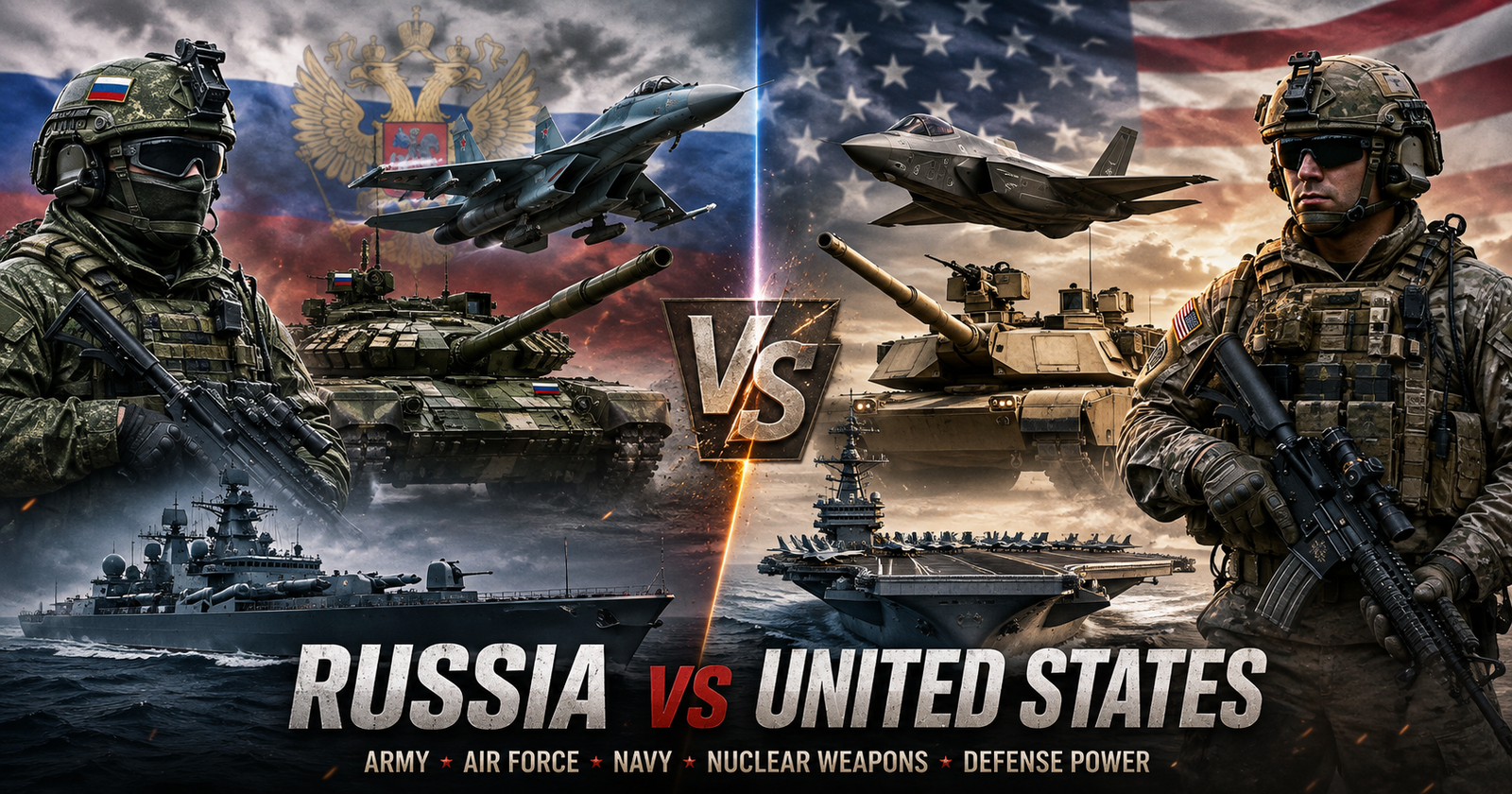
The Russia vs United States military comparison in 2026 brings together the world’s two largest nuclear powers and the top two countries in the 2026 Global Firepower ranking.
The United States ranks 1st out of 145 countries with a PowerIndex score of 0.0741, while Russia ranks 2nd with 0.0791. The small difference between those overall scores, however, should not be interpreted as meaning their armed forces are nearly identical.
They are built around substantially different strengths.
The United States military places exceptional emphasis on air power, carrier aviation, global logistics, intelligence and surveillance, overseas deployment, precision strike and joint operations.
The Russian military maintains particularly large land forces, artillery and rocket inventories, extensive missile capabilities, a major submarine force and one of the world’s two largest nuclear arsenals.
That makes a useful Russia vs USA military comparison much more complicated than simply counting soldiers, tanks or aircraft.
Russia vs USA Military Strength 2026 at a Glance
The headline figures immediately reveal the different structure of the two militaries.
| Military Category | Russia | United States |
|---|---|---|
| 2026 Global Firepower Rank | #2 | #1 |
| PowerIndex | 0.0791 | 0.0741 |
| Active Personnel | 1,320,000 | 1,333,030 |
| Reserve Personnel | 2,000,000 | 799,500 |
| Defense Budget | $212.64 billion | $831.5 billion |
| Total Aircraft | 4,237 | 13,032 |
| Fighter Aircraft | 861 | 1,791 |
| Aerial Tankers | 18 | 610 |
| Helicopters | 1,643 | 5,913 |
| Tanks | 5,630 | 4,666 |
| Self-Propelled Artillery | 3,603 | 1,521 |
| Towed Artillery | 5,920 | 1,878 |
| Mobile Rocket Projectors | 2,486 | 1,731 |
| Listed Naval Assets | 747 | 465 |
| Aircraft Carriers | 1 | 11 |
| Submarines | 66 | 66 |
| Destroyers | 13 | 83 |
The most important takeaway is not that one country wins every category. Russia’s numerical advantages are concentrated heavily in land warfare and some naval-vessel categories, while the United States has enormous advantages in air power, carrier aviation, military spending and long-range logistical support.
Russia vs USA Military Ranking in 2026
The United States and Russia occupy the first two positions in the 2026 Global Firepower ranking.
The United States ranks #1 with a 0.0741 PowerIndex, while Russia ranks #2 with 0.0791. A lower score is considered stronger within the ranking methodology.
The ranking evaluates conventional military capability through numerous factors rather than simply adding weapons together.
This distinction matters because a ranking is a useful starting point, not a prediction of what would happen in an actual conflict.
Military effectiveness can also depend on readiness, training, ammunition availability, command systems, intelligence, geography, objectives, maintenance, logistics, allies and the type of operation being conducted.
Russia vs USA Military Personnel
Russia and the United States have surprisingly similar estimated active-duty force sizes in the 2026 dataset.
| Personnel Category | Russia | United States |
|---|---|---|
| Active Personnel | 1,320,000 | 1,333,030 |
| Reserve Personnel | 2,000,000 | 799,500 |
| Paramilitary Personnel | 250,000 | 0 |
| Available Manpower | 69,002,197 | 150,463,900 |
| Fit for Service | 46,189,226 | 124,816,644 |
| Reaching Military Age Annually | 1,267,387 | 4,445,524 |
The difference between the two systems becomes clearer beyond active personnel.
Russia has a much larger listed reserve force of approximately 2 million, compared with about 799,500 for the United States.
The United States, however, has a much larger overall population and manpower pool.
These numbers should not be treated as interchangeable. A reserve soldier, active-duty service member and theoretically available military-age citizen represent very different levels of immediate military capability.
Russia vs USA Army and Land Power
Land warfare is one of Russia’s strongest areas numerically.
The Russian military has traditionally emphasized tanks, artillery, rocket systems, mechanized formations and ground-based missile forces. Its equipment structure reflects the requirements of large-scale continental warfare.
The United States Army follows a different model, combining armored formations with extensive aviation, precision fires, surveillance, communications and a large supporting logistics system.
Russia vs USA Tanks and Armored Vehicles
The 2026 comparison lists:
| Land Equipment | Russia | United States |
|---|---|---|
| Tanks | 5,630 | 4,666 |
| Armored Vehicles | 126,512 | 409,660 |
| Self-Propelled Artillery | 3,603 | 1,521 |
| Towed Artillery | 5,920 | 1,878 |
| Mobile Rocket Projectors | 2,486 | 1,731 |
Russia leads the tank and artillery categories, including a particularly large numerical advantage in self-propelled and towed artillery.
The United States has fewer listed tanks but a substantially larger armored-vehicle inventory.
Raw equipment totals still require caution. They may include vehicles with different ages, roles, modernization levels and operational status. Equipment listed in an inventory is not necessarily immediately available for deployment.
Russia’s Artillery Advantage
Artillery is one of the clearest numerical Russian strengths in this comparison.
Russia is listed with approximately:
- 3,603 self-propelled artillery systems
- 5,920 towed artillery pieces
- 2,486 mobile rocket projectors
The United States is listed with:
- 1,521 self-propelled artillery systems
- 1,878 towed artillery pieces
- 1,731 mobile rocket projectors
This reflects Russia’s longstanding emphasis on massed fires and rocket artillery within land operations.
The U.S. approach places comparatively greater emphasis on combining ground fires with aircraft, intelligence, surveillance, precision weapons and joint-service support.
Therefore, Russia having more artillery does not by itself establish overall battlefield superiority. It identifies a major difference in force structure and land-warfare emphasis.
Russia vs USA Air Force
Air power produces one of the largest differences between the two countries.
The United States has approximately 13,032 military aircraft in the 2026 dataset compared with Russia’s 4,237.
That means the American advantage extends far beyond fighter aircraft.
| Air Power Category | Russia | United States |
|---|---|---|
| Total Aircraft | 4,237 | 13,032 |
| Fighters | 861 | 1,791 |
| Dedicated Attack Aircraft | 698 | 926 |
| Transport Aircraft | 458 | 917 |
| Trainer Aircraft | 530 | 2,610 |
| Special-Mission Aircraft | 137 | 611 |
| Aerial Tankers | 18 | 610 |
| Helicopters | 1,643 | 5,913 |
| Attack Helicopters | 556 | 1,024 |
Why the U.S. Airpower Advantage Goes Beyond Fighter Numbers
The difference in fighters is substantial, but the aerial tanker comparison is even more revealing.
The United States is listed with 610 tankers, compared with only 18 for Russia.
Tankers allow combat aircraft to remain airborne longer and operate much farther from their normal bases. Combined with transport and special-mission aircraft, they form part of the infrastructure required to sustain military aviation over long distances.
The United States also operates large fleets of aircraft dedicated to airborne early warning, intelligence, surveillance, electronic warfare and other specialized missions.
Russia remains one of the world’s largest military aviation powers, with substantial fighter, interceptor, bomber and attack-aircraft capabilities. But its aviation structure is much more concentrated around operations from Russian territory and surrounding regions.
For global air-power projection, the American support-aircraft ecosystem is a major structural advantage.
Fighter Aircraft: Russia vs United States
The United States has approximately 1,791 fighters, compared with Russia’s 861 in the supplied dataset.
But fighter totals alone cannot measure air combat capability.
The U.S. inventory includes large numbers of F-35 and F-22 stealth aircraft alongside F-15 and F-16 variants and carrier-based F/A-18s.
Russia operates aircraft including the Su-35, Su-30, Su-34, MiG-31 and a smaller but developing Su-57 fleet.
The actual effectiveness of either force would depend on far more than aircraft counts: pilot training, weapons, sensors, electronic warfare, airborne warning, maintenance, basing, tanker support and air-defense conditions would all matter.
Russia vs USA Navy
A simple ship count creates one of the most misleading comparisons in this article.
Russia is listed with 747 naval assets, compared with 465 for the United States.
That does not mean Russia possesses the larger overall naval combat capability.
The composition, displacement and mission of those ships are fundamentally important.
| Naval Category | Russia | United States |
|---|---|---|
| Listed Fleet Assets | 747 | 465 |
| Aircraft Carriers | 1 | 11 |
| Helicopter Carriers | 0 | 9 |
| Submarines | 66 | 66 |
| Destroyers | 13 | 83 |
| Frigates | 12 | 0 |
| Corvettes | 79 | 27 |
| Patrol Vessels | 70 | 0 |
| Mine-Warfare Vessels | 45 | 4 |
Russia’s larger total includes many corvettes, patrol vessels and mine-warfare ships.
The U.S. fleet contains far more aircraft carriers and destroyers and is structured around sustained blue-water operations across multiple regions.
This is a good example of why total ship count should never be used alone to determine naval strength.
Aircraft Carriers: 11 vs 1
The United States is listed with 11 aircraft carriers, compared with one for Russia.
Carrier aviation is central to American global power projection. A carrier strike group combines an aircraft carrier with surface escorts, submarines, aircraft and logistical support.
The wider U.S. amphibious fleet also includes large aviation-capable ships categorized separately from conventional aircraft carriers.
Russia’s naval priorities are different. Its strategic importance rests more heavily on submarines, long-range missiles, coastal defense and regional fleets than on maintaining numerous carrier strike groups.
So the 11-to-1 carrier difference reflects two substantially different naval strategies rather than simply two fleets with different quantities of the same ship type.
Russia vs USA Submarine Power
Interestingly, the dataset lists both countries with 66 submarines.
This numerical tie should not be interpreted as equal submarine capability.
Both operate nuclear-powered ballistic-missile submarines that form a critical part of their strategic nuclear deterrents. They also operate attack submarines designed for missions such as anti-submarine warfare, intelligence gathering and long-range strike.
Russia’s submarine force remains one of the most strategically important components of its navy, including modern Borei-class ballistic-missile submarines and Yasen-class nuclear attack/cruise-missile submarines.
The United States operates a large nuclear-powered submarine fleet built around Ohio-class ballistic-missile submarines and Virginia- and Los Angeles-class attack submarines, while the Columbia class is being developed for the future strategic deterrent.
66 vs 66 is therefore an interesting inventory statistic, not a complete submarine-power comparison.
Russia vs USA Nuclear Weapons
Nuclear weapons fundamentally change any Russia–United States military comparison.
The two countries possess roughly 86% of the world’s nuclear weapons inventory combined, making their strategic relationship unlike a normal conventional military comparison.
Public estimates for the beginning of 2026 place Russia at roughly 5,420 total nuclear warheads and the United States at approximately 5,042, including military stockpiles and retired warheads awaiting dismantlement.
The estimated military stockpiles are closer:
- Russia: about 4,400 warheads
- United States: about 3,700 warheads
These figures are estimates because complete current arsenal information is not publicly available.
Both Countries Maintain a Nuclear Triad
Both Russia and the United States maintain nuclear forces across three major delivery categories:
Land-based missiles
Intercontinental ballistic missiles provide rapid, long-range strategic strike capability.
Ballistic-missile submarines
Submarines provide a survivable sea-based deterrent that is difficult for an adversary to eliminate in a first strike.
Strategic bombers
Long-range bombers provide a more flexible and recallable component of nuclear deterrence.
Russia and the United States are both modernizing important parts of these forces.
Because either country possesses the ability to cause catastrophic destruction with nuclear weapons, nuclear arsenals cannot sensibly be reduced to a conventional “winner” category.
Missiles and Long-Range Strike
Russia maintains a particularly diverse missile force.
Its arsenal includes strategic ballistic missiles, submarine-launched ballistic missiles, land-attack cruise missiles, air-launched weapons and several newer or specialized systems.
Systems such as Iskander, Kalibr, Kh-101, Yars and Kinzhal illustrate the range of delivery platforms used across Russian conventional and nuclear forces.
The United States also maintains extensive long-range strike capability through aircraft, submarines, surface ships and land-based systems.
American strength in this area is closely connected to its wider intelligence, surveillance, satellite, targeting and communications infrastructure.
This makes missile comparison difficult to express through one number. Range, accuracy, payload, survivability, targeting networks, launcher availability and mission all matter.
Russia vs USA Defense Budget 2026
The financial gap is enormous.
The supplied 2026 comparison lists:
- United States: approximately $831.5 billion
- Russia: approximately $212.64 billion
That puts U.S. spending at almost four times the Russian figure in nominal-dollar terms within this dataset.
But defense budgets also require context.
Russia purchases much of its equipment domestically and pays personnel and industrial costs primarily in rubles. A dollar conversion therefore does not perfectly represent how much military capability Russia can generate inside its domestic economy.
Even after that qualification, the scale of American defense resources remains substantial.
The U.S. budget supports not only combat units but also a huge network of research programs, satellites, bases, maintenance facilities, logistics, personnel, nuclear forces and worldwide operations.
Defense Industry and Military Production
The industrial comparison is another area where the two countries follow different models.
Russia maintains a large domestic defense-industrial base focused heavily on missiles, armored vehicles, artillery, ammunition, aircraft, air-defense systems and naval platforms.
The war in Ukraine has also placed unusually high demands on Russian ammunition and equipment production while forcing the defense sector to adapt to sustained wartime requirements.
The United States operates a much larger economy and a broad high-technology defense sector producing stealth aircraft, submarines, missiles, satellites, sensors, precision weapons and advanced electronic systems.
However, industrial capability should not be judged solely by national GDP.
The ability to expand specific production lines, maintain supply chains, obtain skilled labor and manufacture enough ammunition and replacement equipment during prolonged demand is also important.
Logistics: A Major U.S. Advantage
One of the most important differences between Russia and the United States is where their forces are designed to operate.
Russia possesses enormous territory and extensive military infrastructure across its own landmass. Its logistics system is particularly important for supporting forces across Russia and nearby continental theaters.
The United States has spent decades developing forces capable of deploying thousands of kilometers from North America.
The 2026 dataset illustrates part of the difference:
- Russia: 458 transport aircraft
- United States: 917 transport aircraft
- Russia: 18 aerial tankers
- United States: 610 aerial tankers
The United States also benefits from sealift, overseas facilities and long-established military relationships with allies and partners.
These systems make it possible to move aircraft, personnel, equipment, fuel and supplies across enormous distances.
That logistical network is one reason why comparing Russia and the United States solely through tanks and artillery misses a major component of military power.
Geography Changes the Comparison
Geography affects the two militaries in very different ways.
Russia is the world’s largest country by land area. Its strategic environment spans Europe, the Arctic, the Caucasus, Central Asia and the Pacific.
That creates both advantages and challenges.
Russia has tremendous strategic depth and access to enormous natural resources, but defending and supplying forces across such a vast territory requires extensive infrastructure.
The United States benefits from a different geographical position. The Atlantic and Pacific oceans separate the continental United States from most other major military powers, while friendly Canada lies to the north and Mexico to the south.
American military planning therefore places much greater emphasis on moving forces overseas, while Russian planning has historically placed greater emphasis on defending and operating across the Eurasian landmass and its surrounding regions.
Technology, Space and Intelligence
Modern military power increasingly depends on capabilities that are difficult to represent in simple equipment tables.
The United States maintains extensive military satellite, intelligence, surveillance, communications and navigation infrastructure. Space-based systems support everything from GPS-guided weapons and communications to missile warning and reconnaissance.
Russia also possesses significant space, electronic-warfare, intelligence and counterspace capabilities.
Both countries are investing in technologies involving drones, electronic warfare, cyber operations, advanced missiles, artificial intelligence and resilient communications.
These areas are particularly difficult to rank because many of their most important performance characteristics are not publicly available.
Military Alliances: A Major Strategic Difference
A direct Russia vs USA equipment table compares two countries individually, but real-world strategic power does not exist in isolation.
The United States is the largest military member of NATO and maintains treaty alliances and defense relationships across Europe and the Indo-Pacific.
Russia also maintains military partnerships and security relationships, but it does not possess an alliance network comparable in scale to the U.S.-led system.
This does not mean allied forces should simply be added to American totals. Countries retain their own governments, military priorities and decision-making.
It does mean that access to bases, shared intelligence, interoperability, logistics and allied military capacity can matter greatly when evaluating global military influence.
What Russia Does Better Numerically
The 2026 figures show several areas where Russia has a clear numerical advantage.
Russia has:
- More reserve personnel
- More tanks
- More self-propelled artillery
- More towed artillery
- More mobile rocket projectors
- More total listed naval vessels
- More corvettes
- More patrol vessels
- More mine-warfare vessels
- Very large missile forces
- A slightly larger estimated total nuclear inventory
These strengths help explain why Russia remains one of the world’s most formidable military powers despite having a substantially smaller economy and defense budget than the United States.
What the United States Does Better Numerically
The United States leads many of the categories most closely connected with global military reach.
It has:
- A larger overall manpower pool
- A much larger defense budget
- More total aircraft
- More fighter aircraft
- More transport aircraft
- Far more aerial tankers
- More helicopters
- More special-mission aircraft
- More armored vehicles
- Eleven aircraft carriers
- More destroyers
- A large amphibious aviation fleet
- Extensive global logistics infrastructure
The particularly large differences in tankers, transports, carriers and special-mission aircraft help explain why American military power can be deployed globally in a way that raw troop or tank counts cannot show.
Russia vs USA: Who Is More Powerful in 2026?
If the question is overall conventional military capability, the United States holds the stronger position in the 2026 Global Firepower ranking and has major structural advantages in air power, naval aviation, defense spending and global logistics.
That does not mean Russia is simply a weaker version of the United States.
Russia has a different military structure and retains exceptional capabilities in land warfare, artillery, missiles, air defense, submarines and nuclear deterrence. Its geographic position and force structure also make it particularly significant in continental Eurasian military scenarios.
The answer therefore changes depending on what is being measured.
| Area | Relative 2026 Position |
|---|---|
| Overall Global Firepower Ranking | United States |
| Active Personnel | Very close |
| Reserve Personnel | Russia |
| Tank Numbers | Russia |
| Artillery Numbers | Russia |
| Total Air Power | United States |
| Fighters | United States |
| Aerial Refueling | United States by a large margin |
| Carrier Aviation | United States by a large margin |
| Total Listed Naval Vessels | Russia |
| Submarine Numbers | Equal in dataset |
| Defense Budget | United States by a large margin |
| Global Logistics / Power Projection | United States |
| Nuclear Deterrence | Both possess massive strategic arsenals |
The comparison shows why assigning one universal “winner” to every category would be misleading. The United States is structured more strongly for global joint-force projection, while Russia retains particularly formidable land, missile and nuclear capabilities.
Could Russia Defeat the United States in a War?
There is no responsible way to determine the outcome of a hypothetical Russia–United States war from public inventory figures.
The result would depend on the location, objectives, forces committed, duration, logistics, allies, escalation and many other factors.
More importantly, both countries possess enormous nuclear arsenals.
A direct large-scale conflict between them would therefore carry an extreme risk of nuclear escalation, making simplistic predictions about a conventional “winner” misleading.
Military comparisons are better used to understand capabilities and force structures, not to predict wars.
Does Russia Have More Tanks Than the United States?
Yes. The 2026 dataset lists approximately 5,630 Russian tanks compared with 4,666 U.S. tanks.
But inventory size does not reveal how many vehicles are operational, modernized or immediately deployable. It also does not account for supporting aircraft, reconnaissance, logistics, precision weapons or other systems.
Does the United States Have a Bigger Air Force Than Russia?
Yes.
The United States is listed with approximately 13,032 military aircraft, compared with Russia’s 4,237.
The difference is particularly large in support aviation. The U.S. has far more tankers, transports, helicopters and special-mission aircraft, giving it substantially greater capacity for sustained long-range air operations.
Does Russia Have a Bigger Navy Than the United States?
Russia has more listed naval vessels in the dataset—747 compared with 465—but total ship count is misleading.
The United States operates 11 aircraft carriers and 83 destroyers, compared with one carrier and 13 destroyers for Russia.
Russia’s total includes much larger numbers of smaller corvettes, patrol vessels and mine-warfare ships.
Naval capability therefore needs to be evaluated by fleet composition and mission rather than vessel count alone.
Does Russia Have More Nuclear Weapons Than the United States?
Public estimates for early 2026 indicate that Russia has a somewhat larger total nuclear inventory, while both countries maintain enormous arsenals.
Russia is estimated at roughly 5,420 total warheads and the United States at around 5,042 when stockpiled and retired weapons awaiting dismantlement are included.
Exact nuclear numbers remain estimates because complete operational information is not publicly disclosed.
FAQs
Which country has the strongest military in 2026, Russia or the USA?
The United States ranks #1 in the 2026 Global Firepower ranking with a PowerIndex of 0.0741. Russia ranks #2 with 0.0791. The ranking measures conventional military capability and should not be interpreted as a prediction of war outcomes.
Which has more soldiers, Russia or the United States?
Their active forces are close in the supplied 2026 dataset: approximately 1.32 million for Russia and 1.333 million for the United States. Russia has a substantially larger listed reserve force.
Which has more tanks, Russia or the USA?
Russia is listed with 5,630 tanks, compared with 4,666 for the United States.
Which has more fighter jets, Russia or the USA?
The United States leads with approximately 1,791 fighter aircraft, compared with Russia’s 861.
Which country has more submarines?
The 2026 dataset lists 66 submarines for both Russia and the United States. Equal fleet counts do not mean equal submarine capability because submarine types, missions, technology and operational availability differ.
Which country spends more on its military?
The United States. The comparison dataset lists approximately $831.5 billion in U.S. defense spending versus about $212.64 billion for Russia.
Why does Russia have more ships but the U.S. Navy remain more globally capable?
Russia’s total contains larger numbers of smaller vessels such as corvettes, patrol craft and mine-warfare ships. The U.S. Navy has far more aircraft carriers and destroyers and is supported by a worldwide logistics network designed for sustained blue-water operations.
Are Russia and the United States the world’s largest nuclear powers?
Yes. Together, Russia and the United States possess roughly 86% of the world’s estimated nuclear weapons inventory, making nuclear deterrence a central part of any comparison between them.
Final Takeaway
The Russia vs United States military comparison in 2026 shows two superpowers built around very different military strengths.
Russia remains exceptionally strong in land forces, artillery, missiles, submarines and nuclear weapons, with large reserve manpower and equipment inventories designed heavily around continental warfare and strategic deterrence.
The United States combines a similarly large active force with a much larger air fleet, tanker and transport capability, carrier force, defense budget and global logistics network.
That combination places the United States first and Russia second in the 2026 Global Firepower ranking.
But the most useful conclusion is not simply that one country has more military power.
Russia’s strength is particularly concentrated in land warfare, missiles and strategic deterrence. American strength is broader across air power, maritime power projection, logistics and worldwide deployment.
And because both possess thousands of nuclear weapons, no conventional ranking can meaningfully predict the consequences or outcome of a direct conflict between them.