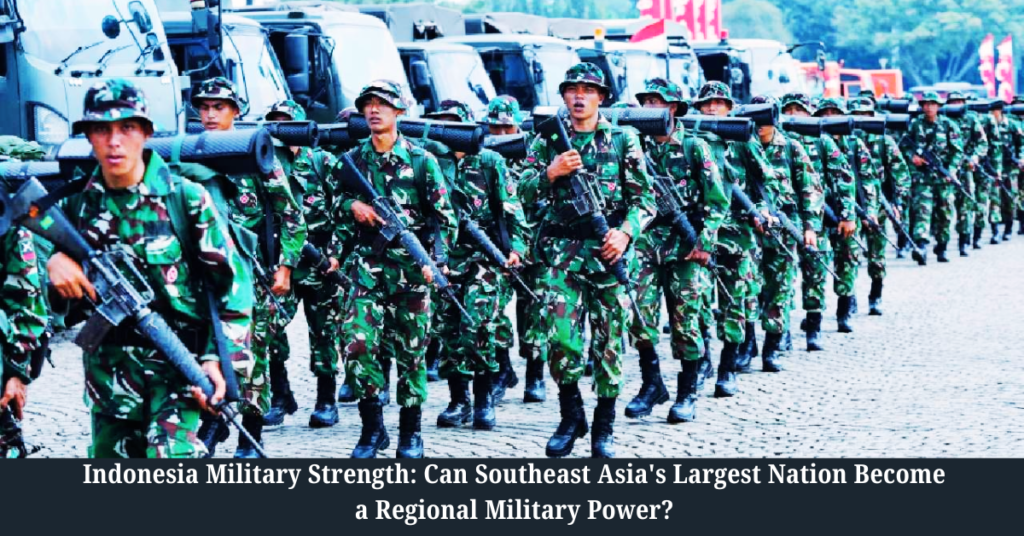
The Indonesia Military Strength 2026 continues to grow as the country strengthens its position as one of the most important military powers in Southeast Asia. As the world’s largest archipelagic nation and the fourth-most populous country, Indonesia faces unique security challenges that require a highly flexible and adaptable defense strategy.
Unlike many countries that focus primarily on protecting a single landmass, Indonesia must secure more than 17,000 islands spread across a vast maritime area connecting the Indian and Pacific Oceans. This strategic geography makes territorial defense, maritime security, and rapid military mobility critical priorities for the Indonesian National Armed Forces (TNI).
The country’s location along some of the world’s busiest shipping routes further increases its strategic importance in regional and global security affairs.
Indonesia’s military strategy focuses heavily on:
- Maritime security
- Territorial defense
- Island protection
- Rapid deployment capability
- Border security
- Maritime surveillance
- Regional stability
In recent years, Indonesia has accelerated military modernization efforts to improve operational readiness and strengthen its ability to respond to emerging security challenges across the Indo-Pacific region.
The government has invested in modern combat aircraft, naval vessels, surveillance systems, missile capabilities, and defense infrastructure while expanding cooperation with regional and international security partners.
The Indonesian National Armed Forces (TNI) continue to modernize through upgrades across all major branches:
- Indonesian Army (TNI-AD)
- Indonesian Navy (TNI-AL)
- Indonesian Air Force (TNI-AU)
As Southeast Asia becomes increasingly important in global geopolitics, Indonesia is also playing a larger role in regional security initiatives, maritime cooperation, and defense diplomacy.
With its large manpower base, strategic location, growing economy, and ongoing modernization programs, the Indonesia Military Strength 2026 is steadily evolving into one of the most capable and influential military forces in the Indo-Pacific region.
Indonesia Military Ranking 2026
According to the 2026 Global Firepower Index, the Indonesia Military Ranking 2026 places the country among the world’s strongest armed forces. With a large population, significant military manpower, expanding defense capabilities, and a highly strategic location, Indonesia continues to strengthen its position as one of the leading military powers in the Indo-Pacific region.
As Southeast Asia’s largest country by population and one of the region’s most influential nations, Indonesia maintains a balanced military structure designed to protect its vast territory, secure critical maritime routes, and support regional stability.
Indonesia Military Overview
| Category | Details |
|---|---|
| Global Military Rank | 13th |
| Power Index Score | 0.2582 |
| Active Personnel | 404,500 |
| Reserve Personnel | 401,000 |
| Paramilitary Personnel | 250,000 |
| Defense Budget | $11.15 Billion |
| Total Aircraft | 460 |
| Naval Assets | 338 |
| Main Battle Tanks | 331 |
| Population | 281.5 Million |
The Indonesia Military Strength 2026 benefits from a combination of large manpower reserves, geographic advantages, growing defense investments, and increasing military modernization efforts.
Indonesia remains one of the strongest armed forces in Southeast Asia and is widely recognized as a Top 15 global military power.
Why Indonesia Matters in the Indo-Pacific
Indonesia occupies one of the most strategically important locations in the world. Positioned between the Indian Ocean and the Pacific Ocean, the country sits along some of the busiest maritime trade routes on the planet.
This unique location gives Indonesia tremendous geopolitical importance and makes maritime security a central component of national defense strategy.
Indonesia is located near several critical waterways, including:
- The South China Sea
- The Malacca Strait
- The Java Sea
- The Celebes Sea
- Major international shipping corridors
These routes are essential for global trade, energy transportation, and military movement, making Indonesia a key player in regional security.
As geopolitical competition in the Indo-Pacific continues to increase, Indonesia’s military significance continues to grow.
The country plays an important role in:
- Maritime security operations
- Regional stability initiatives
- Counter-piracy missions
- Territorial defense
- ASEAN security cooperation
Its strategic location allows Indonesia to influence both regional security and international maritime stability.
Defending the World’s Largest Archipelago
One of the biggest factors shaping the Indonesia Military Strength 2026 is the country’s unique geography.
Indonesia consists of more than 17,000 islands, making it the largest archipelagic nation in the world. Protecting such a vast and dispersed territory presents challenges unlike those faced by most countries.
Rather than concentrating military forces in a single region, Indonesia must maintain security across:
- Thousands of islands
- Extensive coastlines
- Strategic maritime routes
- Remote territories and border regions
This geographic reality requires a military structure focused on mobility, flexibility, and rapid response capability.
As a result, Indonesia places strong emphasis on:
- Naval patrol operations
- Maritime surveillance systems
- Air mobility and transport capability
- Rapid-response military units
The ability to quickly deploy forces across large distances is essential for maintaining territorial integrity and responding to security threats throughout the archipelago.
With its strategic location, growing military capabilities, and responsibility for securing one of the world’s most important maritime regions, the Indonesia Military Strength 2026 continues to play a critical role in Indo-Pacific security.
Indonesia’s Manpower Advantage
One of the greatest strengths behind the Indonesia Military Strength 2026 is its enormous manpower base. As the fourth-most populous country in the world, Indonesia has access to a vast pool of potential military recruits, giving the nation a significant long-term advantage in force generation and national defense planning.
A large population not only supports military recruitment but also provides the workforce needed to sustain defense industries, logistics networks, infrastructure development, and reserve forces.
Indonesia Manpower Statistics
| Category | Total |
|---|---|
| Total Population | 281,562,465 |
| Available Manpower | 137,965,608 |
| Fit for Service | 114,595,923 |
| Active Personnel | 404,500 |
| Reserve Personnel | 401,000 |
| Paramilitary Personnel | 250,000 |
The Indonesia Military Strength 2026 benefits greatly from this demographic advantage. With more than 137 million people available for military service and over 114 million considered fit for service, Indonesia possesses one of the largest manpower reserves in the world.
This provides the country with the ability to:
- Expand military forces when necessary
- Support long-term defense planning
- Strengthen reserve force capabilities
- Maintain national security across a vast territory
- Respond to emergencies and large-scale crises
Another major advantage is Indonesia’s young population. Each year, approximately 4.8 million citizens reach military age, creating a steady pipeline of potential recruits for the armed forces.
This demographic strength helps ensure that the Indonesian National Armed Forces (TNI) can continue maintaining force levels while supporting future military expansion and modernization efforts.
In addition to active-duty personnel, Indonesia also maintains substantial reserve and paramilitary forces that contribute to internal security, disaster response, border protection, and national defense operations.
While modern military power increasingly depends on technology and advanced equipment, manpower remains a critical factor in sustaining military readiness and protecting national territory. Indonesia’s large population therefore remains one of the most important pillars of the Indonesia Military Strength 2026, providing a strong foundation for future growth and long-term defense capability.
Indonesia Army Strength 2026
The Indonesia Army Strength 2026 remains the backbone of the country’s military and plays a central role in protecting national sovereignty across one of the world’s most geographically complex territories. As the largest branch of the Indonesian National Armed Forces (TNI), the army is responsible for defending the nation’s land borders, maintaining internal security, and supporting rapid-response operations throughout the archipelago.
Because Indonesia consists of thousands of islands spread across a vast area, the army must be capable of operating in a wide range of environments, including dense jungles, mountainous regions, urban areas, coastal zones, and remote border territories.
The primary responsibilities of the Indonesian Army include:
- Territorial defense
- Internal security operations
- Border protection
- Disaster relief and humanitarian assistance
- Counterinsurgency operations
The army also plays an important role in supporting national stability during natural disasters, which are relatively common due to Indonesia’s geographic location along the Pacific Ring of Fire.
Indonesia Army Equipment
| Category | Total |
|---|---|
| Main Battle Tanks | 331 |
| Armored Vehicles | 28,064 |
| Self-Propelled Artillery | 153 |
| Towed Artillery | 396 |
| Multiple Launch Rocket Systems | 67 |
The Indonesia Military Strength 2026 benefits from a substantial inventory of armored vehicles and artillery systems that provide mobility, firepower, and operational flexibility across the country’s diverse terrain.
One of the army’s key advantages is its large fleet of armored vehicles, which supports troop movement, rapid deployment, and security operations across multiple islands and regions. These platforms help military units respond quickly to threats while maintaining effective territorial coverage.
Indonesia’s Land Defense Strategy
Unlike many countries that concentrate their military forces near a single border, Indonesia must distribute its forces across a vast archipelago and numerous strategic locations.
As a result, the Indonesian Army places strong emphasis on:
- Rapid mobility
- Regional force deployment
- Territorial defense commands
- Counterinsurgency capability
- Internal security readiness
The army’s territorial command structure allows military units to maintain a presence throughout the country, improving response times and strengthening local security.
Indonesia continues investing in modernization programs designed to improve battlefield communications, mobility, surveillance capability, and armored warfare effectiveness.
With its large manpower base, extensive territorial presence, and growing modernization efforts, the Indonesia Army Strength 2026 remains one of the most important pillars of national defense and a key component of Southeast Asia’s military landscape.
Indonesia Air Force Strength 2026
The Indonesia Air Force Strength 2026 plays a critical role in protecting national airspace, supporting military operations, and maintaining rapid-response capability across one of the world’s largest archipelagic nations. As Indonesia consists of thousands of islands spread over a vast area, air power is essential for national defense, mobility, surveillance, and territorial security.
The Indonesian Air Force (TNI-AU) is responsible for safeguarding the country’s airspace while supporting military deployments, disaster response missions, maritime surveillance, and strategic transportation operations.
Because of Indonesia’s unique geography, air mobility remains one of the most important components of military planning. The ability to quickly move troops, equipment, and supplies between islands is vital for maintaining operational readiness and responding to security challenges.
Indonesia Air Force Inventory
| Category | Total |
|---|---|
| Total Aircraft | 460 |
| Fighter Aircraft | 41 |
| Attack Aircraft | 34 |
| Transport Aircraft | 73 |
| Trainer Aircraft | 114 |
| Special Mission Aircraft | 15 |
| Tanker Aircraft | 1 |
| Helicopters | 212 |
| Attack Helicopters | 15 |
The Indonesia Military Strength 2026 benefits from a balanced air force structure that combines combat capability with strong transport and support functions.
Air Mobility: A Strategic Priority
One of the biggest priorities for the Indonesian Air Force is strategic air mobility. Unlike many countries with compact territories, Indonesia must support military operations across thousands of islands separated by vast stretches of ocean.
As a result, transport aircraft play a crucial role in:
- Rapid troop deployment
- Military logistics
- Humanitarian assistance
- Disaster response operations
- Equipment transportation
The country’s transport fleet allows military forces to respond quickly to emergencies, reinforce remote regions, and maintain operational presence across the archipelago.
Fighter Aircraft and Air Defense
The Indonesian Air Force continues modernizing its combat aviation capabilities to strengthen national air defense and improve operational readiness.
Its primary responsibilities include:
- Airspace protection
- Interception missions
- Maritime surveillance
- Strategic reconnaissance
- Support for joint military operations
Indonesia has invested in modern fighter aircraft, radar systems, and surveillance technologies to improve its ability to monitor and defend national airspace.
The country’s air defense strategy focuses on maintaining sovereignty over its vast territory while supporting maritime security and regional stability.
Supporting National Security Across the Archipelago
Beyond combat operations, the Indonesian Air Force regularly supports missions involving:
- Border monitoring
- Search and rescue operations
- Disaster relief efforts
- Medical evacuation missions
- Humanitarian assistance
Indonesia frequently experiences natural disasters such as earthquakes, volcanic eruptions, floods, and tsunamis. Air force transport aircraft and helicopters are often among the first assets deployed during emergency response operations.
With its growing fleet, improving mobility capabilities, and continued modernization efforts, the Indonesia Air Force Strength 2026 remains a vital component of the country’s overall defense strategy and one of the key pillars of the Indonesia Military Strength 2026.
Indonesia Navy Strength 2026
The Indonesia Navy Strength 2026 is widely considered the most important component of the country’s military. As the world’s largest archipelagic nation, Indonesia depends heavily on maritime security to protect its sovereignty, economy, natural resources, and strategic sea lanes.
With more than 17,000 islands and vast maritime territory stretching between the Indian and Pacific Oceans, maintaining a strong naval presence is essential for national defense.
The Indonesian Navy (TNI-AL) is responsible for safeguarding territorial waters, protecting shipping routes, securing maritime resources, and supporting regional stability across Southeast Asia.
Indonesia Naval Inventory
| Category | Total |
|---|---|
| Total Naval Assets | 338 |
| Frigates | 10 |
| Corvettes | 26 |
| Submarines | 4 |
| Patrol Vessels | 211 |
| Mine Warfare Ships | 10 |
The Indonesia Military Strength 2026 benefits from one of the largest naval fleets in Southeast Asia, with a strong focus on maritime patrol, territorial security, and coastal defense operations.
Why Patrol Vessels Matter More Than Aircraft Carriers
Many people evaluate naval power based on the number of aircraft carriers a country operates. However, Indonesia’s security requirements are very different from those of major global naval powers.
Instead of projecting military power across distant oceans, Indonesia must focus on securing a vast maritime territory made up of thousands of islands, coastal communities, and strategic waterways.
Because of these unique challenges, the Indonesian Navy prioritizes:
- Coastal defense
- Maritime patrol operations
- Anti-smuggling missions
- Fisheries protection
- Territorial security
This explains why Indonesia operates more than 200 patrol vessels, making them one of the most important assets in the country’s naval strategy.
Patrol vessels are highly effective for monitoring coastal waters, intercepting illegal activities, enforcing maritime laws, and maintaining a continuous presence across Indonesia’s extensive territorial waters.
For Indonesia, these vessels often provide greater practical value than expensive aircraft carriers because they are specifically designed to address the country’s day-to-day maritime security needs.
Indonesia’s Maritime Security Strategy
Indonesia sits near some of the world’s most important maritime trade routes, making naval security a critical national priority.
The navy plays a major role in:
- Protecting strategic sea lanes
- Monitoring territorial waters
- Combating illegal fishing
- Preventing smuggling operations
- Supporting maritime law enforcement
Maintaining control over these waters is essential for protecting Indonesia’s economic interests and national sovereignty.
Indonesia’s Submarine Capability
The Indonesia Navy Strength 2026 also includes a growing submarine force that serves as an important element of national deterrence and maritime defense.
Although relatively small compared to major naval powers, Indonesia’s submarines provide valuable strategic capabilities.
Submarines help the country:
- Monitor strategic waterways
- Protect maritime interests
- Conduct intelligence gathering
- Deter potential threats
Because submarines can operate discreetly and monitor large maritime areas, they play an important role in strengthening Indonesia’s overall naval defense posture.
As regional naval competition continues to increase throughout the Indo-Pacific, Indonesia is expected to continue investing in submarine modernization and underwater warfare capabilities.
With its large fleet of patrol vessels, growing submarine force, and focus on maritime security, the Indonesia Navy Strength 2026 remains the cornerstone of the country’s defense strategy and one of the most capable naval forces in Southeast Asia.
Indonesia Defense Budget 2026
The Indonesia Defense Budget 2026 continues to grow as the country invests in military modernization, defense infrastructure, and long-term security capabilities. As one of Southeast Asia’s largest economies and most populous nations, Indonesia has steadily increased defense spending to strengthen the Indonesian National Armed Forces (TNI) and address evolving security challenges across the Indo-Pacific region.
With a vast archipelagic territory to protect, Indonesia must invest in naval assets, air mobility, surveillance systems, border security, and military modernization programs to maintain national security and territorial integrity.
Defense Financial Overview
| Category | Value |
|---|---|
| Defense Budget | $11.15 Billion |
| Purchasing Power Parity | $4.10 Trillion |
| Foreign Exchange Reserves | $155.7 Billion |
Although Indonesia’s defense budget is smaller than those of major military powers, it remains significant within Southeast Asia and continues to support the country’s long-term military development goals.
Where Indonesia’s Defense Spending Goes
The Indonesia Military Strength 2026 is being enhanced through investments across multiple areas of national defense.
Key spending priorities include:
- Military modernization programs
- Naval fleet upgrades
- Air force capability improvements
- Border security initiatives
- Maritime surveillance systems
- Defense infrastructure development
- Military training and readiness
A major focus of defense spending is improving Indonesia’s ability to secure its extensive maritime territory and protect critical sea lanes that support both national and international trade.
Economic Strength Supports Military Growth
One of Indonesia’s biggest strategic advantages is its growing economy. With a purchasing power parity (PPP) of approximately $4.10 trillion, the country possesses a strong economic foundation capable of supporting future defense expansion.
Economic growth allows Indonesia to:
- Increase defense investments over time
- Modernize military equipment
- Strengthen domestic defense industries
- Improve military infrastructure
- Expand technological capabilities
As national revenues and industrial capacity continue to grow, Indonesia will have greater flexibility to invest in advanced military technologies and modernization projects.
Future Defense Investment Priorities
The Indonesian government is expected to continue prioritizing military modernization throughout the coming decade.
Future investment areas are likely to include:
- Advanced naval platforms
- Combat aircraft modernization
- Missile defense systems
- Drone and surveillance technologies
- Cybersecurity capabilities
- Maritime domain awareness systems
These investments are designed to improve operational readiness and ensure Indonesia can effectively protect its territorial waters, airspace, and strategic interests.
With a growing economy, rising defense spending, and ongoing modernization efforts, the Indonesia Defense Budget 2026 provides a strong foundation for the continued development of one of Southeast Asia’s most important military forces.
Indonesia Defense Budget 2026
The Indonesia Defense Budget 2026 continues to increase as the government accelerates military modernization and strengthens national security capabilities. As one of Southeast Asia’s largest economies and most strategically located nations, Indonesia is investing in defense programs designed to improve military readiness, territorial protection, and maritime security.
Protecting a vast archipelago of more than 17,000 islands requires sustained investment across all branches of the Indonesian National Armed Forces (TNI), particularly in naval forces, air mobility, surveillance systems, and rapid-response capabilities.
Defense Financial Overview
| Category | Value |
|---|---|
| Defense Budget | $11.15 Billion |
| Purchasing Power Parity | $4.10 Trillion |
| Foreign Exchange Reserves | $155.7 Billion |
Indonesia’s growing economy provides a strong foundation for future military investment and long-term capability development. As economic output continues to expand, the country is expected to have greater resources available for defense modernization and strategic security initiatives.
The defense budget supports:
- Military modernization programs
- Equipment procurement
- Infrastructure development
- Training and readiness initiatives
- Maritime security operations
- Defense technology upgrades
Indonesia’s Military Modernization
The Indonesia Military Strength 2026 is being enhanced through a series of modernization programs aimed at improving operational effectiveness across land, air, and maritime domains.
Recognizing the increasingly complex security environment in the Indo-Pacific, Indonesia has prioritized investments that improve surveillance, mobility, deterrence, and territorial defense capabilities.
Key Modernization Priorities
- Fighter aircraft acquisition
- Naval fleet expansion
- Advanced radar systems
- Air defense capability
- Maritime surveillance networks
- Domestic defense production
One of the government’s primary goals is to strengthen the country’s ability to monitor and protect its vast maritime territory while maintaining effective control over critical shipping routes and strategic waterways.
Indonesia is also working to reduce reliance on foreign suppliers by supporting the growth of its domestic defense industry and expanding local manufacturing capabilities.
As regional security challenges continue evolving, military modernization remains essential to maintaining the Indonesia Military Strength 2026 and ensuring long-term national security.
Logistics and Infrastructure Strength
One of the most overlooked advantages of the Indonesia Military Strength 2026 is the country’s extensive logistics and transportation infrastructure.
Given Indonesia’s unique geography, the ability to move personnel, equipment, and supplies efficiently across thousands of islands is a critical component of military readiness.
Logistics Overview
| Infrastructure | Total |
|---|---|
| Merchant Fleet | 11,422 |
| Ports and Trade Terminals | 123 |
| Airports | 556 |
| Road Network | 496,607 km |
| Railway Network | 8,159 km |
| Waterways | 21,579 km |
Indonesia ranks among the world’s leading countries in maritime transportation and port infrastructure, reflecting the nation’s status as a major archipelagic and trading power.
Why Logistics Matter for Indonesia
Unlike countries with contiguous land territories, Indonesia must maintain military mobility across a vast network of islands separated by oceans, straits, and waterways.
Its extensive infrastructure supports:
- Military deployments
- Troop transportation
- Equipment movement
- Maritime logistics
- Disaster response operations
- National supply chains
The country’s large merchant fleet and extensive port network are particularly important for supporting military mobility and sustaining operations across remote regions.
Airports, waterways, road networks, and rail systems further enhance Indonesia’s ability to rapidly respond to security threats, humanitarian crises, and natural disasters.
Combined with ongoing modernization efforts, Indonesia’s strong logistics infrastructure provides a significant strategic advantage and strengthens the overall Indonesia Military Strength 2026.
Indonesia vs Vietnam Military Comparison
Indonesia and Vietnam are widely regarded as two of Southeast Asia’s most capable military powers. Both countries maintain large armed forces and play important roles in regional security, but their military strategies are shaped by very different geographic and strategic realities.
While Vietnam focuses heavily on territorial defense and coastal security, Indonesia must secure a vast archipelago spread across thousands of islands.
Indonesia vs Vietnam Military Comparison
| Category | Indonesia | Vietnam |
|---|---|---|
| Population | Higher | Lower |
| Naval Assets | Stronger | Strong |
| Manpower | Stronger | Strong |
| Defense Budget | Higher | Moderate |
| Geography | Archipelago | Mainland |
Indonesia’s biggest advantages include:
- Larger population base
- Greater manpower reserves
- Higher defense spending
- Broader maritime reach
- Larger naval fleet
Vietnam remains highly respected for its military professionalism, coastal defense capabilities, and operational experience. However, Indonesia benefits from greater demographic resources and a larger maritime presence across the Indo-Pacific region.
Indonesia vs Malaysia Military Comparison
Indonesia and Malaysia share important maritime borders and maintain strong security cooperation within Southeast Asia. Both countries operate capable armed forces, but Indonesia possesses significant advantages in terms of size, manpower, and overall military scale.
Indonesia vs Malaysia Military Comparison
| Category | Indonesia | Malaysia |
|---|---|---|
| Population | Much Larger | Smaller |
| Military Manpower | Stronger | Moderate |
| Naval Assets | Larger Fleet | Smaller Fleet |
| Defense Budget | Higher | Lower |
| Territorial Size | Much Larger | Smaller |
Indonesia’s larger territory and strategic responsibilities require a significantly larger defense structure capable of protecting thousands of islands, extensive coastlines, and critical maritime routes.
Key Indonesian advantages include:
- Greater manpower reserves
- Larger naval presence
- More extensive territorial coverage
- Higher military spending
- Broader operational responsibilities
While Malaysia maintains a modern and capable military, Indonesia’s scale and strategic requirements naturally result in a larger armed force.
Indonesia vs Australia Military Comparison
Indonesia and Australia are among the most important military powers in the Indo-Pacific region. Although both countries share a commitment to regional stability, their military strengths differ considerably.
Australia maintains one of the most technologically advanced militaries in the region, while Indonesia benefits from greater manpower and geographic scale.
Indonesia vs Australia Military Comparison
| Category | Indonesia | Australia |
|---|---|---|
| Population | Higher | Lower |
| Manpower Reserves | Larger | Smaller |
| Naval Fleet Size | Larger by Asset Count | Smaller but More Advanced |
| Defense Technology | Developing | More Advanced |
| Strategic Geography | Archipelago | Continental Nation |
Australia generally holds advantages in:
- Advanced military technology
- Training standards
- High-end combat systems
- Air and naval modernization
- Defense spending per soldier
Indonesia’s major strengths include:
- Much larger population
- Greater manpower reserves
- Larger naval fleet by asset count
- Strategic maritime location
- Control of key regional waterways
Both nations play critical roles in Indo-Pacific security and frequently cooperate on maritime security, disaster response, and regional defense initiatives.
While Australia emphasizes technological superiority and expeditionary capability, the Indonesia Military Strength 2026 is built around territorial defense, maritime security, manpower, and protection of one of the world’s most strategically important archipelagos.
Strengths of Indonesia Military
The Indonesia Military Strength 2026 is built on a combination of strategic geography, large manpower reserves, maritime capabilities, and growing defense modernization efforts. As the largest country in Southeast Asia by population and territory, Indonesia possesses several advantages that support its position as one of the region’s leading military powers.
One of Indonesia’s greatest strengths is its ability to control and monitor key maritime routes connecting the Indian and Pacific Oceans. This strategic location gives the country significant geopolitical importance and strengthens its role in regional security.
Key Strengths of Indonesia Military
- Massive manpower base
- Strategic geographic location
- Strong naval presence
- Large maritime patrol capability
- Growing defense industry
- Expanding military modernization
- Strong logistics infrastructure
- Regional influence within ASEAN
Indonesia also benefits from one of the world’s largest populations, providing a substantial pool of potential military recruits and long-term force generation capability.
The country’s extensive network of ports, airports, waterways, and transportation infrastructure further strengthens military mobility across its vast archipelago.
Combined with growing defense investments and expanding domestic manufacturing capabilities, these strengths continue to enhance the overall Indonesia Military Strength 2026.
Weaknesses of Indonesia Military
Despite its growing capabilities, the Indonesian military continues to face several operational and modernization challenges.
Many of these challenges stem directly from the country’s unique geography and the scale of its territorial responsibilities.
Key Weaknesses of Indonesia Military
- Geographic complexity
- Limited defense budget compared to major powers
- Equipment modernization requirements
- Air defense capability gaps
- Large territory requiring extensive resources
Defending more than 17,000 islands requires significant investments in logistics, transportation, surveillance, and rapid-response capability.
Indonesia must also balance military modernization with other national development priorities, which can place pressure on defense spending.
In addition, portions of the military still require modernization to improve interoperability, air defense coverage, surveillance capability, and operational efficiency.
Addressing these challenges remains a major focus for military planners and policymakers.
Future of Indonesia Military
The future of the Indonesia Military Strength 2026 is expected to be shaped by modernization, technological advancement, and increased investment in national defense capabilities.
As security dynamics continue evolving across the Indo-Pacific region, Indonesia is likely to expand its efforts to strengthen deterrence, territorial defense, and maritime security.
Future Priorities of Indonesia Military
- Modern fighter aircraft acquisition
- Naval fleet expansion
- Submarine development programs
- Advanced air defense systems
- Cybersecurity capability
- Indigenous defense manufacturing
Indonesia is also expected to invest more heavily in surveillance systems, unmanned technologies, military communications, and maritime domain awareness capabilities.
A major long-term objective is strengthening the domestic defense industry to reduce dependence on foreign suppliers and improve national defense self-sufficiency.
These investments will help Indonesia maintain its position as one of Southeast Asia’s most capable and influential military powers.
Is Indonesia Military Strong in 2026?
Yes, the Indonesia Military Strength 2026 remains among the strongest in Southeast Asia and ranks within the Top 15 military powers globally.
Indonesia’s military strength is based on a balanced combination of manpower, strategic geography, maritime capability, and modernization efforts.
The country benefits from:
- Large manpower reserves
- Strategic Indo-Pacific location
- Strong naval capabilities
- Growing economy
- Ongoing military modernization programs
Although Indonesia still faces challenges related to modernization and territorial complexity, its long-term military potential remains extremely strong.
With continued investment in defense technology, naval expansion, air power modernization, and domestic defense production, the Indonesia Military Strength 2026 is expected to play an increasingly important role in regional security and Indo-Pacific stability over the coming decade.
Indonesia Military Strength 2026 FAQs
What is Indonesia’s military ranking in 2026?
According to the 2026 Global Firepower Index, Indonesia ranks 13th globally, making it one of the strongest military powers in both Southeast Asia and the Indo-Pacific region.
How many active military personnel does Indonesia have?
The Indonesian National Armed Forces (TNI) have approximately 404,500 active military personnel, supported by around 401,000 reserve personnel and 250,000 paramilitary personnel.
How many naval assets does Indonesia operate?
The Indonesian Navy operates approximately 338 naval assets, making it one of the largest naval forces in Southeast Asia.
Does Indonesia have submarines?
Yes. Indonesia currently operates four submarines, which play an important role in maritime surveillance, intelligence gathering, and strategic deterrence.
What is Indonesia’s defense budget in 2026?
The Indonesia Defense Budget 2026 is estimated at approximately $11.15 billion.
Why is Indonesia’s navy so important?
The Indonesian Navy is crucial because Indonesia is the world’s largest archipelagic nation, consisting of more than 17,000 islands. Protecting maritime borders, shipping routes, fisheries, and strategic waterways requires a strong and capable naval force.
Is Indonesia the strongest military in Southeast Asia?
Indonesia is widely considered one of the strongest military powers in Southeast Asia and consistently ranks among the region’s top armed forces in global military assessments.
What are the main branches of Indonesia’s military?
The Indonesian National Armed Forces (TNI) consist of three primary branches:
- Indonesian Army (TNI-AD)
- Indonesian Navy (TNI-AL)
- Indonesian Air Force (TNI-AU)
Why is Indonesia strategically important in the Indo-Pacific?
Indonesia sits between the Indian Ocean and the Pacific Ocean and controls access to several major international shipping routes, including areas near the Malacca Strait, South China Sea, and Java Sea. This location makes Indonesia a key player in regional and global maritime security.
What are Indonesia’s biggest military strengths?
The major strengths of the Indonesia Military Strength 2026 include:
- Massive manpower reserves
- Strategic geographic location
- Strong naval presence
- Large maritime patrol capability
- Growing defense industry
- Expanding military modernization programs
- Extensive logistics infrastructure
- Strong regional influence within ASEAN
Is Indonesia modernizing its military?
Yes. Indonesia is actively investing in fighter aircraft acquisition, naval expansion, submarine development, air defense systems, cybersecurity, and domestic defense manufacturing as part of its long-term military modernization strategy.
What makes Indonesia different from most military powers?
Unlike many countries that focus on defending a single landmass, Indonesia must secure thousands of islands spread across a vast maritime region. This unique geography requires a defense strategy centered on maritime security, air mobility, naval patrols, and rapid-response operations.
Conclusion
The Indonesia Military Strength 2026 reflects the unique demands of protecting the world’s largest archipelagic nation. With more than 17,000 islands, vast maritime territories, and a strategic location between the Indian and Pacific Oceans, Indonesia requires a military that is flexible, mobile, and capable of operating across both land and sea.
Over the years, the Indonesian National Armed Forces (TNI) have continued to strengthen their capabilities through modernization programs, improved maritime security, enhanced air mobility, and growing defense investments. The country’s large population, substantial manpower reserves, and expanding economy provide a strong foundation for future military growth.
Indonesia’s military advantages include:
- Large manpower reserves
- Strong naval presence
- Extensive maritime patrol capability
- Strategic Indo-Pacific location
- Growing defense industry
- Expanding modernization efforts
- Robust logistics and transportation infrastructure
Although challenges remain in areas such as equipment modernization, air defense capability, and the protection of a vast territory, Indonesia continues making steady progress toward building a more capable and technologically advanced military.
As regional security dynamics evolve and the Indo-Pacific becomes increasingly important to global affairs, the Indonesia Military Strength 2026 is expected to play an even greater role in maritime security, regional stability, and ASEAN defense cooperation.
With its strategic geography, growing military capabilities, and long-term modernization plans, Indonesia is well positioned to remain one of the most influential and powerful military forces in Southeast Asia for years to come.