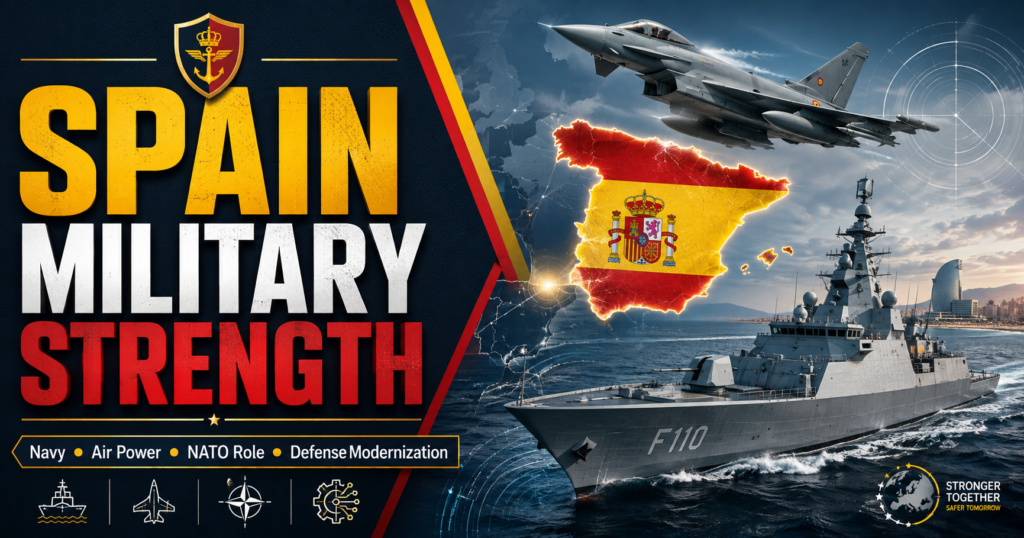
Spain enters 2026 as one of Europe’s most balanced military powers. It does not have the enormous manpower of Turkey, the nuclear deterrent of France or the global expeditionary scale of the United Kingdom, but the Spanish Armed Forces combine capable land forces, a modern fighter fleet, an unusually versatile navy, domestic shipbuilding expertise and a strategically important position between the Atlantic Ocean and Mediterranean Sea.
That geographic position gives Spain a military role that extends beyond the Iberian Peninsula. Spanish forces operate within NATO, contribute to European security missions, protect maritime approaches around the western Mediterranean and Atlantic, and support security around the Canary Islands and Spain’s southern maritime approaches.
Spain is ranked 18th out of 145 countries in the 2026 Global Firepower assessment with a Power Index score of 0.3247. The ranking places Spain firmly among the world’s Top 20 military powers.
The more interesting story, however, is not the ranking itself. Spain is modernizing several capabilities at the same time. The S-80 submarine program is rebuilding the Navy’s undersea strength, F-110 frigates are bringing a new generation of surface combatants, the Eurofighter remains central to Spanish air power, and defense investment is increasingly tied to domestic industrial and technological capability.
Spain Military Ranking 2026
Spain’s 18th-place position reflects a military that is reasonably balanced across land, air and naval categories rather than dominant in one single area.
The main Spain military strength 2026 figures provide a useful snapshot of that balance.
| Spain Military Category | 2026 Figure |
|---|---|
| Global Military Rank | 18th of 145 |
| Power Index Score | 0.3247 |
| Population | 47.28 million |
| Active Military Personnel | 121,802 |
| Reserve Personnel | 24,033 |
| Defense Budget | About $39 billion |
| Total Aircraft | 440 |
| Fighter Aircraft | 136 |
| Tanks | 298 |
| Armored Vehicles | 49,324 |
| Naval Assets | 175 |
| Frigates | 11 |
| Submarines | 2 |
The numbers show why Spain is better described as a balanced European military power than a force built around sheer size. Its fighter fleet, frigate force, armored inventory and defense-industrial base give it capabilities across several domains.
Why Spain Matters Militarily
Spain occupies a strategic position at the meeting point of Europe, North Africa, the Mediterranean and the Atlantic.
The Strait of Gibraltar is one of the world’s most important maritime passages, linking the Atlantic Ocean with the Mediterranean Sea. Spain’s southern geography therefore places it close to shipping lanes used for European commerce, energy movement and naval operations.
Spain also has strategic territory away from the mainland. The Canary Islands extend Spanish interests into the Atlantic, while Ceuta and Melilla sit on the North African coast.
This geography creates a defense requirement that is very different from Germany’s central-European land focus or Poland’s eastern-flank priorities. Spain must maintain credible land forces while also paying close attention to airspace, maritime surveillance, naval mobility and access to surrounding seas.
That is why the Spanish Navy and Air and Space Force carry disproportionate strategic importance.
Spanish Armed Forces Personnel and Manpower
Spain has a population of roughly 47.28 million, with a much larger theoretical manpower pool than the size of its professional armed forces.
The 2026 manpower figures show the distinction clearly.
| Spain Manpower Category | Estimated Figure |
|---|---|
| Total Population | 47,280,433 |
| Available Manpower | 21,748,999 |
| Fit for Service | 17,635,602 |
| Reaching Military Age Annually | 330,963 |
| Active Personnel | 121,802 |
| Reserve Personnel | 24,033 |
| Paramilitary Personnel | 78,470 |
Spain therefore maintains a relatively compact professional force compared with the size of its population.
This structure matches the broader European model of emphasizing trained professional personnel, NATO interoperability and advanced platforms rather than maintaining extremely large standing armies.
Spanish Army Strength in 2026
The Spanish Army remains a capable mechanized European land force built around armored units, infantry, artillery, air-mobile formations and deployable units suitable for NATO operations.
Spain’s land-force numbers include 298 tanks and more than 49,000 vehicles across the broad armored and support-vehicle category.
The core 2026 inventory looks like this:
| Spanish Land Force Category | Inventory |
|---|---|
| Tanks | 298 |
| Armored Vehicles | 49,324 |
| Self-Propelled Artillery | 96 |
| Towed Artillery | 188 |
| Multiple Launch Rocket Systems | 0 |
The absence of a large MLRS inventory does not mean Spain lacks meaningful land combat capability. Its strength lies more heavily in mechanized mobility, tanks, conventional artillery and combined operations with NATO allies.
Leopard 2E and Spanish Armored Power
The Leopard 2E is one of the most recognizable elements of Spain’s armored force.
Based on the German Leopard 2 family but adapted for Spanish requirements, the Leopard 2E gives the Spanish Army a modern main battle tank with strong protection, mobility and firepower.
Spain’s tank numbers are far below those of the largest land powers, but they are sufficient to maintain credible heavy armored formations within NATO’s European force structure.
The Spanish Army also benefits from a large fleet of armored and protected vehicles. These platforms support mechanized infantry, reconnaissance, command, transport, engineering and logistics missions.
Spain Air Force Strength 2026
Spain’s air power is one of the strongest parts of its military profile.
The Spanish Air and Space Force has an estimated 440 aircraft, including 136 fighters. That places Spain significantly higher in fighter strength than many similarly sized European countries.
The aircraft inventory is distributed across several roles.
| Spain Air Power Category | 2026 Inventory |
|---|---|
| Total Aircraft | 440 |
| Fighters | 136 |
| Dedicated Attack Aircraft | 12 |
| Fixed-Wing Transport Aircraft | 51 |
| Trainers | 108 |
| Special-Mission Aircraft | 8 |
| Tanker Aircraft | 0 |
| Helicopters | 169 |
| Attack Helicopters | 17 |
The 136-fighter inventory is the standout figure. It gives Spain a substantial combat-air component for national air defense, NATO missions and regional operations.
Eurofighter Typhoon and Spain’s Fighter Fleet
The Eurofighter Typhoon is central to Spain’s future combat-air strategy.
The aircraft provides modern air-to-air capability while also supporting multirole missions. Spain’s continued investment in the Eurofighter family gives it a European-designed fighter platform that can be upgraded over time as radar, weapons and electronic systems improve.
Spain has also relied on the F/A-18 Hornet, which has served as an important component of its combat fleet for decades.
The long-term challenge is fleet renewal. Older fighters eventually need to be replaced while Spain simultaneously maintains sufficient aircraft for mainland air defense, Canary Islands requirements, training and NATO commitments.
This makes fighter modernization one of the most important areas to watch when assessing Spain’s future military power.
Why Spain’s Air Power Matters to NATO
Spain’s location makes its air bases useful for operations covering the western Mediterranean, North Africa, the Atlantic approaches and southern Europe.
Spanish fighter aircraft also participate in NATO missions beyond national territory.
The value of Spain’s air force therefore goes beyond the number of combat aircraft based within the country. Airfields, maintenance infrastructure, trained pilots, command systems and interoperability with allied aircraft all contribute to Spain’s NATO role.
Spanish Navy Strength 2026
The Spanish Navy, or Armada Española, is arguably the most distinctive branch of Spain’s military.
Spain has centuries of naval tradition, but its modern relevance comes from a fleet designed around frigates, amphibious operations, submarines, patrol vessels and naval aviation rather than an enormous number of heavy surface combatants.
The 2026 fleet data gives Spain 175 total naval assets with total tonnage of about 249,889 tonnes.
| Spanish Naval Category | 2026 Inventory |
|---|---|
| Total Naval Assets | 175 |
| Aircraft/aviation-capable major ship | 1 |
| Frigates | 11 |
| Submarines | 2 |
| Patrol Vessels | 112 |
| Mine Warfare Vessels | 6 |
The high patrol-vessel count reflects the need to monitor a large maritime area rather than suggesting that all 175 vessels are major combatants.
Spain’s real naval combat strength is concentrated in its frigates, submarine force, amphibious capability and aviation-capable flagship.
Juan Carlos I and Spain’s Naval Aviation Capability
One of the most unusual assets in the Spanish Navy is the Juan Carlos I, a large multipurpose amphibious assault ship.
The vessel combines several roles. It can support amphibious operations, helicopters, troops and vehicles while also operating short takeoff and vertical landing aircraft when configured for aviation missions.
That versatility gives Spain a form of sea-based aviation and expeditionary capability that relatively few European navies possess.
Spain does not operate a traditional large fleet carrier comparable with those of the United States, but Juan Carlos I gives the Armada capabilities well beyond those of a navy made up only of frigates and patrol ships.
Spain’s F-100 Frigates
The Álvaro de Bazán-class F-100 frigates are among the most capable surface combatants in the Spanish Navy.
Their sophisticated radar and air-defense systems allow them to perform fleet protection, surveillance and air-defense missions while operating independently or within multinational naval groups.
The F-100 class also demonstrated Spain’s ability to design and build advanced warships domestically, strengthening the country’s naval-industrial reputation.
That experience now feeds directly into the next major Spanish naval program: the F-110 frigate.
F-110 Frigates: Spain’s Next Generation of Surface Warfare
The F-110 program is one of the most important modernization projects for the Spanish Navy.
These new frigates are intended to replace older Santa María-class vessels and bring a new generation of sensors, digital systems, anti-submarine capability and networked warfare technology into service.
The program is already progressing through multiple ships.
In July 2026, the keel of the third frigate, F113 Menéndez de Avilés, was laid at Navantia’s Ferrol shipyard. The construction milestone occurred seven months ahead of the contractual schedule.
This matters for more than fleet renewal. F-110 demonstrates that Spain retains the domestic industrial capability to design, integrate and build sophisticated modern warships rather than relying entirely on foreign yards.
The program also strengthens Navantia’s position as one of Europe’s important naval shipbuilders.
Spain’s S-80 Submarine Program
Undersea capability is another area undergoing major change.
Spain’s S-80 Plus program is rebuilding the submarine arm around a domestically designed class intended to provide greater endurance, modern sensors and advanced operational capability.
The first submarine of the series, Isaac Peral, has already represented an important step in restoring a modern Spanish submarine capability.
The second boat, Narciso Monturiol, reached an important milestone in July 2026 when it successfully completed its first static dive. Its delivery to the Spanish Navy is planned for the end of 2026 if testing continues according to schedule.
That makes 2026 particularly important for Spain’s submarine modernization.
Why the S-80 Matters
Submarines perform missions that surface fleets cannot easily replicate. They can conduct surveillance, gather intelligence, monitor maritime movements and operate discreetly in contested waters.
For Spain, submarine capability is especially relevant because of the strategic waterways surrounding the Iberian Peninsula.
The S-80 program also carries industrial significance. Designing and producing a modern submarine domestically requires expertise in shipbuilding, propulsion, sensors, combat systems and systems integration.
Spain is therefore using the S-80 not only to improve naval capability but also to preserve national technological expertise.
Spain Defense Budget 2026
Spain’s estimated defense budget in the 2026 Global Firepower dataset is approximately $39 billion, placing it around 16th in that particular global spending comparison.
Financial capacity matters because Spain is trying to modernize several areas simultaneously.
| Spain Defense Financial Indicator | Estimated Value |
|---|---|
| Defense Budget | About $39.0 billion |
| Purchasing Power Parity | About $2.361 trillion |
| Foreign Exchange and Gold Reserves | About $107.77 billion |
Spain has also been moving toward higher defense investment relative to its economy, with 2026 analysis from Spain’s defense institutions describing the country as reaching around the 2% of GDP level while shifting more spending toward modernization.
The critical question is how efficiently that money is converted into deployable capability.
Programs such as the F-110, S-80, fighter modernization, digital systems and other equipment upgrades make modernization spending particularly important.
Spain’s Defense Industry
Spain has a defense-industrial base that is stronger than its global military ranking alone might suggest.
The country participates in aerospace, shipbuilding, armored vehicles, electronics, missiles and multinational European defense programs.
Several companies are particularly important.
Navantia is the centerpiece of Spain’s naval industry and is responsible for programs including the S-80 submarines and F-110 frigates.
Airbus Defence and Space has major industrial activity in Spain, connecting the country to European military aviation and transport-aircraft programs.
Indra plays an important role in radar, electronic systems, command-and-control technology and defense electronics.
Spain’s industrial capability matters because modern military power depends not only on owning equipment but also on being able to maintain, upgrade, integrate and eventually replace that equipment.
Defense Technology and Strategic Autonomy
Spain’s 2026 defense modernization is increasingly tied to technological sovereignty and strategic autonomy.
The country’s Defence Technology and Innovation Strategy emphasizes areas where advanced technology will shape future operations.
The broader direction includes digital systems, artificial intelligence, sensors, communications, cybersecurity, autonomous technology and improved industrial capacity.
This does not mean Spain intends to produce every military component domestically. Modern European defense is deeply interconnected.
Instead, the goal is to preserve national expertise in critical sectors while participating in multinational programs where cooperation offers greater scale.
Spain and NATO
Spain joined NATO in 1982 and has become deeply integrated into the alliance’s military structure.
Its contribution is influenced heavily by geography.
Spain provides access to the western Mediterranean, Atlantic approaches and southern Europe while hosting infrastructure relevant to allied operations.
Spanish forces also participate in multinational missions, exercises, air policing and maritime operations.
Spain’s NATO value therefore comes from a combination of deployable forces, strategic geography, naval capability, air power and infrastructure.
Spain’s Mediterranean and Atlantic Role
Few European military powers must balance two major maritime theaters as directly as Spain.
To the east and south lies the Mediterranean. To the west is the Atlantic.
The Strait of Gibraltar connects these environments and gives Spain an important position near one of the world’s busiest strategic waterways.
The Canary Islands extend Spain’s security interests farther into the Atlantic, while the Iberian Peninsula provides access to western European sea routes.
This geography explains why Spain cannot be assessed solely as a land power.
Naval surveillance, anti-submarine warfare, air defense, maritime patrol and amphibious capability are central to its national-defense requirements.
Spain’s Military Logistics and Infrastructure
Spain also benefits from a mature transport network that can support domestic movement and military logistics.
The 2026 infrastructure dataset includes:
| Spain Logistics Category | Scale |
|---|---|
| Airports | 365 |
| Road Network | 150,110 km |
| Railway Network | 15,489 km |
| Ports and Trade Terminals | 52 |
| Merchant Marine Fleet | 503 |
| Internet Coverage | 95% |
These networks matter because military capability depends on moving people, fuel, spare parts, ammunition and equipment rather than merely owning weapons.
Spain’s extensive ports are particularly relevant for a military whose strategic role spans both Atlantic and Mediterranean waters.
Spain Military Strengths and Weaknesses
Spain’s military profile in 2026 is best understood as a collection of complementary advantages rather than one overwhelming capability.
Its main strengths are a substantial fighter fleet, capable frigates, growing submarine capability, modern armored forces, NATO integration, strategic geography and a domestic defense industry capable of building sophisticated ships and electronic systems.
The main limitations are equally clear. Spain does not possess nuclear weapons, its submarine fleet is still rebuilding, its active manpower is modest compared with larger regional powers, and some major platforms require modernization or replacement.
The absence of a large aerial-refueling fleet in the supplied 2026 inventory also limits independent long-range air operations compared with countries that maintain substantial tanker forces.
Spain is therefore strongest when operating as a technologically capable NATO and European military power rather than attempting to match global superpowers independently.
Is Spain One of Europe’s Strongest Militaries?
Yes, but it belongs to a different tier from Europe’s two nuclear-armed Western powers, France and the United Kingdom.
Spain has enough capability to be considered a major European military. Its fighter numbers, naval forces, armored units and defense-industrial capacity are substantial.
What distinguishes Spain from smaller European militaries is the breadth of those capabilities.
It can field modern tanks, operate a large combat-air fleet, deploy amphibious naval forces, build advanced frigates and submarines domestically, and contribute meaningfully to NATO missions.
That makes Spain militarily more significant than its 18th-place global ranking alone might suggest.
What Will Determine Spain’s Future Military Power?
Spain’s position over the next decade will depend less on dramatically increasing manpower and more on completing modernization successfully.
The S-80 program must expand operational submarine availability.
F-110 frigates must transition from shipyard milestones into deployable naval capability.
The combat-air fleet will need to evolve as older aircraft reach the end of their service lives.
Investment in sensors, drones, cyber capability, electronic warfare and space systems will become increasingly important.
The defense industry will also need to retain skilled workers and technological expertise while participating competitively in European programs.
If these areas progress successfully, Spain could maintain or strengthen its position among Europe’s leading conventional military powers.
Spain Military Strength 2026: Overall Assessment
Spain’s military strength is based on balance.
It does not dominate Europe in manpower, tanks, fighter aircraft or naval tonnage individually. Instead, it possesses credible capabilities in nearly every major conventional military domain.
The Spanish Army provides mechanized and armored combat capability. The Air and Space Force maintains a sizeable fighter fleet centered increasingly on the Eurofighter. The Navy combines frigates, amphibious aviation, patrol forces and a submarine arm undergoing major renewal.
Behind those branches sits an important domestic defense industry capable of designing and producing advanced ships, submarines, electronics and aerospace systems.
Spain’s geography then adds another layer of strategic value. Its position between the Atlantic and Mediterranean, close to the Strait of Gibraltar and North Africa, makes it an important NATO and European security partner.
For these reasons, Spain in 2026 is best described not as a military superpower, but as a well-rounded European military power with particularly strong maritime, aerospace and industrial capabilities.
FAQs
What is Spain’s military ranking in 2026?
Spain ranks 18th out of 145 countries in the 2026 Global Firepower assessment, with a Power Index score of 0.3247.
How many active military personnel does Spain have?
Spain has approximately 121,802 active military personnel in the supplied 2026 dataset.
What is Spain’s defense budget in 2026?
The 2026 Global Firepower dataset estimates Spain’s defense budget at approximately $39 billion.
How many fighter jets does Spain have?
The supplied 2026 inventory lists approximately 136 fighter aircraft.
What fighter jets does Spain use?
Spain’s combat-air fleet includes the Eurofighter Typhoon and F/A-18 Hornet, with Eurofighter playing an increasingly important role in future fighter capability.
How many tanks does Spain have?
The 2026 dataset lists approximately 298 tanks. The Leopard 2E is Spain’s principal modern main battle tank.
Does Spain have an aircraft carrier?
Spain operates Juan Carlos I, a large aviation-capable amphibious assault ship. It is not equivalent to a traditional large fleet carrier but can support helicopters and compatible short-takeoff/vertical-landing aircraft.
How many submarines does Spain have?
The supplied 2026 ranking dataset lists two submarines, while the S-80 program is progressively rebuilding the Spanish Navy’s submarine force.
What is the S-80 submarine?
The S-80 Plus is Spain’s new domestically developed submarine class. It is intended to modernize the Navy’s undersea warfare and surveillance capability.
When will Spain’s second S-80 submarine enter service?
The Narciso Monturiol successfully completed its first static dive in July 2026, with delivery planned for the end of 2026 if testing proceeds according to schedule.
What are Spain’s F-110 frigates?
The F-110 is Spain’s next-generation frigate program designed to replace older ships and improve anti-submarine warfare, sensors, digital integration and general surface-combat capability.
Is Spain a NATO member?
Yes. Spain has been a NATO member since 1982 and participates actively in alliance missions, exercises and collective-defense activities.
Does Spain have nuclear weapons?
Spain does not possess an independent nuclear-weapons arsenal.
Is Spain stronger militarily than most European countries?
Spain is one of Europe’s stronger conventional military powers because it combines a sizeable professional force, modern fighters, tanks, frigates, amphibious capability, submarine modernization and a significant domestic defense industry.
What is Spain’s biggest military advantage?
Spain’s biggest advantage is the balance between air power, naval capability, NATO integration, strategic geography and domestic defense manufacturing rather than superiority in a single weapons category.
Conclusion
Spain military strength in 2026 reflects a country modernizing around the capabilities that matter most to its geography and alliance responsibilities.
Spain’s 18th-place global ranking is supported by more than 121,000 active personnel, a substantial combat-air fleet, nearly 300 tanks and a Navy that combines frigates, amphibious capability, patrol forces and an expanding generation of S-80 submarines.
The most important developments are happening beneath those headline numbers. F-110 frigates are advancing through construction, the S-80 submarine program is expanding, defense investment is increasingly focused on modernization, and Spain’s defense industry is strengthening its role in European technological and strategic autonomy.
Spain is unlikely to become a military superpower, nor does its strategy require that. Its real value lies in maintaining a balanced, technologically capable force positioned at one of Europe’s most important strategic crossroads.
As naval modernization, fighter renewal and defense technology programs continue, Spain is positioned to remain one of NATO’s most important southern European military powers throughout the next decade.