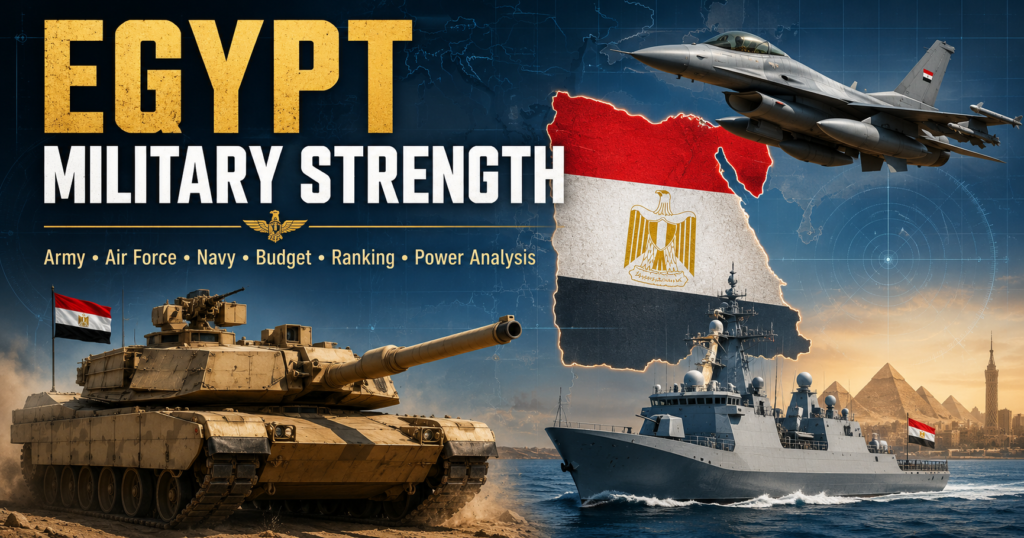
Egypt remains one of the most militarily significant countries in Africa and the Arab world in 2026. Its strength comes from a combination of large manpower reserves, more than 1,000 military aircraft, thousands of tanks, extensive artillery, a sizeable Mediterranean and Red Sea fleet, and control of the strategic Suez Canal corridor.
The Egyptian Armed Forces are designed for a security environment that is far more complex than simple border defense. Egypt faces the Mediterranean to the north, the Red Sea to the east, Libya to the west and Sudan to the south, while the Sinai Peninsula connects the country directly to the Middle East.
This geography helps explain why Egypt military strength in 2026 is distributed across strong land, air and naval forces rather than concentrated in a single branch.
According to the supplied 2026 Global Firepower assessment, Egypt ranks 19th out of 145 countries with a Power Index score of 0.3651. Egypt also performs particularly well in tank strength, combat aircraft, artillery, helicopter carriers and manpower.
Egypt Military Strength 2026 at a Glance
Egypt’s 19th-place global ranking is supported by several categories where the country sits much higher than 19th individually. Its tank force ranks sixth, total aircraft ninth and active personnel 13th in the supplied 2026 dataset.
| Egypt Military Category | 2026 Figure |
|---|---|
| Global Military Rank | 19th of 145 |
| Power Index | 0.3651 |
| Population | 111.25 million |
| Active Personnel | 438,500 |
| Reserve Personnel | 479,000 |
| Paramilitary Personnel | 300,000 |
| Total Military Personnel | About 1.22 million |
| Defense Budget | $5.19 billion |
| Total Aircraft | 1,088 |
| Fighter Aircraft | 242 |
| Tanks | 3,620 |
| Armored Vehicles | 54,694 |
| Naval Assets | 149 |
| Helicopter Carriers | 2 |
| Frigates | 13 |
| Submarines | 8 |
The strongest part of the Egypt military power 2026 profile is not one headline number. Egypt combines a very large army with enough air and naval capability to operate across North Africa, the eastern Mediterranean, the Red Sea and approaches to the Suez Canal.
Egypt Military Ranking 2026
Egypt ranks 19th globally in the supplied 2026 Global Firepower Index, maintaining its position as a Top-20 military power.
A Power Index of 0.3651 places Egypt ahead of most African and Arab militaries in the conventional ranking.
Several individual Egyptian military categories rank even higher:
- Tank strength: 6th
- Self-propelled artillery: 6th
- Trainer aircraft: 6th
- Attack aircraft: 7th
- Attack helicopters: 7th
- Total aircraft: 9th
- Fighters: 10th
- MLRS: 11th
- Active personnel: 13th
- Total naval assets: 23rd
These rankings reveal an important characteristic of the Egyptian Armed Forces: Egypt maintains considerable military depth across multiple conventional categories.
Why Egypt Is Strategically Important
Egypt’s military importance cannot be separated from its geography.
The country sits between North Africa and the Middle East, while the Suez Canal connects the Mediterranean Sea with the Red Sea.
That creates several simultaneous military priorities:
- Protecting the Suez Canal
- Securing Mediterranean approaches
- Monitoring the Red Sea
- Defending the Sinai Peninsula
- Protecting western approaches near Libya
- Maintaining security along the Sudanese border
- Protecting offshore energy infrastructure
Egypt therefore requires forces capable of operating in desert terrain, coastal waters, dense population centers and long maritime approaches.
Unlike a country focused primarily on continental land warfare, Egypt must keep substantial army, air force and navy capabilities active at the same time.
Egypt Military Manpower 2026
Egypt has one of the largest population and manpower bases in the Middle East and Africa.
The supplied 2026 figures estimate Egypt’s population at approximately 111.25 million, with more than 45.6 million people classified as available manpower.
| Egypt Manpower Category | 2026 Estimate |
|---|---|
| Total Population | 111,247,248 |
| Available Manpower | 45,611,372 |
| Fit for Service | 38,269,053 |
| Reaching Military Age Annually | 1,668,709 |
| Active Personnel | 438,500 |
| Reserve Personnel | 479,000 |
| Paramilitary Personnel | 300,000 |
| Estimated Total Military Personnel | 1,217,500 |
Egypt has slightly more reservists than active personnel, giving the military substantial additional manpower beyond its standing force.
The country also has roughly 1.67 million people reaching military age annually, giving Egypt a large long-term recruitment pool.
How Large Is the Egyptian Army?
The Egyptian Army is the largest component of the country’s armed forces.
The supplied 2026 dataset estimates approximately 685,000 Army personnel when the broader service-specific figure is used, while the overall active military total across branches is listed at 438,500 in the main manpower calculation because the source uses different estimation models for branch and total-strength categories.
More important for understanding Egypt Army strength in 2026 is the enormous land-equipment inventory.
Egypt operates:
- 3,620 tanks
- 54,694 armored vehicles
- 1,056 self-propelled artillery systems
- 962 towed artillery pieces
- 648 multiple-launch rocket systems
Few countries combine heavy armor and artillery at this scale.
Egypt Tank Strength 2026
Egypt operates approximately 3,620 tanks, placing it sixth globally in the supplied 2026 tank-strength category.
That makes tanks one of the clearest numerical strengths of the Egyptian military.
The tank fleet has historically included several types, most notably the M1A1 Abrams, alongside older American and Soviet-origin vehicles.
Egypt’s armored force reflects the country’s traditional emphasis on large mechanized formations capable of operating across open desert terrain.
| Egyptian Land Equipment | 2026 Stock |
|---|---|
| Tanks | 3,620 |
| Armored Vehicles | 54,694 |
| Self-Propelled Artillery | 1,056 |
| Towed Artillery | 962 |
| MLRS / Rocket Artillery | 648 |
The tank figure receives the most attention, but Egypt’s artillery numbers are equally important.
Egypt Artillery Strength
Egypt ranks sixth globally in the supplied self-propelled artillery category with 1,056 systems.
It also has 962 towed artillery pieces and 648 multiple-launch rocket systems.
This gives Egyptian ground forces a broad fire-support structure rather than a tank-heavy force operating without artillery depth.
Self-propelled artillery is particularly useful for mechanized operations because guns can move with armored formations instead of depending entirely on slower towed platforms.
Egypt’s large combination of tanks, armored vehicles and artillery explains why Egypt land power remains one of the strongest components of its overall military ranking.
Egypt Air Force Strength 2026
The Egyptian Air Force is one of the largest air forces in Africa and the Middle East by total aircraft inventory.
The supplied 2026 data lists 1,088 aircraft, placing Egypt ninth globally in total military aircraft.
| Egypt Air Power Category | 2026 Inventory |
|---|---|
| Total Aircraft | 1,088 |
| Fighter Aircraft | 242 |
| Dedicated Attack Aircraft | 90 |
| Transport Aircraft | 53 |
| Trainer Aircraft | 344 |
| Special-Mission Aircraft | 11 |
| Aerial Tankers | 0 |
| Helicopters | 348 |
| Attack Helicopters | 100 |
Egypt ranks inside the global Top 10 for total aircraft, dedicated attack aircraft, trainer aircraft and attack helicopters.
The fleet is broad enough to support air defense, strike missions, transport, training, battlefield support and helicopter operations.
Egypt Fighter Jets in 2026
Egypt is listed with 242 fighter aircraft, placing it tenth globally in the supplied 2026 comparison.
Its combat-air fleet has historically included aircraft from multiple suppliers, creating one of the most diverse fighter inventories in the region.
Major types associated with Egyptian combat aviation include:
- F-16 Fighting Falcon
- Rafale
- MiG-29 family aircraft
This mixed procurement strategy has allowed Egypt to avoid depending on a single foreign supplier for every major combat-air requirement.
It also creates challenges because different aircraft families require separate maintenance systems, training pipelines, spare parts and weapons integration.
Rafale and Egypt’s Modern Air Power
The Dassault Rafale is one of the most advanced aircraft in Egypt’s fighter inventory.
Its multirole design supports air-to-air combat, strike operations, reconnaissance and precision missions.
For Egypt, the Rafale provides a modern capability alongside the much larger F-16 fleet.
The important point in an Egypt Air Force strength analysis is that Egypt is not relying exclusively on large quantities of older aircraft. Modern platforms operate alongside the broader inventory and help improve the technological level of the force.
F-16 Remains Central to Egyptian Air Power
The F-16 has long formed a major part of Egypt’s combat-air capability.
Its importance comes from fleet size, accumulated pilot experience, maintenance infrastructure and the ability to perform several mission types.
Egypt’s 242-fighter total therefore represents a mixture of different aircraft generations rather than one uniform fleet.
That makes availability, modernization and weapons integration important when evaluating how much of the raw fighter inventory can provide high-end combat capability at any given time.
Egypt Has 100 Attack Helicopters
Egypt ranks seventh globally in the supplied attack helicopter category with approximately 100 aircraft.
Attack helicopters are particularly useful for a country with extensive desert terrain because they can support armored units, monitor large areas and provide mobile battlefield firepower.
Egypt also operates about 348 helicopters overall, placing it 11th globally in that category.
The combination of a large armored army and a substantial helicopter fleet gives Egyptian land forces considerable vertical mobility and close-support capacity.
Egypt’s Biggest Air-Power Limitation: No Tanker Fleet
One unusual weakness in Egypt’s otherwise large air inventory is aerial refueling.
The supplied 2026 dataset lists zero dedicated aerial tankers.
That matters because tankers extend fighter range, increase time on station and improve long-distance air operations.
Egypt’s geography allows many important regional missions to be supported from land bases, but the absence of a dedicated tanker fleet limits independent long-range air endurance compared with countries that operate substantial refueling aircraft.
This is one area where Egypt’s aircraft quantity is stronger than its long-range support structure.
Egyptian Navy Strength 2026
Egypt’s naval power has changed considerably over the past decade.
The Egyptian Navy must operate across two separate maritime environments: the Mediterranean Sea and Red Sea.
The Suez Canal connects those theaters, making maritime security a direct national-security issue rather than a secondary naval concern.
The supplied 2026 figures list 149 Egyptian naval assets with a combined tonnage of about 235,989 tonnes.
| Egyptian Navy Category | 2026 Inventory |
|---|---|
| Total Naval Assets | 149 |
| Aircraft Carriers | 0 |
| Helicopter Carriers | 2 |
| Frigates | 13 |
| Corvettes | 7 |
| Submarines | 8 |
| Patrol Vessels | 61 |
| Mine Warfare Vessels | 17 |
The fleet is far more balanced than a simple patrol-force navy.
Egypt operates amphibious aviation ships, frigates, corvettes, submarines and mine-warfare vessels, giving it capabilities across several naval mission sets.
Egypt’s Two Mistral Helicopter Carriers
Egypt operates two Mistral-class helicopter carriers, placing it fourth globally in the supplied helicopter-carrier category.
These vessels significantly expand the Egyptian Navy’s ability to move forces by sea.
A Mistral-class ship can support:
- Helicopter operations
- Amphibious forces
- Troop movement
- Command functions
- Vehicles and equipment
- Humanitarian operations
Egypt does not operate conventional fixed-wing aircraft carriers.
The Mistrals instead provide amphibious and helicopter-based power projection, which fits Egypt’s Mediterranean and Red Sea requirements better than maintaining a much more expensive conventional carrier force.
Egypt Frigate Strength
Egypt has approximately 13 frigates, ranking sixth globally in the supplied dataset.
Frigates form an important part of Egypt’s blue-water naval capability because they can support maritime surveillance, anti-surface warfare, escort operations and other missions beyond coastal patrol.
The frigate fleet gives Egypt a much stronger regional naval presence than the total vessel count alone indicates.
Combined with corvettes and submarines, these ships allow Egypt to operate more effectively across both sides of the Suez Canal.
Egypt Submarine Strength 2026
The source lists eight submarines for Egypt, placing it 11th globally in the submarine category.
Egypt’s modern undersea force includes German-built Type 209/1400mod submarines, which form an important part of its contemporary submarine capability.
Undersea warfare is especially valuable for Egypt because submarines can support surveillance and sea-denial missions across both Mediterranean and Red Sea approaches.
Egypt’s 2026 naval modernization discussion has increasingly focused on submarines and unmanned maritime systems rather than simply adding more large surface warships.
That approach makes sense for a navy responsible for protecting sea lanes, offshore assets and the Suez approaches while operating under tighter financial constraints.
Why the Suez Canal Makes Egypt’s Navy Strategically Important
The Suez Canal is one of the most important maritime trade routes in the world.
It allows ships to move between the Mediterranean and Red Sea without sailing around Africa.
For Egypt, protecting the canal means protecting:
- International shipping
- National revenue
- Strategic infrastructure
- Maritime access
- Commercial credibility
Egyptian naval strength therefore has economic implications far beyond the size of the country’s fleet.
A disruption around the Red Sea or Suez approaches can affect shipping well outside Egypt itself.
This makes Suez Canal security one of the most important strategic responsibilities of the Egyptian military.
Mediterranean and Red Sea Defense
Egypt effectively faces two separate naval-security environments.
In the Mediterranean, priorities include offshore infrastructure, shipping routes and interaction with other regional navies.
In the Red Sea, the focus includes shipping security, access toward the Gulf of Aden and protection of the southern approach to the Suez Canal.
This two-sea requirement helps explain Egypt’s investment in:
- Frigates
- Corvettes
- Submarines
- Amphibious vessels
- Patrol ships
- Mine warfare
Egypt is not building a global navy. It is building a force capable of protecting two highly strategic regional maritime theaters.
Egypt Defense Budget 2026
The supplied dataset places the Egypt defense budget at approximately $5.19 billion.
| Egypt Financial Indicator | 2026 Figure |
|---|---|
| Defense Budget | $5.19 billion |
| Purchasing Power Parity | $1.958 trillion |
| Foreign Exchange and Gold Reserves | $44.92 billion |
| External Debt | $117.27 billion |
The defense-budget figure may initially appear modest compared with Egypt’s enormous military inventory.
That contrast is important.
Egypt maintains hundreds of thousands of personnel, more than 1,000 aircraft, thousands of tanks and nearly 150 naval assets, creating substantial maintenance and modernization requirements.
Maintaining older equipment alongside newer systems also creates cost pressures.
The long-term challenge for Egypt is therefore not simply buying more equipment. It is keeping a very large existing force operational, modern and financially sustainable.
Egypt’s Defense Industry and Local Production
Egypt has long sought to maintain a domestic defense-production capability rather than depending entirely on imports.
Local military industry supports areas such as:
- Armored vehicles
- Ammunition
- Small arms
- Maintenance
- Vehicle production
- Naval construction and support
- Electronics
Egypt also cooperates with foreign defense companies on selected programs.
For a military with Egypt’s inventory size, local maintenance and production matter because importing every spare part, vehicle and munition would significantly increase long-term dependence and operating costs.
The strategic value of Egypt defense industry development therefore lies as much in sustainment as in headline weapons production.
Egypt’s Natural Resource Position
Egypt is not an oil superpower, but it has a meaningful energy base.
The supplied 2026 data lists approximately:
| Egypt Strategic Resource | Figure |
|---|---|
| Oil Production | 667,000 barrels |
| Oil Consumption | 830,000 barrels |
| Proven Oil Reserves | 3.3 billion barrels |
| Natural Gas Production | 64.82 billion m³ |
| Natural Gas Consumption | 60.09 billion m³ |
| Proven Natural Gas Reserves | 1.784 trillion m³ |
| Coal Production | 69,000 metric tons |
Natural gas is the most notable part of Egypt’s energy profile.
Domestic gas production and reserves contribute to economic and energy resilience, while offshore gas infrastructure adds another asset that Egyptian naval and air forces may need to protect.
Egypt nevertheless consumes more oil than it produces in the supplied figures, creating an oil deficit rather than full energy self-sufficiency.
Egypt Military Logistics and Infrastructure
Egypt’s logistics network is shaped by the Nile Valley, densely populated urban corridors, desert areas and two major coastlines.
The supplied infrastructure figures include:
| Egypt Infrastructure Category | Figure |
|---|---|
| Internet Coverage | 73% |
| Labor Force | 33.75 million |
| Merchant Marine Fleet | 441 |
| Ports and Trade Terminals | 31 |
| Airports | 73 |
| Road Network | 65,050 km |
| Railway Network | 5,085 km |
| Usable Waterways | 3,500 km |
Egypt’s 31 ports and trade terminals are particularly important for military and commercial movement.
The Suez Canal, Mediterranean ports and Red Sea facilities create a logistics network that is directly connected to Egypt’s strategic geography.
Egypt’s Military Strengths in 2026
Egypt’s strongest military advantages are concentrated in categories directly relevant to regional conventional warfare.
Large manpower: More than 438,000 active personnel, 479,000 reserves and 300,000 paramilitary personnel provide substantial personnel depth.
Heavy land forces: Around 3,620 tanks, more than 54,000 armored vehicles and large artillery inventories make Egypt one of the strongest conventional land powers in Africa.
Large air fleet: Egypt operates more than 1,000 military aircraft and ranks inside the global Top 10 in total aircraft.
Attack helicopters: The 100-aircraft attack-helicopter fleet provides substantial support for ground operations.
Balanced navy: Two helicopter carriers, 13 frigates, eight submarines and extensive patrol capacity provide meaningful maritime reach.
Strategic geography: The Suez Canal and access to both the Mediterranean and Red Sea make Egypt strategically important far beyond its ranking.
Egypt’s Military Weaknesses and Limitations
Egypt’s military scale also creates several challenges.
Maintaining a Very Large Equipment Inventory
Thousands of armored vehicles, aircraft and ships require constant maintenance, spare parts and trained personnel.
Older platforms can remain useful, but keeping them operational becomes increasingly expensive over time.
Mixed Foreign Equipment
Egyptian forces use equipment originating from several countries.
This procurement diversity reduces dependence on one supplier, but it also creates separate maintenance, ammunition, training and logistics requirements.
Limited Aerial Refueling
The supplied 2026 inventory lists no dedicated tanker aircraft, constraining the Egyptian Air Force’s independent long-range endurance.
Financial Pressure
A military of Egypt’s size requires sustained funding.
Modernization programs therefore have to compete with broader economic priorities.
Equipment Quality Varies
A high tank, aircraft or ship count does not mean every platform offers the same combat capability.
Egypt’s inventory contains systems from different generations, making modernization and readiness as important as total numbers.
Is Egypt the Strongest Military in Africa?
Egypt is one of Africa’s strongest militaries and ranks 19th globally in the supplied 2026 assessment.
Its combination of manpower, tanks, aircraft, artillery, submarines and amphibious naval capability makes it exceptionally powerful by continental standards.
Whether Egypt should be called the single strongest African military depends on the ranking methodology and categories being compared.
What is clear from the 2026 figures is that Egypt possesses one of Africa’s deepest conventional force structures, especially in land warfare, combat aviation and naval capability.
Is Egypt a Military Superpower?
Egypt is better described as a major regional military power rather than a global military superpower.
A superpower normally requires capabilities such as worldwide military basing, large strategic forces, global logistics, enormous defense spending and sustained power projection across several continents.
Egypt does not operate at that level.
Its real strength lies in North Africa, the eastern Mediterranean, the Red Sea and the wider Middle East.
Within that environment, Egypt’s combination of geography and conventional military scale gives it considerable influence.
Why Egypt’s Military Is Stronger Than the Defense Budget Suggests
Egypt’s roughly $5.19 billion defense-budget figure appears small when compared with militaries operating more than 1,000 aircraft and 3,600 tanks.
Several factors help explain why raw budget comparisons can be misleading.
Personnel and operating costs differ substantially between countries. Large inventories may also contain older platforms whose acquisition costs were paid years or decades earlier.
Domestic support and local production can reduce some expenses.
Foreign military partnerships and financing arrangements can also affect procurement without appearing neatly inside one headline annual-budget figure.
For this reason, Egypt’s military budget should be analyzed alongside its existing inventory and sustainment requirements rather than viewed in isolation.
Future of Egypt Military Power
Egypt’s next phase of military development is likely to focus less on simply increasing equipment totals and more on improving the capability of its existing force.
Key priorities include:
- Fighter modernization
- Submarine development
- Unmanned aerial systems
- Naval drones
- Maritime surveillance
- Air and missile defense
- Domestic military production
- Electronic warfare
- Networked command systems
The 2026 naval direction is particularly interesting because Egypt appears increasingly interested in submarines and unmanned maritime systems as ways to strengthen surveillance and deterrence without continuously expanding the large surface fleet.
If modernization improves readiness while maintaining current manpower and equipment depth, Egypt can remain a major regional military power even without dramatically increasing total platform numbers.
How Strong Is Egypt’s Military in 2026?
Egypt has one of the strongest conventional militaries in Africa and remains a Top-20 global military power in the supplied 2026 ranking.
Its biggest advantages are not hidden.
Egypt fields:
- More than 438,000 active personnel
- 479,000 reservists
- 3,620 tanks
- 1,088 aircraft
- 242 fighters
- 100 attack helicopters
- 149 naval assets
- Two helicopter carriers
- 13 frigates
- Eight submarines
The country also controls the Suez Canal and operates between the Mediterranean and Red Sea, giving its military assets strategic importance beyond their raw numbers.
Egypt’s main challenge is maintaining and modernizing such a large force while managing financial constraints and a diverse inventory acquired from multiple suppliers.
The Egyptian military in 2026 is therefore best understood as a large, heavily equipped regional force with particularly strong land power, substantial aviation, a diversified navy and one of the world’s most strategically important geographic positions.
FAQs
What is Egypt’s military ranking in 2026?
Egypt ranks 19th out of 145 countries in the supplied 2026 Global Firepower assessment with a Power Index score of 0.3651.
Is Egypt a Top-20 military power?
Yes. Egypt is ranked 19th globally in the supplied 2026 military ranking.
How many active soldiers does Egypt have?
Egypt has approximately 438,500 active military personnel in the main 2026 manpower dataset.
How many reserve soldiers does Egypt have?
Egypt has approximately 479,000 reserve personnel.
How many tanks does Egypt have in 2026?
Egypt is listed with approximately 3,620 tanks, ranking sixth globally in the supplied tank-strength category.
What is Egypt’s strongest military branch?
Egypt has substantial strength across all three major branches, but its land forces are particularly powerful numerically because of the country’s large tank, armored-vehicle and artillery inventories.
How many fighter jets does Egypt have?
Egypt has approximately 242 fighter aircraft in the supplied 2026 inventory.
What fighter jets does Egypt use?
Egypt’s combat fleet includes aircraft such as the F-16, Rafale and MiG-29 family.
How many military aircraft does Egypt have?
Egypt has approximately 1,088 total military aircraft, placing it ninth globally in the supplied 2026 aircraft ranking.
How many attack helicopters does Egypt have?
The 2026 dataset lists approximately 100 attack helicopters.
Does Egypt have aircraft carriers?
Egypt does not operate conventional aircraft carriers. It operates two Mistral-class helicopter carriers.
How many submarines does Egypt have?
Egypt is listed with approximately eight submarines in the supplied 2026 naval inventory.
How many frigates does Egypt have?
Egypt has approximately 13 frigates, placing it sixth globally in the source’s frigate category.
What is Egypt’s defense budget in 2026?
The supplied dataset lists an estimated $5.19 billion defense budget.
Why is Egypt’s military strategically important?
Egypt controls the Suez Canal, has access to both the Mediterranean and Red Sea, and maintains large land, air and naval forces capable of operating across North Africa and the wider Middle East.
Is Egypt the strongest military in Africa?
Egypt is among Africa’s strongest military powers and possesses one of the continent’s largest and most balanced conventional force structures.
Conclusion
Egypt military strength in 2026 rests on a combination few African militaries can match: more than 438,000 active personnel, 479,000 reservists, thousands of tanks, more than 1,000 aircraft, a large artillery arm and a navy capable of operating in both the Mediterranean and Red Sea.
Its 19th-place global ranking captures only part of that picture.
Egypt ranks sixth globally in tanks and self-propelled artillery, ninth in total aircraft and operates two helicopter carriers, 13 frigates and eight submarines. Those assets support a defense strategy shaped directly by Egypt’s geography and responsibility for the Suez Canal.
The next challenge is modernization rather than simple expansion.
Egypt already possesses military scale. The long-term question is how effectively it can modernize older platforms, strengthen undersea and unmanned capabilities, improve readiness and sustain a large multi-source equipment inventory.
For 2026, Egypt remains a major North African and Middle Eastern military power with exceptional land-force depth, substantial air capability and one of the region’s most strategically important navies.
SEO Tags
Egypt Military Strength 2026, Egypt Military Ranking 2026, Egypt Army Strength, Egypt Air Force Strength, Egypt Navy Strength, Egypt Defense Budget 2026, Egyptian Armed Forces, Egypt Military Power, Egypt Fighter Jets 2026, Egypt Tank Strength, Egyptian Navy 2026, Egypt Submarines, Egypt Military Aircraft, Egypt Military Equipment, How Strong Is Egypt Military