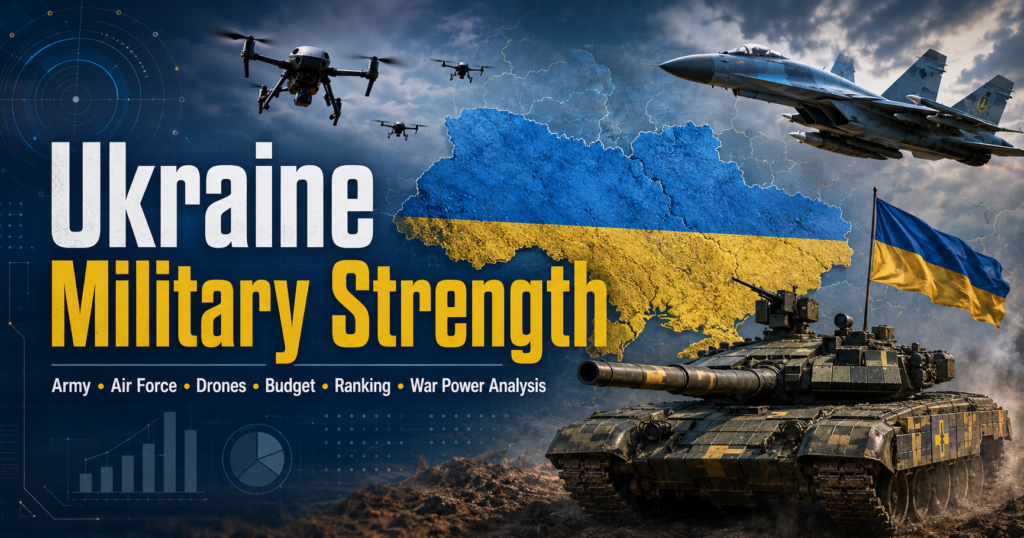
Ukraine enters 2026 with one of the most battle-experienced militaries in the world. Its armed forces have changed dramatically since the beginning of Russia’s full-scale invasion, evolving from a largely conventional post-Soviet military into a force built around mass mobilization, drones, artillery, layered air defense, dispersed logistics, battlefield software and rapidly expanding domestic weapons production.
The numbers alone are striking. Ukraine is ranked 20th out of 145 countries in the 2026 Global Firepower Index with a Power Index score of 0.3691. The supplied dataset lists approximately 900,000 active personnel, 4 million reserves, 347 military aircraft, 1,121 tanks, 45,458 armored vehicles and 169 naval assets.
But a normal Army-Air Force-Navy inventory article does not fully explain Ukraine military strength in 2026.
Ukraine’s most important capabilities increasingly sit outside traditional equipment counts. Millions of unmanned systems, battlefield data networks, domestic missile development, electronic warfare, Western air-defense systems and a defense industry operating under wartime conditions now shape the country’s military power as much as tanks or fighter numbers.
Ukraine Military Strength 2026 at a Glance
Ukraine’s 20th-place global ranking is supported by exceptional manpower, a large reserve pool, heavy artillery and significant defense spending.
| Ukraine Military Category | 2026 Figure |
|---|---|
| Global Military Rank | 20th of 145 |
| Power Index | 0.3691 |
| Population | 35.66 million |
| Active Personnel | 900,000 |
| Reserve Personnel | 4,000,000 |
| Paramilitary Personnel | 100,000 |
| Estimated Total Military Personnel | 5 million |
| Defense Budget | $45 billion |
| Total Aircraft | 347 |
| Fighter Aircraft | 88 |
| Tanks | 1,121 |
| Armored Vehicles | 45,458 |
| Self-Propelled Artillery | 682 |
| Rocket Artillery | 288 |
| Naval Assets | 169 |
Ukraine’s military profile is unusual because traditional platform counts tell only part of the story. Global Firepower does not include drones in its aircraft total, even though unmanned systems have become one of Ukraine’s most important military capabilities.
Ukraine Military Ranking 2026
Ukraine ranks 20th globally in the 2026 Global Firepower assessment.
Its strongest individual rankings include:
- Reserve personnel: 2nd
- Active personnel: 6th
- Self-propelled artillery: 8th
- Patrol vessels: 9th
- Defense spending: 14th
- Attack helicopters: 17th
- Naval fleet strength: 17th
- Rocket artillery: 18th
- Tanks: 19th
The ranking reflects Ukraine’s transition into a heavily mobilized wartime military.
A country with an estimated population of about 35.7 million maintaining 900,000 active personnel and 4 million reservists represents an unusually high level of military mobilization.
Why Ukraine’s 2026 Military Cannot Be Judged Like a Peacetime Army
Most military-strength comparisons assume relatively stable peacetime inventories.
Ukraine is different.
Equipment is continuously:
- Lost
- Repaired
- Replaced
- Donated
- Manufactured
- Upgraded
- Converted for new battlefield roles
This makes Ukrainian military inventories more fluid than those of countries that are not fighting a major war.
A tank count recorded early in 2026 may not perfectly represent operational strength months later. The same applies to artillery, aircraft, air-defense systems and vehicles.
Ukraine’s real military power therefore depends heavily on production rates, repair capacity, ammunition supply, allied assistance and the ability to replace losses quickly.
Ukraine Military Manpower 2026
Manpower remains one of Ukraine’s strongest measurable categories.
The 2026 dataset estimates 900,000 active personnel and approximately 4 million reserves, placing Ukraine sixth globally in active manpower and second in reserve personnel.
| Ukraine Manpower Category | 2026 Figure |
|---|---|
| Population | 35,661,826 |
| Available Manpower | 18,187,531 |
| Fit for Service | 12,731,272 |
| Reaching Military Age Annually | 392,280 |
| Active Personnel | 900,000 |
| Reserve Personnel | 4,000,000 |
| Paramilitary Personnel | 100,000 |
| Total Military Personnel | Around 5 million |
The active military alone represents roughly 2.5% of the population in the supplied dataset.
That scale is a direct consequence of wartime mobilization.
Ukraine’s Four-Million Reserve Force
The Ukraine reserve military strength figure is one of the most important numbers in the entire 2026 dataset.
Four million reservists do not mean four million personnel are simultaneously deployed or immediately combat-ready. Reserve classifications can include people with different levels of training, military experience and availability.
Even with that limitation, the figure shows the enormous manpower base Ukraine can potentially draw upon.
The challenge is not simply finding personnel.
Modern military units require:
- Training
- Officers
- Communications
- Vehicles
- Weapons
- Protective equipment
- Medical support
- Logistics
For Ukraine, maintaining the quality and sustainability of a very large force is as important as the headline manpower number.
Ukraine Army Strength 2026
The Ukrainian Army remains the center of the country’s conventional military strength.
Ukraine’s land inventory includes:
| Ukraine Land Power Category | 2026 Stock |
|---|---|
| Tanks | 1,121 |
| Armored Vehicles | 45,458 |
| Self-Propelled Artillery | 682 |
| Towed Artillery | 625 |
| MLRS / Rocket Artillery | 288 |
These numbers place Ukraine among the world’s stronger artillery-based land forces.
The most important figure may be the 682 self-propelled artillery systems, which gives Ukraine an eighth-place global ranking in that category.
Ukraine Tank Strength 2026
Ukraine is listed with approximately 1,121 tanks in the supplied 2026 inventory.
Its armored force has become highly diverse.
Ukraine has operated or received tanks from several families, including:
- T-64
- T-72
- T-80
- Leopard 1
- Leopard 2
- Challenger 2
- M1 Abrams
This gives Ukrainian forces access to both Soviet-designed and Western tank technology.
The disadvantage is logistical complexity.
Different tank families can require different:
- Spare parts
- Ammunition
- Engines
- Training
- Maintenance tools
Ukraine has therefore had to build an unusually flexible maintenance and logistics network for its armored forces.
Why Ukraine’s Tank Numbers Are Less Important Than Before
The war has demonstrated that tank strength can no longer be measured only by the number of armored vehicles available.
Tanks operate in an environment increasingly shaped by:
- Reconnaissance drones
- FPV drones
- Anti-tank missiles
- Artillery
- Electronic warfare
- Minefields
- Precision-guided weapons
Ukraine has adapted by integrating armored vehicles more closely with drones and infantry rather than treating tanks as isolated breakthrough weapons.
This makes survivability, situational awareness and combined-arms coordination increasingly important.
Ukraine Artillery Strength 2026
Artillery remains one of the most important components of Ukrainian land warfare.
Ukraine’s 2026 inventory includes:
682 self-propelled artillery systems
625 towed artillery systems
288 multiple-launch rocket systems
The self-propelled artillery figure ranks Ukraine 8th globally in the supplied assessment.
Ukraine operates a mixture of Soviet-origin and Western artillery systems, creating both capability and logistical challenges.
Western systems have introduced NATO-standard ammunition and modern fire-control technology, while older equipment remains useful where ammunition and spare parts are available.
Drones Have Become Ukraine’s Defining Military Capability
Any serious Ukraine military power analysis in 2026 must include drones.
Global Firepower explicitly excludes UAVs from its aircraft totals, which means Ukraine’s 347-aircraft figure leaves out one of the country’s largest battlefield assets.
Ukraine’s Ministry of Defence reported in June 2026 that 95% of drones procured for the Defence Forces through its procurement system were Ukrainian-made. Ukraine’s domestic drone sector has reached a scale that would have been difficult to imagine before the war.
Reuters reported in July 2026 that Ukraine was expected to produce roughly 6–7 million small FPV attack drones during 2026, or around half a million per month.
That production scale makes drones one of the most important components of Ukraine military strength 2026.
Why Ukraine’s Drone Industry Matters
Ukraine’s drone sector covers far more than one type of UAV.
The broader unmanned ecosystem includes systems used for:
- Reconnaissance
- Battlefield observation
- Communications support
- Long-range strike
- Logistics
- Electronic-warfare missions
- Maritime operations
The important strategic development is domestic production.
A military dependent entirely on imported drones would face serious vulnerability if external supply slowed.
Ukraine’s expanding domestic manufacturing base allows designs to be changed quickly in response to battlefield feedback.
That rapid development cycle has become one of Ukraine’s most distinctive military advantages.
Ukraine’s AI and Battlefield Technology
By 2026, Ukraine’s military technology sector has moved beyond basic drone production.
On August 24, 2026, the United Kingdom and Ukraine announced a defense partnership focused on artificial intelligence and battlefield technology. The cooperation includes Ukraine’s AI capabilities linked to data generated through systems such as DELTA, which integrates battlefield information for situational awareness.
This matters because modern military effectiveness increasingly depends on how quickly information moves between:
sensor → commander → weapon system
A military with fewer traditional platforms can partially compensate if it can detect, identify and respond to battlefield developments faster.
Ukraine’s battlefield software, drones and AI-assisted systems are therefore increasingly relevant to its overall combat capability.
Ukraine Air Force Strength 2026
Ukraine’s conventional aircraft inventory is much smaller than its land-force structure.
The supplied data lists 347 total military aircraft.
| Ukraine Air Power Category | 2026 Inventory |
|---|---|
| Total Aircraft | 347 |
| Fighter Aircraft | 88 |
| Dedicated Attack Aircraft | 30 |
| Transport Aircraft | 22 |
| Trainer Aircraft | 72 |
| Special-Mission Aircraft | 5 |
| Aerial Tankers | 0 |
| Helicopters | 140 |
| Attack Helicopters | 39 |
Ukraine ranks 32nd globally in total aircraft but 24th in fighter strength and 17th in attack helicopters.
The aircraft inventory is significantly smaller than those of major air powers, making air defense and unmanned systems particularly important to Ukraine’s broader air strategy.
Ukraine Fighter Jets in 2026
The supplied 2026 inventory lists approximately 88 fighter aircraft.
Ukraine’s combat-air fleet has evolved from primarily Soviet-designed aircraft toward a mixed fleet that increasingly includes Western platforms.
Historically important aircraft include:
- MiG-29
- Su-27
- Su-24
- Su-25
Western fighter transfers have added F-16 aircraft, while Mirage 2000 fighters have also contributed to Ukraine’s modernization.
The transition is significant because Western aircraft can improve interoperability with NATO-origin weapons, communications and training systems.
F-16s and the Modernization of Ukraine’s Air Force
F-16 integration is one of the biggest structural changes in the Ukraine Air Force.
The F-16 does not automatically solve Ukraine’s air-power disadvantage against a much larger opponent.
Its value lies in the broader modernization process.
Western fighters can support:
- Air defense
- Interception
- Precision-strike missions
- NATO-standard weapons
- Modern radar integration
The challenge remains fleet size.
A relatively small number of advanced fighters must cover a very large country while operating in an environment dominated by missiles, drones and sophisticated air-defense systems.
Air Defense May Matter More Than Fighter Count
Ukraine’s wartime experience has made air and missile defense one of the country’s most important military requirements.
Aircraft totals alone cannot protect:
- Cities
- Energy infrastructure
- Military bases
- Logistics hubs
- Industrial facilities
Ukraine relies on a mixture of systems supplied domestically and by partners.
These include Western systems such as Patriot, NASAMS and IRIS-T, along with older Soviet-origin air-defense equipment still in service.
In February 2026, international partners confirmed billions of dollars in support that included $2 billion specifically for air defense, as well as support for Patriot missiles and other capabilities.
The availability of interceptor missiles remains a major constraint, making continued international support highly important.
Ukraine Has No Dedicated Aerial Tankers
Like Egypt, Ukraine is listed with zero dedicated tanker aircraft.
This limits long-range fighter endurance compared with air forces that can refuel aircraft in flight.
The limitation matters less for many defensive missions conducted close to Ukrainian airspace, but it reduces independent long-distance aviation flexibility.
The absence of tankers is one reason the Ukrainian Air Force remains primarily a defensive and tactical air force rather than a global expeditionary aviation force.
Ukraine Navy Strength 2026
Ukraine’s naval situation is one of the most unusual in the world.
The supplied Global Firepower dataset lists 169 naval assets, ranking Ukraine 17th globally by total fleet count.
However, the inventory is overwhelmingly concentrated in patrol craft.
| Ukraine Naval Category | 2026 Figure |
|---|---|
| Total Naval Assets | 169 |
| Aircraft Carriers | 0 |
| Helicopter Carriers | 0 |
| Destroyers | 0 |
| Frigates | 0 |
| Corvettes | 0 |
| Submarines | 0 |
| Patrol Vessels | 133 |
| Mine Warfare Vessels | 5 |
The total therefore should not be interpreted as a conventional blue-water fleet comparable with navies operating destroyers, frigates and submarines.
Ukraine’s maritime strategy has developed differently.
Ukraine’s Navy Has Become an Unmanned Maritime Force
The most significant Ukrainian naval capability is not properly represented by conventional ship inventories.
Ukraine has increasingly relied on unmanned maritime systems and long-range weapons to contest access in the Black Sea.
This has created a new model of naval warfare in which a country without a large conventional fleet can still influence maritime operations.
Ukraine’s maritime approach emphasizes:
- Coastal defense
- Maritime drones
- Unmanned surface vessels
- Surveillance
- Long-range strike capability
- Protection of shipping corridors
This is one reason Ukraine’s 169-asset naval figure needs careful interpretation.
Traditional warship counts do not fully capture Ukraine’s actual ability to affect Black Sea security.
Black Sea Strategy Is More Important Than Fleet Tonnage
Ukraine’s listed naval tonnage is only about 22,266 tonnes, placing it far below major navies.
Yet maritime effectiveness is not determined only by tonnage.
Ukraine’s experience has demonstrated how smaller, cheaper and unmanned platforms can threaten much larger naval assets and complicate operations in contested waters.
That makes Ukraine one of the most important case studies in the changing relationship between traditional warships and autonomous maritime systems.
Ukraine Defense Budget 2026
The supplied Global Firepower dataset lists a $45 billion defense budget, placing Ukraine 14th globally in that specific comparison.
However, this number does not capture the entire resources available to Ukraine’s wartime defense.
Ukraine’s Ministry of Defence reported in June 2026 that amendments increased total security and defense expenditure to a record UAH 4.4 trillion, with UAH 2.3 trillion allocated to weapons and military equipment procurement.
International military assistance adds another major layer.
Ukraine’s Defence Ministry said partners confirmed around $38 billion in support for 2026 through the Ramstein-format process, including funding for drones, air defense, ammunition, training and maritime capability.
This means a simple national-budget figure significantly understates the financial ecosystem supporting Ukrainian defense.
European Support Is Part of Ukraine’s Military Capacity
Ukraine’s military strength in 2026 cannot be separated from international support.
The European Union established a broader support mechanism for 2026–2027 under which €60 billion is intended for defense needs, with €28.3 billion expected in defense support during 2026.
On August 24, 2026, the European Commission approved another €6.1 billion package for Ukrainian defense needs, including air defense, missiles, ammunition and radar technology.
This support affects Ukraine’s ability to:
- Purchase ammunition
- Maintain air defense
- Expand domestic production
- Repair equipment
- Procure drones
- Replace losses
For a military fighting a prolonged high-intensity war, those sustainment factors can matter as much as the starting inventory.
Ukraine’s Defense Industry Has Become a Strategic Asset
One of the biggest transformations since 2022 has been the rapid expansion of Ukraine’s domestic defense industry.
The country increasingly produces or develops:
- FPV drones
- Long-range drones
- Electronic-warfare systems
- Armored vehicles
- Ammunition
- Missiles
- Ground robots
- Maritime drones
This industrial capacity reduces the time between battlefield requirement and new equipment entering service.
A conventional procurement cycle can take years.
Ukraine’s wartime system often requires manufacturers to improve products over much shorter development cycles.
That speed of adaptation has become a major part of Ukraine’s military technology advantage.
Western Equipment Has Transformed Ukraine’s Force Structure
Ukraine’s military now operates one of the world’s most diverse collections of Western and Soviet-origin systems.
Western equipment has included:
- Leopard tanks
- Abrams tanks
- Bradley infantry fighting vehicles
- F-16 fighters
- Patriot air defense
- NASAMS
- IRIS-T
- Western self-propelled artillery
- Long-range precision weapons
The benefit is access to modern technology and a large coalition of suppliers.
The drawback is complexity.
A military operating dozens of equipment types needs multiple maintenance pipelines, ammunition standards and training programs.
Ukraine has therefore developed exceptional experience in multinational military logistics.
Ukraine’s Logistics Network
The supplied infrastructure figures include:
| Ukraine Logistics Category | 2026 Figure |
|---|---|
| Internet Coverage | 82% |
| Labor Force | 20.54 million |
| Merchant Marine Fleet | 410 |
| Ports and Terminals | 26 |
| Airports | 152 |
| Road Network | 169,694 km |
| Railway Network | 21,733 km |
| Waterways | 1,672 km |
Ukraine’s railway network is particularly important.
Rail has historically played a central role in moving military equipment, fuel, humanitarian supplies and commercial goods across the country.
Road and rail infrastructure also connects Ukraine with European partners supplying military equipment from the west.
Ukraine’s Natural Resources and Industrial Depth
Ukraine’s natural-resource base remains strategically important despite wartime disruption.
The supplied 2026 data lists:
| Resource | 2026 Figure |
|---|---|
| Oil Production | 3,000 barrels |
| Proven Oil Reserves | 395 million barrels |
| Natural Gas Production | 18.73 billion m³ |
| Proven Natural Gas Reserves | 1.104 trillion m³ |
| Coal Production | 19.6 million metric tons |
| Proven Coal Reserves | 34.375 billion metric tons |
The coal-reserve figure ranks Ukraine eighth globally in the source.
Natural resources matter both directly and indirectly because energy supply affects:
- Industry
- Electricity generation
- Transportation
- Defense manufacturing
At the same time, wartime damage to energy infrastructure can reduce the practical value of theoretical resource abundance.
Ukraine’s Biggest Military Strengths in 2026
Ukraine’s strongest military advantages are now very different from those of a conventional peacetime army.
Mass manpower: Around 900,000 active personnel and four million reserves provide enormous personnel depth.
Combat experience: Ukrainian forces have accumulated years of experience in large-scale modern warfare.
Drone production: Millions of domestically produced unmanned systems increasingly shape battlefield reconnaissance and strike capability.
Artillery: Ukraine ranks eighth globally in self-propelled artillery in the supplied dataset.
Air defense: Western and Soviet-origin systems form a layered network protecting cities and forces.
Domestic defense innovation: Ukrainian manufacturers can rapidly modify drones, software and other systems in response to operational needs.
International support: European and other partner funding expands the resources available beyond Ukraine’s domestic budget.
Ukraine’s Main Military Weaknesses
Ukraine also faces serious structural constraints.
Aircraft Numbers
With only 347 conventional aircraft and 88 fighters in the supplied dataset, Ukraine lacks the scale of the world’s largest air forces.
Air-Defense Ammunition
Advanced air-defense systems remain dependent on a continuing supply of interceptor missiles.
Equipment Diversity
Operating many different Western and Soviet-origin systems creates substantial maintenance and logistical complexity.
Limited Conventional Navy
Ukraine does not maintain a large traditional fleet of submarines, destroyers or frigates.
Economic Pressure
A prolonged high-intensity war requires military spending far beyond normal peacetime levels.
Manpower Sustainability
Maintaining a force approaching one million active personnel places enormous demands on Ukraine’s population, economy and training structure.
Why Ukraine Ranks Only 20th Despite Its Wartime Experience
This is one of the most interesting questions about the Ukraine military ranking 2026.
Global military indexes favor measurable factors such as:
- Aircraft
- Tanks
- Ships
- Population
- Finances
- Infrastructure
Ukraine’s most distinctive modern capabilities are harder to quantify.
How should a ranking score millions of FPV drones?
How should it measure battlefield software, rapidly changing electronic warfare or combat experience?
How much should partner support count toward national military power?
These questions explain why Ukraine’s 20th-place ranking should be interpreted as a conventional-strength indicator rather than a complete measurement of wartime capability.
Is Ukraine One of the World’s Most Experienced Militaries?
In terms of recent high-intensity conventional warfare, Ukraine has accumulated a level of operational experience that few contemporary militaries possess.
Its forces have had to adapt continuously to:
- Drone warfare
- Large-scale artillery battles
- Electronic warfare
- Missile attacks
- Armored warfare
- Air defense
- Long-range strikes
- Distributed command systems
Experience does not automatically make a military stronger than countries with much larger economies or advanced strategic forces.
It does mean Ukraine’s personnel and defense industry have developed practical knowledge that cannot be captured by equipment inventories alone.
Is Ukraine a Top-20 Military Power in 2026?
Yes.
The supplied 2026 Global Firepower assessment ranks Ukraine 20th of 145 countries.
More importantly, Ukraine ranks extremely high in categories such as:
- Reserve manpower
- Active personnel
- Self-propelled artillery
- Defense spending
Combined with drones, Western equipment and domestic defense production, this makes Ukraine one of the world’s most unusual military powers.
Future of Ukraine’s Military
Ukraine’s future military is unlikely to resemble its pre-2022 force.
The direction visible in 2026 points toward:
- Millions of inexpensive drones
- AI-assisted battlefield systems
- Autonomous ground vehicles
- Domestic missile production
- Expanded electronic warfare
- More Western fighter aircraft
- Dense air-defense networks
- Unmanned maritime systems
- Greater domestic ammunition production
Ukraine is effectively attempting to combine a large conventional military with a fast-moving technology sector.
That could become one of the defining military-development models of the late 2020s.
How Strong Is Ukraine’s Military in 2026?
Ukraine is a Top-20 conventional military power with one of the world’s largest wartime manpower structures and one of the most advanced drone ecosystems.
Its supplied 2026 inventory includes:
- 900,000 active personnel
- 4 million reservists
- $45 billion defense budget
- 347 aircraft
- 88 fighters
- 1,121 tanks
- 45,458 armored vehicles
- 682 self-propelled artillery systems
- 169 naval assets
Those figures alone make Ukraine militarily significant.
But they still underestimate the country’s most distinctive strength.
In 2026, Ukrainian military power increasingly comes from the combination of mass manpower + drones + artillery + air defense + battlefield software + domestic manufacturing + international support.
That combination makes Ukraine substantially more complex to evaluate than a normal country-by-country military ranking.
FAQs
What is Ukraine’s military ranking in 2026?
Ukraine ranks 20th out of 145 countries in the supplied 2026 Global Firepower Index with a Power Index score of 0.3691.
Is Ukraine a Top-20 military power?
Yes. Ukraine occupies 20th place in the supplied 2026 global military ranking.
How many active soldiers does Ukraine have?
The source estimates approximately 900,000 active personnel.
How many reserve soldiers does Ukraine have?
Ukraine is listed with approximately 4 million reserve personnel, ranking second globally in that category.
What is Ukraine’s defense budget in 2026?
Global Firepower lists approximately $45 billion, while Ukraine’s broader security and defense spending has been increased substantially through wartime budget amendments and international financing.
How many tanks does Ukraine have in 2026?
The supplied 2026 inventory lists approximately 1,121 tanks.
How many fighter jets does Ukraine have?
Ukraine is listed with approximately 88 fighter aircraft.
Does Ukraine operate F-16 fighter jets?
Yes. F-16 aircraft have become part of Ukraine’s Western-oriented air-force modernization.
How many military aircraft does Ukraine have?
The source lists 347 conventional military aircraft. UAVs are not included in that total.
How many drones does Ukraine have?
There is no single stable inventory because drones are produced, deployed and replaced continuously. Ukraine was expected to manufacture millions of FPV drones during 2026.
Does Ukraine manufacture its own military drones?
Yes. Ukraine’s Ministry of Defence reported that 95% of UAVs procured through its Defence Procurement Agency were Ukrainian-made by June 2026.
How strong is Ukraine’s artillery?
Ukraine has approximately 682 self-propelled artillery systems, 625 towed guns and 288 rocket artillery systems in the supplied dataset.
Does Ukraine have a strong navy?
Ukraine has a limited conventional blue-water fleet, but its maritime strength increasingly comes from patrol craft, coastal weapons and unmanned maritime systems.
Does Ukraine have submarines?
The supplied 2026 inventory lists no submarines.
Why is Ukraine’s military considered technologically innovative?
Ukraine has rapidly expanded drones, electronic warfare, battlefield software, autonomous systems and AI-related defense technology in response to wartime requirements.
What is Ukraine’s biggest military strength in 2026?
Its most distinctive strength is the combination of large manpower, extensive combat experience, domestic drone production, artillery, air defense and rapid battlefield innovation.
Conclusion
Ukraine military strength in 2026 cannot be understood by counting tanks, aircraft and ships alone.
The country ranks 20th globally with 900,000 active personnel, 4 million reserves, 1,121 tanks, 682 self-propelled artillery systems and a $45 billion defense budget in the supplied conventional assessment.
Those figures establish Ukraine as a major military power.
What makes Ukraine different is what sits behind them.
Its armed forces have become deeply integrated with drones, electronic warfare, battlefield software, Western air-defense systems and a rapidly expanding domestic defense industry. Ukraine’s Ministry of Defence says 95% of UAVs procured through its main procurement system are domestically manufactured, while 2026 support commitments continue directing billions toward drones and air defense.
Ukraine is therefore evolving away from the traditional idea of military strength being determined by the largest tank or aircraft inventory.
Its 2026 military model is increasingly defined by adaptation speed, mass-produced unmanned systems, battlefield data, mobilized manpower and the ability to sustain a prolonged high-intensity conflict.
For that reason, Ukraine’s 20th-place ranking is useful—but it does not fully capture how different the Ukrainian military of 2026 has become from the force that entered the war several years earlier.
SEO Tags
Ukraine Military Strength 2026, Ukraine Military Ranking 2026, Ukraine Army Strength, Ukraine Air Force Strength, Ukraine Military Drones, Ukraine Defense Budget 2026, Ukraine Military Power, Ukraine Military Personnel 2026, Ukraine Tank Strength, Ukraine Fighter Jets 2026, Ukraine F-16, Ukraine Drone Production, Ukraine Artillery Strength, Ukraine Military Equipment, How Strong Is Ukraine Military