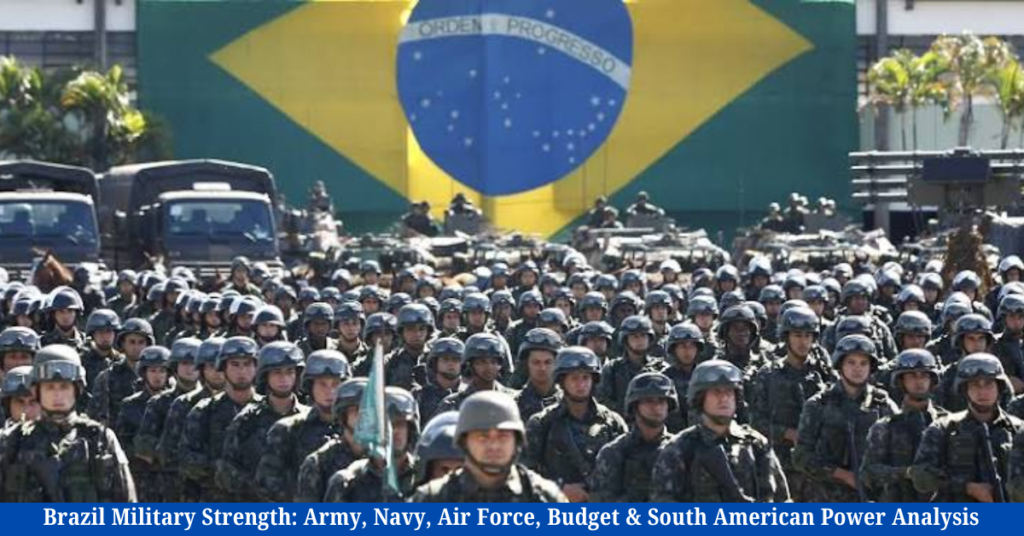
The Brazil Military Strength 2026 continues to rank as the strongest and most influential military force in South America. With massive manpower reserves, strategic geographic advantages, expanding defense industries, and growing regional influence, Brazil remains a dominant military power across Latin America and an increasingly important player among developing nations.
Unlike many Western military powers that focus heavily on overseas combat operations and global intervention missions, Brazil’s military strategy is primarily centered around territorial defense, border protection, internal stability, Amazon security, and regional leadership.
The Brazilian Armed Forces are responsible for protecting several critical national assets and strategic regions, including:
- The Amazon rainforest
- Extensive Atlantic coastlines
- Critical energy infrastructure
- Large international land borders
- River transportation networks
- Strategic natural resources
Brazil’s enormous geographic size creates unique defense challenges that require strong land forces, air surveillance systems, naval patrol capability, and internal security operations.
The country is also playing an increasingly important role within BRICS and continues expanding military cooperation and defense partnerships with countries across Europe, Asia, the Middle East, and Latin America.
In 2026, the Brazilian military combines:
- Large military manpower reserves
- Strong internal security capability
- A modernizing air force
- Regional naval strength
- A growing aerospace industry
- Expanding defense technology programs
Brazil has also accelerated military modernization efforts in recent years through investments in advanced aircraft, submarines, cyber defense, satellite systems, border surveillance technology, and domestic weapons production.
With its strategic regional influence, growing defense industry, and expanding military modernization programs, the Brazil Military Strength 2026 continues to establish the country as the leading military power in South America.
☷On this pageJump to a section of this military guide
Brazil Military Ranking 2026
According to the 2026 Global Firepower Index, the Brazil Military Ranking 2026 places the country among the world’s strongest military powers. Brazil continues to maintain the largest and most influential armed forces in South America through its massive manpower reserves, strategic geography, and growing military modernization programs.
The Brazilian Armed Forces are designed to protect one of the world’s largest national territories, including vast land borders, major coastlines, critical natural resources, and the Amazon rainforest region.
Brazil Military Overview 2026
| Category | Details |
|---|---|
| Global Military Rank | 11th |
| Power Index Score | 0.2374 |
| Total Military Personnel | 1.9 Million |
| Active Personnel | 376,000 |
| Reserve Personnel | 1.34 Million |
| Defense Budget | $26.4 Billion |
| Total Aircraft | 495 |
| Naval Assets | 69 |
| Submarines | 6 |
The Brazil Military Strength 2026 is built around large-scale manpower, regional operational capability, internal security readiness, and expanding domestic defense production.
One of Brazil’s biggest military advantages is its enormous reserve force and territorial depth, which provide strong defensive capability across South America’s largest national territory.
Although Brazil’s defense budget is lower than many global military powers, the country remains the strongest military force in South America because of its overall size, regional influence, strategic resources, and growing modernization efforts.
Brazil is also investing in advanced aerospace technology, submarine programs, cyber defense, border surveillance systems, and military-industrial development to strengthen future defense capability.
With its combination of manpower, geographic strength, regional dominance, and modernization programs, the Brazil Military Strength 2026 continues to play a leading role in Latin American security and regional military balance.
Why Brazil’s Geography Shapes Its Military
The Brazil Military Strength 2026 is heavily shaped by the country’s massive geography and unique environmental challenges. As the fifth-largest country in the world by land area, Brazil requires a military structure capable of operating across enormous distances, remote regions, dense jungles, and difficult terrain.
Unlike many European militaries that are designed mainly for NATO-style conventional warfare, the Brazilian Armed Forces must focus on territorial protection, internal mobility, border security, and operations in geographically challenging environments.
Brazil’s strategic geography includes:
- The fifth-largest land area in the world
- Massive Amazon jungle territories
- More than 16,000 km of land borders
- Extensive Atlantic coastlines
- Large river transportation networks
Protecting such a vast territory creates unique military requirements that are very different from those faced by most Western nations.
Because of these challenges, the Brazilian military focuses heavily on:
- Jungle warfare capability
- Border patrol operations
- Strategic air mobility
- River and waterway security
- Internal defense operations
- Rapid deployment across remote areas
One of the most important areas of focus for Brazil is the protection of the Amazon rainforest region, which requires specialized jungle warfare units, river patrol systems, surveillance aircraft, and rapid-response forces capable of operating in isolated environments.
Brazil’s military must also manage border security across multiple neighboring countries while monitoring illegal trafficking, organized crime activity, smuggling routes, and environmental threats in remote regions.
The country’s large river systems also play a major strategic role in transportation and military logistics, especially in jungle regions where traditional road infrastructure is limited.
Because of these geographic realities, the Brazil Military Strength 2026 places major emphasis on mobility, flexibility, territorial surveillance, and specialized operations rather than large-scale overseas combat deployments.
Brazil Army Strength 2026
The Brazil Army Strength 2026 remains the largest branch of the country’s armed forces and one of the biggest military land forces in the Western Hemisphere. Due to Brazil’s enormous territory, vast border regions, and challenging geography, the army plays a critical role in national defense, internal security, and territorial control operations.
The Brazilian Army is designed to operate across diverse environments including dense rainforests, remote jungle regions, mountains, wetlands, urban areas, and long border zones. This gives Brazil one of the most versatile land warfare capabilities in Latin America.
The army’s primary missions include:
- Territorial defense
- Border security operations
- Jungle warfare capability
- Internal security missions
- Critical infrastructure protection
- Counter-smuggling operations
Brazil Army Equipment and Personnel
| Army Category | Numbers |
|---|---|
| Army Personnel | 1.21 Million |
| Main Battle Tanks | 294 |
| Armored Vehicles | 22,464 |
| Self-Propelled Artillery | 149 |
| Rocket Artillery Systems | 82 |
The Brazilian Army maintains one of the region’s largest and most balanced land warfare capabilities through its combination of manpower, armored units, artillery systems, and specialized jungle warfare forces.
One of the most important strengths of the Brazil Army is its expertise in jungle combat operations. Brazil operates highly trained jungle warfare units specifically designed for combat, patrol, and survival missions in the Amazon rainforest environment.
The army also plays a major role in border surveillance and internal security operations, especially in remote regions affected by illegal trafficking, organized crime, and smuggling activity.
In recent years, Brazil has invested in modern armored vehicles, battlefield communication systems, surveillance technology, and mobility-focused modernization programs to improve operational readiness across its large territory.
With its massive manpower reserves, territorial defense focus, and specialized jungle warfare capability, the Brazil Army Strength 2026 continues to be the dominant land force in South America.
Brazil and Jungle Warfare
One of the most unique and important strengths of the Brazil Military Strength 2026 is its advanced expertise in jungle warfare operations. Because a large portion of Brazil’s territory is covered by the Amazon rainforest, the country has developed highly specialized military units trained to operate in some of the world’s most difficult combat environments.
The Brazilian Army operates dedicated jungle warfare training centers where soldiers receive advanced preparation for operations in extreme tropical conditions.
These specialized forces are trained for combat in:
- Dense rainforest environments
- Extreme humidity conditions
- Remote river systems
- Difficult jungle terrain
The jungle warfare capabilities of the Brazilian military are widely considered among the best in the world for tropical and rainforest combat operations. Soldiers are trained to survive and operate in isolated areas with limited infrastructure, harsh weather conditions, and difficult mobility.
One of the most respected institutions in this field is Brazil’s jungle warfare training program, which attracts military personnel and observers from multiple countries interested in tropical warfare expertise.
Beyond military operations, Brazil’s presence in the Amazon region is also extremely important for national security and environmental protection.
The military plays a major role in:
- Combating illegal mining
- Border surveillance and monitoring
- Anti-smuggling operations
- Environmental security missions
Brazilian forces regularly conduct patrols and monitoring missions in remote jungle areas where illegal activities such as deforestation, trafficking, and unauthorized mining operations occur.
Because the Amazon region contains valuable natural resources and strategic environmental importance, protecting it remains a major national security priority for the Brazilian Armed Forces.
With its specialized jungle units, territorial knowledge, and long-term operational experience in rainforest environments, the Brazil Army Strength 2026 possesses one of the world’s most advanced jungle warfare capabilities.
Brazil Air Force 2026
The Brazil Air Force 2026 plays a critical role in protecting one of the world’s largest national territories. Because Brazil covers enormous land areas that include rainforests, mountains, coastlines, remote border zones, and isolated regions, air mobility and surveillance are essential parts of the country’s defense strategy.
Unlike some global military powers that focus mainly on large-scale overseas air combat operations, the Brazilian Air Force is heavily oriented toward territorial surveillance, rapid deployment, transport capability, and regional air defense.
The air force mainly focuses on:
- Strategic air mobility
- Regional air defense
- Long-range surveillance
- Rapid-response operations
- Border monitoring missions
Brazil Air Force Inventory
| Air Force Category | Total |
|---|---|
| Total Aircraft | 495 |
| Fighter Aircraft | 44 |
| Attack Aircraft | 30 |
| Transport Aircraft | 107 |
| Trainer Aircraft | 124 |
| Helicopters | 186 |
Although the Brazil Air Force does not operate fighter aircraft numbers comparable to global superpowers, it remains one of the most important and capable air forces in Latin America because of its regional reach and operational flexibility.
Brazil Fighter Jets and Air Defense
Brazil currently operates several advanced aircraft platforms, including:
- Saab JAS 39 Gripen
- AMX attack aircraft
- Embraer A-29 Super Tucano
One of the most important modernization programs for the Brazilian Air Force is the acquisition of the Saab JAS 39 Gripen fighter jet. This aircraft significantly improves Brazil’s air combat capability through advanced radar systems, modern avionics, network-based warfare capability, and multirole combat performance.
The Gripen fighter program also strengthens Brazil’s aerospace sector through technology transfer and local industrial participation.
Brazil is additionally expanding investments in:
- Advanced radar systems
- Air surveillance networks
- Border monitoring technology
- Drone and unmanned operations
These systems help improve national airspace protection and surveillance across Brazil’s vast territory and remote border regions.
Embraer and Brazil’s Aerospace Industry
One of Brazil’s biggest strategic advantages is its advanced domestic aerospace industry. The company Embraer is widely respected around the world and plays a major role in strengthening the Brazil Military Strength 2026.
Embraer is internationally known for producing:
- Military transport aircraft
- Surveillance aircraft
- Trainer jets
- Advanced aerospace engineering systems
The company’s strong aerospace expertise gives Brazil an important advantage over many regional military powers that rely almost entirely on foreign defense suppliers for military aviation technology.
Brazil’s growing aerospace sector also supports defense modernization, military exports, technological independence, and long-term development of future aviation systems.
With its modernizing fighter fleet, strong transport capability, expanding surveillance infrastructure, and world-class aerospace industry, the Brazil Air Force Strength 2026 remains one of the most capable air forces in South America.
Brazil Navy Strength 2026
The Brazil Navy Strength 2026 remains one of the strongest and most strategically important maritime forces in Latin America. With responsibility for protecting one of the world’s longest coastlines and vast Atlantic maritime zones, the Brazilian Navy plays a major role in national defense, energy security, and regional maritime stability.
Brazil’s naval strategy is heavily focused on protecting offshore resources, monitoring sea trade routes, strengthening coastal defense, and maintaining control over critical Atlantic Ocean regions.
The Brazilian Navy mainly focuses on:
- Atlantic Ocean security
- Offshore oil infrastructure protection
- Maritime patrol operations
- Submarine warfare capability
- Coastal defense missions
Brazil Naval Fleet Overview
| Naval Category | Total |
|---|---|
| Total Naval Assets | 69 |
| Helicopter Carrier | 1 |
| Frigates | 8 |
| Corvettes | 2 |
| Submarines | 6 |
| Patrol Vessels | 22 |
The Brazilian Navy is widely regarded as one of the most capable maritime forces in South America because of its balanced naval structure, submarine programs, and growing modernization efforts.
Brazil’s Atlantic Strategy
Brazil’s Atlantic coastline contains several strategically important national assets, including:
- Major offshore oil reserves
- International trade routes
- Naval infrastructure
- Large exclusive economic zones
Protecting these critical resources has become a major military and economic priority for the Brazilian government.
Because of this, Brazil has increasingly focused on:
- Offshore maritime patrol systems
- Naval modernization programs
- Submarine expansion projects
- Maritime surveillance capability
The Brazilian Navy regularly conducts patrol operations designed to secure shipping routes, energy infrastructure, fishing zones, and strategic coastal regions throughout the South Atlantic.
Brazil Submarine Program
One of the most important modernization areas for the Brazilian Navy is submarine development and underwater defense capability.
Brazil continues investing heavily in submarine programs to strengthen long-term naval deterrence and maritime security operations.
The country has also shown strong interest in expanding advanced submarine capability to improve:
- Strategic naval deterrence
- Atlantic Ocean defense
- Maritime surveillance
- Protection of offshore energy resources
Submarines are considered especially important for Brazil because of the country’s large maritime territory and the need to monitor critical Atlantic trade and energy routes.
With continued investment in naval modernization, offshore defense systems, and submarine capability, the Brazil Navy Strength 2026 remains one of the leading maritime defense forces in Latin America.
Brazil Defense Budget 2026
The Brazil Defense Budget 2026 remains one of the largest military spending programs in Latin America. As the strongest military power in South America, Brazil continues investing in modernization, border security, aerospace development, naval expansion, and domestic defense production to strengthen long-term national defense capability.
Brazil’s defense strategy is heavily influenced by the need to protect its enormous territory, large population, strategic natural resources, offshore energy zones, and critical infrastructure.
Brazil Military Budget Overview
| Budget Category | Amount |
|---|---|
| Defense Budget | $26.4 Billion |
| Purchasing Power | $4.16 Trillion |
| Foreign Exchange Reserves | $329 Billion |
The Brazilian military budget supports a wide range of defense and modernization programs across all branches of the armed forces.
Major areas of military spending include:
- Border security operations
- Aircraft modernization programs
- Naval expansion projects
- Military infrastructure development
- Cybersecurity initiatives
- Domestic defense manufacturing
One of Brazil’s biggest priorities is improving surveillance and operational capability across remote border areas and strategic regions such as the Amazon rainforest and Atlantic coastline.
The country is also investing heavily in modern fighter aircraft, transport systems, naval modernization, radar networks, and communication infrastructure to improve military readiness and territorial protection.
Brazil’s growing domestic defense industry and aerospace sector also receive major support through military spending programs, helping reduce reliance on foreign suppliers and strengthen long-term defense independence.
Although Brazil spends significantly less on defense compared to military superpowers like the United States, China, or Russia, the Brazil Defense Budget 2026 remains highly significant within South America and continues supporting the region’s strongest military force.
Brazil and BRICS Military Influence
The Brazil Military Strength 2026 has gained additional geopolitical importance through the country’s growing role within BRICS. As one of the founding members of the BRICS grouping, Brazil continues strengthening diplomatic, economic, and strategic cooperation with several major emerging powers.
Brazil works closely with fellow BRICS members including:
- China
- India
- Russia
- South Africa
Through these partnerships, Brazil has expanded its international influence and strengthened its position as one of the leading voices among developing nations.
On the global stage, Brazil often positions itself as:
- A regional stabilizing power
- A leader of the developing world
- A strategic economic and diplomatic partner
Although Brazil is not considered a traditional global military superpower like the United States, China, or Russia, its geopolitical influence continues growing because of its economic size, strategic resources, regional leadership, and diplomatic role within international organizations.
Brazil’s participation in BRICS cooperation also supports broader collaboration in areas such as:
- Defense technology
- Economic development
- Cybersecurity
- Strategic infrastructure
- Global trade partnerships
As the strongest military force in South America, Brazil plays an important role in maintaining regional stability and balancing geopolitical influence across Latin America.
The country’s growing diplomatic connections, expanding defense industry, and increasing involvement in international cooperation programs continue strengthening the overall Brazil Military Strength 2026 and its influence within the developing world.
Strengths of Brazil Military
The Brazil Military Strength 2026 is built around large manpower reserves, vast territorial control capability, regional military dominance, and specialized operational expertise. As the strongest armed force in South America, Brazil possesses several strategic advantages that make it one of the most influential military powers in the developing world.
One of Brazil’s biggest military strengths is its ability to manage and defend an enormous national territory that includes rainforests, coastlines, river systems, and remote border regions.
Key Strengths of Brazil Military
- Massive manpower reserves
- Huge territory and natural resources
- Strong internal logistics capability
- Jungle warfare specialization
- Regional military dominance
- Growing aerospace industry
- Strategic Atlantic coastline
- Strong transport aviation capability
Brazil’s expertise in jungle warfare operations is considered among the best in the world. Specialized military units trained for tropical and rainforest combat provide the country with unique operational capability that few militaries possess.
Another major strength is Brazil’s strong internal mobility and transport infrastructure for military operations. Because of the country’s massive size, the armed forces have developed significant experience in rapid troop movement, air transport, and logistical support across difficult terrain.
Brazil also benefits from a growing domestic aerospace and defense industry led by companies such as Embraer, which strengthens military modernization and reduces dependence on foreign suppliers.
The country’s long Atlantic coastline and strategic maritime zones also increase the importance of naval security and offshore defense capability.
Overall, Brazil’s ability to sustain large-scale regional military operations and maintain dominance across South America remains one of its biggest strategic advantages.
Weaknesses of Brazil Military
Despite being the dominant military force in South America, the Brazilian military also faces several important operational and modernization challenges.
Key Weaknesses of Brazil Military
- Limited advanced fighter aircraft fleet
- Smaller naval force compared to major global powers
- Defense budget limitations
- Infrastructure difficulties in remote regions
- Dependence on long-term modernization programs
- Limited global power projection capability
One of the biggest challenges for the Brazil Air Force is maintaining a modern fighter fleet capable of matching larger global military powers. Although Brazil has improved air capability through the Gripen fighter program, overall fighter numbers remain relatively limited compared to advanced global militaries.
Brazil’s naval force is also smaller than those of major military powers, even though it remains one of the strongest in Latin America.
Additionally, operating across remote rainforest regions and isolated border zones creates major logistical and infrastructure challenges for military deployment and surveillance operations.
Unlike global military superpowers, Brazil’s armed forces are optimized primarily for regional defense, internal security, territorial protection, and strategic deterrence rather than worldwide intervention operations.
Future of Brazil Military
The future of the Brazil Military Strength 2026 is expected to focus heavily on modernization, domestic defense production, technological development, and strategic territorial protection.
Brazil is gradually investing in more advanced military systems designed to improve surveillance, mobility, cyber defense, and long-term operational capability.
Future Focus Areas of Brazil Military
- Indigenous defense manufacturing
- Cybersecurity programs
- Space monitoring systems
- Border surveillance technology
- Drone and unmanned systems
- Naval modernization
- Advanced fighter aircraft integration
The country is also expected to continue strengthening several strategic security priorities, including:
- Amazon rainforest protection
- Maritime resource security
- Regional military cooperation
Future investments in aerospace technology, naval projects, cyber defense infrastructure, and satellite monitoring systems are expected to play a major role in shaping the next generation of the Brazilian Armed Forces.
With continued modernization and regional leadership, the Brazil Military Strength 2026 is expected to remain the dominant military force in South America for the foreseeable future.
Is Brazil Military Strong in 2026?
Yes, the Brazil Military Strength 2026 remains the strongest and most influential military force in South America. With its massive territory, large manpower reserves, expanding defense industries, and growing aerospace capability, Brazil continues to strengthen its position as a major regional military power.
Although Brazil does not compete directly with global military superpowers such as the United States, China, or Russia in terms of worldwide power projection, it maintains one of the most capable and strategically important armed forces in the Southern Hemisphere.
The Brazilian Armed Forces combine:
- Large military manpower
- Strategic geographic advantages
- Strong regional influence
- Expanding aerospace capability
- Growing domestic defense industries
- Modernizing military forces
One of Brazil’s biggest strengths is its ability to defend and operate across an enormous national territory that includes the Amazon rainforest, extensive Atlantic coastlines, major river systems, and remote border regions.
The country also benefits from advanced expertise in jungle warfare operations, making the Brazilian Army one of the most specialized forces in tropical combat environments.
Brazil’s growing aerospace industry, led by companies such as Embraer, further strengthens national defense capability by supporting aircraft production, surveillance systems, transport aviation, and military technology development.
The Brazilian Navy also plays a major role in protecting offshore oil infrastructure, maritime trade routes, and strategic Atlantic Ocean zones, while the Air Force continues modernizing through programs such as the Saab Gripen fighter acquisition.
In recent years, Brazil has expanded investments in cyber defense, surveillance systems, border monitoring, naval modernization, and indigenous defense manufacturing to strengthen long-term military capability.
With its combination of manpower, geography, regional leadership, and modernization programs, the Brazil Military Strength 2026 continues to make Brazil one of the most influential military powers in Latin America and the broader developing world.
Brazil Military Strength 2026 FAQs
What is Brazil military ranking in 2026?
According to the 2026 Global Firepower Index, Brazil Military Ranking 2026 stands at 11th position among the world’s strongest military powers.
Is Brazil the strongest military in South America?
Yes, Brazil is widely considered the strongest and most influential military power in South America because of its manpower, regional influence, defense capability, and strategic geography.
How much is Brazil’s defense budget in 2026?
The Brazil defense budget in 2026 is estimated at approximately $26.4 billion.
How many active military personnel does Brazil have?
Brazil currently has around 376,000 active military personnel along with more than 1.3 million reserve personnel.
Which fighter jets does Brazil use?
The Brazilian Air Force operates advanced aircraft including:
- Saab JAS 39 Gripen
- AMX attack aircraft
- Embraer military aircraft
Does Brazil have submarines?
Yes, the Brazilian Navy operates 6 submarines as part of its maritime defense and Atlantic Ocean security strategy.
Why is Brazil military important?
The Brazilian military is strategically important because of the country’s massive territory, Amazon rainforest region, natural resources, Atlantic coastline, regional influence, and growing role in international organizations such as BRICS.