The world’s most powerful militaries in 2026 are not determined simply by which country has the most soldiers, tanks, aircraft, or ships.
Modern military strength depends on how different capabilities work together: manpower, air power, land forces, naval capability, logistics, defense spending, natural resources, geography, infrastructure, and the ability to sustain military operations.
In the finalized Global Firepower 2026 ranking, 145 countries are assessed using more than 60 individual factors. The United States remains ranked first, followed by Russia, China, India and South Korea.
France moves into sixth place for 2026, followed closely by Japan and the United Kingdom. Türkiye and Italy complete the top 10.
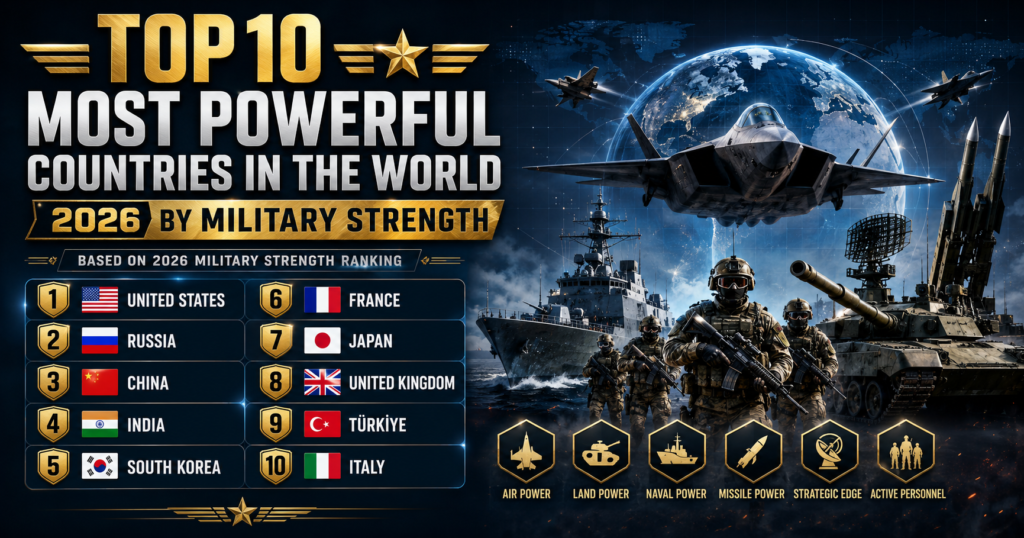
Top 10 Strongest Militaries in the World 2026
The table below shows the finalized 2026 Global Firepower top 10 and their PowerIndex (PwrIndx) scores. A lower score represents a stronger position within the GFP methodology.
| Rank | Country | 2026 PowerIndex |
|---|---|---|
| 1 | United States | 0.0741 |
| 2 | Russia | 0.0791 |
| 3 | China | 0.0919 |
| 4 | India | 0.1346 |
| 5 | South Korea | 0.1642 |
| 6 | France | 0.1798 |
| 7 | Japan | 0.1876 |
| 8 | United Kingdom | 0.1881 |
| 9 | Türkiye | 0.1975 |
| 10 | Italy | 0.2211 |
The ranking shows how close several countries are. France, Japan and the United Kingdom, for example, occupy positions six through eight with relatively small differences between their PowerIndex scores.
It is also important to understand what this table does not mean. A lower PowerIndex does not guarantee victory in a conflict, and the ranking does not measure every classified capability, real-time readiness level, nuclear factor, political decision, alliance commitment, or battlefield circumstance.
1. United States – Rank #1
The United States remains the highest-ranked military power in the world in 2026, with a PowerIndex score of 0.0741.
Its position is not based on one overwhelming numerical category. Instead, the U.S. combines capabilities that few countries possess at comparable scale.
These include:
- A very large military aircraft fleet
- 11 nuclear-powered aircraft carriers
- Extensive submarine capability
- Strategic bombers
- Aerial-refueling aircraft
- Heavy strategic airlift
- Advanced intelligence and surveillance systems
- Nuclear forces
- Space and cyber capabilities
- Overseas military infrastructure
- Large-scale logistics
- Extensive alliance networks
The United States also ranks first in the 2026 GFP defense-budget category, where the dataset assigns it $831.5 billion in annual defense spending.
Why the United States Ranks First
The key advantage is global power projection.
Many countries possess large armies or sizeable equipment inventories. Far fewer can move major forces across oceans, refuel aircraft in flight, operate carrier strike groups, support overseas bases, maintain nuclear submarines, and sustain operations far from their own territory.
That combination keeps the United States at the top of the 2026 conventional military ranking.
2. Russia – Rank #2
Russia ranks second in the world in 2026, with a PowerIndex score of 0.0791.
Russia’s military profile is very different from that of the United States. Its strength is especially concentrated in:
- Large ground forces
- Artillery and rocket systems
- Missile forces
- Strategic nuclear weapons
- Long-range aviation
- Submarines
- Air-defense systems
- Large-scale military-industrial production
Russia also possesses one of the world’s largest nuclear arsenals, although nuclear stockpiles are not equivalent to conventional military power and should be considered separately from simple equipment rankings.
Russia’s Military Position in 2026
The continuing war involving Ukraine makes Russian military statistics particularly difficult to interpret.
Equipment can be:
- Destroyed
- Repaired
- Rebuilt
- Drawn from storage
- Newly produced
- Modernized
- Transferred between formations
For that reason, raw tank or artillery inventories should not automatically be treated as the number of systems immediately available for operations.
Russia nevertheless remains a major conventional and nuclear military power because of its force scale, missile arsenal, industrial capacity, strategic forces and depth of land-based military capability.
3. China – Rank #3
China ranks third in 2026, with a PowerIndex score of 0.0919.
The People’s Liberation Army has undergone extensive modernization across land, air, naval, missile, space and cyber capabilities.
China’s most important military development is not simply that it has a large army. Its force has increasingly shifted toward technology-intensive, joint and long-range operations.
Major areas of Chinese military strength include:
- A very large active-duty force
- A rapidly expanding navy
- Modern destroyers and submarines
- Aircraft-carrier development
- J-20 stealth fighters
- Large conventional missile forces
- Nuclear modernization
- Space capabilities
- Cyber and electronic warfare
- A large domestic defense industry
Why China’s Navy Matters
China operates the world’s largest navy by number of battle-force ships under commonly cited U.S. defense assessments, but ship count alone does not automatically make it the world’s most powerful navy.
Fleet tonnage, carrier aviation, submarine quality, logistics, overseas support, training and mission requirements all matter.
China’s military strength is especially relevant in the Western Pacific, where geographic proximity allows it to concentrate forces much closer to its own bases and support infrastructure.
4. India – Rank #4
India ranks fourth among 145 countries in 2026, with a PowerIndex score of 0.1346.
India’s military profile combines very large manpower with nuclear deterrence, a substantial air force, major land forces and an increasingly important navy.
Its strategic environment is also distinctive because India must consider:
- Its land border with China
- Its relationship with Pakistan
- Security across the Indian Ocean
- Maritime trade routes
- A nuclear deterrent involving multiple regional powers
India’s Major Military Strengths
India operates:
- Large active and reserve forces
- Su-30MKI, Rafale and Tejas combat aircraft
- T-90 and other armored systems
- Ballistic and cruise missile systems
- Aircraft carriers
- Nuclear-powered submarine capability
- Nuclear weapons
- A growing domestic defense industry
The development of indigenous systems is an increasingly important part of Indian military modernization.
Programs involving combat aircraft, missiles, artillery, naval vessels, helicopters and other platforms are intended to reduce dependence on imported defense equipment over time.
Why India Ranks Fourth
India combines scale with increasingly diverse high-end capability.
It does not yet possess the same global logistics network as the United States, nor China’s manufacturing scale, but its combination of land forces, air power, naval capability, nuclear deterrence and strategic geography makes it one of the world’s most significant military powers.
5. South Korea – Rank #5
South Korea ranks fifth in 2026, with a PowerIndex score of 0.1642.
Its high ranking can surprise readers because South Korea is much smaller geographically and demographically than the United States, Russia, China or India.
Its military has been shaped primarily by the continuing security challenge posed by North Korea.
That environment has encouraged extensive investment in:
- Modern fighter aircraft
- Air and missile defense
- Artillery
- Armored forces
- Surveillance
- Precision-strike systems
- Ballistic and cruise missiles
- Naval forces
- Domestic weapons manufacturing
South Korea’s Defense Industry
South Korea has also become an increasingly important defense manufacturer.
Systems such as the:
- K2 Black Panther tank
- K9 Thunder self-propelled howitzer
- FA-50 light combat aircraft
- KF-21 fighter
- Naval vessels
- Missile systems
demonstrate that South Korea’s military power is supported by substantial domestic industrial capability.
Its alliance with the United States also plays an important role in its broader security structure, although GFP’s national ranking should not be interpreted simply as an alliance ranking.
6. France – Rank #6
France rises to sixth place in the 2026 Global Firepower ranking, with a PowerIndex score of 0.1798.
This is one of the important differences between the finalized 2026 ranking and older versions of this article.
France possesses a relatively compact force compared with the largest military powers, but it retains capabilities that many countries do not.
These include:
- An independent nuclear deterrent
- Rafale multirole fighters
- A nuclear-powered aircraft carrier
- Nuclear-powered submarines
- Long-range military aviation
- Overseas military access and territories
- Modern armored forces
- Space and intelligence capabilities
Why France Ranks So Highly
France can operate across multiple military domains without depending entirely on another country for strategic deterrence or major expeditionary capabilities.
Its combination of nuclear forces, advanced aviation, naval power and expeditionary capability gives it a broader military profile than manpower totals alone would suggest.
7. Japan – Rank #7
Japan ranks seventh in 2026, with a PowerIndex score of 0.1876.
Japan’s military structure is heavily oriented toward air and maritime defense, reflecting the country’s island geography and security environment in East Asia.
Major Japanese capabilities include:
- F-35 fighters
- Modernized F-15J aircraft
- Aegis-equipped destroyers
- Advanced conventional submarines
- Maritime patrol aircraft
- Missile-defense systems
- Type 10 tanks
- Large anti-submarine warfare capability
Japan’s Changing Defense Posture
Japan has been expanding defense spending and developing greater long-range counterstrike capability.
The conversion of Izumo-class ships to support F-35B operations is also significant because it increases the flexibility of Japanese naval aviation.
Japan remains non-nuclear, but its alliance with the United States forms an important part of its national defense framework.
Japan’s #7 ranking therefore reflects technology, maritime capability, air power, logistics and modernization, rather than exceptionally large manpower.
8. United Kingdom – Rank #8
The United Kingdom ranks eighth in 2026, with a PowerIndex score of 0.1881.
The UK dropped below France and Japan in the finalized 2026 ranking, although the difference among these countries remains relatively small within the GFP scoring system.
British military capability is concentrated around a smaller professional force equipped with several high-end systems.
Key strengths include:
- Two Queen Elizabeth-class aircraft carriers
- F-35B fighters
- Eurofighter Typhoon aircraft
- Nuclear-powered submarines
- Ballistic-missile submarines
- An independent nuclear deterrent
- Advanced intelligence capabilities
- NATO integration
- Overseas military access
Strength Versus Scale
The United Kingdom demonstrates why military strength cannot be measured only by active troop numbers.
Its land force is substantially smaller than those of several countries ranked below it, but the UK retains carrier aviation, nuclear deterrence, advanced combat aircraft, submarine capability and expeditionary experience.
Its challenge is maintaining those sophisticated capabilities while operating with a comparatively limited force size.
9. Türkiye – Rank #9
Türkiye ranks ninth globally in 2026, with a PowerIndex score of 0.1975.
Türkiye’s military is particularly notable because it combines a large conventional force with a rapidly expanding domestic defense industry.
Important areas include:
- Large ground forces
- F-16 combat aircraft
- Unmanned aerial vehicles
- Artillery
- Armored vehicles
- Submarines
- Frigates and corvettes
- Missile development
- Indigenous aircraft and naval programs
Türkiye’s Drone and Defense Industry
Türkiye has become internationally associated with systems such as the Bayraktar TB2, but its domestic defense industry extends well beyond drones.
Programs include:
- KAAN fighter development
- Altay main battle tank
- TCG Anadolu
- MILGEM warships
- Atmaca anti-ship missile
- Various unmanned aircraft
That domestic production capability is strategically important because military power depends not only on existing inventories but also on the ability to maintain, replace and develop equipment.
10. Italy – Rank #10
Italy completes the global top 10 in 2026, with a PowerIndex score of 0.2211.
Italy has a relatively balanced military structure built around NATO and Mediterranean requirements.
Its capabilities include:
- F-35 fighters
- Eurofighter Typhoon aircraft
- Modern frigates and destroyers
- Submarines
- Carrier-capable naval aviation
- Amphibious forces
- Modern helicopters
- NATO-integrated land forces
Italy’s 2026 GFP data estimates approximately 288,800 total military personnel and around 714 military aircraft.
Why Italy Makes the Top 10
Italy does not lead the ranking in manpower, tanks or defense spending.
Its position comes instead from maintaining meaningful capability across air, land and naval forces, supported by industrial capacity, infrastructure and alliance integration.
Its Mediterranean geography also makes naval and air capability particularly important to the structure of the Italian armed forces.
What Changed in the 2026 Military Ranking?
The top five remain:
United States → Russia → China → India → South Korea.
The notable movement occurs immediately below them.
France rises to #6, Japan holds #7, and the United Kingdom sits at #8.
Türkiye remains ninth, while Italy completes the top 10.
Direct year-to-year comparisons should still be made carefully because Global Firepower can modify its formula and underlying data between annual editions.
A country’s movement in the ranking therefore does not necessarily mean its armed forces suddenly became dramatically stronger or weaker.
What Actually Makes a Country Militarily Powerful?
A top-10 ranking becomes more useful when we understand the factors behind it.
Military Personnel
Large active and reserve forces provide depth, but manpower alone is insufficient.
A million personnel cannot be evaluated without considering training, equipment, command systems, logistics and the missions they are expected to perform.
Air Power
Modern air capability includes much more than fighter numbers.
It can involve:
- Fighters
- Bombers
- Transport aircraft
- Tankers
- Helicopters
- Surveillance aircraft
- Electronic-warfare platforms
- Training and maintenance systems
A country with fewer fighters but much stronger support aircraft can possess a very different type of air capability.
Land Forces
Tank totals attract attention, but modern land warfare also depends on:
- Infantry fighting vehicles
- Artillery
- Rocket systems
- Air defense
- Engineering
- Communications
- Drones
- Logistics
The age and condition of equipment also matter.
Naval Power
A total fleet number can be particularly misleading.
One aircraft carrier cannot be treated as equivalent to one patrol vessel simply because both count as naval assets.
Useful naval analysis considers:
- Fleet tonnage
- Submarines
- Destroyers and frigates
- Carrier aviation
- Amphibious capability
- Missile systems
- Logistics
- Naval aviation
Defense Spending
Large defense budgets can support modernization, personnel, maintenance, procurement and research.
But direct dollar comparisons have limitations because procurement costs, salaries, domestic production and purchasing power differ widely between countries.
For example, the 2026 GFP spending dataset lists the United States at $831.5 billion, China at $303 billion, Russia at about $212.6 billion, India at $109 billion, and Germany at approximately $127.4 billion.
This demonstrates why military rank and budget rank are not identical.
Logistics
Logistics is one of the most underrated components of military strength.
A country must be able to move:
people + fuel + ammunition + food + spare parts + vehicles + aircraft + ships
and maintain them once deployed.
This becomes particularly important for militaries expected to operate outside their home territory.
Defense Industry
Countries capable of producing their own missiles, aircraft, ammunition, armored vehicles, ships or drones may have greater ability to sustain modernization and replace equipment.
The United States, Russia, China, India, South Korea, France, Japan, the UK, Türkiye and Italy all possess meaningful domestic defense-industrial capabilities, although their scale and areas of specialization differ considerably.
Does Nuclear Power Determine the Strongest Military?
No.
Nuclear weapons are extremely important to strategic deterrence, but they should not be added to conventional equipment totals as if a nuclear warhead were simply another military asset.
Among the 2026 top 10, several countries possess their own nuclear arsenals, while others rely on alliance-based deterrence structures.
A conventional military ranking and a nuclear-force comparison therefore answer different questions.
A country can possess a formidable nuclear deterrent while having a smaller conventional military, or maintain an extremely capable conventional force without an independent nuclear arsenal.
Why Global Firepower Rankings Have Limits
The Global Firepower ranking is useful as a broad comparative tool, but it should not be interpreted as a prediction of warfare.
The 2026 formula considers more than 60 factors across military equipment, manpower, finances, logistics, natural resources and geography, and 145 countries are included.
However, no public ranking can fully measure:
- Classified capabilities
- Real-time operational readiness
- Leadership
- Morale
- Training quality
- Intelligence
- Wartime strategy
- Political objectives
- Alliance responses
- Actual equipment serviceability
- Battlefield conditions
This is why #4 versus #8 does not automatically mean the fourth-ranked country would defeat the eighth-ranked country in every possible conflict.
Rankings are best used as a starting point for understanding the structure of different armed forces.
Top 10 Military Powers 2026: Key Takeaways
The United States remains #1, supported by its combination of air power, naval aviation, logistics, technology, defense resources and global reach.
Russia remains #2, with enormous land, missile, nuclear and industrial capabilities despite the difficulty of assessing real-time wartime inventories.
China is #3 and continues to build a force increasingly centered on naval modernization, missiles, advanced aviation and operations in the Western Pacific.
India remains #4, combining exceptional manpower, nuclear deterrence, major land and air forces and growing Indian Ocean capability.
South Korea at #5 demonstrates how modern equipment and a strong defense industry can place a smaller country among the highest-ranked military powers.
The European and Asian positions from #6 to #10 are much closer, with France, Japan, the UK, Türkiye and Italy each representing a different military model.
FAQs
Which country has the strongest military in the world in 2026?
The United States ranks #1 in the finalized 2026 Global Firepower ranking with a PowerIndex score of 0.0741.
What are the top 5 military powers in 2026?
The top five are United States, Russia, China, India and South Korea.
Which country ranks sixth in military strength in 2026?
France ranks #6, with a PowerIndex score of 0.1798.
What is India’s military rank in 2026?
India ranks 4th out of 145 countries in the 2026 Global Firepower assessment.
What is China’s military rank in 2026?
China ranks 3rd, behind the United States and Russia.
What is the United Kingdom’s military rank in 2026?
The United Kingdom ranks 8th in the finalized 2026 ranking.
Which European countries are in the top 10?
The European countries in the top 10 are France, United Kingdom, Türkiye and Italy, depending on the geographic definition used for Türkiye.
Is Japan a top-10 military power?
Yes. Japan ranks #7 in the 2026 Global Firepower assessment.
Which country has the biggest defense budget in 2026?
The United States ranks first in the GFP 2026 defense-spending dataset at approximately $831.5 billion, followed by China.
Does the strongest military ranking predict who would win a war?
No. Military rankings cannot reliably predict conflict outcomes because actual wars depend on objectives, geography, readiness, logistics, alliances, intelligence, strategy and many other factors.
Why is South Korea ranked fifth?
South Korea combines sizeable armed forces with modern aircraft, armored forces, missiles, naval capability, infrastructure and a substantial domestic defense industry.
Why is Türkiye in the top 10?
Türkiye combines large ground forces with growing domestic production of drones, missiles, armored vehicles, naval systems and aircraft, alongside its broader NATO military structure.
Final Takeaway
The Top 10 most powerful militaries in the world in 2026 represent very different approaches to military strength.
The United States leads through global reach, air and naval power, logistics and defense resources. Russia relies heavily on land forces, missiles, strategic weapons and industrial scale. China combines enormous resources with rapid naval and technological modernization. India brings massive force size, nuclear capability and growing maritime power.
South Korea, France, Japan, the United Kingdom, Türkiye and Italy demonstrate that a country does not need the world’s largest population to rank highly when it combines modern equipment, logistics, technology, infrastructure and specialized military capabilities.
The most important lesson from the 2026 ranking is therefore not simply who is #1.
Military power is multidimensional, and a ranking is most useful when it helps explain why each country’s armed forces are structured differently and where their actual strengths and limitations lie.
The rewritten version fixes the largest factual issue in the published article: its old table uses values such as 0.0744 for the U.S., 0.0788 for Russia and 0.0788 for China, while the finalized 2026 figures are 0.0741, 0.0791 and 0.0919 respectively.
I would also remove the old Wikipedia link, the re