The United States vs Iran military strength comparison in 2026 brings together two armed forces designed around almost opposite military strategies.
The United States maintains the world’s highest-ranked conventional military force. Its strength comes from a combination of enormous air power, carrier aviation, nuclear-powered submarines, long-range bombers, aerial refueling, strategic transport, satellites, precision weapons, overseas logistics and a defense budget measured in hundreds of billions of dollars.
Iran cannot—and does not attempt to—match that military structure platform for platform.
Instead, Iranian military power is built around a large standing force, ballistic and cruise missiles, drones, mobile launch systems, extensive artillery, air-defense networks, dispersed infrastructure, the Islamic Revolutionary Guard Corps, and an asymmetric maritime strategy centered heavily on the Persian Gulf and Strait of Hormuz.
That distinction is crucial.
A comparison limited to fighter aircraft or aircraft carriers makes the United States’ advantage look overwhelming but explains very little about why Iran remains militarily important.
Likewise, Iran’s substantial missile, rocket and artillery forces do not make it equivalent to the United States in global conventional military capability.
The two countries are trying to solve different military problems.
In the 2026 military ranking, the United States stands at #1 among 145 countries with a PowerIndex score of 0.0741. Iran ranks #16 with a score of 0.3199.
The U.S. therefore maintains the much stronger overall conventional military system.
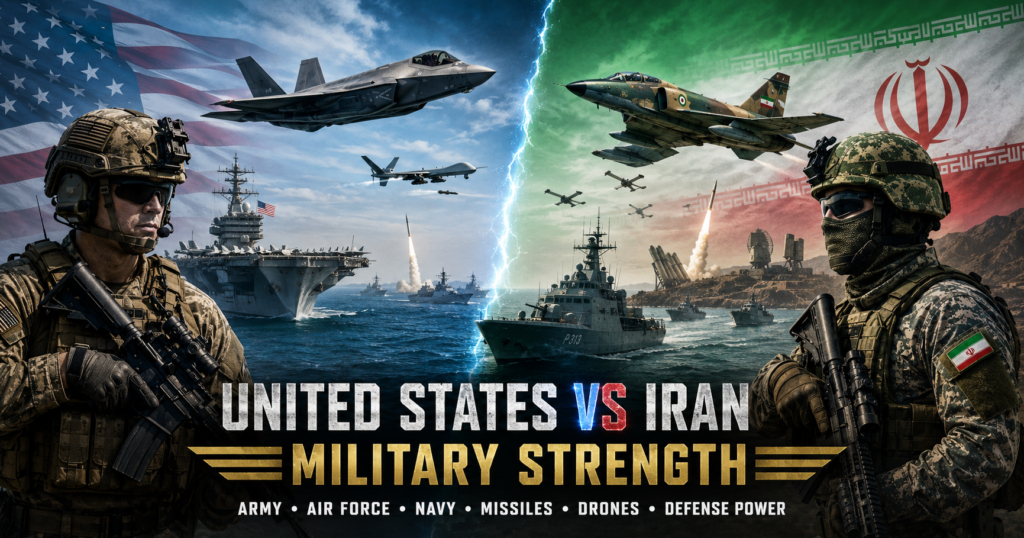
But understanding U.S. vs Iran military power in 2026 requires going deeper into air power, missiles, drones, naval strategy, geography, logistics and the different ways the two countries attempt to deter an opponent.
United States vs Iran Military Strength 2026 at a Glance
The headline military statistics reveal an enormous difference in overall scale, particularly in aviation, naval power, logistics and defense spending.
Iran nevertheless maintains substantial manpower, land forces, missiles, drones and regional military capabilities.
| Military Category | United States | Iran |
|---|---|---|
| Global Military Rank | #1 | #16 |
| PowerIndex | 0.0741 | 0.3199 |
| Active Personnel | 1,333,030 | 610,000 |
| Reserve Personnel | 799,500 | 350,000 |
| Paramilitary Personnel | 0 | 220,000 |
| Defense Budget | $831.5 billion | $9.23 billion |
| Total Aircraft | 13,032 | 551 |
| Fighter Aircraft | 1,791 | 188 |
| Transport Aircraft | 917 | 86 |
| Special-Mission Aircraft | 611 | 10 |
| Aerial Tankers | 610 | 6 |
| Helicopters | 5,913 | 129 |
| Attack Helicopters | 1,024 | 13 |
| Tanks | 4,666 | 2,675 |
| Armored Vehicles | 409,660 | 75,939 |
| Self-Propelled Artillery | 1,521 | 424 |
| Towed Artillery | 1,878 | 1,803 |
| Mobile Rocket Projectors | 1,731 | 1,550 |
| Naval Assets | 465 | 109 |
| Aircraft Carriers | 11 | 0 |
| Submarines | 66 | 25 |
| Destroyers | 83 | 0 |
The United States leads almost every conventional category in this table.
But notice something important: Iran’s artillery and mobile-rocket numbers are much closer to American totals than its aircraft or naval numbers are.
More importantly, the table does not include one of Iran’s defining strengths—its broader ballistic-missile, cruise-missile and drone ecosystem.
That is why the comparison cannot stop here.
United States vs Iran Military Ranking 2026
The United States holds the #1 global military position with a PowerIndex of 0.0741.
Iran ranks #16 with 0.3199.
The gap reflects enormous differences in military investment, aviation, naval capability, logistics and global deployment capacity.
The United States maintains military capabilities that Iran does not possess on a comparable scale, including:
- Large stealth-aircraft fleets
- Strategic bombers
- Hundreds of aerial tankers
- Massive transport aviation
- Nuclear-powered aircraft carriers
- Nuclear attack submarines
- Ballistic-missile submarines
- Worldwide military logistics
- Extensive military-space infrastructure
Iran’s military model concentrates more heavily on capabilities that are relatively affordable, survivable and useful within its regional environment.
These include:
- Ballistic missiles
- Cruise missiles
- Drones
- Rocket artillery
- Mobile launchers
- Coastal missiles
- Small naval craft
- Submarines
- Air defenses
- Dispersed military infrastructure
Therefore, the ranking correctly identifies the United States as the much larger overall conventional power without making Iran militarily irrelevant.
Why U.S. vs Iran Is an Asymmetric Military Comparison
This is the most important concept in the article.
Iran does not need 11 aircraft carriers to create military problems for the United States.
It does not need 13,000 aircraft.
And it does not need to replicate American military spending.
Iran’s strategy instead attempts to make military operations close to Iranian territory costly, uncertain and difficult.
That can involve overlapping layers of:
Missiles + drones + coastal defenses + submarines + mines + small naval craft + air defenses + dispersed launch systems
The United States approaches the same strategic environment from the opposite direction.
It relies much more heavily on:
Aircraft + carrier groups + submarines + long-range weapons + satellites + tankers + intelligence + logistics + regional bases
That is why simply declaring that the United States has 11 carriers and Iran has none adds little useful information.
The real question is how those carriers, aircraft and bases interact with Iranian missiles, drones, submarines and regional geography.
U.S. vs Iran Military Manpower
The United States maintains the larger active and reserve forces.
The 2026 figures list approximately:
United States active personnel: 1,333,030
Iran active personnel: 610,000
The U.S. also has approximately 799,500 reserve personnel, compared with Iran’s 350,000.
Iran, however, has a substantial listed paramilitary component of approximately 220,000 personnel.
| Manpower Category | United States | Iran |
|---|---|---|
| Active Personnel | 1,333,030 | 610,000 |
| Reserve Personnel | 799,500 | 350,000 |
| Paramilitary Personnel | 0 | 220,000 |
| Available Manpower | 150,463,900 | 49,496,685 |
| Fit for Service | 124,816,644 | 41,541,860 |
| Reaching Military Age Annually | 4,445,524 | 1,414,191 |
The manpower comparison nevertheless needs qualification.
The United States organizes its military primarily around a professional force equipped to deploy globally.
Iran maintains its own conventional armed forces alongside the Islamic Revolutionary Guard Corps, producing a more complicated military structure than one active-personnel figure suggests.
Iran’s Regular Military and the IRGC
Iranian military strength is divided across two major institutional structures.
The conventional Artesh operates traditional Army, Air Force, Navy and air-defense capabilities.
The Islamic Revolutionary Guard Corps (IRGC) performs a different but overlapping set of roles.
The IRGC is particularly important to Iran’s:
- Missile capabilities
- Drone programs
- Asymmetric warfare
- Maritime strategy
- Strategic deterrence
- Regional military relationships
This dual structure is a defining characteristic of Iran.
It means Iran should not be analyzed simply as a smaller version of an American-style conventional military.
The country’s most strategically important capabilities may sit outside the equipment categories that dominate standard military rankings.
United States Army vs Iran Army 2026
The United States maintains the larger land-equipment inventory across the major categories contained in the 2026 comparison.
It has more tanks, dramatically more armored vehicles, more self-propelled artillery and slightly more towed artillery and mobile rocket systems.
| Land Category | United States | Iran |
|---|---|---|
| Tanks | 4,666 | 2,675 |
| Armored Vehicles | 409,660 | 75,939 |
| Self-Propelled Artillery | 1,521 | 424 |
| Towed Artillery | 1,878 | 1,803 |
| Mobile Rocket Projectors | 1,731 | 1,550 |
The differences are not equally large.
The United States has more than five times Iran’s listed armored-vehicle inventory.
But the towed-artillery and mobile-rocket numbers are surprisingly close.
This reflects Iran’s continuing emphasis on land-based firepower.
U.S. Tanks vs Iranian Tanks
The United States is listed with approximately 4,666 tanks, compared with Iran’s 2,675.
The U.S. heavy armored force is centered around the M1 Abrams family.
Iran operates a more diverse inventory consisting of equipment from different periods and origins alongside locally developed or modified systems.
Raw tank totals, however, are not particularly useful for evaluating a direct U.S.–Iran confrontation.
The United States and Iran do not share a land frontier.
Deploying large American armored formations into the region would require transportation, ports, bases, logistics and political access.
Iran’s tanks, meanwhile, operate much closer to Iranian domestic infrastructure.
So the American numerical and technological advantage in armor is real—but the operational usefulness of that advantage depends on the scenario.
Iran’s Artillery and Rocket Forces Are More Important Than the Tank Gap
The artillery figures deserve more attention.
The U.S. has approximately 1,878 listed towed artillery systems, while Iran has 1,803.
Mobile rocket projectors are also relatively close:
United States: 1,731
Iran: 1,550
This does not mean the forces are technologically equivalent.
It shows instead that Iran maintains substantial numerical depth in land-based fires.
More importantly, Iran’s military strategy extends beyond ordinary battlefield artillery into much longer-range ballistic and cruise missiles.
That is where Iranian land-based strike becomes strategically significant against the United States.
United States vs Iran Air Force 2026
The largest conventional capability gap appears in aviation.
The United States is listed with approximately 13,032 military aircraft.
Iran has 551.
That means the American military aviation inventory is more than twenty times larger.
The fighter comparison is similarly dramatic:
United States: 1,791
Iran: 188
But even these figures do not show the most important difference.
The United States also has an enormous fleet of tankers, transports, helicopters and special-mission aircraft that allows its combat aviation to operate as part of a global system.
| Air-Power Category | United States | Iran |
|---|---|---|
| Total Aircraft | 13,032 | 551 |
| Fighter Aircraft | 1,791 | 188 |
| Dedicated Attack Aircraft | 926 | 21 |
| Transport Aircraft | 917 | 86 |
| Trainer Aircraft | 2,610 | 103 |
| Special-Mission Aircraft | 611 | 10 |
| Aerial Tankers | 610 | 6 |
| Helicopters | 5,913 | 129 |
| Attack Helicopters | 1,024 | 13 |
This is not simply an advantage in fighter quantity.
It is a difference in the entire air-warfare ecosystem.
U.S. Air Power: F-35, F-22, F-15, F-16 and Long-Range Aviation
American combat aviation includes major fighter families such as:
- F-35 Lightning II
- F-22 Raptor
- F-15
- F-16
- Carrier-based combat aircraft
The United States also operates long-range bomber forces and large supporting fleets.
The F-35 and F-22 provide fifth-generation stealth capability.
Other aircraft add long-range payload, multirole flexibility and large fleet numbers.
But the real strength of American aviation comes from integration.
Combat aircraft are supported by:
- Aerial tankers
- Airborne early-warning aircraft
- Electronic-warfare platforms
- Surveillance aircraft
- Satellites
- Strategic transports
- Intelligence systems
This allows the United States to conduct operations at distances that would be extremely difficult for most air forces.
Iran’s Air Force: Why Fighter Numbers Don’t Tell the Full Story
Iran’s conventional fighter inventory is far smaller.
The country has historically operated aircraft including:
- F-14
- F-4
- F-5-derived platforms
- MiG-29
- Su-24
- Locally modified aircraft
A significant portion of Iran’s combat-aircraft inventory originates from older generations.
Maintaining these fleets has required extensive domestic maintenance and adaptation.
This creates obvious limitations compared with the enormous American stealth, tanker and support-aircraft ecosystem.
But it also helps explain Iran’s military investment decisions.
Rather than trying to close an extremely expensive fighter-aircraft gap directly, Iran has invested heavily in missiles and unmanned aircraft.
That is one of the most important strategic adaptations in Iranian military development.
610 U.S. Tankers vs 6 Iranian Tankers
The aerial-refueling comparison reveals just how differently the two air forces are structured.
The United States is listed with 610 aerial tankers.
Iran has six.
That’s more than a 100-to-1 difference.
Tankers allow aircraft to fly farther, remain airborne longer and conduct operations thousands of kilometers from their normal bases.
For a military expected to operate globally, this capability is essential.
Iran’s aviation operates primarily around its own country and nearby region.
Its limited tanker capacity therefore reinforces the difference between:
U.S. global air-power projection
and
Iranian regionally concentrated aviation.
Strategic Airlift: 917 vs 86 Transport Aircraft
The United States is listed with 917 transport aircraft, compared with Iran’s 86.
Strategic transport is another category that doesn’t attract as much attention as fighters, but it is fundamental to American military power.
Transport aircraft move:
- Personnel
- Ammunition
- Spare parts
- Vehicles
- Medical equipment
- Supplies
Iran can rely more heavily on domestic road and rail networks for forces operating inside Iran.
The United States requires airlift and sealift because much of its potential military activity around Iran would occur thousands of kilometers from the continental United States.
That logistical reality is fundamental to the matchup.
Iranian Ballistic Missiles: The Most Important Conventional Counterweight
If one capability deserves more emphasis than almost anything in the raw GFP tables, it is Iran’s ballistic-missile force.
Iran has developed numerous missile families covering different ranges and missions.
These systems provide Iran with a way to threaten military infrastructure without requiring aircraft to penetrate opposing air defenses.
Missile families associated with Iran’s broader arsenal include systems from groups such as:
- Fateh
- Shahab
- Ghadr
- Emad
- Sejjil
- Khorramshahr
Individual systems vary greatly in range, propulsion, mobility, payload and accuracy.
The larger strategic point is what matters.
Iran can use land-based missile launchers to create risk for military facilities, airbases and other regional targets without attempting to compete directly with America’s 13,000-aircraft inventory.
Why Mobile Missile Launchers Matter
A missile becomes more difficult to neutralize if the launch platform can move.
Fixed facilities can be identified and monitored.
Mobile launchers can relocate, disperse and use concealment.
That creates a demanding intelligence problem.
An opponent needs not only weapons capable of destroying a launcher but also sufficiently current intelligence to locate it before it moves again.
Iran’s vast territory gives mobile systems substantial room for dispersion.
This interaction between mobility, concealment and surveillance is one of the most important elements of the U.S.–Iran military balance.
Iran’s Cruise Missiles
Iran also possesses cruise-missile capability.
Cruise missiles create a different defensive challenge from ballistic missiles.
Ballistic missiles travel along high-speed trajectories, while cruise missiles can approach targets at lower altitude and through different routes.
This creates different demands on:
- Radar
- Air defense
- Detection
- Tracking
- Interception
Using several kinds of long-range weapons increases complexity for a defender.
That is one reason modern military comparisons increasingly need to examine mixed missile and drone attacks, not individual systems in isolation.
Iran’s Drone Forces
Drones are another cornerstone of Iran’s military development.
Iran has invested heavily in unmanned systems because they provide capabilities at costs far below those of high-end manned aircraft.
Iranian UAVs can support roles including:
- Surveillance
- Reconnaissance
- Targeting
- One-way attack
- Strike
The strategic advantage is partly economic.
A country does not need to risk a pilot every time it launches an unmanned aircraft.
Large numbers can also create additional defensive problems.
A sophisticated air-defense system may be able to intercept many drones, but every detection, tracking decision and interceptor expenditure still consumes resources.
Missiles and Drones Together Create a Different Threat
Missiles and drones become especially relevant when used as part of the same broader strike problem.
A defender may have to distinguish among:
- Fast ballistic missiles
- Low-flying cruise missiles
- Slower drones
- Decoys
Each can require different sensors or interception methods.
The challenge is therefore not merely “Can the United States shoot down an Iranian missile?”
The deeper question is how well a layered defense can manage different threats approaching simultaneously while preserving interceptor stocks and protecting critical infrastructure.
That makes Iran’s missile-and-drone combination far more strategically meaningful than simply comparing its 188 fighters with America’s 1,791.
United States Missile and Long-Range Strike Power
The United States approaches long-range strike differently.
American strike capability is distributed across:
- Combat aircraft
- Strategic bombers
- Submarines
- Surface ships
- Land-based systems
- Long-range precision weapons
That distribution provides flexibility.
A strike capability does not depend on one class of missile launcher or one type of aircraft.
Instead, the United States can combine aviation, naval and other long-range systems.
This integration is one reason America’s conventional advantage remains so large even when Iran’s missile arsenal is considered.
U.S. vs Iran Air Defense
Both countries operate air- and missile-defense capabilities, but their defensive problems differ.
Iran must defend an enormous territory covering around 1.65 million square kilometers.
Potentially important sites are distributed across:
- Military bases
- Missile facilities
- Cities
- Energy infrastructure
- Industrial facilities
- Nuclear-related facilities
Iran therefore faces a coverage problem.
No air-defense network can protect every location equally.
Systems need to be prioritized around the most important areas.
The United States, meanwhile, would rely heavily on the air and missile defenses surrounding deployed forces and regional facilities rather than defending only its continental homeland from Iranian conventional aircraft.
The effectiveness of both sides’ defenses depends on far more than the number of launchers.
It involves:
Radar + sensors + communications + electronic warfare + interceptors + command systems + ammunition
United States vs Iran Navy 2026
The conventional naval comparison strongly favors the United States.
The U.S. has approximately 465 listed naval assets, compared with Iran’s 109.
It also operates:
11 aircraft carriers vs 0
66 submarines vs 25
83 destroyers vs 0
But this is another category where raw totals can be misleading.
| Naval Category | United States | Iran |
|---|---|---|
| Total Naval Assets | 465 | 109 |
| Aircraft Carriers | 11 | 0 |
| Helicopter Carriers | 9 | 0 |
| Submarines | 66 | 25 |
| Destroyers | 83 | 0 |
| Frigates | 0* | 7 |
| Corvettes | 27 | 3 |
| Patrol Vessels | 0* | 21 |
| Mine-Warfare Vessels | 4 | 1 |
*These zeroes reflect the way this particular inventory dataset classifies U.S. vessels, not an absence of smaller combat or patrol capability.
The United States Navy is designed for blue-water operations across the world’s oceans.
Iran’s maritime forces are designed far more heavily around nearby constrained waters.
U.S. Aircraft Carriers: 11 vs Iran’s Zero
The U.S. is listed with 11 aircraft carriers.
Iran has none.
An American aircraft carrier functions as far more than a large ship.
Carrier strike groups combine:
- Fighter aircraft
- Airborne warning
- Destroyers
- Submarines
- Logistics ships
- Sensors
- Communications
This allows the U.S. to move significant air power without depending entirely on nearby land bases.
Iran cannot match this capability directly.
Its maritime strategy therefore focuses on imposing risk through cheaper and more geographically concentrated systems.
Iran’s Asymmetric Naval Strategy
Iran does not attempt to defeat the U.S. Navy by constructing eleven comparable carrier strike groups.
Its maritime strategy uses a different mixture of capabilities, including:
- Small fast craft
- Coastal missiles
- Drones
- Submarines
- Mines
- Shore-based support
This approach is particularly relevant in confined waters.
Large blue-water ships are optimized for open-ocean operations.
Smaller craft, mines and coastal weapons can become more relevant around narrow waterways and near shore.
This is why U.S. Navy vs Iran Navy should not be reduced to 465 vs 109 ships.
Strait of Hormuz: Iran’s Most Important Geographic Naval Advantage
Iran sits beside the Strait of Hormuz, which connects the Persian Gulf with the Gulf of Oman.
Its location gives Iran strategic significance far beyond its naval hull count.
The waters are geographically constrained, and significant international energy traffic passes through the wider region.
For Iran, this environment favors capabilities such as:
- Coastal missiles
- Mines
- Small craft
- Submarines
- Drones
- Land-based surveillance
For the United States, operating in the region requires not only naval superiority but also mine countermeasures, air defense, surveillance, anti-submarine warfare and protection of shipping and infrastructure.
Geography therefore narrows some of the advantages that appear overwhelming in a global fleet table.
U.S. Submarines vs Iranian Submarines
The United States is listed with 66 submarines.
Iran has 25.
But the two submarine forces are fundamentally different.
The U.S. fleet is centered around nuclear-powered submarines used for:
- Attack missions
- Intelligence
- Long-range strike
- Nuclear deterrence
Iran operates a more varied force that includes smaller conventional submarines particularly suited to regional waters.
Quantity therefore does not equal equivalence.
The U.S. possesses a much more globally capable undersea force.
Iran’s submarine strategy is more oriented toward creating localized risk and sea-denial problems.
U.S. vs Iran Defense Budget 2026
The financial gap is enormous.
The 2026 figures list:
United States: $831.5 billion
Iran: $9.23 billion
That means the listed American budget is roughly 90 times larger.
This financial difference supports the U.S. ability to maintain expensive systems simultaneously:
- Aircraft carriers
- Nuclear submarines
- Stealth fighters
- Bombers
- Satellites
- Tankers
- Strategic transports
- Missile systems
- Global bases
- Large personnel costs
- Research programs
Iran could not sustainably duplicate this force structure at its current financial scale.
Instead, it concentrates investment in systems capable of imposing disproportionate costs relative to their price.
That’s one reason missiles and drones are so important to Iran.
Iran’s Lower Budget Does Not Mean Its Weapons Cost 1/90 as Much
Nominal-dollar military budgets must be interpreted carefully.
Labor costs, domestic procurement prices and accounting systems differ.
Iran produces several categories of weapons domestically.
The country can therefore field some systems at costs that are not directly comparable with U.S. procurement expenditure.
Still, the difference between $831.5 billion and $9.23 billion is too large to dismiss.
It gives the United States vastly greater resources for:
- Research
- Training
- Maintenance
- Procurement
- Logistics
- Personnel
- Global deployment
The important distinction is that Iran tries to extract deterrent value from a much smaller resource base.
Defense Industry: Advanced Technology vs Cost-Effective Mass
The United States and Iran also represent two very different defense-industrial models.
The American industry produces or supports some of the world’s most complex military systems, including:
- Stealth aircraft
- Nuclear submarines
- Aircraft carriers
- Precision missiles
- Satellites
- Radars
- Electronic systems
Iran’s industrial base has developed under much greater restrictions on foreign military technology.
This has encouraged domestic development in areas such as:
- Missiles
- Drones
- Air defenses
- Rockets
- Small naval craft
- Ammunition
- Equipment modernization
Iran cannot match the breadth of American defense technology.
But its industrial base gives it a degree of self-reliance in the capabilities most central to its deterrence model.
Logistics: America’s Biggest Structural Advantage
Military power depends on getting weapons and personnel where they are needed.
The United States has an enormous logistics advantage.
The 2026 comparison lists:
- 16,116 usable airports vs Iran’s 177
- 3,533 merchant vessels vs 965
- 666 ports and terminals vs 18
- 6.59 million km of roads vs 223,485 km
- 293,564 km of railway vs 8,484 km
These figures reflect the dramatically larger American economic and infrastructure system.
But domestic infrastructure is only part of the U.S. advantage.
The American military also benefits from:
- Tanker aircraft
- Strategic transports
- Sealift
- Logistics ships
- Overseas facilities
- Regional partners
Iran’s compensating advantage is proximity.
Iranian forces operating inside Iran do not need to cross an ocean to reach Iranian military facilities.
This creates one of the most important contrasts in the matchup:
The United States has vastly greater logistics capacity. Iran operates far closer to home.
Geography Gives Iran Strategic Depth
Iran covers approximately 1.648 million square kilometers.
That is a large territory containing:
- Mountains
- Desert
- Cities
- Coastline
- Interior regions
Large territory creates challenges for defense but also provides strategic depth.
Missile launchers, military facilities and air-defense systems can be dispersed across a broad area.
The United States has vastly greater total land area, but that is not the important geographic comparison.
In a regional military confrontation, the issue is that American forces would be operating far from the continental United States while Iranian forces would operate inside or close to Iranian territory.
That distinction changes the importance of logistics, range and basing.
U.S. Regional Bases and Access
American global power does not depend on sending every aircraft directly from the continental United States.
The U.S. has spent decades developing military relationships and access arrangements across multiple regions.
Regional facilities can support:
- Aircraft
- Logistics
- Intelligence
- Air defense
- Naval operations
- Maintenance
This infrastructure shortens the effective distance between U.S. forces and potential operating areas.
However, forward facilities can also become important targets during a confrontation.
That is where Iranian missile capability becomes strategically relevant.
The competition therefore becomes partly one of:
U.S. forward access and logistics vs Iranian long-range strike capability.
Iran’s Natural Resources and Energy Depth
Iran possesses enormous hydrocarbon reserves.
The supplied figures list approximately:
Iran oil production: 4.112 million barrels
U.S. oil production: 20.953 million barrels
The United States leads strongly in production.
But Iran has the larger listed proven oil reserve:
Iran: 208.6 billion barrels
United States: 38.2 billion barrels
Iran also has much larger listed proven natural-gas reserves.
Natural resources do not convert automatically into military power.
But they matter to:
- Energy security
- Government revenue
- Industry
- Strategic resilience
The United States combines very high production with an enormous industrial economy.
Iran combines large reserves with a much smaller economic and defense-budget base.
Cyber and Electronic Warfare
Cyber and electronic warfare are important but difficult to measure through public military statistics.
Both countries possess capabilities related to:
- Network operations
- Signals intelligence
- Electronic warfare
- Communications
- Cyber defense
- Cyber operations
The United States benefits from an enormous military-intelligence and technological infrastructure.
Iran has also developed cyber capabilities as part of its broader asymmetric strategy.
But there is no credible public “cyber inventory” comparable to a tank count.
For that reason, declaring a numerical cyber winner would create more certainty than public information supports.
U.S. Nuclear Weapons vs Iran’s Nuclear Program
This section requires a particularly careful distinction.
The United States is a declared nuclear-armed state and operates a mature nuclear triad consisting of:
- Land-based intercontinental ballistic missiles
- Ballistic-missile submarines
- Strategic bombers
Iran should not be described the same way.
Iran has maintained an extensive nuclear program, but Iran has not publicly declared possession of a nuclear weapon.
Therefore, an article should not state “U.S. vs Iran nuclear weapons” as though both countries possess confirmed operational arsenals.
The more accurate comparison is between:
America’s established strategic nuclear arsenal
and
Iran’s nuclear program and associated international proliferation concerns.
That distinction is important for accuracy and credibility.
Where the United States Has the Larger 2026 Capability Base
The United States has major advantages in:
- Overall military ranking
- Active personnel
- Reserve personnel
- Defense spending
- Total aircraft
- Fighter aircraft
- Attack aircraft
- Transport aircraft
- Special-mission aircraft
- Aerial tankers
- Helicopters
- Attack helicopters
- Tanks
- Armored vehicles
- Self-propelled artillery
- Naval assets
- Aircraft carriers
- Submarines
- Destroyers
- Strategic airlift
- Global logistics
- Worldwide power projection
Its most important advantages are not merely the biggest numbers.
Tankers, transports, carriers, submarines, satellites and logistics allow the United States to move and sustain military power thousands of kilometers from home.
Where Iran Remains Particularly Significant
Iran’s military relevance comes from a different set of strengths:
- Large active force
- IRGC structure
- Ballistic missiles
- Cruise missiles
- Drones
- Mobile launch systems
- Substantial artillery
- Large rocket inventory
- Coastal missile forces
- Submarines
- Small-boat capability
- Geographic depth
- Persian Gulf position
- Strait of Hormuz
- Large oil and gas reserves
- Domestic missile and drone production
These capabilities do not give Iran conventional military parity with the United States.
They do provide ways to raise the risks and costs of military operations close to Iran.
United States vs Iran: Which Military Is Stronger in 2026?
For overall conventional military strength, the United States is substantially stronger.
The United States ranks #1 globally while Iran ranks #16.
It possesses enormous advantages in aviation, naval power, defense spending, logistics, high-end technology and worldwide military deployment.
But that is only half the useful conclusion.
Iran has developed a military structure specifically designed to avoid competing with American strengths on identical terms.
A more meaningful comparison looks like this:
| Capability Area | Broader 2026 Position |
|---|---|
| Overall Conventional Ranking | United States |
| Active Personnel | United States |
| Reserve Personnel | United States |
| Paramilitary Structure | Iran has a large listed component |
| Tank Inventory | United States |
| Armored Vehicles | United States |
| Self-Propelled Artillery | United States |
| Towed Artillery | United States, narrowly |
| Mobile Rocket Systems | United States, narrowly in dataset |
| Total Aircraft | United States by a very large margin |
| Fighter Aircraft | United States |
| Aerial Refueling | United States by a very large margin |
| Strategic Airlift | United States |
| Total Naval Assets | United States |
| Aircraft Carriers | United States |
| Submarine Numbers | United States |
| Global Logistics | United States |
| Ballistic-Missile Emphasis | Iran is particularly strong regionally |
| Long-Range Drone Emphasis | Iran is particularly significant |
| Geographic Proximity to Persian Gulf | Iran |
| Strait of Hormuz Position | Iran |
| Nominal Defense Budget | United States |
| Proven Oil Reserves | Iran |
| Nuclear Weapons | United States confirmed; Iran not a declared nuclear-armed state |
This provides far more information than declaring that America “wins” 15 categories.
Could Iran Defeat the United States in a War?
A military comparison cannot responsibly predict the outcome of a hypothetical war.
The conventional balance clearly favors the United States overall.
But a real confrontation would depend on variables that an inventory database cannot model:
- Political objectives
- Geographic scope
- Regional basing
- Missile attacks
- Air-defense performance
- Drone operations
- Submarines
- Mines
- Intelligence
- Electronic warfare
- Cyber operations
- Ammunition
- Logistics
- Outside participants
- Duration
- Escalation
Most importantly, the military objective matters.
Destroying one military installation is a fundamentally different problem from maintaining a prolonged regional campaign or attempting to occupy a large country.
Therefore, “who wins?” is a much less useful question than identifying where the U.S. possesses overwhelming conventional advantages and where Iran can impose meaningful regional costs.
FAQs
Which country has the stronger military in 2026, the USA or Iran?
The United States has the substantially stronger overall conventional military. It ranks #1 globally compared with Iran at #16 and maintains much larger air, naval, logistics and financial capabilities.
What is the United States military rank in 2026?
The United States ranks #1 out of 145 countries with a PowerIndex score of 0.0741.
What is Iran’s military rank in 2026?
Iran ranks #16 out of 145 countries with a PowerIndex score of 0.3199.
How many active soldiers do the USA and Iran have?
The 2026 comparison lists approximately 1.333 million active U.S. personnel and 610,000 active Iranian personnel.
Which country has more fighter jets?
The United States. It is listed with approximately 1,791 fighters, compared with Iran’s 188.
How many total military aircraft do the USA and Iran have?
The United States is listed with approximately 13,032 aircraft, compared with Iran’s 551.
Why is Iran still dangerous despite having far fewer aircraft?
Iran has invested heavily in capabilities such as ballistic missiles, cruise missiles, drones, mobile launchers and regional air defenses, reducing its dependence on conventional fighter aviation.
Does the United States have more tanks than Iran?
Yes. The supplied 2026 figures list approximately 4,666 U.S. tanks compared with 2,675 Iranian tanks.
Does Iran have a large missile force?
Yes. Missiles are one of the most important parts of Iran’s military strategy. Iran operates multiple ballistic- and cruise-missile families covering different ranges and missions.
Why are Iranian drones important?
Drones provide Iran with relatively affordable surveillance and strike capabilities. They can also complement missile operations and create additional demands on air-defense systems.
Which country has the stronger Navy?
The United States has a vastly larger blue-water naval capability, including 11 aircraft carriers, 66 submarines and 83 destroyers in the supplied dataset.
Why is Iran’s Navy still important?
Iran’s naval forces operate close to the Persian Gulf and Strait of Hormuz and emphasize submarines, coastal missiles, smaller vessels, mines and asymmetric tactics rather than trying to reproduce an American carrier fleet.
How many submarines do the USA and Iran have?
The United States is listed with 66 submarines, compared with Iran’s 25.
How much does the United States spend on defense compared with Iran?
The supplied 2026 figures list approximately $831.5 billion for the United States and $9.23 billion for Iran.
Why is the Strait of Hormuz important in a U.S.–Iran military comparison?
Iran’s location beside the Strait of Hormuz gives it strategic influence over a narrow maritime region important to international shipping and energy flows. The geography increases the relevance of missiles, submarines, mines and smaller naval craft.
Does Iran have nuclear weapons?
Iran has not publicly declared possession of nuclear weapons. Its nuclear program should therefore not be presented as equivalent to the United States’ confirmed operational nuclear arsenal.
Does the United States have nuclear weapons?
Yes. The United States maintains a mature nuclear triad involving land-based missiles, ballistic-missile submarines and strategic bombers.
What is Iran’s biggest military strength against the United States?
Rather than one weapon, Iran’s most important regional strength comes from the combination of missiles, drones, geographic depth, dispersed forces, coastal defenses and its strategic position around the Persian Gulf.
What is America’s biggest military advantage over Iran?
The U.S. advantage comes particularly from air power, long-range aviation, carrier groups, nuclear submarines, tankers, transport aircraft, intelligence and global logistics.
Conclusion
The United States vs Iran military strength comparison in 2026 shows one of the clearest examples of two countries pursuing completely different approaches to military power.
The United States ranks #1 globally and fields approximately 1.333 million active personnel, 13,032 aircraft, 1,791 fighters, 4,666 tanks, 465 naval assets, 11 aircraft carriers and 66 submarines, supported by a listed defense budget of approximately $831.5 billion.
Those figures describe a military built for global operations.
America’s greatest strength is not simply that it owns more weapons. It has also built the tankers, transports, satellites, bases, ships and logistics networks required to move those weapons far from home.
Iran ranks #16 and has approximately 610,000 active personnel, 551 aircraft, 188 fighters, 2,675 tanks, 109 listed naval assets and 25 submarines, with a defense budget of approximately $9.23 billion.
Those numbers are dramatically smaller.
But Iran has deliberately concentrated military resources in other areas.
Its ballistic missiles, cruise missiles, drones, mobile launchers, artillery, coastal defenses, submarines, IRGC structure and strategic geography around the Persian Gulf and Strait of Hormuz provide ways of creating military risk without attempting to match America’s expensive conventional force structure directly.
The best conclusion is therefore straightforward but nuanced:
The United States possesses the much stronger overall military system in 2026 and an overwhelming advantage in global air, naval, technological and logistical power. Iran remains a significant regional military power because its force structure is designed around missiles, drones, dispersion, geography and asymmetric deterrence rather than direct conventional parity with the United States.
That distinction matters more than any single equipment table.
A useful USA vs Iran military comparison is not about asking whether 551 Iranian aircraft can compete numerically with 13,032 American aircraft.
It is about understanding how American global power projection interacts with Iranian regional deterrence—and why missiles, drones, geography and logistics make that interaction more complicated than the conventional ranking alone suggests.