In 2026, the global balance of military power continues to shift, but North America remains one of the most stable and secure regions in the world—thanks to its two powerful allies, the United States and Canada. These neighboring nations share the world’s longest peaceful border and maintain a deep strategic partnership through NATO (North Atlantic Treaty Organization) and NORAD (North American Aerospace Defense Command).
While both countries stand united in defense cooperation and continental security, their military capabilities differ greatly. The United States continues to lead as the world’s strongest military superpower, equipped with advanced technology, massive defense budgets, and unmatched global reach. In contrast, Canada maintains a smaller but highly professional defense force, focusing on peacekeeping missions, maritime security, disaster response, and alliance operations.
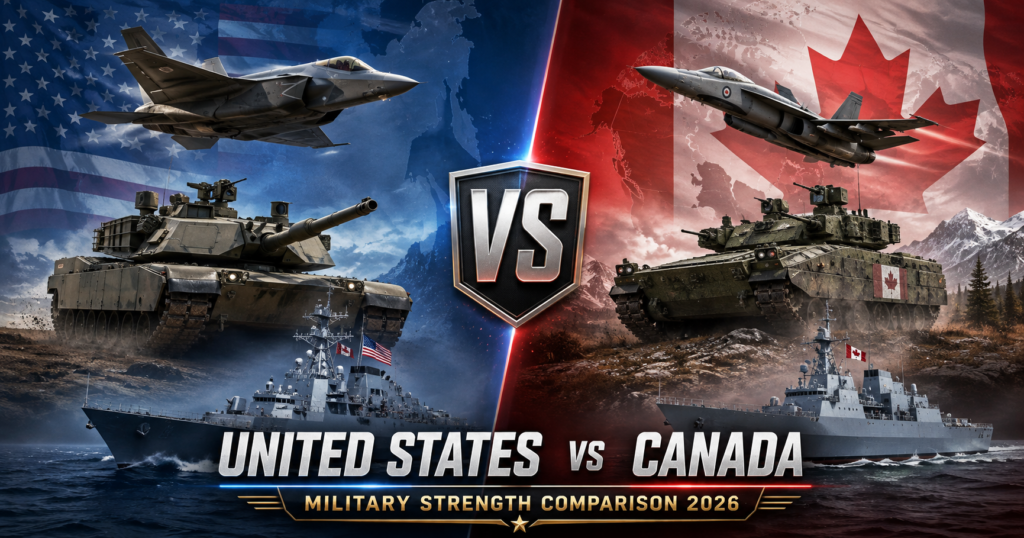
This detailed US vs Canada Military Comparison 2026 highlights the differences in their armed forces, including military strength, defense budget, equipment, resources, and manpower. From air power and naval assets to ground troops and defense spending, this side-by-side analysis provides a clear and updated picture of how the two allies compare in the modern era.
US vs Canada Military Power Index 2026: Global Ranking and Defense Focus
In 2026, the United States continues to dominate as the world’s strongest military power, holding the top global position with unmatched capabilities across land, sea, air, and cyber warfare. With a Power Index (PwrIndx) of 0.0744, the U.S. secures Rank 1 out of 145 countries, reflecting its vast defense resources, nuclear deterrence capability, and global reach.
On the other hand, Canada stands at Rank 28 globally, with a Power Index of 0.5179. While smaller in scale, Canada’s defense strength lies in its modern technology, skilled forces, and commitment to peacekeeping and Arctic defense. The nation plays a significant role in NATO missions and North American security, emphasizing cooperation, humanitarian support, and advanced maritime protection.
Overall Military Power Index Comparison (2026)
| Category | United States | Canada |
|---|---|---|
| Power Index (PwrIndx) | 0.0744 (Rank 1/145) | 0.5179 (Rank 28/145) |
| Defense Focus | Global dominance, rapid deployment, nuclear deterrence | Peacekeeping, homeland defense, Arctic security |
The U.S. Armed Forces remain the global benchmark for power projection and defense readiness. With advanced fighter jets, a strong naval fleet, and one of the largest defense budgets in the world, the U.S. continues to lead in global dominance and deterrence strategies.
In comparison, Canada’s military focuses on quality over quantity—prioritizing peacekeeping, regional defense, and Arctic operations. Despite its smaller size, Canada is recognized for its professionalism, modern equipment, and strong alliance commitments through NATO and NORAD.
Both nations together ensure North America’s security, balancing global strength with strategic cooperation.
US vs Canada Military Manpower Comparison 2026
Manpower is the true backbone of any nation’s defense capability. In 2026, the United States continues to maintain one of the largest active military forces in the world, while Canada focuses on maintaining a smaller but highly skilled and efficient defense workforce.
The U.S. Armed Forces are structured for global operations and rapid deployment, supported by a vast reserve component. In contrast, Canada’s lean and professional force emphasizes peacekeeping, homeland defense, and Arctic operations, backed by top-tier training and strong coordination with NATO and NORAD partners.
Overall Military Manpower Comparison (2026)
| Type | United States | Canada |
|---|---|---|
| Total Population | 341.9 million | 38.7 million |
| Available Manpower | 150.4 million | 16.6 million |
| Fit for Service | 124.8 million | 13.5 million |
| Reaching Military Age Annually | 4.44 million | 0.42 million |
| Active Personnel | 1.33 million | 68,000 |
| Reserve Personnel | 799,500 | 27,000 |
| Paramilitary Forces | None | 5,500 |
US vs Canada Military Financial Strength 2026
In 2026, military funding reflects the strategic priorities of the United States and Canada. The U.S. defense budget remains unmatched globally, enabling cutting-edge technology, global deployments, and nuclear deterrence. Meanwhile, Canada continues its steady modernization efforts, prioritizing advanced equipment, Arctic defense, and alliance contributions, all within a smaller but carefully managed budget.
Military Financial Comparison (2026)
| Type | United States | Canada |
|---|---|---|
| Defense Budget | $895 billion | $41 billion |
| External Debt | $22.3 trillion | $2.3 trillion |
| Foreign Reserves | $773 billion | $117 billion |
| Purchasing Power | $24.6 trillion | $2.2 trillion |
Observation: US vs Canada Defense Spending 2026
The United States spends more on defense than the next ten countries combined, giving it unparalleled military reach, advanced technology acquisition, and strategic readiness. This immense budget supports a global presence across land, air, sea, and cyber domains, maintaining the U.S.’s status as a superpower.
Canada, on the other hand, allocates its $41 billion defense budget toward modernization programs, including:
- Arctic surveillance for national security and environmental monitoring
- F-35 fighter jet acquisition to strengthen air defense
- Naval fleet renewal for coastal and alliance operations
Despite a smaller financial footprint, Canada maximizes efficiency, ensuring its forces remain highly capable, modern, and interoperable with allied nations.
US vs Canada Air Power Comparison 2026
In 2026, air superiority remains a decisive factor in modern warfare. The United States Air Force (USAF), along with the Navy’s aviation wing, commands a global edge with unmatched numbers, advanced fighter jets, and strategic capabilities. Canada, while operating a smaller fleet, maintains high-performance aircraft tailored for continental defense, Arctic operations, and NATO missions, ensuring efficiency and interoperability with allied forces.
Air Power Comparison (2026)
| Type | United States | Canada |
|---|---|---|
| Total Aircraft | 13,043 | 351 |
| Fighter Jets | 1,790 | 66 |
| Transport Aircraft | 918 | 28 |
| Trainer Aircraft | 2,647 | 95 |
| Special Mission Aircraft | 647 | 33 |
| Aerial Tankers | 605 | 6 |
| Helicopters | 5,843 | 145 |
Highlight: United States vs Canada Air Force Strength
The United States Air Force and Navy aviation combined operate more aircraft than any other nation in the world, enabling rapid deployment, global reach, and dominance in both conventional and modern warfare. This includes strategic bombers, stealth fighters, transport planes, and aerial refueling tankers.
Canada, while smaller in scale, is modernizing its air fleet with key initiatives such as:
- F-35 Lightning II acquisition for next-generation air superiority
- Upgrades to existing fighter and transport aircraft for enhanced performance
- Expansion of Arctic patrol capabilities to secure northern territories
- Seamless integration into NATO air operations
Despite its size, Canada’s air force remains highly efficient, focusing on quality, interoperability, and mission-specific readiness, complementing North America’s overall defense architecture.
US vs Canada Land Forces Comparison 2026
In 2026, land forces remain a cornerstone of national defense. The United States Army continues to maintain full-scale armored and mechanized capabilities, designed for global deployment, rapid response, and large-scale warfare. In contrast, Canada’s land forces are smaller and more agile, emphasizing mobility, defense, and strategic cooperation rather than extensive battlefield engagements.
Land Forces Comparison (2026)
| Type | United States | Canada |
|---|---|---|
| Main Battle Tanks | 4,640 | 74 |
| Armored Vehicles | 391,963 | 21,704 |
| Self-Propelled Artillery | 671 | 0 |
| Towed Artillery | 1,212 | 0 |
| Rocket Projectors | 641 | 0 |
Insight: US vs Canada Ground Combat Strength
The United States Army possesses one of the most formidable ground forces in the world, equipped with thousands of main battle tanks, armored vehicles, artillery systems, and rocket projectors. This massive mechanized force allows the U.S. to conduct large-scale combat operations anywhere globally, from conventional warfare to high-intensity conflicts.
Canada’s Army, while significantly smaller, focuses on highly trained troops, mobility, and modern equipment for homeland defense, peacekeeping missions, and allied operations. Its land forces are designed to support NATO operations, protect Arctic territories, and integrate seamlessly with other North American defense components.
Despite the disparity in size, both nations contribute to regional and global security, balancing raw strength with efficiency and strategic deployment.
US vs Canada Naval Power Comparison 2026
In 2026, naval strength is a key indicator of global and regional influence. The United States Navy remains the undisputed leader in blue-water capabilities, with unmatched global reach, aircraft carriers, and strategic submarines. Canada’s Royal Navy, though smaller, plays a crucial role in Arctic security, North Atlantic patrols, and NATO maritime missions, ensuring sovereignty and regional stability.
Naval Forces Comparison (2026)
| Type | United States | Canada |
|---|---|---|
| Total Fleet | 440 | 73 |
| Aircraft Carriers | 11 | 0 |
| Submarines | 70 | 4 |
| Destroyers | 81 | 0 |
| Frigates | 0 | 12 |
| Patrol Vessels | 0 | 24 |
Summary: US vs Canada Naval Strength
The U.S. Navy provides unmatched global power projection, capable of operating anywhere in the world with aircraft carriers, destroyers, submarines, and advanced support vessels. Its size, technology, and strategic flexibility make it the most dominant naval force globally.
Canada’s Navy, although smaller, focuses on mission-critical tasks such as:
- Arctic sovereignty and patrol to secure northern waters
- Search and rescue operations along extensive coastlines
- Participation in NATO maritime exercises for allied security
- Coastal and regional defense missions to protect national interests
Together, the U.S. and Canadian navies form a complementary force in North American and global maritime security, balancing global dominance with regional defense expertise.
US vs Canada Military Logistics and Infrastructure 2026
In 2026, logistics and infrastructure are critical for maintaining military readiness and operational efficiency. The United States boasts one of the most extensive military and civilian infrastructure networks in the world, enabling rapid deployment, global operations, and strategic mobility. Canada, while smaller in scale, has developed an efficient and reliable logistics system that supports both domestic defense and international peacekeeping missions.
Military Logistics and Infrastructure Comparison (2026)
| Type | United States | Canada |
|---|---|---|
| Airports | 15,873 | 1,425 |
| Ports & Terminals | 666 | 284 |
| Roadways | 6.58 million km | 1.04 million km |
| Labor Force | 170.5 million | 22.1 million |
Insight: US vs Canada Logistics Strength
The United States’ logistics infrastructure allows for unprecedented global military mobility, with thousands of airports, hundreds of ports, and an extensive roadway network that supports rapid troop deployment and supply chain efficiency. Its large labor force ensures continuous operation and maintenance of these assets worldwide.
Canada’s logistics network, though smaller, emphasizes strategic efficiency, reliability, and adaptability. It is designed to:
- Support domestic operations across vast and challenging terrains
- Enable peacekeeping missions and international deployments
- Maintain supply chain readiness for Arctic and coastal defense operations
- Integrate seamlessly with allied operations, including NATO exercises
Together, the U.S. and Canadian logistics capabilities form a complementary system that ensures North American security and rapid response readiness.
US vs Canada Natural Resources Comparison 2026
In 2026, natural resources play a crucial role in military sustainability and national security. Energy independence ensures that a nation can maintain defense operations without heavy reliance on foreign imports. The United States leads in energy production and consumption, while Canada possesses some of the world’s largest proven oil reserves, particularly in Alberta’s oil sands, making it a key energy contributor to North America.
Natural Resources Comparison (2026)
| Type | United States | Canada |
|---|---|---|
| Oil Production (barrels/day) | 20.8 million | 5.6 million |
| Proven Oil Reserves | 38.2 billion | 170.3 billion |
| Natural Gas Reserves | 13.4 trillion m³ | 2.06 trillion m³ |
| Coal Reserves | 248.9 billion tons | 6.5 billion tons |
Observation: US vs Canada Energy and Resource Strength
The United States maintains a significant advantage in energy production, providing a stable supply for military operations, industrial needs, and global deployments. This high level of production enhances energy security and strengthens its strategic autonomy.
Canada, while producing less energy annually, holds substantial oil reserves, especially in the oil sands of Alberta, and also has notable natural gas reserves. These resources make Canada a critical energy partner in North America, contributing to both domestic energy security and allied operations, while supporting sustainable defense logistics.
By combining U.S. production capacity with Canada’s resource reserves, North America enjoys a strategically advantageous energy position, essential for long-term defense readiness and operational sustainability.
US vs Canada Geography and Strategic Position 2026
In 2026, geography and strategic location are critical factors influencing military capabilities and defense planning. The United States and Canada share the world’s longest undefended border, providing a unique advantage for continental security and allied coordination. Both nations’ geography shapes their military priorities, access to global theaters, and strategic deployment capabilities.
Geography and Strategic Comparison (2026)
| Type | United States | Canada |
|---|---|---|
| Land Area | 9.83 million sq km | 9.98 million sq km |
| Coastline | 19,924 km | 202,080 km |
| Shared Border | 12,002 km | 8,893 km |
Highlight: Strategic Strengths of US and Canada
The United States benefits from multiple oceanic access points, including the Atlantic, Pacific, and Gulf of Mexico, allowing for global power projection, naval mobility, and rapid deployment of forces. Its varied geography also supports advanced training facilities, logistics networks, and strategic bases across the country.
Canada, while slightly larger in land area, boasts an extensive coastline of over 202,000 km, making it strategically vital for Arctic defense, maritime security, and coastal operations. Canada’s Arctic territories are increasingly important for national security, surveillance, and resource protection, while the shared border with the U.S. ensures regional stability and close military collaboration.
Together, the U.S. and Canada leverage geography to maintain continental defense, secure trade routes, and support NATO and NORAD operations, reinforcing North America’s strategic advantage on the global stage.
FAQs: United States vs Canada Military Strengths 2026
Q1: Which country has a stronger military, the US or Canada in 2026?
The United States has a far stronger military, ranking 1st globally, while Canada ranks 28th with a smaller but well-trained defense force.
Q2: How many active military personnel does the US have compared to Canada?
The US has approximately 1.33 million active personnel, whereas Canada has around 68,000.
Q3: What is the defense budget of the US and Canada in 2026?
The US defense budget is about $895 billion, and Canada’s budget is around $41 billion.
Q4: How does airpower of the US compare to Canada?
The US operates over 13,000 aircraft including 1,790 fighters, while Canada has 351 aircraft with 66 fighters.
Q5: What about naval strength of both countries?
The US Navy has 440 ships including 11 aircraft carriers; Canada’s navy has 73 ships focused on Arctic and coastal operations.
Q6: Who has more tanks and armored vehicles?
The US leads with 4,640 tanks and 391,963 armored vehicles; Canada has 74 tanks and 21,704 armored vehicles.
Q7: Which country has more natural resources for defense sustainability?
Canada has larger proven oil reserves, while the US produces more oil and natural gas annually, supporting its energy independence.
Q8: Do the US and Canada cooperate militarily?
Yes, both countries work closely under NORAD and NATO, sharing intelligence and conducting joint defense operations.
Q9: How does geography affect their military strategies?
The US uses its multiple oceanic access points for global operations, while Canada focuses on Arctic security and coastal defense.
Q10: What is the overall takeaway from the US vs Canada military comparison?
The US dominates globally in all military domains, while Canada specializes in regional defense, peacekeeping, and allied support, making them complementary partners.