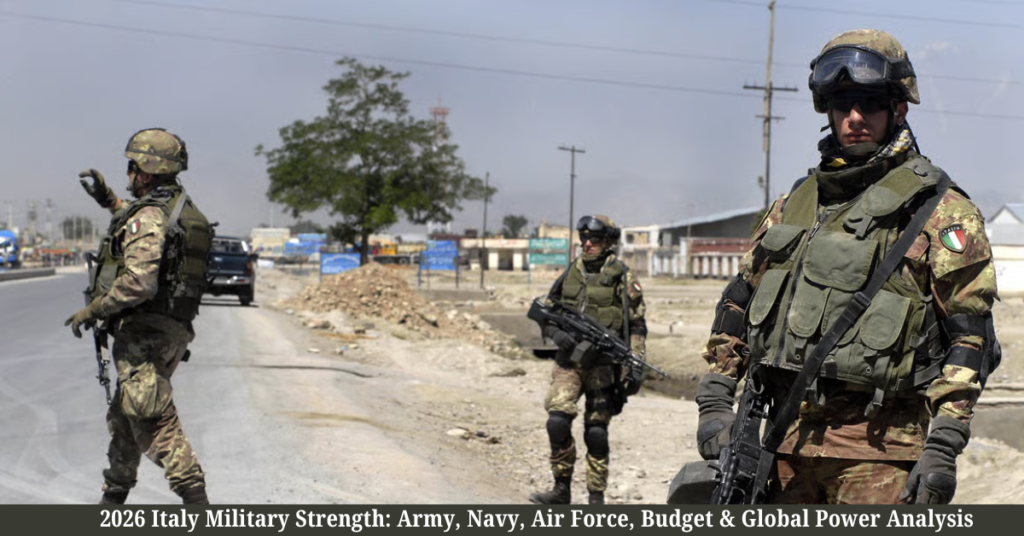
The Italy Military Strength 2026 continues to rank among the most powerful and strategically important defense forces in Europe. With its strong position in the Mediterranean region, advanced naval fleet, modern air force, and deep NATO integration, Italy remains a key player in both European and global security operations.
Although global military attention often focuses on countries like the United States, China, and Russia, the Italian Armed Forces quietly maintain one of the most balanced and technologically advanced military structures in Europe. Italy combines powerful naval capabilities, modern fighter aircraft, aircraft carriers, armored ground forces, and expeditionary military operations into a highly flexible defense system.
The country’s military strategy is mainly focused on:
- Mediterranean security
- NATO military operations
- Rapid overseas deployment
- Maritime defense
- Air superiority
- Peacekeeping missions
- European defense cooperation
Italy’s strategic location in Southern Europe gives it major importance in securing Mediterranean trade routes, supporting NATO missions, and responding to regional security challenges across Europe, North Africa, and the Middle East.
In recent years, the Italian military has accelerated modernization programs due to rising geopolitical tensions, migration-related security concerns, instability in North Africa, and increasing pressure within NATO to strengthen European defense readiness.
The country continues investing in advanced naval warships, fifth-generation fighter jets, missile defense systems, cyber warfare capabilities, and next-generation military technologies designed for future combat operations.
With its strong NATO partnerships, modern defense infrastructure, and growing military modernization efforts, the Italy Military Strength 2026 remains one of Europe’s most capable and influential armed forces.
Italy Military Ranking 2026
According to the 2026 Global Firepower Index, the Italy Military Ranking 2026 places the country among the world’s top military powers. Italy continues to maintain one of Europe’s most balanced and technologically advanced armed forces through strong NATO cooperation, naval strength, modern fighter aircraft, and highly professional military personnel.
Unlike some larger military powers that rely heavily on massive troop numbers, the Italian military focuses more on modernization, expeditionary capability, naval operations, and advanced defense technology.
Italy Military Ranking Overview
| Category | Details |
|---|---|
| Global Military Rank | 10th |
| Power Index Score | 0.2211 |
| Total Military Personnel | 288,800 |
| Active Personnel | 165,500 |
| Defense Budget | $37.3 Billion |
| Total Aircraft | 714 |
| Naval Assets | 285 |
| Aircraft Carriers | 2 |
| Submarines | 8 |
The Italy Military Strength 2026 is built around professionalism, strategic flexibility, advanced naval reach, and deep integration within NATO military operations. Italy’s armed forces are highly experienced in multinational missions, peacekeeping operations, maritime security, and rapid overseas deployment.
Why Italy Is Militarily Important in Europe
Italy’s geographical location gives the country enormous strategic importance within Europe and the Mediterranean region. Positioned in Southern Europe and surrounded by the Mediterranean Sea, Italy serves as a critical bridge connecting multiple strategic regions.
Italy links:
- Europe
- North Africa
- The Middle East
- The Balkans
Because of this strategic position, the Italian Armed Forces play a major role in several important international security operations and defense missions.
Italy is heavily involved in:
- NATO naval operations
- Mediterranean maritime security
- Anti-piracy missions
- Refugee and migration control
- Energy route protection
- European rapid response operations
The country is also one of the founding members of NATO and regularly contributes to international military missions, peacekeeping operations, and coalition defense activities across Europe, Africa, and the Middle East.
Italy’s powerful naval presence in the Mediterranean, combined with advanced air capabilities and rapid deployment forces, makes the Italy Military Strength 2026 one of the most strategically valuable defense systems in Europe.
Italian Army Strength 2026
The Italian Army Strength 2026 continues to be one of the most professional and technologically advanced land forces in Europe. Rather than maintaining a massive army focused only on large-scale territorial warfare, Italy has developed a modern military structure centered around mobility, rapid deployment, multinational operations, and NATO combat support missions.
The Italian Army is specially designed to respond quickly to international crises, peacekeeping operations, urban combat situations, and expeditionary warfare environments. Its military doctrine focuses heavily on flexibility, coordination with allied forces, and advanced battlefield technology.
The army mainly emphasizes:
- Flexible combat group operations
- Mechanized infantry warfare
- Expeditionary military capability
- Urban combat readiness
- NATO interoperability
Italy Army Equipment and Personnel
| Army Category | Numbers |
|---|---|
| Army Personnel | 97,755 |
| Main Battle Tanks | 203 |
| Armored Vehicles | 87,364 |
| Self-Propelled Artillery | 64 |
| Rocket Artillery Systems | 21 |
The Italian Army operates several advanced armored and battlefield systems designed for high mobility and modern combat operations.
Major Military Systems of the Italian Army
Italy currently operates:
- Ariete Main Battle Tank
- Centauro tank destroyers
- Freccia infantry fighting vehicles
- PzH 2000 self-propelled artillery systems
The Ariete Main Battle Tank serves as the backbone of Italy’s armored warfare capability, while the Centauro and Freccia vehicles provide fast-moving mechanized support for rapid deployment missions.
Italy has also invested heavily in military modernization programs focused on digital battlefield management, advanced communications systems, electronic warfare capability, and network-centric combat operations. These upgrades are designed to improve coordination between ground forces, air support units, and NATO allies during joint military operations.
With its highly trained personnel, mechanized combat systems, and advanced modernization programs, the Italian Army Strength 2026 remains one of Europe’s most capable expeditionary land forces.
Strengths of the Italian Army
One of the biggest strengths of the Italian Army is its extensive operational and international mission experience. Over the years, Italian troops have participated in multiple peacekeeping operations, combat missions, stabilization efforts, and NATO-led deployments across different regions of the world.
These missions have helped the Italian Armed Forces develop highly trained personnel, strong multinational coordination capability, and real-world battlefield experience in modern military operations.
Italian troops have served in operations across:
- Afghanistan
- Iraq
- Kosovo
- Lebanon
- Libya
- Africa
This international operational experience has played a major role in transforming the Italian Army Strength 2026 into a highly professional and expeditionary-focused military force.
One of Italy’s key military advantages is its ability to work effectively within multinational NATO operations and coalition missions. Italian forces regularly cooperate with allied militaries in areas such as peacekeeping, counterterrorism, humanitarian assistance, maritime security, and rapid-response operations.
The experience gained from overseas deployments has also improved Italy’s expertise in:
- Urban warfare operations
- Peacekeeping missions
- Crisis response
- Counterinsurgency operations
- Joint NATO combat coordination
Combined with modern equipment, advanced training standards, and strong NATO integration, the Italian Army remains one of the most experienced and reliable military forces in Europe.
Italian Air Force 2026
The Italian Air Force 2026 remains one of the most advanced and technologically capable air forces in Europe. As a key NATO member, Italy plays an important role in regional air defense, multinational military operations, surveillance missions, and NATO air policing activities across Europe and the Mediterranean region.
Over the years, the Italian Air Force has focused heavily on modernization and interoperability with allied forces, allowing it to operate effectively in both national defense and international military missions.
Italy’s air force strategy mainly emphasizes:
- Multirole fighter aircraft capability
- Strategic air mobility
- Electronic warfare systems
- Precision strike operations
- NATO integrated air defense
Italy Air Force Inventory
| Air Power Category | Total |
|---|---|
| Total Aircraft | 714 |
| Fighter Aircraft | 88 |
| Attack Aircraft | 65 |
| Transport Aircraft | 31 |
| Helicopters | 352 |
| Attack Helicopters | 37 |
| Tanker Aircraft | 8 |
The Italian Air Force operates a combination of advanced European and American military aircraft, giving it strong flexibility in combat, surveillance, transport, and NATO joint operations.
Major Italian Fighter Jets
Italy’s combat aircraft fleet includes several highly advanced platforms, such as:
- F-35 Lightning II
- Eurofighter Typhoon
- AMX International attack aircraft
- Leonardo M-346 trainers
The Eurofighter Typhoon remains one of Italy’s primary air superiority fighters, while the F-35 Lightning II significantly strengthens the country’s stealth combat and precision strike capability.
Italy is also among the leading European countries investing heavily in fifth-generation stealth aircraft technology, helping modernize its future air combat capability.
Italy and the F-35 Program
Italy plays a particularly important role in the international F-35 fighter jet program. The country not only operates F-35 aircraft but also participates directly in manufacturing, maintenance, and assembly operations connected to the program.
This involvement provides Italy with several major strategic advantages, including:
- Advanced stealth warfare capability
- Improved NATO interoperability
- Long-term growth of the domestic aerospace industry
Participation in the F-35 program also strengthens Italy’s defense manufacturing sector and helps the country maintain an important position within the future European and NATO air power structure.
With its modern fighter fleet, advanced electronic warfare capability, NATO integration, and investment in next-generation aviation technology, the Italian Air Force Strength 2026 remains one of the strongest air forces in Europe.
Italy Navy Strength 2026
The Italy Navy Strength 2026 remains one of the most powerful and technologically advanced naval forces in Europe. Due to its long coastline, strategic Mediterranean location, and heavy dependence on maritime trade routes, Italy places major importance on naval power and maritime security operations.
The Italian Navy plays a critical role in protecting national interests, securing Mediterranean sea lanes, supporting NATO operations, and conducting overseas military deployments. Over the years, Italy has developed a highly capable naval fleet built around aircraft carriers, advanced frigates, submarines, and modern amphibious warfare capability.
Unlike countries that focus primarily on land warfare, Italy has invested heavily in maritime defense and naval modernization to maintain influence across the Mediterranean region.
Italy Naval Fleet Overview
| Naval Category | Total |
|---|---|
| Total Naval Assets | 285 |
| Aircraft Carriers | 2 |
| Destroyers | 3 |
| Frigates | 14 |
| Submarines | 8 |
| Patrol Vessels | 15 |
| Mine Warfare Ships | 10 |
The Italian Navy is specially designed for a wide range of maritime operations, including:
- Sea control operations
- Power projection missions
- NATO maritime operations
- Amphibious warfare capability
- Mediterranean regional dominance
One of the biggest strengths of the Italian naval force is its ability to operate modern aircraft carriers and expeditionary naval groups capable of supporting international missions far from Italian territory.
The navy also plays a key role in maritime security, anti-piracy patrols, refugee and migration monitoring operations, submarine warfare, and protection of strategic energy routes across the Mediterranean Sea.
Italy’s advanced frigates and submarines provide strong anti-submarine warfare capability, while its carrier operations significantly improve naval aviation strength and rapid deployment flexibility.
With strong NATO integration, modern naval platforms, and strategic Mediterranean influence, the Italy Navy Strength 2026 continues to rank among Europe’s leading maritime forces.
Italy Aircraft Carriers
Italy is one of the few countries in the world that currently operates modern aircraft carriers, giving the country an important strategic advantage in naval warfare and overseas military operations.
The Italian Navy operates two major aircraft carriers:
- Cavour aircraft carrier
- Giuseppe Garibaldi aircraft carrier
These warships significantly strengthen the Italy Navy Strength 2026 by allowing the country to conduct advanced naval aviation operations, rapid military deployments, and multinational NATO missions across the Mediterranean and beyond.
Both carriers are capable of operating advanced aircraft, including the F-35B Lightning II stealth fighter, which provides Italy with modern stealth strike capability, improved air defense, and expeditionary combat flexibility.
The addition of F-35B fighter jets to carrier operations has greatly improved Italy’s ability to project military power far beyond its national borders. This capability allows the Italian Navy to support maritime security missions, NATO operations, amphibious warfare, and crisis response deployments in multiple regions.
Aircraft carriers also enhance Italy’s strategic influence in the Mediterranean Sea, where naval dominance and rapid-response capability remain increasingly important due to rising regional security challenges.
Italian Submarine Capabilities
Although Italy’s submarine fleet is smaller compared to some major global naval powers, it remains highly modern, technologically advanced, and operationally effective within NATO maritime operations.
The Italian submarine force mainly focuses on:
- Mediterranean surveillance missions
- Anti-submarine warfare
- Intelligence gathering
- NATO support operations
Italian submarines are designed for stealth operations, maritime monitoring, reconnaissance, and underwater defense missions throughout the Mediterranean region.
These submarines play an important role in tracking naval activity, protecting strategic sea routes, supporting allied naval forces, and strengthening Italy’s overall maritime defense capability.
Combined with advanced frigates, aircraft carriers, and NATO naval cooperation, the Italian Navy Strength 2026 remains one of the most capable maritime defense systems in Europe.
Italy Defense Budget 2026
The Italy Defense Budget 2026 continues to grow as the country strengthens military modernization programs and fulfills its expanding commitments within NATO and European defense cooperation initiatives. Rising geopolitical tensions, Mediterranean security concerns, and increasing pressure on European nations to improve defense readiness have pushed Italy to invest more heavily in military capability.
The Italian government is focusing on advanced naval systems, next-generation aircraft, cybersecurity infrastructure, and modern battlefield technology to maintain one of the strongest defense forces in Europe.
Italy Military Budget Overview
| Budget Category | Amount |
|---|---|
| Defense Budget | $37.3 Billion |
| Purchasing Power | $3.13 Trillion |
| Foreign Exchange Reserves | $290 Billion |
A large portion of the Italian military budget is currently directed toward modernization and long-term defense development projects.
Italy’s military spending mainly supports:
- Naval modernization programs
- F-35 stealth fighter procurement
- Cybersecurity and cyber warfare systems
- NATO military operations
- European defense cooperation programs
- Drone and electronic warfare development
One of Italy’s major priorities is strengthening its naval capability in the Mediterranean region through new warships, submarines, maritime surveillance systems, and aircraft carrier operations.
The country is also heavily investing in the F-35 fighter program, helping modernize the Italian Air Force while improving interoperability with NATO allies and expanding Italy’s domestic aerospace industry.
In addition, Italy continues upgrading digital battlefield systems, intelligence infrastructure, electronic warfare capability, and cybersecurity defenses to prepare for future warfare environments.
Although Italy’s defense budget remains lower than military superpowers such as the United States, China, or the United Kingdom, the Italy Military Strength 2026 still ranks among Europe’s most capable and technologically advanced defense systems because of its efficient modernization strategy, NATO integration, and balanced military structure.
Italy’s Role in NATO
Italy remains deeply integrated into NATO military operations and continues to play a major strategic role within the alliance in 2026. Because of its geographical location in Southern Europe and direct access to the Mediterranean region, Italy is considered one of NATO’s most important members for regional security and rapid-response operations.
The country regularly contributes military personnel, aircraft, naval forces, intelligence support, and logistical infrastructure to alliance missions across Europe, the Mediterranean, and nearby regions.
Italy’s role inside NATO includes:
- Air policing operations
- Naval patrol missions
- Peacekeeping deployments
- Mediterranean maritime security
- Intelligence and surveillance cooperation
The Italian Armed Forces frequently participate in multinational NATO exercises, rapid-response deployments, anti-piracy missions, and joint security operations. Italy also hosts several strategically important NATO facilities and military infrastructure that support alliance coordination and defense planning.
One of Italy’s biggest advantages within NATO is its strategic position between Europe, North Africa, and the Middle East. This location allows Italy to serve as a key operational hub for Mediterranean security operations, migration control missions, and regional crisis response activities.
Because of this geographic importance, the Italy Military Strength 2026 continues to play a major role in strengthening NATO’s southern defense posture.
Italian Defense Industry
One of the strongest areas of the Italian military sector is its advanced domestic defense industry. Italy has built a highly respected military manufacturing and defense technology sector that supports both national defense requirements and international defense exports.
The country performs especially well in areas such as:
- Aerospace technology
- Naval shipbuilding
- Military helicopters
- Radar and surveillance systems
- Missile technology
- Defense electronics
Italian defense manufacturers produce advanced military equipment used by both the Italian Armed Forces and international customers worldwide.
Major Italian Defense Companies
Some of the most important companies driving Italy’s defense industry include:
- Leonardo
- Fincantieri
- Iveco Defence Vehicles
These companies play a major role in developing military aircraft, naval warships, armored vehicles, radar systems, electronic warfare technology, and advanced defense infrastructure.
The growth of the Italian defense industry helps Italy maintain greater technological independence in key military sectors while also strengthening the country’s global defense export market.
Combined with strong NATO integration and advanced military manufacturing capability, the Italy Military Strength 2026 continues to remain one of Europe’s most balanced and strategically important defense systems.
Challenges Facing Italy Military
Despite being one of Europe’s most capable armed forces, the Italy Military Strength 2026 still faces several operational, demographic, and financial challenges that could affect long-term military readiness and modernization efforts.
Like many European countries, Italy must balance defense modernization with economic pressures, changing security environments, and evolving NATO responsibilities.
Key Weaknesses of Italy Military
- Limited military manpower
- Aging population
- Defense budget pressures
- Dependence on NATO support during large-scale conflicts
- Slow modernization of some ground combat systems
One of the biggest long-term concerns for the Italian military is demographic pressure. Italy’s aging population could impact future recruitment levels and reduce available military manpower over time.
Budget limitations also create challenges for maintaining large-scale modernization programs across all branches of the armed forces simultaneously. While Italy has invested heavily in naval and aerospace modernization, some ground warfare systems still require upgrades and replacement programs.
Another important challenge is Italy’s dependence on broader NATO support structures during major large-scale military conflicts. Although the country maintains strong independent military capability, NATO cooperation remains central to Italy’s overall defense strategy.
Italy also faces increasing security pressure across the Mediterranean region because of migration routes, maritime security concerns, instability in North Africa, and rising geopolitical competition in nearby waters.
Future of Italy Military
The future of the Italian military is expected to focus strongly on modernization, advanced technology integration, and expanded NATO cooperation.
Italy is gradually transforming its armed forces into a more flexible, technology-driven military capable of responding to modern warfare challenges across land, sea, air, cyber, and space domains.
Future Focus Areas of Italy Military
- NATO modernization programs
- Mediterranean naval dominance
- Drone warfare capability
- Cyber defense systems
- Space-based surveillance
- Stealth aircraft expansion
- European defense cooperation
The country is also expected to continue increasing investment in advanced naval platforms, next-generation aerospace systems, electronic warfare technology, artificial intelligence, and digital battlefield networks.
Italy’s expanding role in programs such as the F-35 stealth fighter project and European defense cooperation initiatives will likely strengthen both military capability and domestic defense manufacturing over the coming years.
With continued modernization and strong NATO integration, the Italy Military Strength 2026 is expected to remain one of Europe’s leading defense forces and a major security player in the Mediterranean region.
Is Italy Military Strong in 2026?
Yes, the Italy Military Strength 2026 remains one of the strongest and most respected military forces in Europe. Although Italy does not possess the massive military size or global reach of superpowers like the United States, China, or Russia, it continues to maintain a highly balanced, technologically advanced, and strategically important armed force.
The Italian Armed Forces combine strong naval capability, modern air power, professional military personnel, and deep NATO integration to maintain an influential role in European and Mediterranean security operations.
Today, Italy’s military strength is built around:
- Advanced naval forces
- Aircraft carrier capability
- Modern fighter aircraft
- Strong NATO integration
- Highly professional armed forces
- Advanced domestic defense industries
One of Italy’s biggest military advantages is its powerful naval presence in the Mediterranean region. The country operates modern aircraft carriers, advanced frigates, submarines, and maritime security systems that allow it to project military power far beyond its national borders.
The Italian Air Force also remains one of Europe’s most advanced air forces, operating modern aircraft such as the F-35 Lightning II and Eurofighter Typhoon, while participating heavily in NATO air defense and multinational military operations.
Italy’s defense industry further strengthens the country’s military capability by supporting domestic production in aerospace, naval shipbuilding, military electronics, and armored vehicles.
While Italy may not match the enormous military scale of global superpowers, its balanced force structure, strategic Mediterranean location, NATO influence, and advanced military technology make the Italy Military Strength 2026 one of the most capable and respected defense systems in Europe.
Italy Military Strength 2026 FAQs
What is Italy military ranking in 2026?
According to the 2026 Global Firepower Index, Italy Military Ranking 2026 stands at 10th position among the world’s strongest military powers.
How strong is Italy military in 2026?
The Italian military remains one of the strongest armed forces in Europe, with advanced naval capability, modern fighter aircraft, aircraft carriers, and strong integration within NATO operations.
How much is Italy defense budget in 2026?
The Italy defense budget in 2026 is estimated at approximately $37.3 billion.
Does Italy have aircraft carriers?
Yes, Italy operates two aircraft carriers:
- Cavour aircraft carrier
- Giuseppe Garibaldi aircraft carrier
Both carriers support advanced naval aviation operations, including F-35B stealth fighter deployment.
How many submarines does Italy have?
The Italian Navy currently operates 8 submarines, mainly focused on Mediterranean surveillance, NATO maritime operations, and anti-submarine warfare.
Is Italy part of NATO?
Yes, Italy is a founding and active member of NATO and regularly participates in alliance military operations and security missions.
Which fighter jets does Italy use?
The Italian Air Force operates advanced combat aircraft including:
- F-35 Lightning II
- Eurofighter Typhoon
These fighter jets form the backbone of Italy’s modern air combat capability.