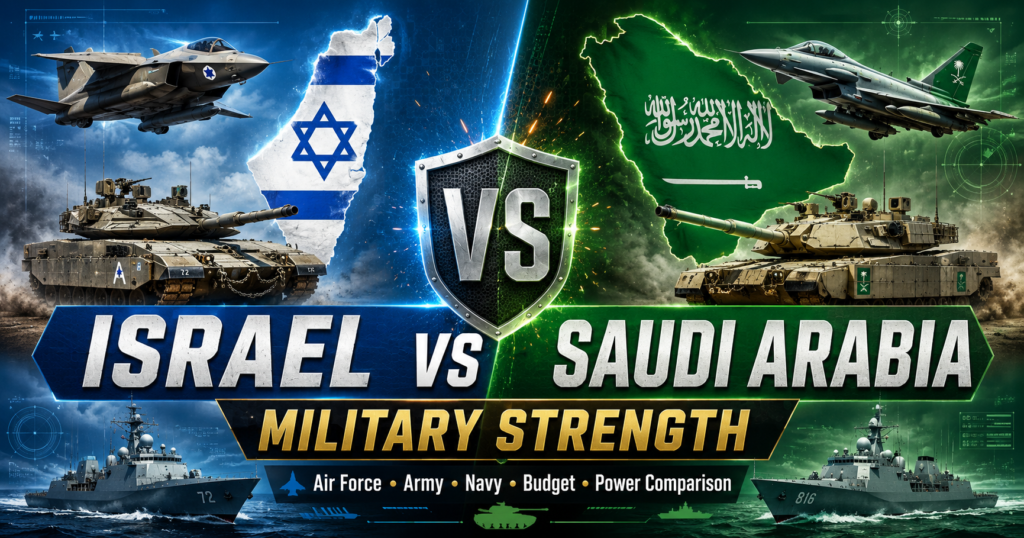
The Israel vs Saudi Arabia military strength 2026 comparison is unusual because the country with the larger population, defense budget and aircraft fleet does not hold the higher overall military ranking.
Saudi Arabia has about 36.5 million people, 247,000 active personnel, 917 military aircraft and a defense budget of nearly $64 billion. Israel has a population of about 9.4 million, 169,500 active troops, 597 aircraft and an estimated $34.6 billion defense budget.
Yet Israel ranks 15th out of 145 countries in the 2026 Global Firepower assessment, while Saudi Arabia ranks 25th.
The difference highlights what makes this comparison interesting. Saudi Arabia brings greater financial resources, more active personnel, more fighters, more aerial tankers and a much larger energy base. Israel offsets its smaller scale with 465,000 reservists, more tanks and armored vehicles, a larger naval inventory, submarines, advanced combat aircraft, missile-defense capabilities and a defense system built around rapid mobilization and high technological integration.
Israel vs Saudi Arabia Military Strength 2026 at a Glance
The headline figures show that neither country dominates every part of the Israel Saudi Arabia military comparison.
| Military Category | Israel | Saudi Arabia |
|---|---|---|
| Global Military Rank | 15th | 25th |
| Power Index | 0.2707 | 0.4473 |
| Population | 9.40 million | 36.54 million |
| Active Personnel | 169,500 | 247,000 |
| Reserve Personnel | 465,000 | 0 |
| Defense Budget | $34.6 billion | $63.99 billion |
| Total Aircraft | 597 | 917 |
| Fighter Aircraft | 239 | 283 |
| Aerial Tankers | 13 | 22 |
| Tanks | 1,300 | 1,085 |
| Armored Vehicles | 62,380 | 22,370 |
| Self-Propelled Artillery | 323 | 380 |
| Naval Assets | 82 | 32 |
| Submarines | 6 | 0 |
Saudi Arabia leads many of the size and financial indicators, but Israel’s higher ranking reflects a stronger overall balance across several conventional military categories.
Israel vs Saudi Arabia Military Ranking 2026
Israel’s 2026 military ranking of 15th comes with a Power Index score of 0.2707. Saudi Arabia is ranked 25th with a score of 0.4473.
A lower Power Index is considered stronger within this ranking system.
The ten-place gap is notable because Saudi Arabia leads Israel in population, active manpower, defense spending and total aircraft.
This shows why military rankings cannot be reduced to one statistic. Israel performs strongly in armored vehicles, tank numbers, reserve manpower, naval assets and submarines, while its broader military structure is designed around a much smaller territory and population.
Saudi Arabia’s military power follows a different model: high spending, modern imported aircraft, large support fleets, strong artillery categories and substantial energy resources.
Israel vs Saudi Arabia Manpower Comparison
Saudi Arabia has the larger population and active military.
Its population of approximately 36.54 million is almost four times Israel’s 9.4 million. Saudi Arabia also has roughly 247,000 active military personnel, compared with Israel’s 169,500.
The manpower picture changes once reserves are included.
| Manpower Category | Israel | Saudi Arabia |
|---|---|---|
| Population | 9,402,617 | 36,544,431 |
| Available Manpower | 3,949,099 | 19,003,104 |
| Fit for Service | 3,281,513 | 17,468,238 |
| Reaching Military Age Annually | 131,637 | 621,255 |
| Active Personnel | 169,500 | 247,000 |
| Reserve Personnel | 465,000 | 0 |
| Paramilitary Personnel | 35,000 | 150,000 |
Saudi Arabia has the clear advantage in population, available manpower, annual recruitment potential and active personnel.
Israel’s most important manpower advantage is its 465,000-person reserve force in the supplied dataset.
That reserve structure means Israel’s standing active-force number does not fully represent the manpower available to the Israel Defense Forces during mobilization.
Israel’s Reserve System Changes the Manpower Picture
For anyone comparing Israel vs Saudi Arabia army size, active personnel alone can create the wrong impression.
Saudi Arabia leads 247,000 to 169,500 in active personnel, but Israel maintains a very large trained reserve component relative to its population.
The reserve system is particularly important to Israel because the country has a limited population base and cannot maintain every required military formation on permanent active duty.
This creates a distinctive Israeli force model: a comparatively compact standing military backed by a reserve pool several times larger than the active component.
Saudi Arabia’s supplied 2026 figures, by contrast, emphasize a larger standing and paramilitary force.
Active Manpower Advantage: Saudi Arabia
Saudi Arabia has more active military personnel and a much larger recruitment pool.
Reserve Manpower Advantage: Israel
Israel’s 465,000 reservists give it a major advantage in the reserve category.
Israel vs Saudi Arabia Defense Budget 2026
The Saudi Arabia defense budget 2026 is one of the kingdom’s strongest military indicators.
Saudi Arabia is listed with almost $63.99 billion in defense spending, compared with Israel’s $34.6 billion.
| Financial Category | Israel | Saudi Arabia |
|---|---|---|
| Defense Budget | $34.6 billion | $63.99 billion |
| Foreign Exchange Reserves | $214.54 billion | $463.87 billion |
| Purchasing Power | $472.18 billion | $2.213 trillion |
Saudi Arabia leads all three financial measures in the supplied comparison.
Its defense budget exceeds Israel’s by about $29.4 billion, while its purchasing-power figure is several times larger.
The Saudi spending advantage helps support a force built around expensive combat aircraft, aerial-refueling capability, artillery, air-defense equipment and other advanced systems.
Israel spends less in absolute terms but concentrates substantial resources on a smaller population and military structure, including air power, missile defense, armored forces, intelligence-oriented capabilities and domestic defense technology.
Defense Budget Advantage: Saudi Arabia
For the direct search query Israel vs Saudi Arabia defense budget, Saudi Arabia holds the clear advantage in the supplied 2026 figures.
Israel vs Saudi Arabia Air Force Strength
Air power is where Saudi Arabia looks particularly strong on paper.
The Royal Saudi Air Force and related aviation inventory total 917 aircraft, compared with Israel’s 597.
Saudi Arabia also leads in fighter aircraft, dedicated attack aircraft, transports, trainers, tankers and total helicopters.
| Air Power Category | Israel | Saudi Arabia |
|---|---|---|
| Total Aircraft | 597 | 917 |
| Fighter Aircraft | 239 | 283 |
| Dedicated Attack Aircraft | 45 | 81 |
| Transport Aircraft | 14 | 49 |
| Trainer Aircraft | 148 | 202 |
| Special-Mission Aircraft | 19 | 16 |
| Aerial Tankers | 13 | 22 |
| Helicopters | 127 | 264 |
| Attack Helicopters | 48 | 34 |
Israel leads only two categories in this table: special-mission aircraft and attack helicopters.
That makes the Israel vs Saudi Arabia air force comparison much closer than Israel’s higher overall military ranking might suggest.
Israel vs Saudi Arabia Fighter Jets
Saudi Arabia leads the fighter-aircraft count with 283 fighters, compared with Israel’s 239.
Saudi Arabia’s combat fleet includes modern platforms from the F-15 and Eurofighter Typhoon families, giving the kingdom a substantial high-performance fighter force.
Israel operates a smaller fighter inventory but fields advanced aircraft across multiple generations, including the F-35I Adir, F-15 and F-16 families.
The F-35I is particularly important when evaluating Israeli air power because aircraft quality, sensors, stealth characteristics, electronic systems and weapons integration cannot be measured simply by counting airframes.
So while Saudi Arabia wins the fighter jet quantity comparison, raw numbers do not settle which air force has the stronger overall combat capability.
Why Israel’s Smaller Air Force Still Ranks Highly
Israel’s military model places exceptional emphasis on air power because of the country’s limited geographic depth.
A large country can sometimes trade distance for reaction time. Israel has much less room to do so.
That has encouraged long-term investment in:
- Rapid-response combat aviation
- Intelligence and surveillance
- Precision-strike capability
- Electronic warfare
- Air and missile defense
- Networked battlefield systems
The result is an air force whose strategic value is not fully described by its 597-aircraft total.
Saudi Arabia’s aviation strength, meanwhile, comes from larger fleet numbers, substantial defense spending, modern Western fighters and unusually strong aerial-refueling capacity.
Saudi Arabia’s 22 Aerial Tankers Are a Major Advantage
Saudi Arabia has 22 aerial tankers, compared with Israel’s 13.
That makes tanker aircraft one of Saudi Arabia’s clearest aviation advantages.
Aerial refueling allows fighters to remain airborne longer and operate farther from their home bases. For Saudi Arabia, which covers a very large territory between the Red Sea and Persian Gulf, that capability is particularly useful.
Saudi tanker strength also complements the kingdom’s sizeable fighter fleet.
Israel still maintains meaningful refueling capability, but the 2026 inventory gives Saudi Arabia a clear numerical lead.
Israel Leads in Attack Helicopters
The helicopter comparison produces a different result.
Saudi Arabia has more helicopters overall, with 264 compared with Israel’s 127.
Israel, however, has 48 attack helicopters compared with Saudi Arabia’s 34.
Attack helicopters support armored formations, reconnaissance and close battlefield firepower. Israel’s advantage in this category fits its broader emphasis on highly integrated ground and air operations.
Israel vs Saudi Arabia Army Strength
The Israel vs Saudi Arabia land power comparison is much more balanced than the air-power numbers.
Israel leads in tanks and armored vehicles. Saudi Arabia leads in self-propelled artillery, towed artillery and mobile rocket projectors.
| Land Power Category | Israel | Saudi Arabia |
|---|---|---|
| Tanks | 1,300 | 1,085 |
| Armored Vehicles | 62,380 | 22,370 |
| Self-Propelled Artillery | 323 | 380 |
| Towed Artillery | 171 | 557 |
| Mobile Rocket Projectors | 228 | 327 |
Israel’s strongest land advantage is armored mobility.
The Israeli inventory contains almost 40,000 more armored vehicles than the Saudi figure in the supplied dataset.
Saudi Arabia’s artillery numbers, however, are stronger across all three listed categories.
Israel vs Saudi Arabia Tank Strength
Israel operates approximately 1,300 tanks, giving it a modest numerical lead over Saudi Arabia’s 1,085.
The gap is only 215 tanks, making this much closer than many other country comparisons.
Israel’s tank force is closely associated with the Merkava main battle tank, a platform developed specifically around Israeli operational requirements.
Saudi Arabia’s tank fleet includes modern M1 Abrams-family tanks, reflecting the kingdom’s longstanding use of advanced imported Western equipment.
For Israel vs Saudi Arabia tanks, Israel wins by quantity in the supplied 2026 inventory, but both countries maintain substantial modern armored forces.
Armored Vehicles Give Israel a Much Larger Lead
The tank comparison is close. The broader armored-vehicle comparison is not.
Israel has approximately 62,380 armored vehicles, while Saudi Arabia has 22,370.
That is a difference of more than 40,000 vehicles in the broad Global Firepower category.
These numbers include more than frontline infantry fighting vehicles alone, but they still indicate a far deeper Israeli pool of protected and military vehicles.
For a country with only 9.4 million people, Israel’s armored-vehicle inventory is particularly significant.
Saudi Arabia Leads the Artillery Comparison
Saudi Arabia has the stronger numerical position across every artillery category in the supplied figures.
It leads:
- Self-propelled artillery: 380 vs 323
- Towed artillery: 557 vs 171
- Mobile rocket projectors: 327 vs 228
The differences are not enormous in self-propelled artillery, but the towed-artillery gap is substantial.
This gives Saudi Arabia a meaningful advantage in artillery quantity, even though Israel leads the broader armored-force comparison.
Israel vs Saudi Arabia Navy Strength
The naval comparison produces another split result.
Israel has 82 total naval assets, compared with Saudi Arabia’s 32.
But the composition matters more than the overall number.
| Naval Category | Israel | Saudi Arabia |
|---|---|---|
| Total Naval Assets | 82 | 32 |
| Aircraft Carriers | 0 | 0 |
| Submarines | 6 | 0 |
| Destroyers | 0 | 0 |
| Frigates | 0 | 7 |
| Corvettes | 7 | 9 |
| Patrol Vessels | 66 | 9 |
| Mine Warfare Vessels | 0 | 3 |
Israel’s numerical fleet advantage comes heavily from patrol vessels.
Saudi Arabia, however, has more conventionally classified frigates and corvettes.
The most important Israeli advantage is its six-submarine fleet, a capability Saudi Arabia does not possess in the supplied comparison.
Israel’s Six Submarines Are the Key Naval Difference
The Israel vs Saudi Arabia submarine comparison is straightforward.
Israel has six submarines. Saudi Arabia is listed with zero.
Submarines provide capabilities that surface vessels cannot easily duplicate, particularly persistent undersea surveillance and discreet maritime operations.
This gives Israel an undersea warfare capability that changes the qualitative balance between the two navies.
Saudi Arabia has advantages elsewhere, including seven frigates, nine corvettes and three mine-warfare vessels.
Israel therefore has the larger total fleet and submarine capability, while Saudi Arabia has a stronger frigate presence.
Saudi Arabia Has More Frigates and Corvettes
Saudi Arabia leads Israel in two important surface-combatant categories.
The kingdom has:
- 7 frigates
- 9 corvettes
Israel is listed with:
- 0 frigates
- 7 corvettes
Israel’s naval structure is oriented differently, with six submarines and 66 patrol vessels forming much of its inventory.
Saudi Arabia’s naval forces must operate across two distinct maritime environments: the Red Sea and Persian Gulf. This helps explain the importance of larger surface combatants within the Saudi fleet.
Missile Defense Gives Israel an Important Capability Not Shown in Basic Fleet Counts
A simple Israel vs Saudi Arabia military equipment comparison misses one of Israel’s most distinctive defense strengths: its multi-layered missile-defense architecture.
Israel has invested heavily in systems designed to address threats at different ranges, including Iron Dome, David’s Sling and Arrow-family systems.
Saudi Arabia also maintains substantial air- and missile-defense capabilities, supported by its high defense spending and imported systems.
But missile defense is central to Israel’s broader national-defense model because of its small territory, dense population centers and exposure to rocket and missile threats.
That capability helps explain why raw counts of fighters, tanks or soldiers cannot fully represent Israeli military power.
Technology and Defense Industry Favor Israel in a Different Way
Saudi Arabia has the larger defense budget, but Israel possesses a highly developed domestic defense-technology sector.
Israeli companies are active in:
- Missile defense
- Unmanned systems
- Radars
- Electronic warfare
- Precision weapons
- Military communications
- Aerospace technology
This gives Israel greater domestic depth in several advanced military-technology areas.
Saudi Arabia has historically purchased a larger share of its most sophisticated systems from foreign suppliers, although defense localization has become an increasingly important national priority.
This difference matters for long-term military sustainability.
Buying advanced equipment provides immediate capability. Developing and producing systems domestically also creates engineering knowledge, upgrade capacity and greater control over future modernization.
Israel vs Saudi Arabia Natural Resources
Few sections of this comparison favor Saudi Arabia as decisively as energy resources.
Saudi Arabia produces approximately 11.174 million barrels of oil in the supplied dataset, compared with just 15,000 for Israel.
Its proven oil reserves are approximately 258.6 billion barrels, compared with Israel’s 12.73 million.
| Energy Category | Israel | Saudi Arabia |
|---|---|---|
| Oil Production | 15,000 | 11.174 million |
| Proven Oil Reserves | 12.73 million | 258.6 billion |
| Natural Gas Production | 22.886 billion | 121.87 billion |
| Proven Natural Gas Reserves | 176.018 billion | 9.423 trillion |
| Coal Production | 0 | 0 |
Saudi Arabia also holds a very large advantage in natural-gas production and reserves.
For the Israel vs Saudi Arabia natural resources comparison, the kingdom is the clear winner.
Its energy base contributes directly to national revenue, economic resilience and the financial capacity to sustain high defense spending.
Israel vs Saudi Arabia Logistics and Infrastructure
Saudi Arabia also leads the supplied logistics and infrastructure comparison in several important categories.
| Logistics Category | Israel | Saudi Arabia |
|---|---|---|
| Internet Coverage | 87% | 100% |
| Airports | 40 | 90 |
| Merchant Marine Fleet | 41 | 433 |
| Ports and Terminals | 5 | 16 |
| Labor Force | 4.71 million | 17.17 million |
| Road Network | 20,391 km | 221,372 km |
| Railway Network | 1,497 km | 5,410 km |
Saudi Arabia’s much larger territory partly explains the scale of its road network and number of airports.
The merchant-marine difference is especially large, with 433 Saudi vessels compared with 41 for Israel in the supplied dataset.
Israel operates over a much smaller geographic area, so its infrastructure requirements are structurally different.
In raw logistics scale, however, Saudi Arabia holds the advantage.
Geography Favors Saudi Arabia in the 2026 Comparison
Saudi Arabia also receives the geography advantage in the supplied Global Firepower comparison.
The kingdom covers a vast portion of the Arabian Peninsula and has coastlines on both the Red Sea and Persian Gulf.
This places it close to:
- Gulf energy routes
- Red Sea shipping
- Arabian Sea approaches
- Major Middle Eastern trade corridors
Israel occupies a much smaller territory along the eastern Mediterranean.
Its compact geography allows shorter internal movement distances but creates limited strategic depth, a recurring factor in Israeli defense planning.
Saudi Arabia therefore has far more physical space, while Israel’s smaller geography has encouraged a military model focused on rapid detection, mobilization and response.
Israel’s Small Size Is Both a Strength and a Constraint
Israel’s territory allows military units, aircraft and reserves to move across relatively short internal distances.
That can support rapid concentration of forces.
But small geographic size also creates vulnerability.
Critical infrastructure, air bases and population centers are concentrated within a limited area, leaving less distance between borders and strategically important locations.
This makes air defense, missile interception, intelligence and early warning unusually important components of Israel military strength.
Saudi Arabia faces almost the opposite challenge: a much larger territory that provides depth but requires more infrastructure and longer-distance coverage.
Israel vs Saudi Arabia Category Winners
The individual categories show why this comparison cannot be answered from the global ranking alone.
| Military Category | 2026 Advantage |
|---|---|
| Overall Military Ranking | Israel |
| Population | Saudi Arabia |
| Active Personnel | Saudi Arabia |
| Reserve Personnel | Israel |
| Paramilitary Personnel | Saudi Arabia |
| Defense Budget | Saudi Arabia |
| Total Aircraft | Saudi Arabia |
| Fighter Aircraft | Saudi Arabia |
| Aerial Tankers | Saudi Arabia |
| Attack Helicopters | Israel |
| Tanks | Israel |
| Armored Vehicles | Israel |
| Self-Propelled Artillery | Saudi Arabia |
| Towed Artillery | Saudi Arabia |
| Rocket Artillery | Saudi Arabia |
| Total Naval Assets | Israel |
| Submarines | Israel |
| Frigates | Saudi Arabia |
| Corvettes | Saudi Arabia |
| Patrol Vessels | Israel |
| Natural Resources | Saudi Arabia |
| Financial Capacity | Saudi Arabia |
| Logistics Scale | Saudi Arabia |
| Geography | Saudi Arabia |
Saudi Arabia wins more raw statistical categories than its lower ranking might suggest.
Israel’s advantage is concentrated in areas such as overall conventional ranking, reserve mobilization, armored forces, submarines, attack helicopters and several technology-intensive capabilities not fully captured by simple equipment totals.
Why Does Israel Rank Higher Than Saudi Arabia?
This is probably the most important question in the entire Israel vs Saudi Arabia military comparison 2026.
Saudi Arabia has:
- More population
- More active soldiers
- A larger defense budget
- More aircraft
- More fighter jets
- More tankers
- More helicopters
- More artillery in several categories
- Greater natural resources
- Larger logistics infrastructure
Yet Israel still ranks ten places higher.
The answer is that overall military indexes combine many variables rather than awarding victory to the country with the most equipment.
Israel performs strongly in:
- Reserve manpower
- Tanks
- Armored vehicles
- Submarines
- Patrol fleet
- Special-mission aviation
- Attack helicopters
Its military structure also emphasizes rapid mobilization, integrated air and missile defense, advanced domestic military technology and intensive use of sophisticated combat systems.
Saudi Arabia’s raw-resource and budget advantages are substantial, but equipment quantity is only one dimension of military power.
Is Saudi Arabia’s Air Force Stronger Than Israel’s?
By raw aircraft numbers, Saudi Arabia has the advantage.
It has:
- 917 total aircraft vs Israel’s 597
- 283 fighters vs 239
- 81 dedicated attack aircraft vs 45
- 22 tankers vs 13
- 264 helicopters vs 127
That makes the Saudi air fleet numerically larger.
But asking which air force is stronger, Israel or Saudi Arabia requires more than adding aircraft.
Aircraft generation, sensor capability, pilot training, mission systems, electronic warfare, intelligence integration, precision weapons and operational doctrine all influence air-force effectiveness.
Israel’s use of the F-35I and its deep integration of air operations with intelligence and air-defense systems make the qualitative comparison much less straightforward than the inventory suggests.
Is Israel’s Army Stronger Than Saudi Arabia’s?
Israel has the stronger armored inventory.
It leads Saudi Arabia in:
- Tanks: 1,300 vs 1,085
- Armored vehicles: 62,380 vs 22,370
Saudi Arabia has more:
- Self-propelled artillery
- Towed artillery
- Rocket projectors
So the Israel vs Saudi Arabia army comparison depends on what is being measured.
Israel holds the advantage in armored depth, while Saudi Arabia has the stronger artillery count in the supplied data.
Which Country Has the Stronger Navy?
Israel has the larger overall naval inventory at 82 vessels compared with Saudi Arabia’s 32.
It also has six submarines, while Saudi Arabia has none in the supplied figures.
Saudi Arabia, however, has seven frigates compared with none for Israel and nine corvettes compared with seven.
For undersea capability and total fleet size, Israel leads.
For larger surface combatants such as frigates, Saudi Arabia has an advantage.
The two navies are also built for different operational environments, which makes a simple ship-count comparison less useful than examining fleet composition.
Main Military Strengths of Israel
Israel’s strongest military advantages in 2026 include:
- 15th-place global military ranking
- Large reserve force
- Advanced combat-aircraft capability
- 1,300 tanks
- More than 62,000 armored vehicles
- Six submarines
- Multi-layer missile defense
- Advanced defense technology
- Intelligence and surveillance capability
- Compact rapid-mobilization model
Main Military Strengths of Saudi Arabia
Saudi Arabia’s major strengths include:
- Nearly $64 billion defense budget
- 247,000 active personnel
- 917 military aircraft
- 283 fighters
- 22 aerial tankers
- 380 self-propelled artillery systems
- 327 mobile rocket projectors
- Seven frigates
- Massive oil and gas reserves
- Large geographic depth
- Extensive road and airport infrastructure
Who Is Stronger: Israel or Saudi Arabia in 2026?
Israel ranks as the stronger overall conventional military in the supplied 2026 Global Firepower assessment, taking 15th place compared with Saudi Arabia’s 25th.
But the answer needs context.
Saudi Arabia is larger in population, active manpower, total aircraft, fighter aircraft, aerial tankers, defense spending, energy resources and infrastructure. It also leads Israel in several artillery and surface-naval categories.
Israel’s advantage comes from a different military structure. It combines a very large reserve system with more tanks and armored vehicles, six submarines, a larger total naval inventory, sophisticated combat aircraft, missile-defense systems and a technologically advanced defense sector.
So the best summary is:
Saudi Arabia has greater financial, manpower, air-fleet and resource scale, while Israel has the stronger overall 2026 military ranking and a more compact force built around reserves, armored depth, undersea capability and advanced defense technology.
FAQs
Which military is stronger, Israel or Saudi Arabia?
Israel ranks higher overall in the supplied 2026 Global Firepower assessment, at 15th compared with Saudi Arabia at 25th.
What is Israel’s military ranking in 2026?
Israel ranks 15th out of 145 countries with a Power Index of 0.2707.
What is Saudi Arabia’s military ranking in 2026?
Saudi Arabia ranks 25th out of 145 countries with a Power Index of 0.4473.
Which country has more soldiers, Israel or Saudi Arabia?
Saudi Arabia has more active personnel, with approximately 247,000 compared with Israel’s 169,500.
Which country has more reserve soldiers?
Israel leads with approximately 465,000 reserve personnel in the supplied dataset.
Which country has a bigger defense budget?
Saudi Arabia has the larger defense budget at approximately $63.99 billion, compared with Israel’s $34.6 billion.
Which country has more fighter jets?
Saudi Arabia leads the fighter count with 283 aircraft compared with Israel’s 239.
Which country has more military aircraft?
Saudi Arabia has approximately 917 total aircraft, while Israel has 597.
Which country has more aerial tankers?
Saudi Arabia leads with 22 aerial tankers, compared with Israel’s 13.
Which country has more tanks?
Israel has approximately 1,300 tanks, compared with Saudi Arabia’s 1,085.
Which country has more armored vehicles?
Israel leads by a large margin, with 62,380 armored vehicles compared with Saudi Arabia’s 22,370.
Which country has more artillery?
Saudi Arabia leads in self-propelled artillery, towed artillery and mobile rocket projectors in the supplied 2026 figures.
Which country has the stronger navy?
Israel has more naval assets overall and operates six submarines. Saudi Arabia has more frigates and slightly more corvettes.
Does Saudi Arabia have submarines?
The supplied 2026 comparison lists no Saudi submarines.
How many submarines does Israel have?
Israel is listed with six submarines.
Why does Israel rank higher despite Saudi Arabia spending more?
Overall military rankings evaluate many categories together. Israel’s reserve structure, armored strength, submarines and other capabilities contribute to its higher overall score despite Saudi Arabia’s larger budget and aircraft fleet.
Conclusion
The Israel vs Saudi Arabia military strength 2026 comparison shows why modern military power cannot be measured through defense spending or equipment totals alone.
Saudi Arabia leads many headline categories. It has 247,000 active personnel, 917 aircraft, 283 fighters, 22 aerial tankers and nearly $64 billion in defense spending. Its huge oil and natural-gas resources provide financial and strategic depth that Israel cannot match.
Israel operates at a much smaller demographic and financial scale but still ranks significantly higher overall. Its 465,000 reservists, 1,300 tanks, 62,380 armored vehicles, six submarines, advanced combat aviation and layered missile-defense capabilities create a force designed around technological integration and rapid mobilization.
Saudi Arabia is the larger military spender and has the larger air fleet. Israel has the higher overall conventional ranking and stronger positions in several strategically important capabilities.
For the broad question “Israel vs Saudi Arabia, who is militarily stronger in 2026?”, the supplied ranking favors Israel overall, while Saudi Arabia remains stronger in a surprisingly large number of individual manpower, financial, aviation, artillery, resource and infrastructure categories.